

ERISA Lien Settlement: How Colorado Injury Victims Can Handle It
An ERISA lien is a claim by your employer’s health plan to be repaid out of your car accident settlement for the medical bills it covered. Whether the plan can collect, and how much, depends mostly on two things: whether the plan is self-funded or fully insured, and what the written plan document says. Both can be checked, and both can change what you take home.
This guide explains how these liens work, how the Supreme Court cases shape them, what Colorado law adds, and the steps that tend to matter most when you are trying to settle one.
Table of Contents
- What an ERISA lien is and why it shows up in your settlement
- Self-funded or fully insured: the question that decides most of it
- Read the plan language before you accept the demand letter
- What the Supreme Court decisions mean for your settlement
- What Colorado law adds
- Negotiating an ERISA lien down
- A worked example
- What to do right now
- Our perspective
- How we help with liens at Malnar Injury Law
- FAQ
- Sources
What an ERISA lien is and why it shows up in your settlement
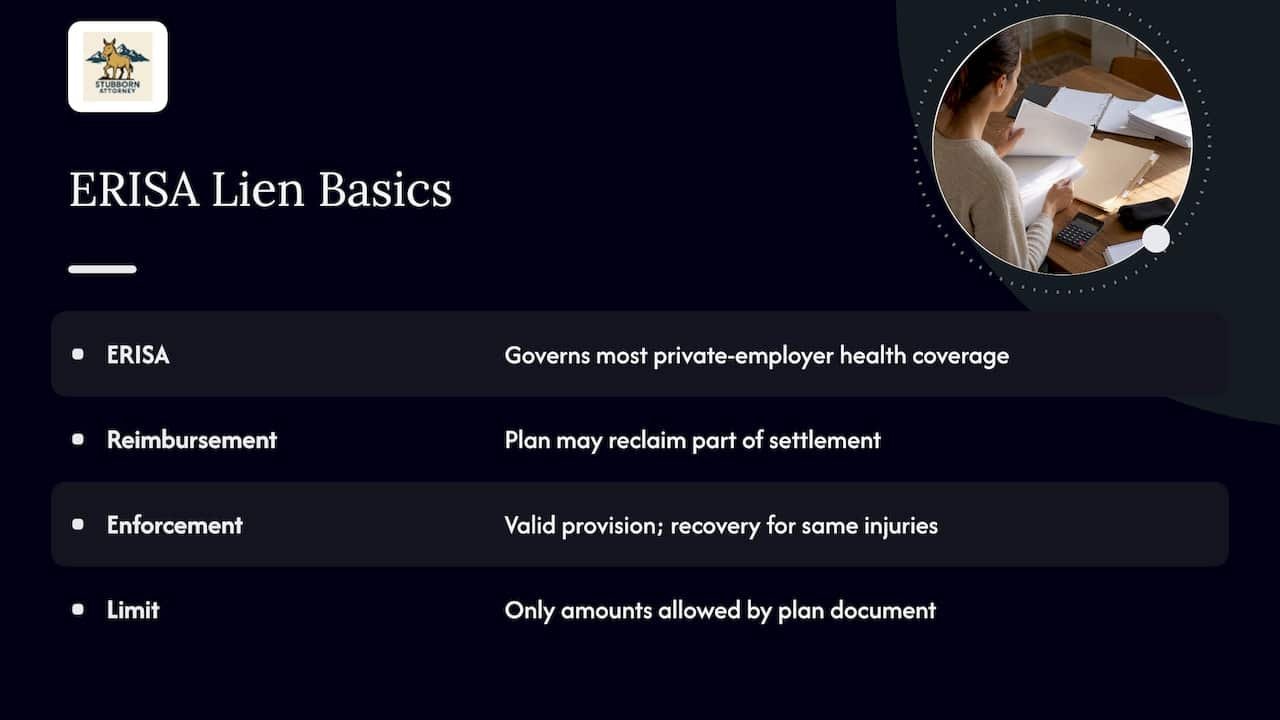
ERISA is the federal Employee Retirement Income Security Act. It governs most health coverage that comes through a private employer. When that plan pays for your treatment after a crash and you later recover money from the at-fault driver’s insurer, the plan may claim part of that money back. This right is usually called subrogation or reimbursement, and most ERISA health plans include clauses that let the plan claim a portion of your injury settlement.
The legal footing is narrow but real. In Sereboff v. Mid Atlantic Medical Services, the Supreme Court held that a plan with a valid reimbursement provision can enforce it as an equitable lien by agreement under ERISA § 502(a)(3) when the participant recovers from a third party for the same injuries. In plain terms: the plan’s right comes from the contract language, and it reaches the money you recovered for the injuries the plan paid to treat.
So the lien is not automatic. It exists only if the plan document says so, and only for the amounts that fall inside what that document allows.
Self-funded or fully insured: the question that decides most of it
Before anything else, find out how your employer’s plan is funded. The difference is large.
- Fully insured plan: the employer buys a policy from an insurance company. The plan is subject to ERISA and to state insurance regulation.
- Self-funded plan: the employer pays claims from its own money, often using an insurer or administrator only to process them. These plans are subject to ERISA but exempt from state insurance regulation.
That exemption is why the same medical bill can produce very different results for two people. The Supreme Court held in FMC Corp. v. Holliday that ERISA’s deemer clause keeps self-funded plans out of reach of state laws that regulate insurance, including a state law that blocked subrogation. A fully insured plan, by contrast, generally has to follow state rules that limit how much an insurer can take back.
The insurance card is not a reliable guide. Many self-funded plans carry the name of a large insurer because that company administers the claims. The plan documents tell the truth.
How to find out which type you have
Ask the plan administrator for the governing documents in writing. Participants have a legal right under 29 U.S.C. § 1024(b)(4) to request and receive copies of the Summary Plan Description (SPD), the Master Plan Document (MPD) and other governing instruments. The MPD is the main document that sets the plan’s recovery rights, though the SPD is the one participants usually see first.
Attorneys also look at the plan’s annual Form 5500. According to one malpractice insurer’s lien guide, line 9a shows the funding arrangement: one box points to a fully insured plan subject to state anti-subrogation rules, while the other boxes point to a plan likely to be self-funded. That guide dates from 2013, so use it to understand the method, not as a current form reference.
Read the plan language before you accept the demand letter
The first letter from a plan or its recovery vendor is a demand, not a final answer. It often states a number with no explanation. Your job, or your attorney’s, is to compare that number with the plan itself.
What to check:
- Does the plan document actually contain a reimbursement or subrogation right? The same guide notes that after Cigna Corp. v. Amara, an SPD alone does not dictate the plan’s terms. The right has to appear in the plan itself and in the SPD, and if either is insufficient, there may be a way to avoid the claim.
- Which version applied on the date of injury? The plan terms at the time of your injury are the ones to examine, not a later amendment.
- What does it say about attorney fees and costs? This single clause often drives the whole negotiation (more on that below).
- Does it say anything about made-whole or common-fund rules? A plan can expressly reject them, or it can say nothing.
- Are the charges related to the crash? Request an itemized ledger. Auditing itemized bills for unrelated or duplicate charges is a standard first step in challenging a lien. A claim for your knee surgery in March should not include a dermatology visit in January.
If the plan is self-funded, one lien-resolution firm advises obtaining the Form 5500 to confirm funding, then reading the SPD and MPD closely for deficiencies in the language about the plan’s right to recover.
What the Supreme Court decisions mean for your settlement
Three cases do most of the work in ERISA lien settlements.
| Case | Year | What it means for you |
|---|---|---|
| Sereboff v. Mid Atlantic | 2006 | A plan with a valid reimbursement clause can enforce it as an equitable lien against the settlement it traces to. |
| US Airways v. McCutchen | 2013 | The plan’s written terms control. If the plan is silent on attorney fees, the common-fund doctrine fills the gap. |
| Montanile v. Board of Trustees | 2016 | If you have spent the settlement on non-traceable items, the plan cannot reach your general assets. |
McCutchen: the contract wins, unless it is silent
In US Airways v. McCutchen, the Court held that when a plan sues on an equitable lien by agreement, the plan’s terms govern. Equitable doctrines such as the double-recovery rule and the common-fund rule cannot override clear contract language. But where the plan says nothing about attorney fees, the common-fund doctrine is the default rule. That means the plan shares in the cost of obtaining the recovery.
This is why a skilled review of the plan matters. One 2026 discussion of lien negotiation puts the practical point this way: a plan document that is silent on allocating fees leaves room to argue for a common-fund reduction, while one that expressly assigns the full cost of recovery to you narrows that argument considerably.
Montanile: why timing and spending matter
In Montanile v. Board of Trustees, the Court ruled that a plan cannot recover from a participant’s general assets when the participant has wholly dissipated the settlement on nontraceable items. The lien attaches to a specific fund, and when that fund is gone, so is the equitable lien.
Do not read this as a plan for spending the money. A plan can act while the funds are still identifiable, and a settlement that sits in an account is exactly what it can trace. The safer course is to resolve the lien in writing before the money is disbursed.
What Colorado law adds
Colorado has one of the more protective statutes for injury victims. C.R.S. § 10-1-135 expanded the made-whole doctrine, and where an insured settles within the available liability or uninsured/underinsured motorist limits, it creates a rebuttable presumption that the insured has been made whole. In practical terms, a payer generally cannot take from your recovery until you have been fully compensated.
The catch is federal preemption. Commentary written for Colorado practitioners notes that ERISA plans routinely claim exemption from the state’s made-whole and common-fund statute, and that only plans that are self-funded and have appropriately drafted plan language are entitled to it. That is a practitioner article of uncertain date, so treat it as a description of how the dispute usually plays out and confirm the current law with your attorney.
Put together for a Colorado car accident case:
- Fully insured employer plan or an individual policy: Colorado’s made-whole and common-fund rules are likely to apply, which can reduce or block the reimbursement claim.
- Self-funded ERISA plan with clear language: federal law and the plan document govern, and the state statute may not help.
- Self-funded plan with unclear or missing language: this is where the McCutchen default and the plan’s drafting gaps matter most.
We cover the state rules in more detail in our guide to Colorado subrogation law, and our explainer on what a lien is in injury cases walks through the other types of lien you may meet, such as Medicare, Medicaid, medical provider and health insurer liens.
Negotiating an ERISA lien down
There is no guaranteed formula, but the strategies that come up again and again are these.
Settle the injury claim first
Finalize the settlement with the at-fault party’s insurer before you address the lien. Lienholders may demand more at the outset if they believe more money is available. Keep the lien conversation separate until the gross number is fixed.
Argue the common fund
If the plan is silent on fees, ask that the plan bear its share of attorney fees and costs. You can only reach that argument by reading the plan, which is why document review comes first. Where the plan is explicit, this argument narrows.
Use hardship and limited recovery
Financial hardship and a limited recovery can be used as arguments to reduce a lien. A plan facing a case where policy limits are low, liability is disputed, or your losses far exceed the available money may accept less than it demanded. Document it: policy limits letters, wage loss, remaining treatment.
Check the bills line by line
Request the itemized payment history and remove anything unrelated to the crash or charged twice. Even modest corrections lower the starting number before any negotiation begins.
Get the reduction in writing
Before settlement funds are disbursed, get a signed lien-reduction or full-satisfaction letter. An email saying the plan is “probably fine” is not enough. Without a written release, the plan can come back later.
A worked example

This illustration uses invented round numbers to show the mechanics. It is not a prediction for any case.
Say a driver is rear-ended on Academy Boulevard in Colorado Springs. The at-fault driver’s policy pays $100,000. The employer’s health plan paid $40,000 in medical bills. The attorney fee is one-third, and costs are $5,000.
- If the plan is silent on fees and the common-fund doctrine applies, the plan might be asked to carry its proportional share of the fee and costs, which would lower its payoff well below $40,000.
- If the plan is self-funded and expressly claims first-dollar recovery with no fee reduction, the plan document governs under McCutchen, and the negotiation turns to hardship, billing errors and the plan’s willingness to compromise.
- If the plan is fully insured, Colorado’s made-whole rules may restrict the claim, because the settlement is within the available limits and the presumption of being made whole applies.
Three identical settlements, three very different net results. The only way to know which one you are in is to read the documents.
What to do right now
- Keep every letter from your health plan, its administrator and any recovery vendor.
- Don’t sign or send reimbursement forms or recorded statements to the plan without your attorney reviewing them.
- Request the SPD and plan document in writing from the plan administrator.
- Ask your attorney to confirm whether the plan is self-funded or fully insured.
- Hold settlement funds in your attorney’s trust account until the lien is resolved in writing.
- Tell your attorney about every payer, including Medicare, Medicaid, med-pay and any provider that has asked for payment.
If you are still weighing whether to bring in counsel, our page on when to hire an automobile accident attorney lays out the signs. And because liens are one of several things that affect your net recovery, our overview of key factors that affect settlement amounts puts them in context.
Our perspective
Most people hear about the health plan’s claim after the settlement is nearly done, and by then they are anxious. The number on the first letter looks official, so they assume it is final. It rarely is.
Before I started representing injured people, I worked as a claims adjudicator for the federal government. I know how large payers evaluate a claim and how they decide what to demand. That experience shapes how we handle liens: we ask for the plan documents, we find out how the plan is funded, and we do not accept a payoff figure until we understand what the plan can legally claim.
We handle these cases directly, not as a volume operation, because the details decide the outcome. A single sentence about attorney fees in a plan document can move the result by thousands of dollars. That is the kind of detail we are stubborn about.
We work on a contingency basis, so you pay no attorney fee unless we recover money for you. Our goal is for the settlement to be measured by what lands in your hands, not by the headline number.
Ryan
How we help with liens at Malnar Injury Law
StubbornAttorney.com is the new brand home of Malnar Injury Law, with the same team and the same commitment. We represent injured people in Colorado, including car, truck, motorcycle, bicycle and pedestrian accident victims, and we work on contingency. If a health plan is asking you for money out of your settlement, contact our Colorado Springs personal injury team for a free case review, or see all the case types we handle.
FAQ
Can an ERISA plan take my entire car accident settlement?
A plan can claim up to what its documents allow, and some plans claim first-dollar recovery. In practice, the claim is limited by the plan’s wording, by what it actually paid for crash-related care, and by any fee-sharing or hardship arguments available. Plans often negotiate, so the first demand is seldom the final figure.
How do I know if my plan is self-funded?
Request the plan document and SPD from the plan administrator in writing, since you have a legal right to those documents. Your attorney can also check the plan’s Form 5500, which shows how the plan is funded. The name on your insurance card does not settle the question.
Does Colorado’s made-whole law protect me from an ERISA lien?
It can if your plan is fully insured, because state insurance rules apply to those plans. A self-funded ERISA plan with clear language is generally exempt from state insurance regulation, so the state statute may not help. Which category you are in decides the answer.
What if I already spent the settlement?
The Supreme Court held in Montanile that a plan cannot reach your general assets if the settlement was fully spent on non-traceable items. That is a narrow rule, and a plan that acts while the money is still identifiable can pursue it. Talk to your attorney before you disburse anything.
When should I try to negotiate the lien?
After the injury claim itself has settled, so the plan cannot argue that more money is available. Then compare the demand to the plan document, correct billing errors, and get any agreed reduction in a signed letter before the funds are paid out.
Sources
- ERISA liens and self-funded plans, Advocate Magazine
- Sereboff v. Mid Atlantic Medical Services
- ERISA 101: Key Terms and Concepts, Georgetown Center on Health Insurance Reforms
- FMC Corp. v. Holliday, Cornell Law School
- ERISA lien resolution overview, Synergy
- Medical & Personal Injury Lien Traps, Lawyers Mutual NC
- How to Negotiate Medical Bills and Liens Down
- Strategies for Reducing Self-Funded ERISA Liens
- US Airways v. McCutchen, Cornell Law School
- Medical Lien Negotiation and Reduction
- Montanile v. Board of Trustees, Cornell Law School
- Colorado’s Made Whole Doctrine and Its Effect on Subrogation Claims
- Subrogation Rights of Health Plans Established Under ERISA
- ERISA Plan Subrogation and Reimbursement: Strategies