
Crosswalk Accident Liability in Colorado: Who Pays and Why
In most Colorado crosswalk crashes, the driver who failed to yield or keep a proper lookout is the main party liable. But Colorado does not treat the crosswalk as a magic shield. Liability turns on what each person did, and a pedestrian who shares the blame can see their compensation reduced or, at 50% or more, barred. This guide explains the rules that decide who pays, how fault gets split, what you can claim and how much time you have.
Table of Contents
- What counts as a crosswalk in Colorado
- Who has the right of way
- Who can be liable after a crosswalk crash
- What happens if you were outside the crosswalk
- How Colorado’s 50% rule affects what you recover
- Evidence that decides liability
- What damages you can seek
- How long you have to act
- Steps to take after a crosswalk crash
- Help with a Colorado Springs or Colorado crosswalk claim
- Frequently asked questions
- Sources
What counts as a crosswalk in Colorado
Many people picture a painted zebra stripe. Colorado law is broader. Under C.R.S. § 42-1-102(21), a crosswalk is the part of a roadway ordinarily included within the extension of the sidewalk lines at an intersection, or any part of the roadway clearly marked for pedestrian crossing by lines or other markings.
That gives you two kinds:
- Marked crosswalks: painted lines, high-visibility striping, or other markings on the pavement, including mid-block crossings with signs or flashing beacons.
- Unmarked crosswalks: the natural continuation of the sidewalk across an intersection, even when no paint is there.
The second kind surprises people. A pedestrian crossing a residential street at a corner with no stripes may still be in a legal crosswalk, and the driver’s duty to yield still applies.
Who has the right of way
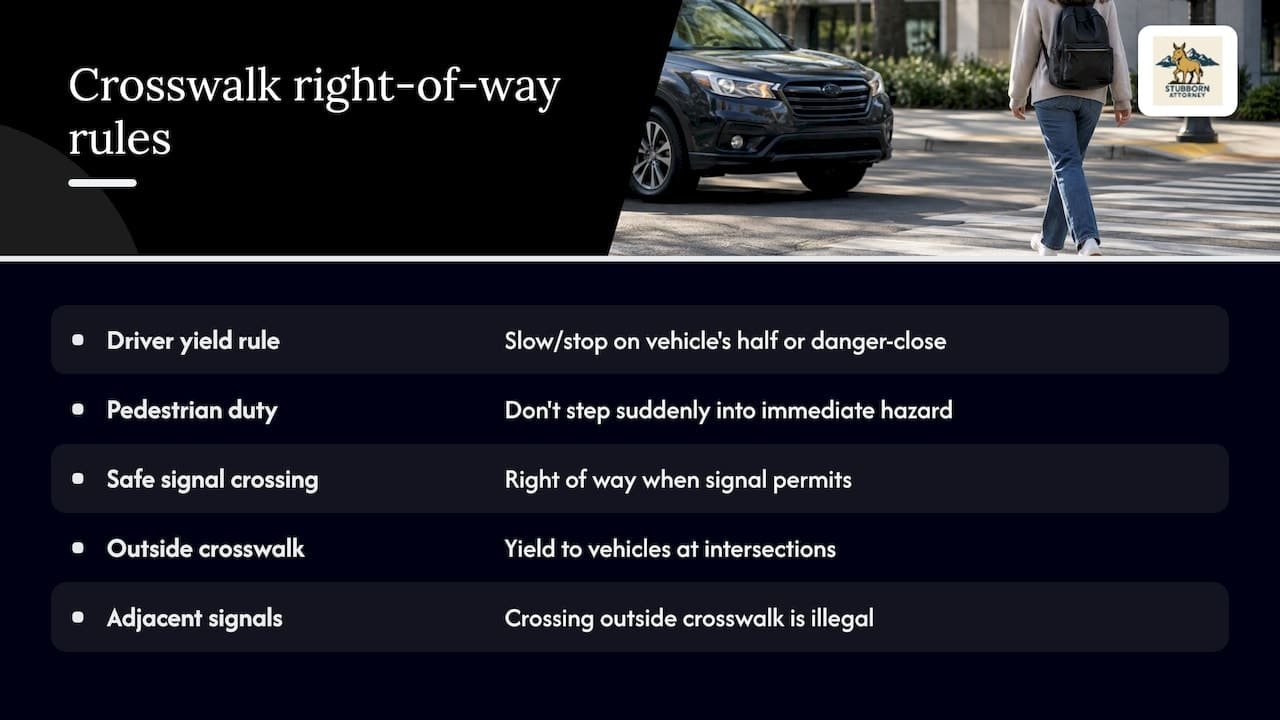
Colorado’s yield rule sits in C.R.S. § 42-4-802. Drivers must slow or stop for a pedestrian in a crosswalk when the pedestrian is on the half of the roadway the vehicle is traveling on, or is approaching from the other side so closely that there is danger. The same statute tells pedestrians not to suddenly leave a curb or other place of safety and step into the path of a vehicle so close it is an immediate hazard.
The Colorado Department of Transportation puts the everyday version this way: pedestrians have the right of way in crosswalks and intersections when signals show it is safe to cross. Crossing at an intersection outside a marked or unmarked crosswalk means yielding to vehicles, and crossing between two adjacent signalized intersections outside a crosswalk is illegal, according to CDOT’s pedestrian guidance.
We go through the statute line by line, including what “so close as to be in danger” means in practice, in our guide to Colorado crosswalk laws and who yields.
Right of way is not the same as zero responsibility
This is the point that trips up injured pedestrians and their families. The Colorado Judicial Branch’s model jury instructions say a pedestrian properly in a crosswalk has the right of way over vehicles, but a pedestrian with the right of way must still use reasonable care under the circumstances. The same standard applies to drivers: even a driver with the right of way must use reasonable care given the conditions.
So the law gives pedestrians priority, then asks everyone on the road to behave sensibly. An insurance adjuster will read it the same way, and will look for anything you did that might have contributed.
Who can be liable after a crosswalk crash
Liability in Colorado is based on negligence, not on a simple rule that the driver always pays. A traffic violation is strong evidence, but the Colorado Court of Appeals has noted that traffic statutes do not create strict liability. In May v. Petersen, 2020 COA 75, the court explained that fault depends on the circumstances, and that a pedestrian’s failure to be properly in a crosswalk matters for comparative fault only if it actually caused the injury.
The driver
The most common defendant. The jury instructions describe driver duties that include keeping a proper lookout and driving at a speed reasonable for the conditions. Typical failures include:
- not slowing or stopping for a person already in the crosswalk
- turning right or left while looking only at oncoming traffic, not the crosswalk
- speeding near schools, parks or downtown blocks with heavy foot traffic
- distracted driving, such as texting or using a navigation screen
- driving impaired
- passing a car that has stopped for a pedestrian
Violating a traffic provision such as the driver due-care statute, C.R.S. § 42-4-807, or the duty to yield to people with disabilities, § 42-4-808, may be treated as negligence per se. The May v. Petersen decision adds that this does not automatically erase a comparative negligence defense. The jury still weighs everyone’s conduct.
An employer or vehicle owner
If the driver was working at the time, such as a delivery driver, rideshare driver or someone in a company vehicle, the employer may share responsibility. The same goes for a vehicle owner who handed the keys to someone they knew should not be driving. These facts open up additional insurance coverage, which matters when a serious injury exceeds a personal policy.
A government entity or property owner
Sometimes the crosswalk itself is part of the story: a signal that malfunctions, a faded crossing, a blocked sight line, a missing curb ramp or poor lighting. Claims against a public entity follow special notice rules, and the deadline is much shorter than for an ordinary car crash. See our page on Colorado road hazard claims and the 182-day notice if a road condition may have played a part.
A driver who left
If the driver fled, your own insurance may still respond. Our guide to pedestrian hit-and-run cases in Colorado covers what to do and what coverage to look at.
What happens if you were outside the crosswalk
Being outside a crosswalk does not end your claim. The Colorado Judicial Branch instructions say a pedestrian who is not in a crosswalk is not necessarily negligent. If they were outside one, that fact must have been a cause of the injury before it counts against them in a comparative fault analysis.
That is a meaningful distinction. Consider two examples:
- A pedestrian crosses mid-block at night in dark clothing, steps out from between parked cars, and is hit by a driver traveling at a reasonable speed. A jury may assign a large share of fault to the pedestrian.
- A pedestrian crosses mid-block on a straight, well-lit road, is visible for hundreds of feet, and is hit by a speeding, distracted driver. The driver still owed a duty to keep a lookout and control the vehicle, and a jury may put most of the blame there.
The second situation is why we tell clients not to assume a case is over because there was no crosswalk. The location is one fact among many.
How Colorado’s 50% rule affects what you recover
Colorado uses modified comparative negligence, set out in C.R.S. § 13-21-111. Two things follow:
- If your negligence is less than the negligence of the person you are suing, you can still recover, but your damages are reduced in proportion to your share of fault.
- If your negligence is equal to or greater than theirs, recovery is barred.
Here is how that looks with a hypothetical $200,000 in total damages:
| Your share of fault | Driver’s share | What you can recover |
|---|---|---|
| 0% | 100% | $200,000 |
| 20% | 80% | $160,000 |
| 40% | 60% | $120,000 |
| 50% | 50% | $0 |
| 60% | 40% | $0 |
The jump from 40% to 50% is where cases are won and lost. That is why the percentages the insurer assigns in a first offer deserve a hard look. Our article on the 50% rule and special verdicts explains how juries are asked to allocate fault, and our broader piece on fault in Colorado car accidents shows how the same rules apply to other crashes.
When more than one driver is involved, fault is divided among each of them too. Our guide to fault in multi-car accidents walks through that.
Evidence that decides liability
Crosswalk cases are often a dispute over a few seconds. The person with the better evidence usually wins that dispute. Useful evidence includes:
- Police report and citations. A citation for failure to yield is not conclusive, but it helps. Make sure the officer has your account.
- Video. Traffic cameras, nearby businesses, doorbell cameras and dashcams. Many systems overwrite footage within days, so ask quickly.
- Photos of the scene. Crosswalk markings, signs, signal phase, lighting, sight lines, skid marks and debris, ideally taken at the same time of day.
- Witnesses. Names and phone numbers of people who saw the crash or the moments before it.
- Vehicle data. Many newer vehicles record speed and braking. A lawyer can send a preservation request.
- Phone records. If distraction is suspected, records can show activity at the time of the crash.
- Medical records. They link your injuries to the crash and document treatment from the first emergency visit onward.
The state’s own safety guidance gives a hint at what adjusters and juries consider reasonable. The Department of Revenue advises drivers not to assume pedestrians can see or hear their vehicles or the crossing signals, and notes that children and people using wheelchairs may be harder to see, according to Colorado DMV pedestrian safety tips. CDOT suggests pedestrians try to make eye contact or nod to confirm the driver sees them before crossing. If you did that, say so. If you did not, expect the question.
What damages you can seek
An injured pedestrian can seek compensation for losses caused by the crash. They generally fall into two groups:
- Economic damages: emergency care, surgery, hospital stays, rehabilitation, prescriptions, future medical needs, lost wages and reduced earning capacity, and property damage such as a broken phone, glasses or bike.
- Noneconomic damages: pain and suffering, inconvenience, emotional stress and loss of quality of life.
Colorado limits noneconomic damages. Under C.R.S. § 13-21-102.5, the total for such damages in most civil actions filed on or after January 1, 2025 must not exceed $1.5 million, with higher amounts reserved for cases that meet separate statutory exceptions. Lower caps applied to lawsuits filed before that date. We explain what that means for real settlements in our guide to Colorado car accident settlements.
No article can tell you what your case is worth. Value depends on the severity and permanence of your injuries, your medical bills, your work situation, how fault is split and the insurance available. Be wary of anyone who quotes a number before seeing your records.
How long you have to act
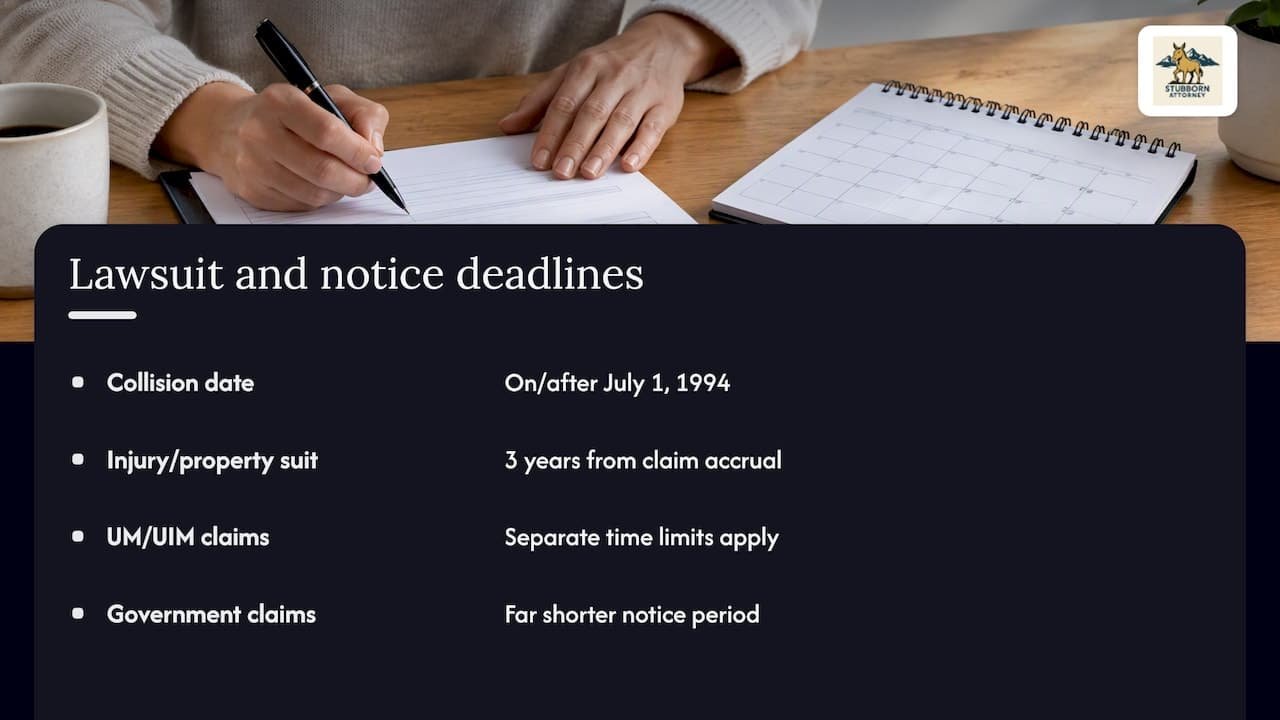
For a bodily-injury or property-damage lawsuit arising from a motor-vehicle collision on or after July 1, 1994, Colorado allows three years from when the claim accrues under C.R.S. § 13-80-101(1)(n). The same act sets separate time limits for actions involving uninsured and underinsured motorist claims, so check those if the driver had little or no coverage.
Three years is the outer edge for filing suit, not a target. Evidence disappears, witnesses move and insurers push for early statements. Claims involving a government entity have a far shorter notice period, as noted above. Do not wait to find out which deadline applies to you.
Our perspective
After more than a decade as a lawyer, and earlier work as a claims adjudicator for the federal government, I have seen how a crosswalk claim is evaluated from the other side of the desk. The first question is rarely whether the driver was careless. It is how much of the blame can be moved onto the pedestrian. Even a small shift matters in Colorado, because 50% is a hard line.
That is why we do not treat these cases as simple. We look at the crossing signal, the lighting, the driver’s speed and what the driver was looking at. We gather video before it is erased. We push back on fault percentages that do not match the evidence.
The mule is our symbol because mules are stubborn in the right way: steady, careful and unwilling to quit on a hard trail. An injured pedestrian facing an insurer has the same kind of climb. Our attorneys handle cases directly, not as a case mill, and we represent only injured people.
Ryan
Steps to take after a crosswalk crash
- Call 911 and get medical care. Injuries such as concussions, internal bleeding and spinal damage can be hidden at first. Treatment also creates a record.
- Stay at the scene if you can. Ask for a police report and give your account plainly. Do not guess about speed or distances.
- Gather what you can. Photos, witness contacts, the driver’s insurance and license details, and any cameras you notice.
- Be careful with the other insurer. Their adjuster may ask for a recorded statement early. You can decline until you have advice. Our list of mistakes to avoid after car accidents covers what often hurts claims.
- Keep a simple journal. Pain levels, missed work, appointments and everyday tasks you cannot do.
- Talk to a personal injury lawyer before accepting any offer. A first offer is often made before the full extent of your injuries is known.
Help with a Colorado Springs or Colorado crosswalk claim
We represent injured pedestrians across Colorado, including Colorado Springs. Our work is on a contingency fee basis: you pay nothing unless there is a monetary recovery in your case. We also help clients get access to medical care regardless of their financial situation. Read more on our pedestrian accident lawyer page, or see why you might need a pedestrian accident lawyer. If you are ready to talk, you can contact our team through our site for a case review.
Frequently asked questions
Is the driver always at fault in a Colorado crosswalk accident?
No. Drivers must yield to pedestrians in crosswalks, and that makes them the most common at-fault party. But Colorado courts apply negligence principles, and traffic statutes do not create automatic liability. If the pedestrian darted into traffic or ignored a signal, a jury can assign them part of the blame.
Can I recover compensation if I was jaywalking?
Possibly. Being outside a crosswalk is not automatically negligence, and it counts against you only if it helped cause the injury. If your share of fault is less than the driver’s, you can still recover, reduced by your percentage. At 50% or more, recovery is barred.
How long do I have to sue after being hit in a crosswalk?
For a lawsuit over a motor-vehicle collision on or after July 1, 1994, the general limit is three years from when the claim accrues. Claims against a government body, and uninsured or underinsured motorist claims, can follow shorter or separate timelines, so get advice early.
What if the driver left the scene?
You may still have options, including coverage through your own policy. Report the crash to police immediately, note any vehicle details, witnesses or camera locations, and speak to a lawyer about next steps.
Do I need a lawyer for a crosswalk accident claim?
You are not required to have one. But liability disputes, fault percentages and serious injuries are where insurers push hardest. A lawyer can gather evidence, deal with the insurer and make sure the claim reflects your full losses.
Sources
- Colorado Revised Statutes Title 42, Vehicles and Traffic (2024)
- C.R.S. § 42-4-802, pedestrians in crosswalks
- CDOT, Information for Pedestrians
- Colorado Judicial Branch, civil jury instructions
- May v. Petersen, 2020 COA 75
- C.R.S. § 13-21-111, comparative negligence
- C.R.S. § 13-21-102.5, limits on noneconomic damages
- Colorado DMV, Pedestrian Safety Tips
- 1994 Colorado act on limitation periods, § 13-80-101