

Colorado Whiplash Settlements: $6,000 to $25,000 and Policy Limits
Most whiplash claims in Colorado settle somewhere between several thousand dollars and the low five figures, with the exact number driven by how long you were treated, what your records show, and how much work you missed. Cases with documented, consistent treatment and objective findings land higher; thin records and quick recoveries land lower. Before you accept anything, get your medical care finished or stabilized, keep every record, and talk to a lawyer before you sign a release.
Table of Contents
- Typical Settlement Ranges for a Colorado Whiplash Claim
- What Actually Moves the Needle on Settlement Value
- Colorado Law That Shapes Your Claim Timeline and Value
- How to Evaluate an Insurance Settlement Offer Step by Step
- What to Do Next to Protect Your Claim
- Why This Guidance Comes From Direct Claims Experience
- The Part of Whiplash Claims Most People Get Wrong
- Get a Free Case Evaluation for Your Whiplash Claim
- FAQ
- Sources
Typical Settlement Ranges for a Colorado Whiplash Claim
Settlement numbers for whiplash vary more than most people expect, mainly because there is no single public database that tracks every claim resolved in Colorado. Insurers settle the overwhelming majority of these cases privately, so what circulates online is a mix of practitioner experience, regional averages, and occasional reported verdicts. That said, patterns repeat often enough to sketch realistic bands.
- Low range: brief treatment (a few weeks of chiropractic or physical therapy), no missed work, and no imaging findings typically settle toward the lower end of the spectrum.
- Mid range: treatment lasting one to three months, some lost wages, and at least one objective finding (restricted range of motion documented by a provider, for example) push value toward the middle.
- High range: prolonged treatment, specialist referrals, diagnostic imaging showing disc or soft-tissue damage, or any lasting impairment move a claim toward the top of the range and sometimes beyond it.
Practitioners commonly report that whiplash and minor soft-tissue claims in Colorado settle between roughly $6,000 and $25,000, with higher figures reserved for prolonged care or clear objective findings. That range is a starting reference point, not a ceiling or floor for every case: a crash with contested liability, a disputed low-impact collision, or an insurer that disputes causation can push a claim lower, while severe or long-lasting symptoms can push it well past $25,000.
Part of why ranges vary so widely comes down to case mix and insurer tactics. Adjusters assign internal values based on software models, claims history, and how aggressively a claimant pushes back, which means two nearly identical injuries can resolve at very different numbers depending on who is negotiating and how well the file is documented. Our overview of statewide settlement patterns breaks down how averages shift once you account for injury severity and policy limits.
What Actually Moves the Needle on Settlement Value
Insurers and juries weigh a predictable set of factors when they put a number on a whiplash claim. Knowing what they look for tells you exactly what to document and what questions to ask before you negotiate.
Economic damages form the floor of any settlement: medical bills, projected future care, and lost wages. Each needs a paper trail. Pay stubs or employer letters prove lost income; itemized bills and provider estimates prove past and future medical costs. Non-economic damages, commonly called pain and suffering, are harder to pin down. Some adjusters apply a multiplier to economic damages, others use a per-diem approach that assigns a daily value for the recovery period, and some lean on comparable verdicts in similar cases. All three methods are rules of thumb, not formulas, and an adjuster’s first number almost always starts conservative.
- Objective findings matter more than subjective complaints: imaging, specialist notes, and documented range-of-motion limits carry far more weight than pain descriptions alone.
- Pre-existing conditions get scrutinized: insurers often argue that prior neck or back issues explain some or all of your symptoms, which can lower an offer unless your records clearly separate old injuries from new ones.
- Policy limits cap recovery regardless of damages: even a well-documented six-figure injury claim cannot exceed what the at-fault driver’s policy (or your own underinsured motorist coverage) actually provides.
Pro Tip: Ask your treating provider to document functional limitations in plain language (what you can no longer do at work or home), not just clinical findings. Adjusters respond to concrete impact.
Thorough documentation from day one changes how these factors play out. Our guide on protecting your claim through documentation walks through what to collect and when.
Colorado Law That Shapes Your Claim Timeline and Value
A few Colorado-specific rules directly affect how much time you have and how much leverage you hold during negotiations.
- Three-year statute of limitations: Colorado generally requires a bodily injury lawsuit from a vehicle accident to be filed within three years of the crash under C.R.S. §13-80-101. Acting early, rather than waiting until the deadline nears, preserves evidence and negotiating leverage.
- Modified comparative negligence: Colorado reduces your recovery by your percentage of fault, and bars recovery entirely if you are found 50% or more at fault, according to Nolo’s summary of Colorado accident law. A claim where you share even partial blame still has value, but that share comes off the top.
- Policy limits disclosure: under C.R.S. §10-3-1117, a claimant or their attorney can formally request the at-fault driver’s policy limits, and the insurer must respond within 30 days or face statutory penalties, including $100 per day after the deadline plus attorney-fee exposure.
- If an insurer stonewalls: the Colorado Division of Insurance can review how an insurer handled your claim and will contact the company to confirm compliance, though it does not decide liability or negotiate on your behalf.
How to Evaluate an Insurance Settlement Offer Step by Step
A first offer is almost never a final offer. Running these steps before you respond keeps you from accepting less than your claim supports.
- Total your documented medical costs, past bills plus a realistic estimate of any future treatment your provider recommends.
- Calculate lost wages, including any projected long-term impact if your injury affects your ability to work the same hours or role.
- Apply a pain-and-suffering estimate using a multiplier against your economic damages or a per-diem rate for your recovery period, then set a target range rather than a single number.
- Confirm the policy limits available, using a formal request under C.R.S. §10-3-1117 if the insurer has not already disclosed them, and check whether underinsured motorist coverage adds another layer.
- Watch for red flags: pressure to sign quickly, a request to release all claims before your treatment is complete, or an offer that ignores documented lost wages are all signs to pause and get a second opinion.
Pro Tip: Never sign a release until your treatment has stabilized. Settling before you know the full extent of your recovery locks in a number that cannot be reopened later.
Our breakdown of how attorneys negotiate with insurance companies covers what changes once a lawyer sends the demand letter instead of you.
What to Do Next to Protect Your Claim
The sequence you follow after a crash has a direct effect on what your claim is worth months later.
- Immediately: get or continue medical care, keep every bill and record, photograph your injuries and the vehicles, and obtain a copy of the police report.
- Short term: send a written request for the at-fault driver’s policy information, preserve any physical evidence, and gather pay stubs or employer statements if you missed work.
- When to involve a lawyer: a low initial offer, disputed liability, a serious or lingering injury, or any sign that available policy limits may not cover your damages are all reasons to get counsel involved before negotiations go further.
- If litigation becomes necessary: a lawsuit must generally be filed within the three-year window, and most personal injury representation, including ours, works on contingency, meaning no fee unless you recover.
Our page on financial compensation after a Colorado crash outlines the categories of damages available once a claim moves toward litigation.
Why This Guidance Comes From Direct Claims Experience
Ryan Malnar has practiced personal injury law in Colorado for more than a decade and previously worked as a federal claims adjudicator, reviewing claims from the inside of the system that now evaluates the cases we bring on behalf of injured clients. That background shapes practical tactics like requesting policy limits early and anticipating how an adjuster will value a file before an offer ever comes in. Our firm has settled hundreds of injury cases and recovered millions of dollars for clients across Colorado, with cases handled directly by attorneys rather than passed through a high-volume case mill. Understanding how adjusters are trained to evaluate claims, including the internal pressure to settle low and fast, informs how we document a file, time a demand, and respond when an early offer falls short of what the evidence supports.
The Part of Whiplash Claims Most People Get Wrong
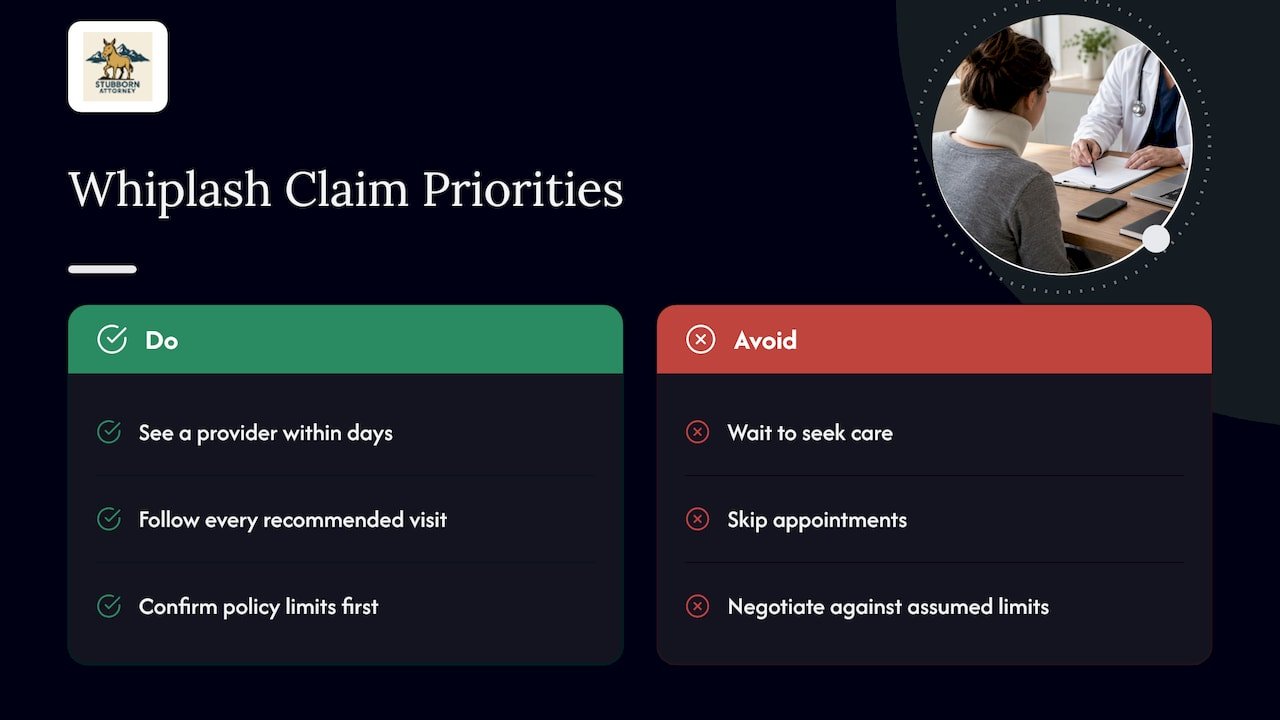
The biggest misconception about whiplash settlements is that the injury itself determines the number. It doesn’t. The quality and consistency of your medical documentation determines the number, often more than the severity of the actual injury. Two people with nearly identical symptoms can walk away with very different settlements because one saw a provider within days and followed through on every recommended visit, while the other waited, skipped appointments, or let gaps appear in the record. Insurers read gaps as proof the injury wasn’t serious, whether or not that’s true.
The second thing conventional advice underplays is how early you should find out what policy limits actually exist. Negotiating against a number you assume is available, rather than one you’ve confirmed, wastes time and often ends in a settlement below what coverage could have supported. If you take one thing from this article, let it be that: treat consistently, document everything, and confirm the ceiling before you start negotiating toward it.
— Ryan
Get a Free Case Evaluation for Your Whiplash Claim
Figuring out what your whiplash claim is actually worth, and whether an insurer’s offer reflects it, is harder from the outside than it looks. We represent injured clients on contingency, which means you pay nothing unless we recover compensation for you, and every case is handled directly by an attorney rather than handed off to a processing team.
- We request policy limits under C.R.S. §10-3-1117 when insurers are slow to disclose them.
- We help clients access medical care even when finances are tight.
- We negotiate directly with adjusters and take cases to litigation when an offer doesn’t reflect the damages.
If you’re weighing a settlement offer or wondering whether you have a claim worth pursuing, start with our free case evaluation for whiplash injuries.
This article is general information, not a substitute for advice from a qualified lawyer. Consult a qualified legal professional about your own circumstances before acting on anything here.
FAQ
What is the minimum settlement for whiplash?
There is no fixed minimum settlement for whiplash in Colorado; outcomes depend on treatment, documentation, and the at-fault driver’s available coverage. Claims with very brief treatment and no lost wages tend to settle toward the lower end of the typical range, sometimes a few thousand dollars, while better-documented cases settle higher.
Can you sue for pain and suffering in Colorado?
Yes, Colorado allows injured accident victims to pursue pain and suffering as part of a personal injury claim, alongside economic damages like medical bills and lost wages. Any award is still subject to Colorado’s modified comparative negligence rule, which reduces recovery by your share of fault and bars it entirely at 50% or more, under Colorado accident law.
What is considered a minor fender bender?
A minor fender bender generally refers to a low-speed collision with limited vehicle damage and no immediate visible injury, though whiplash and soft-tissue injuries can still occur even in low-impact crashes. Insurers often use the “minor” label to argue for a lower settlement, which is why documented medical evaluation matters regardless of how the collision looks.
How much of a $25,000 settlement will I get?
What you keep from a settlement depends on attorney fees (commonly handled on contingency), outstanding medical liens, and any case costs advanced during the claim. A contingency fee arrangement means your attorney is paid a percentage of the recovery only if the case settles or wins, so the exact amount left for you varies by case and should be itemized in your settlement statement.
What is the statute of limitations for a car accident injury claim in Colorado?
Colorado generally requires a bodily injury lawsuit from a vehicle accident to be filed within three years of the crash date under C.R.S. §13-80-101. Missing that deadline typically bars you from filing suit, even if your injury claim is otherwise valid.
Sources
- Auto Insurance | DORA – Division of Insurance
- Colorado Revised Statutes and related regulation (policy disclosure provisions)
- What’s the Colorado Car Accident Lawsuit Deadline? | Nolo