

How to choose the best injury lawyer in Colorado
TL;DR:
- Choosing a Colorado injury lawyer requires verifying licensing, specialization, and peer-reviewed awards.
- Use official directories and review patterns to identify experienced, reputable local attorneys.
- Interview multiple lawyers, assess their communication, and verify credibility before making a decision.
After a Colorado accident, the pressure to find the right attorney can feel just as overwhelming as the injury itself. You’re in pain, unsure of your rights, and suddenly bombarded with billboard ads, TV commercials, and endless online listings. Denver alone sees top firms averaging 4.88 out of 5 from over 11,000 Google reviews, which tells you two things: the competition is intense, and clients care deeply about who represents them. This guide cuts through the noise. We’ll walk you through exactly what to look for, where to search, how to interview candidates, and how to verify credibility so you can make a confident, informed decision about who handles your case.
Table of Contents
- What makes a top injury lawyer in Colorado?
- Where to find Colorado injury lawyers with proven reputations
- How to interview and compare injury lawyers
- How to verify credibility and avoid common mistakes
- What most injury clients get wrong when choosing a lawyer
- Ready to find your best injury lawyer? Start here
- Frequently asked questions
Key Takeaways
| Point | Details |
|---|---|
| Verify lawyer credentials | Use Colorado-specific directories and peer-reviewed awards to ensure your attorney is authorized. |
| Prioritize experience | Choose lawyers who specialize in personal injury and have proven results in Colorado cases. |
| Focus on review patterns | Look for trends across many client reviews and rely on peer awards over paid listings. |
| Interview multiple lawyers | Meeting several attorneys gives you the best chance to compare expertise and trustworthiness. |
| Avoid common mistakes | Don’t base your decision on ads or one-off reviews—verify credibility with official resources. |
What makes a top injury lawyer in Colorado?
Not every lawyer who calls themselves a personal injury attorney is equally equipped to fight for you. Colorado has specific legal rules, court procedures, and insurance practices that reward attorneys who genuinely specialize in injury cases. Picking someone who dabbles in personal injury on the side of a general practice is like hiring a trail guide who’s only hiked on flat ground. When the terrain gets steep, you’ll feel the difference.
The qualities of injury lawyers that actually move the needle fall into a few clear categories. First, confirm the attorney holds an active Colorado law license. This sounds obvious, but out-of-state attorneys sometimes market in Colorado without proper authorization. Second, look for a practice that focuses primarily, or exclusively, on personal injury. Specialization matters enormously in negotiations and at trial.
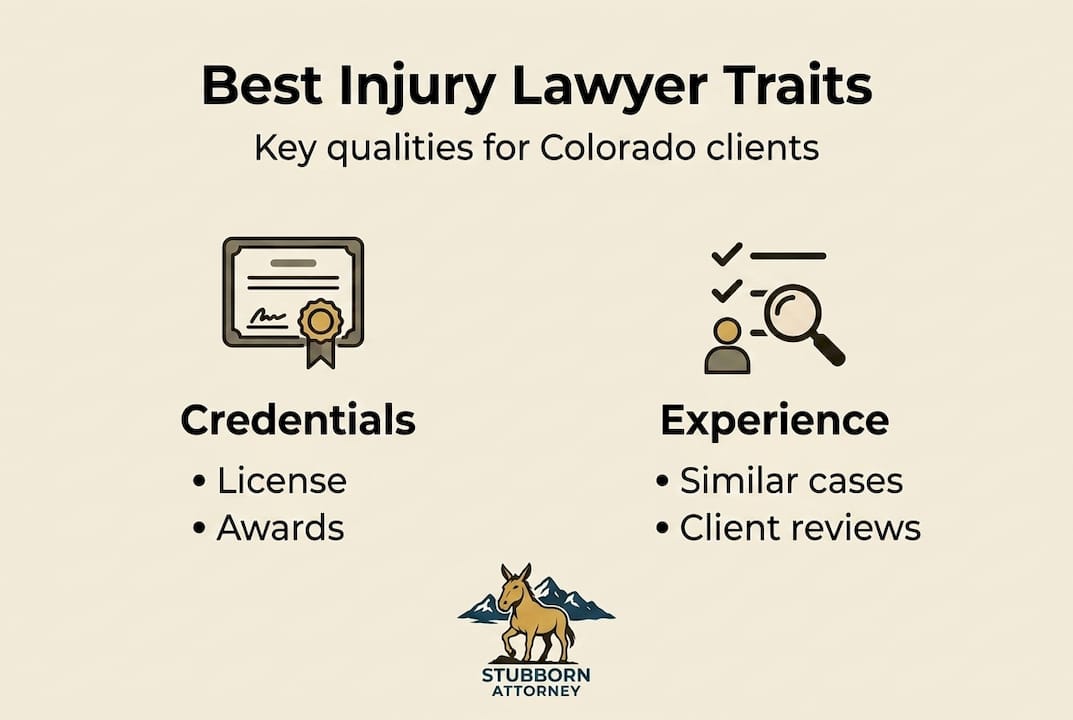
Experience with cases like yours is equally critical. A lawyer who handles slip-and-fall cases regularly thinks differently than one whose experience is mostly car accident claims. Ask directly: how many cases similar to mine have you resolved in the last two years?
When evaluating credentials, it helps to know the difference between peer-reviewed awards and paid directory listings. Peer-reviewed recognitions, like those from Super Lawyers or Best Lawyers, require nominations and evaluations from other attorneys. Paid listings simply require a check. Use official directories like the Colorado Bar Association, Colorado Trial Lawyers Association, Avvo, Super Lawyers, and Best Lawyers to find attorneys whose credentials have been vetted rather than purchased.
Client reviews deserve careful reading. One glowing review from a friend doesn’t tell you much. A pattern across dozens of reviews mentioning the same strengths, or the same complaints, tells you a great deal. Look for consistent themes around communication, responsiveness, and actual case results.
Here’s a quick comparison of what separates strong candidates from weak ones:
| Factor | Strong candidate | Weak candidate |
|---|---|---|
| Practice focus | Primarily personal injury | General practice, dabbles in injury |
| Colorado licensing | Active, verified | Unverified or out-of-state |
| Awards | Peer-reviewed (Super Lawyers, Best Lawyers) | Paid directory listings only |
| Reviews | Consistent patterns across many clients | A few one-off comments |
| Communication | Responsive, direct, clear | Vague, hard to reach |
| Case experience | Similar cases to yours | Broad, unfocused case history |
Key qualities to prioritize when building your shortlist:
- Active Colorado Bar license with no disciplinary history
- Focused personal injury practice, not a general law firm
- Peer-recognized awards from respected legal organizations
- Strong review patterns emphasizing communication and results
- Demonstrated experience with your specific type of injury claim
- Contingency fee structure, so you pay nothing unless you win
Pro Tip: Never rely solely on an attorney’s website or online profile to make your decision. Profiles are marketing tools. The real picture emerges when you sit across from a lawyer, ask direct questions, and observe how they treat you from the first conversation.
Where to find Colorado injury lawyers with proven reputations
Knowing what to look for is only useful if you know where to look. Fortunately, Colorado injury victims have access to several reliable resources that go far beyond a quick Google search.
The most trustworthy starting points are official and peer-reviewed directories. The Colorado Bar Association directory lets you verify active licenses and check disciplinary records. The Colorado Trial Lawyers Association features attorneys who focus specifically on representing injured victims. Avvo, Super Lawyers, and Best Lawyers all offer searchable databases filtered by practice area and location.

When you search these directories, always filter by practice area, personal injury, and by location, Colorado or your specific region. An attorney licensed in Colorado but based in New York is not the right fit for your case. Local presence means local court knowledge, established relationships with judges and mediators, and familiarity with how Colorado insurance carriers operate.
Review patterns also carry serious weight. Denver-area firms, for example, average 4.88 stars from over 11,000 client reviews. That volume of feedback gives you a statistically meaningful signal. A firm with 12 reviews averaging 5 stars tells you far less.
You can also explore case examples and outcomes on attorney websites to gauge what results look like in practice. Settlements and verdicts that resemble your situation are a strong indicator of relevant experience.
Here’s a data table summarizing the most reliable directories for finding a qualified Colorado injury attorney:
| Directory | What it verifies | Filter by Colorado? | Peer-reviewed? |
|---|---|---|---|
| Colorado Bar Association | License status, discipline | Yes | No |
| Colorado Trial Lawyers Assoc. | Injury focus, membership | Yes | Yes |
| Avvo | License, client reviews | Yes | Partial |
| Super Lawyers | Peer nominations, experience | Yes | Yes |
| Best Lawyers | Peer evaluation, recognition | Yes | Yes |
Follow this numbered checklist when screening attorneys from any directory:
- Confirm the attorney’s Colorado Bar license is active and in good standing
- Verify their primary practice area is personal injury, not a broad mix
- Check for peer-reviewed awards or organization memberships
- Read review patterns across at least 20 or more client reviews
- Look for published case results relevant to your injury type
- Confirm they offer free consultations with no upfront fees
- Note how quickly the office responds to your initial inquiry
Response speed during the inquiry phase is often a preview of communication throughout your case. If a firm takes four days to return your call before you’ve even hired them, consider what that pattern might look like six months into your case.
How to interview and compare injury lawyers
A shortlist of names is just the beginning. The interview stage is where you transform online research into real information about how each attorney will actually handle your case. This step is non-negotiable.
Start by preparing a focused set of questions before any meeting. Walking in without a plan means you’ll likely leave with vague answers and no clear way to compare your options. Here is a numbered process to guide your interviews:
- Schedule free consultations with at least three attorneys
- Bring all documents related to your accident: police reports, medical records, insurance correspondence
- Ask each attorney to walk you through how they would approach your specific case
- Inquire about their fee structure, most personal injury attorneys work on contingency
- Ask directly how often they take cases to trial versus settling
- Request examples of similar cases they’ve resolved and the outcomes
- Clarify who will handle your case day to day, the lead attorney or a paralegal
- Ask about their current caseload and whether they have capacity to prioritize your file
Beyond the structured questions, pay attention to the feel of the conversation. Does the attorney listen, or do they talk over you? Do they explain legal concepts clearly, or rely on jargon to sound impressive? These details matter.
As research confirms, client reviews are subjective; focus on patterns, peer awards are more reliable than paid lists, and meeting multiple attorneys allows you to compare real differences. This is especially important when it comes to evaluating reasons to pursue your injury claim with the right representation from the start.
Red flags to watch for during interviews:
- Guarantees of a specific dollar outcome before reviewing your case
- Pressure to sign immediately at the first consultation
- Vague answers about who will manage your case
- No verifiable history of case results in Colorado
- Reluctance to discuss fee structure openly
- Dismissiveness when you ask about their trial experience
Positive signs that indicate a strong fit:
- Clear, honest explanation of case strengths and weaknesses
- Transparent contingency fee terms with no hidden costs
- Willingness to share relevant case outcomes
- Prompt, professional communication from their first contact
- Demonstrated knowledge of Colorado injury law and local courts
Using the Colorado car accident legal checklist before your consultations can help you organize your documents and walk into each meeting prepared. Preparation signals seriousness to the attorney and helps you get more useful answers.
Pro Tip: After each consultation, write down three words that describe how the attorney made you feel. Confident, skeptical, rushed? Your instinct during that initial meeting often proves accurate over the long run of a case.
How to verify credibility and avoid common mistakes
Interviewing three lawyers and leaving with a good impression is not the same as verifying their credibility. One final layer of due diligence separates informed clients from those who realize too late they chose the wrong representation.
Start with the Colorado Bar Association’s official website. You can search any attorney by name and confirm their license status, the date they were admitted to practice, and whether they have any public disciplinary actions on record. This takes five minutes and can save you enormous regret.
Next, cross-reference their awards. If an attorney claims to be a Super Lawyer or Best Lawyers honoree, you can verify this on those organizations’ websites directly. Remember that peer-reviewed organizations like the Colorado Bar Association, Colorado Trial Lawyers Association, Avvo, Super Lawyers, and Best Lawyers provide a much more reliable signal than any self-described ranking.
Common mistakes that injury victims make during the selection process:
- Choosing the lawyer with the biggest advertising budget rather than the best track record
- Ignoring review patterns and focusing only on star ratings
- Skipping the license verification step entirely
- Selecting the first attorney they speak with out of urgency
- Confusing a large firm with a guaranteed large outcome
- Overlooking the importance of direct attorney access throughout the case
Reliable verification steps to complete before signing anything:
- Search the Colorado Bar Association’s online directory for license and discipline status
- Confirm peer-reviewed award claims directly on Super Lawyers or Best Lawyers websites
- Read at least 30 or more client reviews and identify recurring themes
- Ask the attorney directly for references from past clients with similar cases
- Review any published settlements or verdicts on their website for relevance to your claim
- Check if they are members of the Colorado Trial Lawyers Association
Denver-area personal injury firms average 4.88 out of 5 stars from over 11,000 client reviews, according to Denver market data. That benchmark matters. When you’re evaluating a firm, it tells you what the best in the market looks like and gives you a realistic standard to hold every candidate against.
Understanding the full Colorado injury lawsuit timeline before you commit helps you ask better questions and gauge whether a lawyer’s process aligns with your expectations. Similarly, knowing the types of car accident claims that apply to your situation helps you confirm that your chosen attorney has direct, relevant experience.
What most injury clients get wrong when choosing a lawyer
Here’s an uncomfortable truth most guides won’t say plainly: the majority of injury clients pick their lawyer based on who made them feel the best during a 20-minute conversation. Charisma is not a legal strategy.
We’ve seen it repeatedly. A client chooses an attorney who had a polished pitch and a fancy office, then spends months frustrated by poor communication and a settlement far below what their case was worth. The attorney was a great talker. They were not a great fighter.
“The uncomfortable truth: most clients focus more on charisma and less on track record or peer reputation. That instinct costs them.”
What actually predicts outcomes is pattern. Patterns in reviews tell you how a firm operates at scale, not just on its best day. Peer-reviewed awards from organizations where attorneys evaluate other attorneys carry more weight than any client-facing marketing. And meeting multiple lawyers, not just one, gives you a baseline for comparison that a single consultation can never provide.
We built our entire approach around the top lawyer qualities that actually drive case results. Steadiness under pressure. Intelligence about risk. And a stubborn refusal to back down once we commit to a client’s case. Those qualities aren’t something you can spot in an ad. You find them by doing the work this guide outlines.
The right lawyer for your Colorado injury case is out there. But finding them requires more than a quick search. It requires the same determination you’d want them to apply to your claim.
Ready to find your best injury lawyer? Start here
You’ve now got a clear framework: know what qualities to seek in a Colorado injury attorney, use verified directories, interview multiple candidates, and complete the credibility checks before signing. That’s the full process. Now it’s time to act on it.
At Malnar Injury Law, operating as StubbornAttorney.com, we represent only injured victims. Ryan Malnar is a former federal claims adjuster who knows exactly how insurance companies evaluate your claim from the inside. We’ve settled hundreds of cases and recovered millions for Colorado clients. You can review real case outcomes to see what that looks like in practice.
If you’re ready to speak with an attorney who won’t let go of your case, visit StubbornAttorney.com for a free case evaluation. No pressure. No upfront fees. Just a direct conversation about your rights and your options in Colorado.
Frequently asked questions
How do I verify a Colorado injury lawyer’s credentials?
Search the attorney’s name through the Colorado Bar Association directory to confirm their license is active and to check for any disciplinary history. Cross-check claimed awards directly on the Super Lawyers or Best Lawyers websites to confirm they are peer-reviewed and current.
Are online client reviews reliable for choosing an injury lawyer?
Reviews are useful when you focus on patterns across many reviews rather than a single standout story, because patterns reveal how a firm consistently operates. Peer-reviewed awards from organizations like Super Lawyers are more objective and harder to manufacture than any collection of online ratings.
What’s the first step after narrowing down potential lawyers?
Schedule in-person or video consultations with at least three attorneys and bring all relevant case documents so each can give you a specific, informed assessment. Prepare a written list of questions about Colorado case experience, fee structure, and communication practices before each meeting.
How important is local knowledge for a Colorado injury lawyer?
Local knowledge is critical because Colorado has specific procedural rules, statutes of limitations, and insurance practices that directly affect your case strategy and outcome. An attorney who regularly practices in Colorado courts will have established familiarity with local judges, mediators, and opposing counsel, which can meaningfully influence how your case resolves.