

Slip and fall injury: Colorado victim’s guide (8.8M ER visits)
TL;DR:
- Over 8.8 million Americans seek emergency care annually due to slip and fall injuries.
- Colorado property owners have a legal duty to maintain safe premises and address known hazards.
- Proper documentation and prompt legal action are crucial for maximizing injury compensation.
Over 8.8 million Americans visit emergency rooms every year because of slip and fall injuries. That number is staggering, yet most people who experience one have no idea what their legal rights actually are. Many assume it was just an accident, nobody’s fault, move on. Others think pursuing a claim means suing a neighbor and burning bridges. Neither assumption is accurate. Colorado law offers real protections for people hurt on someone else’s property, and understanding how those protections work could be the difference between recovering your losses and absorbing costs that were never yours to carry. This guide breaks down what a slip and fall injury is, how Colorado determines liability, and what steps give you the strongest path to compensation.
Table of Contents
- What is a slip and fall injury?
- Common injuries and their impact
- How liability is determined in Colorado
- Prevention, awareness, and next steps after an injury
- Our unique perspective: What Colorado victims really need to know
- Connect with a Colorado personal injury attorney
- Frequently asked questions
Key Takeaways
| Point | Details |
|---|---|
| Defining slip and fall injury | It refers to any injury caused by unsafe conditions on another’s property that result in a sudden slip or loss of balance. |
| Injury types and risk | Common injuries include fractures and head trauma, especially dangerous for older adults. |
| Premises liability in Colorado | Property owners may be legally responsible for injuries caused by known hazards if they fail to act. |
| Prevention and next steps | Prevention is possible with regular maintenance; prompt action after an injury can help secure compensation. |
| Expert legal support | A Colorado injury attorney can help victims navigate claims and improve their compensation chances. |
What is a slip and fall injury?
Now that you understand how common these incidents are, let’s clarify what constitutes a slip and fall injury in legal terms.
According to the Cleveland Clinic, a slip and fall injury is a personal injury occurring when a person slips on a slippery surface, loses traction, and falls backward due to hazardous conditions on another’s property, often leading to premises liability claims. That last phrase, premises liability, is the legal concept that holds property owners responsible for maintaining a reasonably safe environment for visitors.
Premises liability is not about proving someone was malicious. It is about proving they were negligent. A store owner who mops a floor and walks away without placing a wet floor sign has created a hazard. A landlord who ignores a broken stair for months has done the same. The law expects property owners to know about risks on their property and to fix them or warn people about them.
Common causes of slip and fall accidents in Colorado
Colorado’s climate and landscape create a unique set of hazards. Black ice on parking lots, wet entryways from melting snow, and uneven pavement from freeze-thaw cycles are all extremely common here. Research consistently shows that wet or slippery floors account for roughly 55% of all slip and fall incidents, while uneven surfaces cause around 24%. Ice and snow contribute a significant portion of the remaining cases, especially in Colorado’s mountain communities.
Here is a breakdown of the most common causes and where they typically occur:
| Cause | Common Location |
|---|---|
| Wet or slippery floors | Grocery stores, restaurants, lobbies |
| Uneven surfaces | Sidewalks, parking lots, driveways |
| Ice and snow accumulation | Entrances, parking structures, walkways |
| Poor lighting | Stairwells, hallways, parking garages |
| Loose rugs or mats | Retail stores, residential entryways |
| Cluttered walkways | Warehouses, construction sites, offices |
Beyond these environments, Colorado’s outdoor retail spaces, ski resort properties, and mountain town sidewalks create additional slip and fall risks that many victims simply write off as part of living in a rugged state. They shouldn’t.
“Property owners in Colorado have a legal duty to inspect their premises regularly and address known hazards. Failing to do so can make them liable for injuries that result.”
If you were hurt on someone else’s property and you are wondering whether to take action, understanding the reasons to pursue injury claims is a useful first step. Most people are surprised to learn how broad that duty of care really is.
Common injuries and their impact
With the basics of slip and fall injuries established, let’s examine the types of injuries that can result and why they are so serious.

Not all slip and fall injuries look dramatic from the outside. Some of the most serious outcomes come from what appears to be a simple stumble. The Cleveland Clinic notes that common slip and fall injuries include bruises and cuts at the minor end, but also fractures of the hip and wrist, traumatic brain injuries (TBIs), and spinal injuries, all of which can be severe, especially in older adults.
How injuries range in severity
Here is a comparison that puts the spectrum into context:
| Injury Type | Severity Level | Recovery Timeline |
|---|---|---|
| Bruises and soft tissue | Minor | Days to weeks |
| Wrist or ankle fractures | Moderate | 6 to 12 weeks |
| Hip fractures | Severe | 3 to 6 months or longer |
| Traumatic brain injury | Severe to critical | Months to years |
| Spinal cord injuries | Critical | Potentially permanent |
The numbers behind elderly fall injuries are genuinely alarming. Every year, 14 million older adults experience a fall, and falls are responsible for roughly 47,000 deaths annually among seniors in the United States. These are not small numbers. They represent real people with real families whose lives change completely because of a moment nobody saw coming.
Why injury severity matters for your legal claim
Here is something most people don’t realize: the extent of your injury directly shapes the value of your legal claim. A bruised knee might lead to a few hundred dollars in medical costs. A hip fracture can result in surgery, weeks of inpatient rehabilitation, home health aides, lost income, and long-term mobility limitations. Courts and insurance adjusters look at all of these costs, both current and future, when evaluating what you are owed.
The following factors determine how injury severity affects compensation:
- Immediate medical expenses including emergency room visits, imaging, and surgery
- Ongoing treatment costs such as physical therapy, specialist care, and follow-up appointments
- Lost wages if your injury kept you from working during recovery
- Pain and suffering which accounts for the non-economic impact on your daily life
- Long-term disability if your injury creates permanent limitations
Reviewing Colorado injury case examples can give you a clearer sense of what outcomes look like for injuries similar to yours. And if you are ready to understand what the process actually involves, the Colorado injury lawsuit steps are worth reading before you make any decisions.
How liability is determined in Colorado
Understanding the injuries is only part of the equation. Next, let’s clarify how liability is determined and whether you have a legal claim.
Colorado follows premises liability law, which means property owners owe a duty of care to people who enter their property lawfully. As the Cleveland Clinic explains, premises liability claims often arise from hazardous conditions on another’s property. The key question in every Colorado slip and fall case is whether the property owner knew or should have known about the hazard, and whether they took reasonable steps to fix it or warn people about it.
To succeed in a premises liability claim in Colorado, your attorney generally needs to establish the following:
- The property owner had a legal duty to keep the area safe for you
- A hazardous condition existed on the property
- The owner knew or reasonably should have known about it
- The owner failed to correct the hazard or provide adequate warning
- You were injured as a direct result of that failure
Each of these points requires evidence. That is why what you do in the hours and days after a slip and fall matters enormously.
Colorado’s comparative fault rule
Colorado uses a modified comparative fault system. This means that if you are found to be partially at fault for your own injury, your compensation is reduced by that percentage. However, if you are found to be more than 50% at fault, you cannot recover anything at all. Insurance companies know this rule well and will use it aggressively to reduce what they owe you.
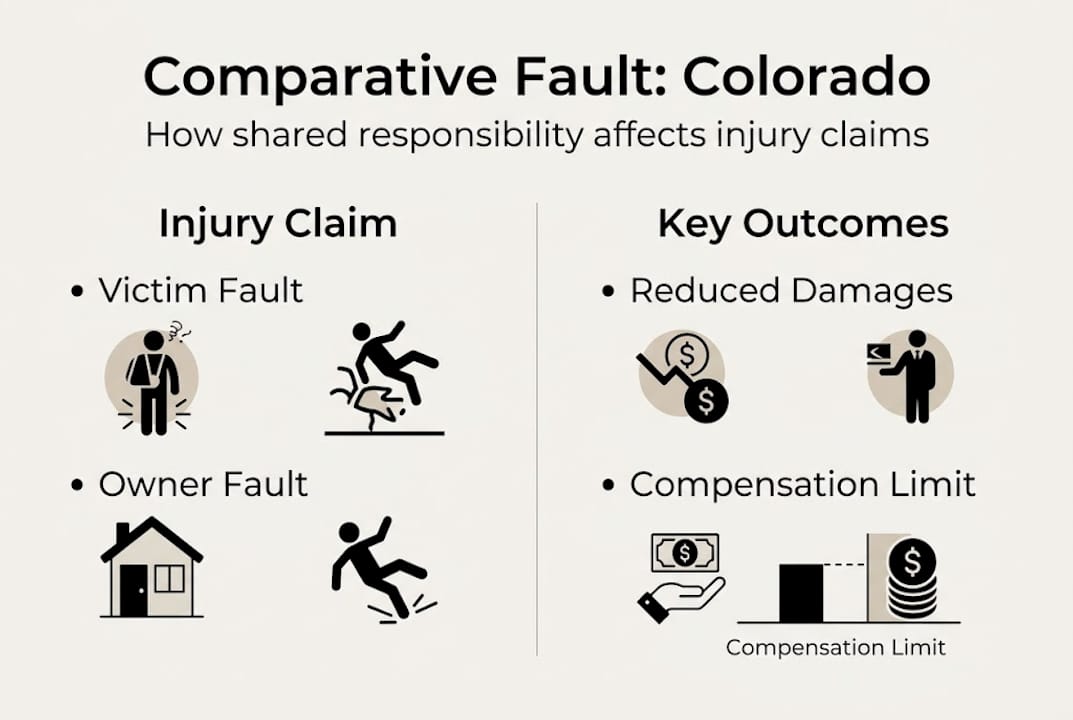
For example, if a jury finds you 20% responsible for not watching where you were walking, and your total damages are $100,000, you would receive $80,000. This is why having clear evidence and strong legal representation matters so much.
Pro Tip: Take photos of the exact location where you fell, including any hazard that caused it, immediately after the incident. Capture lighting conditions, signage (or the absence of it), and any witnesses. This documentation is harder to dispute later.
Understanding Colorado injury compensation in broader terms can also help you set realistic expectations before negotiations begin. And knowing the qualities of a Colorado injury lawyer helps you choose someone who will actually fight for the full amount you deserve.
Prevention, awareness, and next steps after an injury
Once liability is understood, the next priority is prevention and knowing your rights if you experience an injury.
Research published in PMC shows that regular inspections, ice melt, and lighting significantly reduce slip and fall risks, yet poor perception of fall risk is common in older adults, with 81% showing low awareness of their personal vulnerability. That stat is critical. It means most older adults do not believe they are at real risk until after something happens.
Prevention strategies for Colorado residents
For homeowners and renters in Colorado, these steps can meaningfully reduce your risk:
- Apply ice melt or sand to walkways before and during winter storms
- Install adequate lighting in all stairwells, hallways, and entryways
- Secure loose rugs and replace worn flooring before it becomes a hazard
- Keep walkways clear of clutter, especially in garages and basements
- Inspect exterior steps and handrails at the start of each season
- Report hazards to property managers or landlords in writing so there is a record
For older adults specifically, balance training and regular vision checks lower fall risk substantially. These are not just wellness tips. They are practical defenses against one of the leading causes of injury-related death in people over 65.
“Awareness is the first layer of prevention. If you don’t believe you are at risk, you won’t take steps to protect yourself. That gap in perception is where most fall injuries begin.”
What to do immediately after a slip and fall
If you are injured on someone else’s property, the steps you take right after the incident can determine whether you have a viable claim:
- Stay at the scene long enough to document the hazard and gather information
- Report the incident to the property manager, store employee, or owner and ask for a written incident report
- Take photos and video of the exact location, the hazard, and your visible injuries
- Get witness information including names and phone numbers from anyone who saw what happened
- Seek medical care immediately, even if you feel okay at first, because some injuries are not apparent right away
- Contact a Colorado injury attorney before speaking to any insurance company
Pro Tip: Do not give a recorded statement to an insurance adjuster without legal counsel. They are trained to get you to say things that minimize your claim. One wrong phrase can cost you thousands.
The legal checklist for accident victims is another resource that walks you through the documentation process in more detail, which is worth reviewing before your first attorney consultation.
Our unique perspective: What Colorado victims really need to know
Having explored the practical steps and prevention advice, let’s look at what most guides won’t tell you from an attorney’s perspective.
I’ve been practicing personal injury law for over a decade, and before that I worked as a claims adjudicator for the federal government. That background means I’ve seen the same cases from both sides of the table. Here is the honest truth: most victims who walk away with less than they deserve do so because they waited too long, documented too little, or trusted that the insurance company would be fair.
Insurance companies are not your advocates. They are businesses built to minimize payouts. They evaluate your claim based on what you can prove, not on what actually happened. That gap, between reality and provable facts, is exactly where victims lose value.
The Cleveland Clinic notes that severe injuries are most common in older adults, and these cases require a legal and medical strategy that is genuinely different from a standard soft-tissue claim. Treating them the same way is a mistake I’ve seen cost families significantly.
What separates successful claims is not luck. It is preparation, documentation, and working with someone who understands how adjusters think. Knowing the best qualities in a Colorado injury lawyer before you hire anyone is one of the most important steps you can take. Don’t choose based on the biggest billboard. Choose based on track record, transparency, and genuine commitment to your outcome.
Connect with a Colorado personal injury attorney
If you’ve been hurt in a slip and fall, the worst thing you can do is wait and hope it works out. Evidence disappears. Witnesses forget. Statutes of limitations close doors permanently. Taking action early gives you the best chance at full and fair compensation.
At Malnar Injury Law, now operating as StubbornAttorney.com, we represent only injured victims. We’ve recovered millions in settlements for people across Colorado, and we know exactly how insurance companies evaluate these claims because we’ve worked on both sides. If you’re ready to understand why pursuing an injury case is worth your time, or you want to see real personal injury case outcomes from cases like yours, we’re here to help. Your consultation is free. Your fight deserves someone stubborn enough to see it through.
Frequently asked questions
What qualifies as a slip and fall injury in Colorado?
A slip and fall injury occurs when someone falls due to a hazardous condition on another’s property, often resulting in a premises liability claim. In Colorado, the property owner must have known or should have known about the hazard to be held liable.
What are the most common injuries from slip and fall accidents?
Bruises, fractures, traumatic brain injuries, and spinal injuries are the most common outcomes, with older adults at greater risk of severe and life-altering consequences. Hip fractures in particular often require surgery and extended rehabilitation.
How is liability proven in Colorado slip and fall cases?
Liability is established by showing the property owner was negligent in addressing a known hazard or failed to warn visitors about dangerous conditions on their property. Evidence such as photos, incident reports, and witness statements are essential.
What steps should I take right after a slip and fall?
Document the scene, seek medical treatment immediately, and consult a Colorado injury attorney before speaking to any insurance company. Acting quickly protects your ability to build a strong claim, as shown by fall risk and prevention research.
Can I prevent slip and fall injuries at home?
Yes. Regular inspections, good lighting, and ice melt significantly lower your risk, especially during Colorado winters. Addressing hazards before they cause injury is always better than dealing with the aftermath.
Recommended
- Why pursue an injury case? Key reasons for Colorado victims
- Types of car accident claims: Your guide to Colorado options
- Top personal injury case examples and outcomes in Colorado
- Colorado car accident legal checklist: protect your rights
- Slip and Fall Accidents | Serendib Law Firm
- 6 Common Types of Slip and Fall Injuries Explained