


Your rights after injury in Colorado: What you need to know
TL;DR:
- Colorado’s personal injury laws cover a wide range of harms beyond major accidents.
- Different case categories (negligence, intentional acts, strict liability) determine legal strategies.
- Recent 2025 legislation raised damage caps but removed doubling, affecting settlement negotiations.
Most people assume personal injury law only applies to dramatic accidents, catastrophic crashes, or situations where someone is clearly at fault in an obvious way. That assumption is wrong, and it costs injured Coloradans real money every year. The truth is, Colorado’s personal injury laws protect a far broader range of people than most guides ever acknowledge, covering everything from a slippery parking lot fall outside a Denver grocery store to a dog bite in Colorado Springs to a defective product that fails without warning. This guide will walk you through what personal injury law actually means in Colorado, which types of cases qualify, what compensation looks like under new 2025 rules, and exactly what steps you should take to protect your rights from day one.
Table of Contents
- What is personal injury law?
- Types of cases covered by Colorado personal injury law
- Understanding compensation and damages in Colorado
- Steps to take after an injury in Colorado
- What most guides miss about Colorado personal injury law
- Connect with Colorado legal experts for your personal injury claim
- Frequently asked questions
Key Takeaways
| Point | Details |
|---|---|
| Broad law protection | Personal injury laws in Colorado protect victims of negligence, intentional acts, and strict liability. |
| New damage caps | 2025 Colorado damage caps affect settlement limits and legal strategies for accident victims. |
| Action steps matter | Prompt action after injury, including evidence documentation, can make or break your Colorado claim. |
| Seeking expert advice | Consulting a Colorado injury lawyer is essential to navigate unique local law and maximize compensation. |
What is personal injury law?
Personal injury law sits inside a broader legal category called tort law. A tort is simply a civil wrong, meaning a situation where one person’s action or inaction causes harm to another person, and the legal system provides a path for the injured party to seek financial compensation.
As a legal framework, personal injury law is a subset of tort law that allows individuals harmed by another’s negligence, intentional acts, or strict liability to seek compensation for physical, emotional, or financial damages. That definition covers a lot of ground, which is exactly the point. It means that your case doesn’t need to involve a dramatic accident or a criminal act to qualify.
In Colorado, personal injury law operates under state statutes and common law principles that establish how fault is assigned, how damages are calculated, and how long you have to file a claim. One of the most important concepts for Colorado residents to understand is the statute of limitations. Under Colorado law, most personal injury claims must be filed within three years of the date of the injury. Wait too long, and you lose your right to pursue compensation entirely.
Colorado also follows what’s called a modified comparative negligence rule. This means that even if you were partially at fault for your own injury, you can still recover compensation as long as your share of the fault doesn’t exceed 50 percent. However, your final payout will be reduced by your percentage of responsibility. So if a court finds you 20 percent at fault for a slip and fall, your total compensation is reduced by 20 percent. This is why understanding your legal position early, including through a thorough injury case evaluation, matters so much.
Here are the core types of harm that Colorado personal injury law can address:
- Physical injuries: Broken bones, traumatic brain injuries, spinal damage, soft tissue injuries, and burns
- Emotional distress: Anxiety, depression, PTSD, and psychological trauma following an accident
- Financial losses: Medical bills, lost wages, reduced earning capacity, and out-of-pocket expenses
- Property damage: In some cases, damage to your vehicle or other property is included in the claim
- Wrongful death: When a negligent act leads to a fatal outcome, surviving family members may bring a claim
“Personal injury law isn’t just about big accidents. It’s a system designed to make you whole again after someone else’s carelessness or wrongdoing takes something from you.”
Whether your injury came from slip and fall injuries on a wet floor, a rear-end collision on I-25, or a product that malfunctioned and burned your hand, the legal framework can apply. The key is understanding how to recognize when your situation fits and what to do next. If you’ve been in a vehicle accident, reviewing a detailed car accident legal checklist is one of the smartest early moves you can make.
Types of cases covered by Colorado personal injury law
Colorado recognizes three main categories of personal injury cases. Knowing which category your situation falls into isn’t just academic. It directly shapes the legal strategy your attorney will use and can significantly affect how much compensation you’re entitled to.
Here’s a breakdown of all three categories:
-
Negligence cases: These are by far the most common. Negligence means someone failed to act with reasonable care, and that failure caused your injury. Car accidents where a driver runs a red light, slip and falls caused by unmarked wet floors, and medical malpractice all fall into this category.
-
Intentional act cases: These involve deliberate harm. Assault, battery, and intentional infliction of emotional distress are examples. Even if the person faces criminal charges, you can still file a separate civil personal injury claim.
-
Strict liability cases: Here, fault doesn’t need to be proven in the traditional sense. If a defective product injures you, or if someone’s dog bites you in Colorado, the law holds the responsible party liable regardless of whether they were “trying” to hurt you.
Here’s a comparison of how these three categories differ in practice:
| Case type | Fault required? | Common Colorado examples | Key legal challenge |
|---|---|---|---|
| Negligence | Yes, must prove breach of duty | Car accidents, slip and falls, medical errors | Establishing what “reasonable care” looked like |
| Intentional act | Intent to act (not to harm) | Assault, fraud, harassment | Connecting the act directly to your damages |
| Strict liability | No, liability is automatic | Dog bites, defective products | Identifying the responsible product or owner |
Understanding where your case fits matters enormously when choosing how to build your claim. To see how these categories play out in real Colorado situations, reviewing personal injury case examples can give you a clearer picture of how courts and insurance companies have responded to similar facts.
Let’s look at some real Colorado-specific scenarios to make this concrete:
- A driver on Highway 24 rear-ends your car while texting. That’s a negligence case. The driver breached their duty to drive carefully.
- A retail store in Colorado Springs fails to clean up a spilled drink for over an hour. You slip, fall, and break your wrist. Negligence again, because the store failed its duty to maintain safe premises.
- Your neighbor’s dog jumps the fence and bites your child. Colorado’s dog bite statute makes the owner strictly liable, meaning you don’t need to show the dog had a history of aggression.
- You buy a popular portable heater, use it exactly as directed, and it catches fire and burns your kitchen. That’s a product liability case under strict liability.
Different car accident claim types also vary depending on the specific facts, such as whether a commercial truck was involved, whether road conditions played a role, or whether a government entity is liable for a dangerous road design.
Pro Tip: Document the category of your case as early as possible. An attorney who understands the specific legal standard that applies to your situation will build a stronger, more targeted strategy from day one. Generic legal advice rarely accounts for the differences between these three tracks, and the wrong approach can cost you thousands. Knowing what type of case you have is one of the qualities of injury lawyers you should ask about when choosing representation.
Understanding compensation and damages in Colorado
Once you’ve established that your situation qualifies as a personal injury case, the next question is: what can you actually recover? Colorado law allows injury victims to claim several distinct categories of compensation, and understanding each one helps you know what to ask for and what to expect.
Here are the major types of damages available in Colorado personal injury cases:
- Medical expenses: Past bills and future treatment costs, including surgeries, therapy, prescriptions, and medical equipment
- Lost wages: Income you missed while recovering, including both hourly pay and salary
- Loss of earning capacity: Compensation for your reduced ability to earn money in the future if your injury affects your career long-term
- Pain and suffering: Compensation for the physical pain and emotional anguish caused by your injury
- Emotional distress: Separate from general pain and suffering, this covers diagnosed psychological conditions like PTSD or anxiety
- Loss of enjoyment of life: If your injury permanently limits your ability to participate in hobbies or activities you valued before the accident
- Punitive damages: Awarded in cases where the defendant’s conduct was particularly reckless or malicious, intended to punish and deter
A major shift for Colorado residents to understand is the impact of recent legislation. The new 2025 damage caps established by HB24-1472 provide higher baselines but introduce hard caps that remove the prior doubling option, which meaningfully changes how settlements are structured and negotiated.
Here’s a comparison of how the caps changed:
| Damage category | Pre-2025 cap | Post-2025 cap (HB24-1472) | Key change |
|---|---|---|---|
| Noneconomic damages (general) | $613,760 (with doubling to $1.2M) | $1,500,000 hard cap | Doubling removed; higher base |
| Physical impairment / disfigurement | $613,760 | $1,500,000 | Same structure, higher limit |
| Punitive damages | Equal to actual damages | Equal to actual damages | Unchanged |
| Medical malpractice (total) | $1,000,000 | Adjusted under separate track | More complex calculation |
The removal of the doubling option is a critical detail that many injury victims and even some general practice attorneys overlook entirely. Before HB24-1472, a court could double noneconomic damages in cases involving extraordinary circumstances. That option is now gone. The higher baseline cap sounds better on paper, but for certain serious injury cases where doubling would have produced a larger outcome, the new rules can actually limit recovery.
This is not a minor technical change. It reshapes how an attorney evaluates your case, what settlement offers to accept, and when going to trial makes sense versus settling early. Understanding the full range of compensation types available to you gives you the foundation to make informed decisions.

For those who suffered injuries in vehicle accidents specifically, understanding financial compensation in the context of Colorado auto insurance requirements adds another important layer to your claim strategy.
Key stat to know: Colorado’s noneconomic damage cap for most personal injury cases now sits at $1,500,000 under HB24-1472. This is significantly higher than before, but it is a hard ceiling with no exceptions for doubling, so maximizing every documented category of harm matters more than ever.
Steps to take after an injury in Colorado
Knowing your rights is only half the battle. What you do in the hours and days after an injury in Colorado can make or break your claim. Evidence disappears fast. Insurance companies move quickly to minimize their exposure. Your window to act is shorter than most people realize.
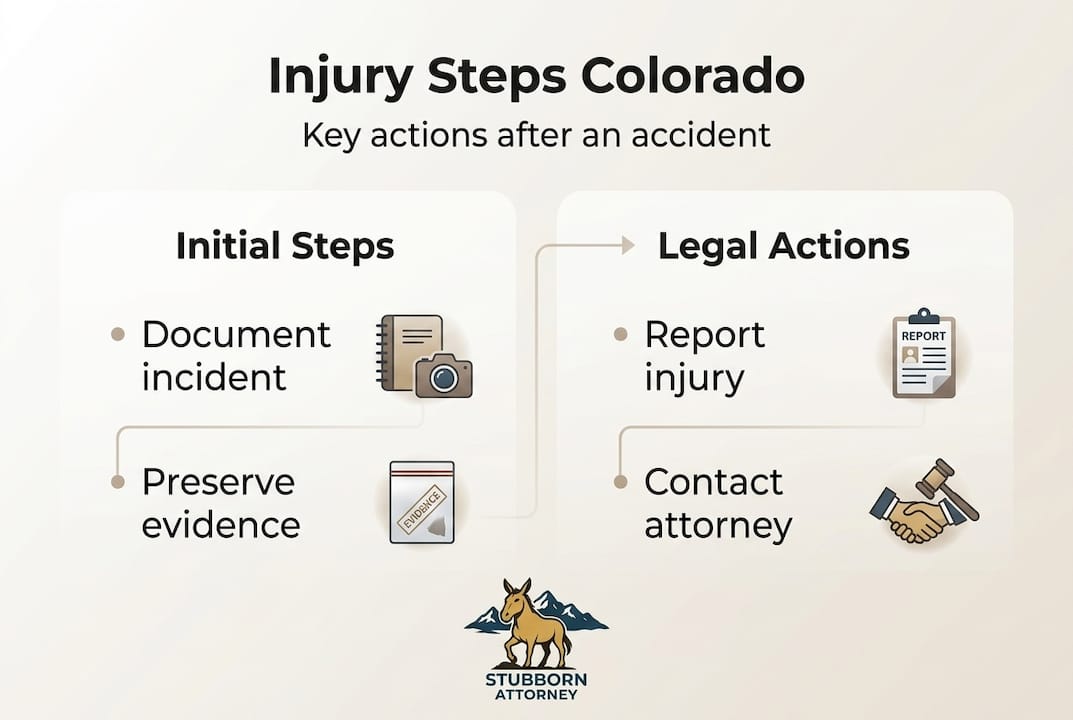
Here is a clear, step-by-step process to protect yourself:
-
Get medical attention immediately. Even if you feel fine, some injuries like concussions, soft tissue damage, and internal trauma are not always obvious right away. Seeing a doctor creates an official medical record that directly links your injury to the incident.
-
Call the police or report the incident. For car accidents, a police report is often essential. For slip and falls or other incidents, report the event to the property owner or manager and ask for a written incident report. Get a copy for yourself.
-
Document everything at the scene. Take photographs of your injuries, the location, any hazards that contributed to the accident, and any visible property damage. If there are witnesses, collect their names and phone numbers before anyone leaves.
-
Do not give a recorded statement to insurance companies. Adjusters are trained to ask questions in ways that minimize your claim. Politely decline until you’ve spoken with an attorney. This single step protects more cases than almost anything else.
-
Preserve all evidence. Keep the clothes you were wearing, save any defective products involved, hold onto receipts for medical visits and any out-of-pocket expenses, and screenshot any text messages or communications related to the incident.
-
Keep a personal injury journal. Write down daily notes about your pain levels, limitations, emotional struggles, and any activities you’ve had to give up because of your injury. This documentation supports your pain and suffering claim and makes your experience real and concrete for a jury or insurance adjuster.
-
Contact a personal injury attorney promptly. Colorado’s three-year statute of limitations sounds long, but the real deadline is much tighter in practice. Evidence degrades, memories fade, and witnesses become hard to locate. Early legal counsel gives your case its best foundation.
Here are additional practical resources to pull together after an injury:
- Copies of all medical records and bills
- Your employer’s documentation of missed work and lost wages
- Photos organized by date with location data preserved
- Any surveillance footage from the scene (request it quickly, as many systems overwrite footage within days)
Personal injury law gives you real rights as a victim of someone else’s negligence, intentional acts, or strict liability, but those rights only matter if you take action to protect them. Understanding why pursuing an injury case is worth the effort helps many people move past hesitation and toward real accountability.
Pro Tip: The most damaging mistake injury victims make is waiting. People often want to see “how bad it really is” before contacting a lawyer. But the actions you take in the first 48 to 72 hours have an outsized impact on your case. Every day you wait, evidence becomes harder to gather and insurance companies gain more ground. Review a clear injury lawsuit timeline to understand what happens at each stage so you know what to expect.
What most guides miss about Colorado personal injury law
Most personal injury guides treat Colorado law as if it’s identical to every other state. They give you generic advice about filing claims, documenting injuries, and calling a lawyer. That advice isn’t wrong. It’s just incomplete in ways that can seriously hurt your case.
Here’s what nearly every generic guide fails to mention: the 2025 legislative changes under HB24-1472 didn’t just raise caps. They fundamentally shifted the negotiating landscape for injury attorneys and insurance companies alike. Before the change, the threat of doubling noneconomic damages gave attorneys a powerful tool in settlement negotiations. That leverage is gone now. What takes its place is an even greater need for meticulous, thorough documentation of every category of harm from day one.
We’ve seen cases where clients came to us after receiving lowball settlement offers because their early documentation didn’t capture the full picture of their losses. Medical bills alone rarely tell the whole story. Emotional distress, lost capacity to work, and reduced quality of life are all real, compensable damages that require deliberate effort to document and prove.
Colorado also has specific rules about government liability, premises liability for recreational land use, and modified comparative fault that affect cases in ways most residents would never anticipate. A single overlooked detail about where your injury happened or who owns the property can change your claim dramatically.
The attorneys who get the best results for Colorado clients are the ones who understand these local nuances, not just the general framework. Knowing what to look for in the qualities of Colorado injury lawyers you choose to work with is one of the most important decisions you’ll make after an accident.
Connect with Colorado legal experts for your personal injury claim
Understanding personal injury law in Colorado is a powerful first step. But knowing the law and successfully navigating it are two different things. Insurance companies have teams of adjusters and attorneys working to limit what they pay you. You deserve someone in your corner who is just as determined and just as well-prepared.
At Malnar Injury Law, we represent only injured victims. That focus means everything we know and everything we build goes toward one goal: getting you the best possible result. If you’re trying to understand why pursuing an injury case makes sense for your situation, we can walk you through it at no cost. You can also review Colorado injury case outcomes to see how similar cases have resolved and explore the complete injury compensation guide to understand what you may be entitled to. Reach out today for a free case evaluation. The conversation costs you nothing. The delay might.
Frequently asked questions
What qualifies as a personal injury case in Colorado?
Any harm caused by negligence, intentional acts, or strict liability, including car accidents, slips, and defective products, can qualify under Colorado law, as long as another party’s conduct caused your injury.
How do Colorado damage caps affect injury settlements?
Colorado’s new 2025 caps set a $1,500,000 hard ceiling on noneconomic damages and eliminate the previous doubling provision, which changes how attorneys negotiate and what settlement amounts are realistic to pursue.
What steps should I take after an injury in Colorado?
Document your injuries, report the incident to the appropriate party, preserve all physical and digital evidence, and consult with a personal injury attorney as quickly as possible to protect your rights under Colorado tort law.
Can emotional distress be compensated in Colorado injury cases?
Yes, emotional distress is recognized as a compensable category of harm in Colorado, and it can be claimed alongside medical bills, lost wages, and other documented losses in a personal injury case.