

Why Get a Free Case Evaluation After a Car Accident
A free case evaluation is a no-cost, no-obligation consultation where a personal injury attorney reviews your accident details to determine whether you have a viable legal claim. In Colorado, car accident victims face tight deadlines, fading evidence, and aggressive insurance adjusters from day one. Knowing why get a free case evaluation matters is the difference between protecting your rights and losing them. The standard industry term for this meeting is an “initial legal consultation,” though most Colorado personal injury firms call it a free case evaluation or free case review. Both terms describe the same process: a confidential meeting where an attorney assesses your situation at zero financial cost to you.
Why get a free case evaluation right after a crash
A free case evaluation typically lasts 30–60 minutes at no cost and with no obligation to hire. That time is not spent on legal strategy. It is spent on fact gathering. The attorney needs to understand what happened, who was involved, what injuries you sustained, and what evidence currently exists. Most clients are surprised to learn the meeting is less about courtroom planning and more about determining whether a valid claim exists at all.
Attorneys use this initial meeting to assess four core elements of a negligence claim: duty, breach, causation, and damage. All four elements must be present for a case to move forward. If any element is weak or missing, the attorney will tell you directly. That honest assessment is itself a major benefit, because it saves you from pursuing a claim with little chance of success.

Timing is the factor most accident victims underestimate. Evidence like video footage can be overwritten within days, and witnesses become harder to reach within weeks. The sooner you sit down with an attorney, the better your chances of preserving the evidence that supports your claim. Waiting even a few weeks can permanently weaken a case that would otherwise be strong.
Early evaluation also protects you from costly mistakes. Signing a medical release too soon, or discussing your claim with an insurance adjuster without legal guidance, can seriously damage your position. An attorney who reviews your case early can warn you away from these traps before you walk into them.

Pro Tip: Do not speak with any insurance adjuster, including your own, before your free case evaluation. Adjusters are trained to gather information that minimizes your payout. One unguarded statement can reduce your settlement significantly.
Here is what a typical free case evaluation covers:
- Accident details: date, location, road conditions, and how the collision occurred
- Injury documentation: current medical treatment, diagnosis, and prognosis
- Evidence inventory: photos, police reports, witness names, and any available video
- Insurance information: your policy, the other driver’s policy, and any coverage gaps
- Preliminary negligence assessment: whether duty, breach, causation, and damage are present
- Realistic case outlook: whether pursuing a claim makes practical and legal sense
What are the real benefits of a free case evaluation?
The most direct benefit is financial: you pay nothing for expert legal analysis of your situation. Personal injury attorneys work on a contingency fee basis, meaning they only collect a fee if they win your case. Standard contingency fees run 33–40% of the final settlement or judgment. Because the firm absorbs the cost of the initial review, you get professional legal analysis with zero upfront risk.
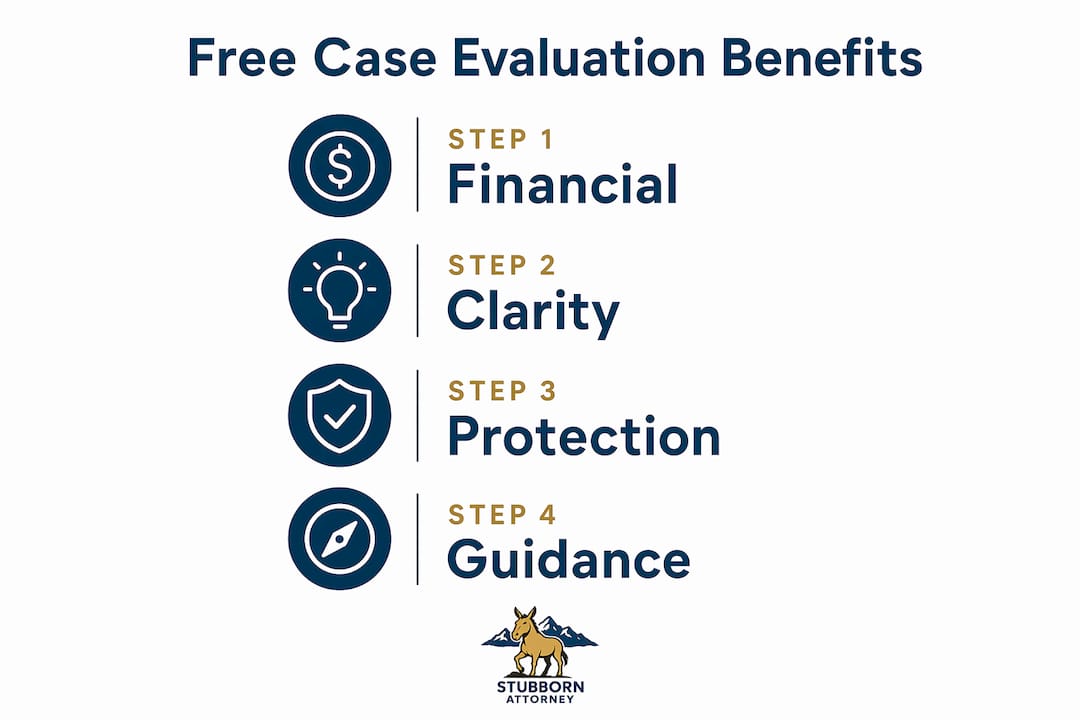
The second major benefit is clarity. Many accident victims either overestimate or underestimate the value of their claim. A free evaluation provides factual clarity on fault, injuries, and realistic compensation, replacing assumptions with documented facts. You leave the meeting knowing whether your case is strong, marginal, or unlikely to succeed. That knowledge lets you make informed decisions rather than emotional ones.
A third benefit is protection from errors. Without legal guidance, accident victims routinely make mistakes that reduce or eliminate their compensation. Accepting a quick settlement offer, missing a filing deadline, or failing to document injuries properly are all common and avoidable. An attorney who evaluates your case early can identify these risks before they become permanent problems.
Pro Tip: Bring your own list of questions to the evaluation. Ask the attorney how many car accident cases they have handled in Colorado, what their typical settlement timeline looks like, and how they communicate with clients throughout the process. The answers tell you as much about the firm as the evaluation tells them about your case.
The evaluation also gives you a chance to assess the law firm itself. Meeting multiple firms before hiring helps you compare communication style, experience, and personal comfort. A firm that listens carefully, explains things clearly, and gives you honest feedback is a firm worth trusting with your case.
Key benefits at a glance:
- No financial cost and no obligation to retain the attorney
- Honest assessment of claim strength based on documented facts
- Early identification of evidence that needs immediate preservation
- Protection from common mistakes like premature settlements or unsupervised adjuster contact
- Opportunity to evaluate the attorney’s experience and communication style before committing
- Confirmation that your case has merit, since attorney acceptance signals strong claim potential
How to prepare for your free case evaluation
Preparation directly affects the quality of the assessment you receive. An attorney can only evaluate what you bring to the table. Walking in with organized information produces a more accurate and useful result than arriving with scattered memories and no documentation.
Follow these steps before your evaluation:
-
Write a timeline of the accident. A written timeline of events helps the attorney perform a more accurate assessment. Include the date, time, weather, road conditions, what you were doing before the crash, and exactly how the collision unfolded. Do not guess. Write only what you know for certain.
-
Gather your medical records. Bring any emergency room reports, physician notes, imaging results, and prescription records related to your injuries. If you have not yet sought medical treatment, do so before your evaluation. Documented injuries are the foundation of any personal injury claim.
-
Collect the police report. The official accident report establishes facts about the crash, including whether a citation was issued. Request a copy from the responding law enforcement agency as soon as it is available.
-
Organize your photos and videos. Photos of vehicle damage, road conditions, visible injuries, and the accident scene are critical. If you gathered accident evidence at the scene, bring everything you have.
-
List all witnesses. Write down the names and contact information of anyone who saw the accident. Witness availability fades quickly, so this information is time-sensitive.
-
Document your financial losses. Compile records of medical bills, missed work, and any out-of-pocket expenses directly related to the accident. These numbers form the basis of your economic damages claim.
-
Prepare your questions. Write down what you want to know before you walk in. Ask about case timelines, the attorney’s experience with Colorado car accident claims, and how the firm handles client communication.
Pro Tip: Do not speculate during the evaluation. If you are unsure whether a detail is accurate, say so. Attorneys build cases on documented facts, not guesses. A speculative statement that contradicts later evidence can create problems for your claim.
One thing to avoid: do not sign any documents before or during the evaluation without reading them carefully. The evaluation itself carries no obligation, but some paperwork may create one. Ask what any document means before you sign it.
What happens after your free case evaluation?
The attorney will give you one of three recommendations after reviewing your case. Understanding what each means helps you plan your next steps clearly.
- Pursue the claim. The attorney believes your case has merit and is willing to represent you. This is the green light to move forward. If you agree to retain the firm, you will sign a contingency fee agreement and the legal process begins.
- Gather more evidence. The case has potential but needs stronger documentation before the attorney can commit. This typically means additional medical records, a more complete accident reconstruction, or witness statements that have not yet been secured.
- No viable claim. The facts do not support a negligence claim under Colorado law. This is not a failure. It is honest information that saves you time, money, and stress.
If the attorney recommends moving forward, the next step is understanding the fee structure. Contingency fee arrangements mean you pay nothing unless the case resolves in your favor. The attorney will explain the percentage, what costs are deducted from the settlement, and how expenses are handled during the case.
Acting promptly on the attorney’s advice is critical. Evidence preservation does not pause while you consider your options. If the attorney identifies specific evidence that needs to be secured, treat that as urgent. Delay can mean the difference between a strong case and a compromised one.
Evaluating the firm itself is a legitimate part of your decision. You are not obligated to hire the first attorney who reviews your case. Meeting multiple firms before deciding gives you a clearer picture of who will fight hardest for your outcome. Pay attention to how the attorney communicates, whether they explain things in plain language, and whether they treat your situation with genuine attention.
Once retained, a personal injury attorney will handle communication with insurance companies, gather and preserve evidence, negotiate on your behalf, and keep you updated throughout the process. Your job is to focus on recovery. Their job is to protect your claim.
What I have learned from a decade of car accident cases in Colorado
The biggest mistake I see accident victims make is waiting. They assume they have time to figure things out, that the insurance company will treat them fairly, or that their injuries are not serious enough to warrant legal help. By the time they call, critical evidence is gone, they have already signed documents they should not have, and their claim is weaker than it needed to be.
A free case evaluation is not a formality. It is a protective tool. The information you receive in that first meeting shapes every decision that follows. Clients who come in early, with organized information and honest accounts of what happened, consistently get better outcomes than those who wait and hope things resolve on their own.
I also want to address a myth I hear often: that free evaluations are only for people who are certain they want to sue. That is wrong. The evaluation exists precisely to answer the question of whether legal action makes sense at all. Many clients leave with the honest answer that their situation does not support a claim. That answer has real value. It lets them move forward without false hope or wasted effort.
My advice is to treat the evaluation as a fact-finding mission, not a commitment. You are gathering information. The attorney is gathering information. Neither party is locked into anything. If the firm is a good fit and the case has merit, you will both know it by the end of the meeting. If not, you have lost nothing and gained clarity.
One more thing: do not settle for the first evaluation if something feels off. The right attorney listens more than they talk in that first meeting. They ask good questions. They give you honest answers, even when the honest answer is not what you hoped to hear. That is the standard worth holding out for.
— Ryan
Stubbornattorney’s free case evaluation for Colorado accident victims
Stubbornattorney offers a free personal injury case review to Colorado car accident victims with zero cost and no obligation to hire. Ryan Malnar brings over a decade of personal injury experience and a background as a former federal claims adjudicator, which means he understands exactly how insurance companies evaluate your claim from the inside. The firm works exclusively on a contingency fee basis, so you pay nothing unless your case resolves in your favor. If you were injured in a Colorado car accident and want to know where you stand, reviewing common personal injury case examples is a useful first step before your evaluation. Stubbornattorney is ready to assess your case, answer your questions, and give you the honest picture your situation deserves.
FAQ
What is a free case evaluation in a personal injury claim?
A free case evaluation is a confidential, no-cost consultation where a personal injury attorney reviews your accident details to determine whether you have a viable legal claim. It typically lasts 30–60 minutes and carries no obligation to hire the attorney.
Does a free case evaluation mean I have to file a lawsuit?
No. A free case evaluation carries no obligation whatsoever. The meeting exists to give you information about your legal options, not to commit you to any course of action.
How soon after a car accident should I get a case evaluation?
You should schedule a free case evaluation as soon as possible after a crash. Evidence like video footage can be overwritten within days, and waiting reduces your attorney’s ability to build a strong case.
What does it cost to get a free case evaluation?
A free case evaluation costs nothing. Personal injury attorneys work on contingency, meaning they only collect a fee if they win your case, so the initial review is absorbed by the firm at no charge to you.
Can I get evaluations from more than one law firm?
Yes, and doing so is advisable. Meeting multiple firms before hiring lets you compare experience, communication style, and overall fit before making a commitment.