


The Litigation Process Explained for Colorado Injury Claims
The litigation process is the court-based sequence that moves a civil dispute from pre-suit investigation through pleadings, discovery, pretrial motions, trial, and any appeals. For a Colorado personal-injury claimant, that sequence typically spans several years and almost always resolves before a jury ever hears the case.
What you need to do right now:
- Preserve every piece of evidence — photos, medical records, accident reports, and any communications related to your injury
- Contact a personal-injury attorney before speaking with any insurance adjuster
- Track all medical care and out-of-pocket costs from day one, including mileage to appointments
Colorado’s statute of limitations for most personal-injury claims is two years from the date of injury. Missing that deadline ends your case permanently.
Table of Contents
- What is the litigation process, stage by stage?
- How long does litigation take, and what does it cost?
- Why discovery decides most personal-injury cases
- How settlement, mediation, and pretrial motions actually work
- What you should do now and how to work with your attorney
- Litigation is about controlled risk, not courtroom drama
- Stubbornattorney offers a free case evaluation for Colorado injury claims
- Useful sources for further reading
- FAQ
What is the litigation process, stage by stage?
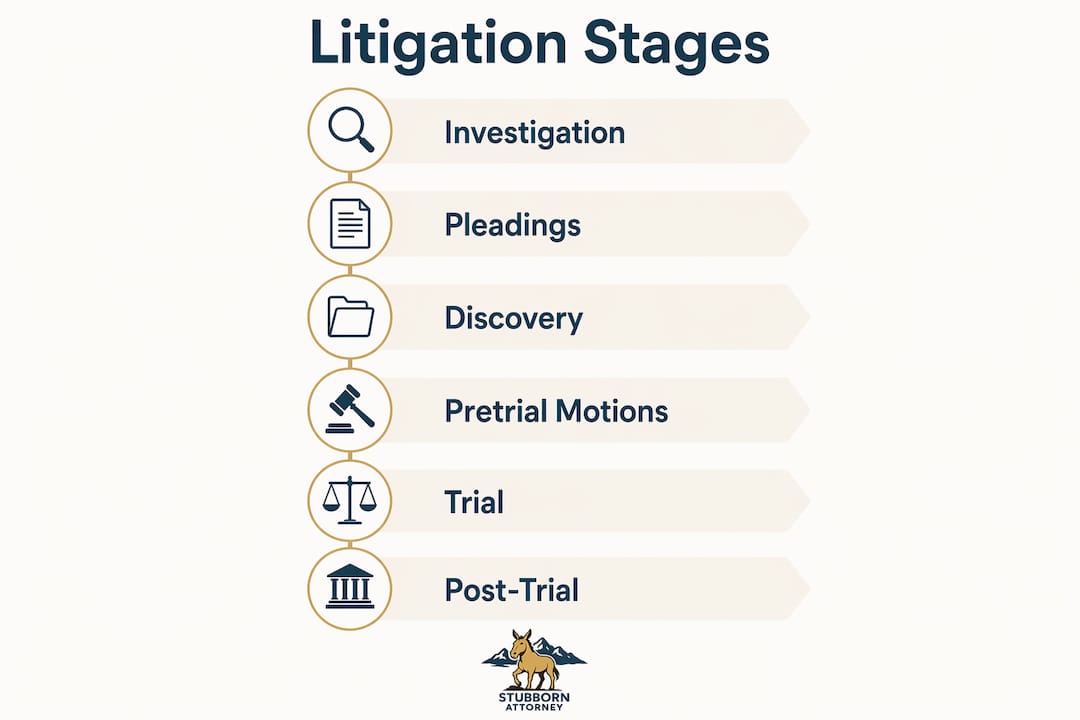
Civil litigation follows a standard chronology: pre-suit investigation, complaint and service, answer, discovery, pretrial motions, trial, and appeals. Here is what each stage actually looks like.
Pre-suit investigation and demand
Before anything is filed, your attorney gathers evidence, orders medical records, interviews witnesses, and evaluates the strength of your claim. A written demand letter goes to the at-fault party or their insurer. Many cases settle here. If the insurer low-balls or denies the claim, the next step is filing. Understanding what pre-litigation involves helps you set realistic expectations for this phase.
Pleadings: complaint, summons, and service
A lawsuit officially begins when your attorney files a complaint. The complaint states the facts, the legal basis for your claim, and the damages you seek. Service of process — physically delivering the summons and complaint to the defendant — is a required step. Improper service or missed deadlines can result in dismissal.
The defendant’s answer and default judgment risk
Once served, the defendant must respond. Answer windows range from 21 to 180 days depending on jurisdiction and case type. In Colorado state court, the standard window is 21 days for in-state defendants. The answer admits or denies each allegation, raises affirmative defenses, and may include counterclaims. If the defendant fails to respond at all, you can move for a default judgment.
Discovery: the decisive phase
Discovery is where cases are won or lost. Both sides exchange information through interrogatories (written questions answered under oath), requests for production of documents, requests for admission, and depositions. Depositions can be used at trial to expose inconsistencies in witness testimony. Expert disclosures — medical experts, accident reconstructionists, economists — are also exchanged during this phase.
Pretrial motions
Common motions include motions to dismiss, motions for summary judgment, and motions to compel discovery responses. A motion for summary judgment asks the judge to rule in one party’s favor because no genuine factual dispute exists. If granted, the case ends without trial. Motions in limine exclude certain evidence before trial begins.

Trial and post-trial
In a jury trial, the jury decides the facts; in a bench trial, the judge does both. After a verdict, either side may file post-trial motions challenging the result. Appeals review alleged legal errors from the trial court and do not re-examine factual findings. Notice of appeal windows are narrow and set by jurisdiction.
| Stage | Who Acts | Typical Duration |
|---|---|---|
| Pre-suit investigation/demand | Attorney, client | Weeks to months |
| Complaint and service | Plaintiff’s attorney | Days to weeks |
| Defendant’s answer | Defense attorney | within a time frame set by jurisdiction and case type |
| Discovery | Both sides | several years |
| Pretrial motions/mediation | Both sides, court | several months |
| Trial | Both sides, judge/jury | Days to weeks |
| Post-trial/appeal | Appellant | Months to years |
Pro Tip: The scheduling order the judge issues early in the case sets every major deadline. Ask your attorney for a copy and keep it. Missing a discovery deadline can cost you evidence — or the case.
How long does litigation take, and what does it cost?
Civil cases commonly move from filing to trial over a period of several years, though simpler claims can resolve faster and complex multi-party cases can stretch longer. Colorado’s state courts add their own scheduling pressures depending on the county and docket load.
Factors that affect your timeline:
- Court scheduling and docket congestion in your county
- Number of defendants and insurance carriers involved
- Complexity of medical issues and need for expert witnesses
- Discovery disputes requiring court intervention
- Whether the case goes to mediation and how many sessions it takes
Cost structure for Colorado personal-injury cases:
Most personal-injury attorneys, including Stubbornattorney, work on a contingency fee basis. You pay nothing upfront. The attorney advances litigation costs — filing fees, deposition costs, expert fees, medical record retrieval — and recoups those expenses from the settlement or verdict. If you recover nothing, you owe nothing in attorney fees.
| Cost Category | Who Advances It | Paid From |
|---|---|---|
| Attorney fees (contingency) | Attorney | Settlement/verdict |
| Court filing fees | Attorney | Settlement/verdict |
| Deposition and transcript costs | Attorney | Settlement/verdict |
| Expert witness fees | Attorney | Settlement/verdict |
| Medical record retrieval | Attorney | Settlement/verdict |
The vast majority of personal-injury cases settle before trial. Settlement at multiple stages — pre-suit, during discovery, at mediation — is common and often the right outcome when the offer meets your goals.
Why discovery decides most personal-injury cases
Discovery is designed to give both sides access to virtually all information relevant to any claim or defense, subject to privilege and relevance limits. Strong documentation going into discovery gives your attorney real leverage. Weak records give the defense room to minimize your damages.
Documents and records plaintiffs typically must gather:
- All medical records and billing statements related to the injury
- Photographs of injuries, the accident scene, and property damage
- Employment records and pay stubs to support lost-wage claims
- Out-of-pocket receipts (prescriptions, medical equipment, transportation)
- Communications with insurers, employers, or the at-fault party
- Witness contact information and any written statements
Many clients underestimate the administrative load. Collecting and organizing these materials can be the single largest time commitment a plaintiff faces during litigation.
Courts and judges use scheduling orders to control discovery timing. Missing a disclosure deadline can mean losing the right to use that evidence at trial. Your attorney manages those deadlines, but you have to be responsive when they ask for documents.
Pro Tip: Start a dedicated folder — physical or digital — the day you are injured. Drop every receipt, photo, and piece of correspondence into it. By the time discovery opens, you will have most of what your attorney needs already organized.
How settlement, mediation, and pretrial motions actually work
Settlement gives both parties control over the outcome and avoids the cost and risk of trial. It can happen at any stage: after the demand letter, during discovery, at mediation, or even mid-trial.
How mediation fits in:
- Many courts require or strongly encourage ADR before trial; in Colorado, court-ordered mediation is common in civil cases
- Mediation is confidential — nothing said in the session can be used at trial
- A neutral mediator facilitates negotiation but cannot force a settlement
- Arbitration is a separate process where a neutral arbitrator issues a binding or non-binding decision
When your attorney pushes for settlement versus trial:
- Settlement makes sense when the offer covers your documented damages and future medical needs
- Settlement makes sense when trial risk is high due to liability disputes or comparative fault issues
- Trial makes sense when the defense refuses to offer fair value and the evidence strongly supports your claim
- Trial makes sense when a verdict would set a precedent that protects your long-term interests
Understanding how attorneys manage settlement negotiations is worth reading before you sit down at a mediation table. Pharmacy and medical liens also affect your net recovery; managing those liens through the litigation timeline is a step many claimants overlook until settlement day.
What you should do now and how to work with your attorney
Immediate actions after an injury:
- Get medical care the same day, even if you feel “okay” — gaps in treatment hurt claims
- Document the scene with photos and video before anything is moved
- Get names and contact information for all witnesses
- Do not give a recorded statement to any insurance adjuster without counsel
Pre-filing preparation:
- Request all medical records and bills from every provider
- Write a detailed account of the accident while memory is fresh
- Estimate lost wages and gather pay stubs or employer documentation
After hiring counsel, expect a retention agreement that spells out the contingency fee percentage and how costs are handled. Your attorney will handle court filings, deadlines, and negotiations. Your job is to stay responsive, keep attending medical appointments, and tell your attorney about any changes in your condition or circumstances.
Questions to ask during a free case evaluation:
- What is the likely value range of my claim based on my injuries?
- How long do you expect this case to take?
- What is your contingency fee, and how are litigation costs handled?
- Have you handled cases similar to mine in Colorado?
- What are the biggest risks to my claim?
Litigation is about controlled risk, not courtroom drama
Most people picture litigation as a courtroom showdown. The reality is more like a long negotiation with procedural guardrails. The courtroom is the last resort, not the goal.
What I have seen over a decade of practice and years as a former federal claims adjudicator is this: the cases that settle well are almost always the ones where the plaintiff’s documentation was airtight from day one. Insurance carriers and defense attorneys evaluate claims the same way I was trained to evaluate them on the other side. They look for gaps in treatment, inconsistencies in recorded statements, and missing records. When those gaps exist, they use them.
Discovery is not a formality. It is the phase where your attorney builds the factual record that either forces a fair settlement or wins at trial. Rushing through it, or being slow to produce records, costs real money. The clients who get the best outcomes are the ones who treat their case like a job during discovery: organized, responsive, and thorough.
Realistic timelines matter too. A client who expects a resolution in six months and gets one in two years loses trust in the process. I set honest expectations from the first consultation, because a client who understands the timeline makes better decisions about settlement offers along the way.
Stubbornattorney offers a free case evaluation for Colorado injury claims
If you are injured and wondering whether litigation is the right path, a free case evaluation answers that question without any commitment. At Stubbornattorney, the evaluation covers the merits of your claim, a realistic timeline, and exactly how the contingency fee and cost structure work for your situation.
What to bring: your accident report, any medical records you have, photos of the injury or scene, and a summary of your lost wages. Ryan Malnar has spent over a decade representing only injured victims across Colorado, and his background as a former federal claims adjudicator means he evaluates your case the same way the other side will. Request your free case review and get a straight answer about what your claim is worth and what comes next.
Useful sources for further reading
- U.S. Courts: Civil Cases Overview — primary federal court explanation of civil case types and timelines
- U.S. Courts: A Journalist’s Guide to Federal Courts — detailed breakdown of civil litigation stages and procedural rules
- FindLaw: What to Expect — A Lawsuit Chronology — plain-language walkthrough of each litigation step
- DLA Piper Global Litigation Guide (U.S.) — authoritative reference on discovery scope and case management
- Minnesota Judicial Branch: Alternative Dispute Resolution — ADR and mediation process explained
- Stoel Rives: How Does a Lawsuit Work — concise overview of motions and dispositive practice
- Stubbornattorney: Colorado Injury Lawsuit Timeline — Colorado-specific stage-by-stage guide for injury claimants
Bring any of these sources to your first consultation. An attorney who can walk through them with you is one who knows the process cold.
FAQ
What is the litigation process in a personal-injury case?
The litigation process is the formal court-based sequence that takes a dispute from pre-suit investigation through pleadings, discovery, pretrial motions, trial, and any appeals. For Colorado personal-injury claimants, it typically spans two to three years.
How long does a personal-injury lawsuit take in Colorado?
Most civil cases move from filing to trial in roughly 2–3 years, though simpler claims can resolve sooner and complex cases can take longer depending on discovery disputes and court scheduling.
What happens during discovery in a personal-injury case?
Discovery is the phase where both sides exchange information through interrogatories, document requests, depositions, and expert disclosures. It is widely considered the decisive phase because the evidence gathered here shapes both settlement leverage and trial readiness.
Do most personal-injury cases go to trial?
No. The vast majority of personal-injury cases settle before trial, often during discovery or at mediation. Settlement gives both parties control over the outcome and avoids the cost and uncertainty of a jury verdict.
What does a free case evaluation at Stubbornattorney include?
Stubbornattorney’s free evaluation covers the merits of your claim, a realistic timeline, and how the contingency fee and cost structure apply to your situation, with no upfront cost or obligation to proceed.