
Act Fast: Colorado Wrongful Death Car Crash C.R.S. 72 Hours Lawyer
Yes, certain family members can sue after a fatal Colorado crash, and the clock is already running. Under Colorado law, a spouse, children, or parents typically hold the right to file, with an estate administrator stepping in for other circumstances. You generally have a two-year limitation period from the date of death, not the crash date, to file a wrongful death car accident claim in Colorado. The single most urgent move right now is contacting a Colorado wrongful death attorney and locking down the police report, medical records, and any scene evidence before it disappears.
Table of Contents
- Who Can File a Wrongful Death Car Accident Claim in Colorado
- The Two-Year Deadline: How Colorado’s Statute of Limitations Actually Works
- What Damages Can You Recover in a Colorado Wrongful Death Case
- How Fault Gets Proven in a Fatal Colorado Car Crash
- Wrongful Death Claims vs. Survival Actions: Why the Difference Matters
- What to Expect From the Insurance and Settlement Process
- Choosing a Wrongful Death Attorney in Colorado: What to Ask First
- Why Ryan Malnar’s Background Matters in a Case Like This
- What Actually Matters in the First Days After a Fatal Crash
- How Stubbornattorney Can Help After a Fatal Crash
- Sources
- FAQ
Who Can File a Wrongful Death Car Accident Claim in Colorado
Colorado’s wrongful death statute doesn’t let just anyone sue. The law creates a strict priority order, and courts enforce it without much flexibility.
For the first year after the death, only the surviving spouse has the right to file. If there’s no spouse, or the spouse chooses not to pursue a claim, the decedent’s children can step in, but only after that first year passes. Parents of an unmarried adult child without children of their own also have standing, though their position in the priority line depends on the family structure involved.
Colorado law defines these relationships broadly. Adopted children carry the same rights as biological children. Stepchildren generally do not, unless a legal adoption occurred, which surprises a lot of blended families dealing with a loss. This gap trips up more households than you’d expect, especially when a stepparent raised a child for years without formalizing the adoption.
When there’s no surviving spouse, children, or qualifying parent, or when the situation is more complicated (a decedent with no immediate family, or a dispute among heirs), a probate court can appoint an estate administrator or personal representative. That person then brings the claim on behalf of the estate and distributes any recovery according to Colorado’s intestacy rules or the decedent’s will.
A few scenarios worth knowing before you assume you’re locked out:
- A spouse who remarries after the crash doesn’t lose standing to file the original claim.
- Adult children can file once the one-year spousal priority window closes, even if a spouse is technically still alive but inactive on the case.
- Divorced parents of a deceased adult child may both have standing, which sometimes leads to disputes over who controls litigation strategy.
- An estate administrator can be a family member, a professional fiduciary, or, in disputed cases, a neutral third party appointed by the court.
If your family situation doesn’t fit neatly into spouse, child, or parent, an attorney can usually sort out standing within a single consultation. Waiting to figure this out on your own costs time you don’t have.
The Two-Year Deadline: How Colorado’s Statute of Limitations Actually Works
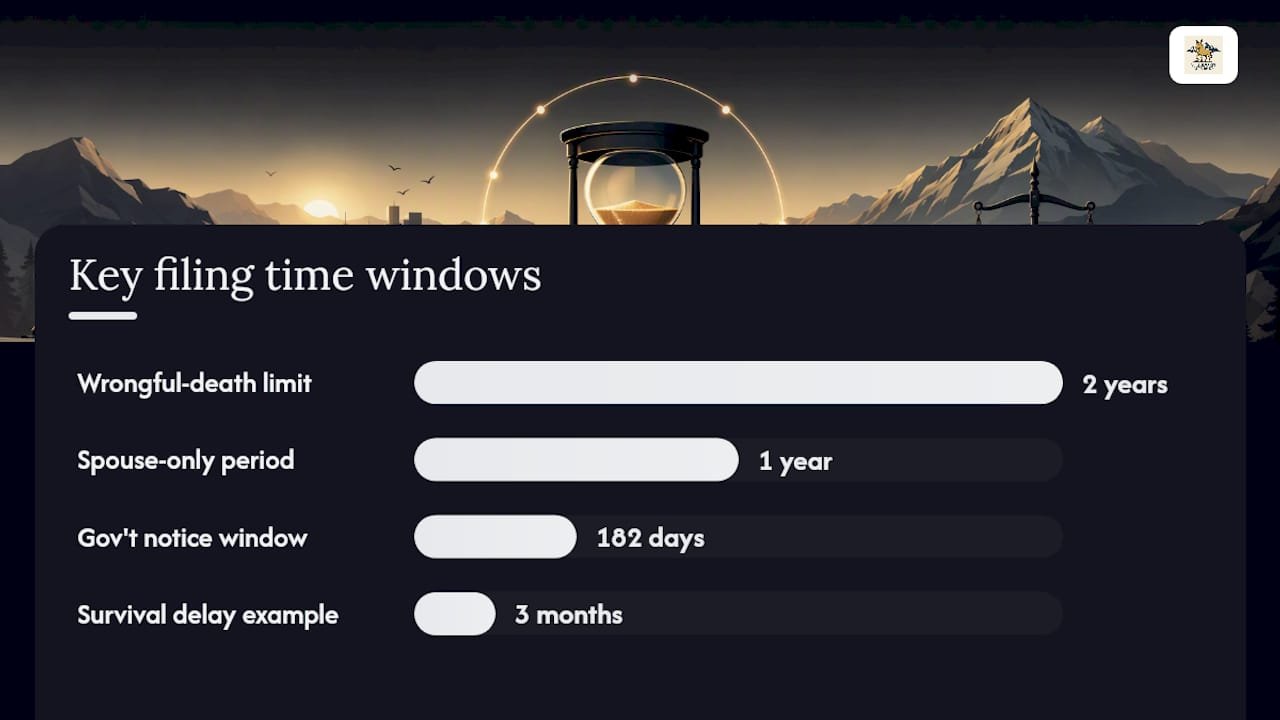
Colorado gives wrongful death claimants two years from the date of death to file suit, under C.R.S. § 13-21-204. That distinction between date of death and date of crash matters more than most people realize.
If someone survives a crash for weeks or months before dying from their injuries, the two-year clock starts on the day they die, not the day of the collision. A family dealing with a loved one on life support for three months, for example, gets those three extra months added onto their filing window compared to a family whose loved one died at the scene.
The statute also builds in a practical quirk that catches families off guard: the “Year 1, Year 2” structure tied to who holds priority to sue.
- During the first year after death, only the surviving spouse can file the claim, regardless of how the rest of the family feels about it.
- If the spouse doesn’t act within that first year, children (or, in some cases, parents) gain the right to file during year two.
- A spouse who is slow to act, unreachable, or intentionally sitting on the claim can unintentionally run down time that other family members later need.
- Waiting until close to the two-year mark to consult a lawyer leaves almost no room to correct mistakes, gather records, or negotiate with an insurer before litigation becomes the only option.
Two years is the outside limit, not a target. Cases filed with only weeks to spare are far harder to build well.
There are exceptions. Claims against a government entity, such as a municipality responsible for a dangerous intersection, require a formal notice of claim within 182 days under the Colorado Governmental Immunity Act, a much shorter window than the general two-year deadline. Legislative updates addressed in recent Colorado bill revisions also touch on procedural details that can affect notice requirements and filing mechanics, which is one more reason to get a lawyer involved early rather than relying on general online guidance. Fraudulent concealment by the at-fault party can, in narrow circumstances, toll the deadline, but this is not something to count on without legal confirmation specific to your facts. If you’re still inside the general window, reviewing Colorado’s statute of limitations for car accidents is a reasonable starting point before your consultation.
What Damages Can You Recover in a Colorado Wrongful Death Case
Colorado divides wrongful death damages into two categories, and the difference between them shapes how much a case is ultimately worth.
Economic damages cover the financial losses that came with the death itself. These include:
- Medical bills incurred before death, including hospital, ambulance, and trauma care costs
- Funeral and burial expenses
- Lost income and benefits the decedent would have earned over their working life
- Loss of household services the decedent provided, from childcare to home maintenance
Proving these losses takes documentation, not estimates. Pay stubs, tax returns, employer records, and hospital billing statements all matter. For a working parent in their 30s or 40s, an economist often calculates lost future earnings using life expectancy tables and career trajectory data, and that number frequently becomes the largest single line item in the case.
Non-economic damages compensate for grief, loss of companionship, and the emotional toll on survivors. Colorado caps these damages, and the cap adjusts periodically for inflation, so the exact figure changes year to year. There’s one major exception: if the death resulted from felony killing (murder or manslaughter), the cap on non-economic damages does not apply. That distinction has real consequences in DUI fatalities and cases involving extreme recklessness, where prosecutors pursue criminal charges alongside the civil claim.
Life-care planners, vocational experts, and economists typically build the financial model behind these numbers. For a family trying to understand what their specific losses might be worth, the firm’s page on Colorado wrongful death claims and damages breaks down how these calculations typically work, and types of personal injury compensation available to accident victims and their families walks through the broader compensation categories that can apply.
How Fault Gets Proven in a Fatal Colorado Car Crash
Winning a wrongful death case comes down to proving the at-fault driver, company, or entity was negligent, and negligence has to be shown with evidence, not assumption.
Here’s what typically needs to be gathered, and fast:
- The police crash report. This is the foundation of most cases, documenting officer observations, citations issued, and initial fault assessments. Local departments, including the Colorado Springs Police Department, maintain these records and can provide copies through formal requests.
- Scene photos and video. Skid marks, vehicle positioning, debris fields, and traffic signals all fade or get repaired within days. Dashcam and nearby surveillance footage often gets overwritten within a week or two if nobody requests it.
- Eyewitness statements. Memories fade fast. Contact information for witnesses at the scene needs to be captured immediately, not weeks later.
- Vehicle data. Modern cars store event data recorder information, sometimes called a “black box,” that can show speed, braking, and steering inputs in the seconds before impact.
- Medical and autopsy records. Hospital documentation from centers such as UCHealth Memorial Hospital Central or Penrose Hospital establishes the cause and timeline of death, which matters for both liability and the statute of limitations calculation.
- Toxicology reports. These confirm or rule out impairment on either side of the collision.
Once the evidence is collected, experts translate it into a legal argument. Accident reconstructionists analyze physical evidence to determine speed, point of impact, and driver behavior in the moments before a crash, and their reconstruction work often becomes the backbone of a liability argument when the at-fault driver disputes what happened. Medical experts connect the crash to the cause of death when that link isn’t obvious on paper. Economists then translate lost future income into a defensible dollar figure.
Most fatal crash claims rest on ordinary negligence, but some open the door to punitive damages, which exist to punish especially reckless conduct rather than just compensate the family. Drunk driving, excessive speeding in a school zone, or a commercial driver falsifying hours-of-service logs are the kinds of facts that can support a punitive claim in Colorado.
Pro Tip: Request the 911 call audio along with the police report. Dispatchers often ask callers questions that reveal details never written into the official report, and that audio can be requested and preserved for months longer than some video footage.
Wrongful Death Claims vs. Survival Actions: Why the Difference Matters
A wrongful death claim and a survival action are not the same thing, and Colorado law treats them differently.
A wrongful death claim belongs to the surviving family. It compensates spouses, children, or parents for their own losses, grief, lost companionship, and financial support the decedent would have provided.
A survival action, by contrast, belongs to the decedent’s estate. It covers claims the deceased person could have brought had they lived, most commonly pain and suffering endured between the crash and death, along with medical expenses paid before death.
- Wrongful death damages go to the surviving family members with legal standing.
- Survival action recovery goes into the decedent’s estate and gets distributed according to a will or Colorado’s intestacy laws.
- The two actions can be filed together in the same lawsuit, and often are, since they draw on much of the same evidence.
- Settlement negotiations frequently allocate a portion of any recovery to each claim, which affects how the total payout gets divided among the estate and individual survivors.
Filing both isn’t redundant. It’s how families and estates recover the full range of losses tied to a single fatal crash, from the decedent’s own suffering to the survivors’ ongoing loss.
What to Expect From the Insurance and Settlement Process
Insurance companies don’t treat wrongful death claims like routine property damage disputes. The stakes are higher, and so is the resistance.
Expect early settlement offers to come in low, sometimes dramatically so, particularly if the family hasn’t retained an attorney yet. Adjusters know that grieving families often want the process over quickly, and delay tactics, slow-walking document requests or repeatedly asking for “just one more form,” are common enough that they shouldn’t surprise anyone.
The process generally unfolds in stages:
- Investigation and demand letter. Once liability and damages are documented, the claimant’s attorney sends a formal demand outlining the case value.
- Insurer valuation. The insurance company reviews the claim and typically counters with a lower figure, sometimes far lower.
- Negotiation. Multiple rounds of back and forth follow, often over weeks or months, as both sides adjust based on new documentation or expert reports.
- Mediation. A neutral third party helps both sides reach a resolution without going to trial, and many wrongful death claims settle at this stage.
- Release and payment issues. Once a settlement is reached, the release language matters, particularly around how funds are allocated between survival and wrongful death claims.
Litigation becomes the right path when the insurer’s offer doesn’t come close to covering documented losses, when liability is genuinely disputed, when damages are complex enough that a jury’s judgment carries more weight than an adjuster’s spreadsheet, or when the facts support pursuing punitive damages that an insurance settlement alone can’t capture. Filing a lawsuit doesn’t mean the case is guaranteed to go to trial. It often moves the insurer to negotiate more seriously once they see the family is prepared to litigate.
Choosing a Wrongful Death Attorney in Colorado: What to Ask First
Not every personal injury attorney has real wrongful death trial experience, and that distinction matters more here than in almost any other type of case.
At a consultation, ask directly:
- How many wrongful death cases has this attorney handled, specifically involving fatal car crashes?
- What’s their trial record, not just their settlement record? Insurers negotiate differently with attorneys known to actually try cases.
- Who does the day-to-day work on the file, the attorney you’re meeting or a team you’ll rarely speak with?
- How are experts (reconstructionists, economists, medical specialists) selected and paid for?
- What’s the realistic timeline for a case like this, given the specific facts?
Nearly every wrongful death attorney in Colorado works on contingency, meaning the family pays nothing upfront and the firm only gets paid if there’s a recovery. Case expenses (expert witness fees, filing costs, record requests) are typically advanced by the firm and repaid out of any settlement or verdict. Get this arrangement in writing before signing anything.
Pro Tip: Ask how the firm handles cases where liability is contested by the at-fault driver’s estate or insurer. The answer reveals whether they’re built for a negotiated settlement or an actual courtroom fight, and you want to know which one you’re getting before you sign a retainer agreement.
Red flags include vague answers about trial experience, pressure to settle quickly without a full damages workup, and reluctance to explain how fees and costs are handled. A checklist for protecting your rights after a fatal crash can help you walk into that first meeting prepared with the right questions.
Why Ryan Malnar’s Background Matters in a Case Like This
Ryan Malnar has spent over a decade representing injury victims across Colorado, and before that, worked as a federal claims adjudicator and adjuster. That background gives him a working knowledge of exactly how insurance companies, and government agencies, build their internal case files and decide what to offer.
Malnar Injury Law, now operating as Stubbornattorney, has settled hundreds of injury cases and recovered millions in compensation for Colorado families. The firm’s approach, what it calls the Mule Standard, treats steadiness under pressure and a refusal to back down as operating principles, not marketing language. Ryan’s Colorado Bar membership is publicly verifiable, and readers can review his background directly before deciding who should handle a case this consequential.
What Actually Matters in the First Days After a Fatal Crash
The families who come through this process with the strongest cases are almost never the ones who moved fastest on a settlement. They’re the ones who moved fastest on documentation, deadlines, and getting an attorney involved before the insurance company set the terms of the conversation.
Autopsy records, medical charts, and the police report need to be requested early, before they age out of easy access. And no family should sign anything from an insurer in the first weeks after a death without a lawyer reviewing it first. A quick settlement offer almost always undervalues what a case is actually worth.
Grief doesn’t pause for paperwork, and nobody should expect it to. But the legal deadlines don’t pause either, and that tension is exactly why getting professional guidance early matters more here than in almost any other kind of injury claim.
— Ryan
How Stubbornattorney Can Help After a Fatal Crash
Stubbornattorney represents Colorado families through every stage of a wrongful death claim on contingency, which means no fees unless there’s a recovery. That structure matters most right when a family can least afford legal bills on top of a funeral and lost income.
The firm’s approach starts with an investigation built to withstand insurer pushback: securing police and medical records, bringing in accident reconstructionists and economists when the facts call for it, and preparing every case as though it could go to trial, because that preparation is what actually moves insurance companies toward fair settlements. Ryan Malnar’s background as a former federal claims adjudicator shapes how the firm anticipates insurer tactics before they happen.
If you’ve lost a family member in a Colorado car crash, the next step is a free case evaluation to review your standing, the deadline that applies to your situation, and what evidence needs to be preserved right now. Bring the police report if you have it, and don’t sign anything from an insurer until that conversation happens.
This article is general information, not a substitute for advice from a qualified lawyer. Consult a qualified legal professional about your own circumstances before acting on anything here.
Sources
- 2024a_1472 (signed) — Colorado legislative PDF
- 2024a_1472_rev — Colorado legislative bill revision document
- Colorado Bar (COBAR) member profile
- Colorado Springs Police Department
FAQ
What Are the Laws Regarding Wrongful Death in Colorado?
Colorado law, under C.R.S. § 13-21-204, gives a surviving spouse the exclusive right to file during the first year after death, with children or parents gaining standing in year two if the spouse doesn’t act. The filing deadline is two years from the date of death, and non-economic damages are capped except in cases involving murder or manslaughter.
What Is the Average Settlement for Wrongful Death?
Settlement amounts vary widely based on the decedent’s income, age, medical expenses, and whether liability is contested, so there’s no single reliable average figure. A case involving a young working parent with clear liability typically resolves for a substantially higher amount than one involving disputed fault or an older, retired decedent with no dependents.
What Happens if the Person at Fault Dies in a Car Accident?
A civil wrongful death claim can still move forward against the at-fault driver’s estate, even after that driver has died. The estate’s assets and any applicable insurance coverage remain the source of potential compensation, though the estate’s personal representative becomes the defendant in place of the deceased driver.
Does Colorado Have a No-Fault Car Accident Law?
No. Colorado is an at-fault state, meaning the driver responsible for causing a crash is legally liable for the resulting damages, including wrongful death claims. This differs from no-fault states, where each driver’s own insurance covers their losses regardless of who caused the collision.