

Attorney Evidence Plan: Win Colorado Insurance Bad Faith Claims
Yes, you can sue an insurer for bad faith in Colorado. Statutory claims under C.R.S. 10-3-1115 and 10-3-1116 let you recover two times the covered benefit plus attorney fees, and require a lower proof standard. Common-law bad faith claims demand tougher proof (the insurer knew or recklessly disregarded its own unreasonableness) but can open the door to exemplary damages. One catch: if your coverage comes through an employer-sponsored ERISA plan, federal law may limit or replace these state remedies entirely.
Table of Contents
- What Does Insurance Bad Faith Mean Under Colorado Law?
- Statutory vs. Common-Law Bad Faith: Which Applies to You?
- Warning Signs Your Insurer Is Acting in Bad Faith
- How Do You File a Bad Faith Claim in Colorado?
- What Does an Attorney Actually Do in a Bad Faith Case?
- When Should You File a Colorado Division of Insurance Complaint?
- Attorney Perspective: What to Look For Before Hiring Counsel
- Auto, Home, Health, and Business Claims Handle Bad Faith Differently
- How Do You Negotiate a Bad Faith Settlement?
- Does It Matter if You’re the Policyholder or a Third Party?
- A Note From StubbornAttorney
- How StubbornAttorney Handles Colorado Insurance Bad Faith Claims
- Sources
- FAQ
What Does Insurance Bad Faith Mean Under Colorado Law?
Insurance bad faith happens when an insurer breaks its duty to handle your claim fairly and honestly. Colorado law spells this out in C.R.S. §10-3-1104, which lists specific practices classified as unfair claim settlement tactics, including misrepresenting policy terms, failing to properly investigate a claim, and dragging out a decision without justification.
That duty covers more than just cutting a check. Insurers owe you a fair investigation, honest communication about what your policy covers, and a decision made in a reasonable timeframe. Colorado regulation generally requires insurers to decide and pay a valid, complete claim within 60 days. Miss that window without a good reason, and you’re already looking at the “unreasonable delay or denial” standard that anchors most statutory bad faith claims.
The insurer doesn’t have to be right to avoid liability. It has to be reasonable. That distinction is where most disputes actually get decided.
Statutory vs. Common-Law Bad Faith: Which Applies to You?
Colorado gives policyholders two separate paths to hold an insurer accountable, and they don’t require the same proof or pay out the same way.
- Statutory claims under C.R.S. 10-3-1116 apply when an insurer unreasonably delays or denies payment of covered benefits. You don’t have to prove the insurer acted maliciously, just that the delay or denial was unreasonable. Win, and you’re entitled to two times the covered benefit plus reasonable attorney fees and costs.
- Common-law bad faith demands more. Colorado’s Chapter 25 jury instructions explain that you must show the insurer knew, or recklessly disregarded, the fact that its conduct was unreasonable. That’s a steeper climb, but it opens the door to broader tort damages, including exemplary damages in especially egregious cases.
Both paths can apply to the same set of facts, and attorneys often pursue them together. One wrinkle worth knowing upfront: if your health coverage comes through an employer group plan governed by ERISA, federal preemption frequently blocks these state-law remedies and shifts you into a different, more limited federal framework. That’s worth flagging to a lawyer early, before you build a case around remedies that might not apply.
Warning Signs Your Insurer Is Acting in Bad Faith
Bad faith rarely announces itself. It shows up in patterns.
- Payment or a decision drags well past the 60-day mark with no clear explanation.
- The adjuster never orders an inspection, never talks to witnesses, or ignores evidence you submitted.
- You’re told your policy doesn’t cover something it clearly does, or key language gets twisted.
- Settlement offers come in far below what your damages, medical bills, or repair estimates actually support.
- The insurer keeps demanding paperwork you already sent, or invents new requirements to stall.
Watch for denial letters that repeat the same vague boilerplate without addressing your specific facts, or a claim file with dates that don’t add up. Insurers do have one legitimate defense: if the claim’s value was genuinely “fairly debatable” based on conflicting evidence, a denial or lowball offer isn’t automatically bad faith. The line between a hard-nosed but lawful denial and an unreasonable one usually comes down to whether the insurer actually looked at the facts before deciding.
Pro Tip: Keep a simple log every time you talk to your adjuster: date, name, what was said. That log becomes some of the most persuasive evidence if the claim turns into a dispute later.
How Do You File a Bad Faith Claim in Colorado?
- Preserve everything now. Save every email, letter, and text from your insurer. Record the date, time, and name of anyone you speak with by phone, and request a written copy of your policy if you don’t already have one.
- Request the insurer’s claim file. This internal record often contains adjuster notes, investigator reports, and internal communications that reveal whether the company actually investigated your claim in good faith.
- Consider a Colorado Division of Insurance complaint. It’s free, and it puts your dispute on the state’s radar, though it won’t award you money directly.
- Send a formal demand letter. This puts the insurer on notice and often triggers a serious settlement conversation before litigation even starts.
- File suit if necessary. Once litigation begins, discovery tools like depositions and subpoenas can pull loose the internal records an insurer wouldn’t hand over voluntarily.
- Track your deadlines. Colorado generally applies a two-year statute of limitations to bad faith tort claims, so don’t sit on evidence, and see this firm’s guide to Colorado injury claim deadlines for related timing rules.
If your coverage runs through an ERISA plan, the process above may not apply. Ask a lawyer early which track you’re actually on.
What Does an Attorney Actually Do in a Bad Faith Case?
Most personal injury and bad faith attorneys in Colorado work on contingency, meaning you owe nothing upfront and pay only out of a recovery. That fee structure matters more here than in most disputes, because C.R.S. 10-3-1116’s attorney-fee provision often makes smaller claims economically worth pursuing that wouldn’t otherwise justify the cost of litigation.
An attorney’s real value shows up in the digging: depositions of adjusters, subpoenas for internal claim notes, and expert reports on what a claim was actually worth. If your insurer’s file shows inconsistent reasoning or missed deadlines, that’s usually the signal a case is worth litigating rather than settling quietly.
When Should You File a Colorado Division of Insurance Complaint?
Filing with the Colorado Division of Insurance makes sense when you want a regulator to review the insurer’s conduct, even though the DOI can’t hand you a settlement check. The agency investigates patterns of unfair practices and can issue fines, but those penalties go to the state, not the claimant.
Where it helps most is as leverage: a DOI file full of documented insurer misconduct can become useful evidence if you later pursue a private lawsuit for damages.
Attorney Perspective: What to Look For Before Hiring Counsel
With over a decade practicing law and prior experience as a federal claims adjudicator, Ryan Malnar looks past the denial letter itself and straight to the insurer’s internal notes, investigator reports, and time logs between claim milestones. Those records usually show whether the company actually did its job or just went through the motions.
At a free consultation, ask what specific evidence supports “unreasonable” delay in your case, and treat missed statutory deadlines or contradictory denial reasons as red flags that justify calling a lawyer immediately, not later.
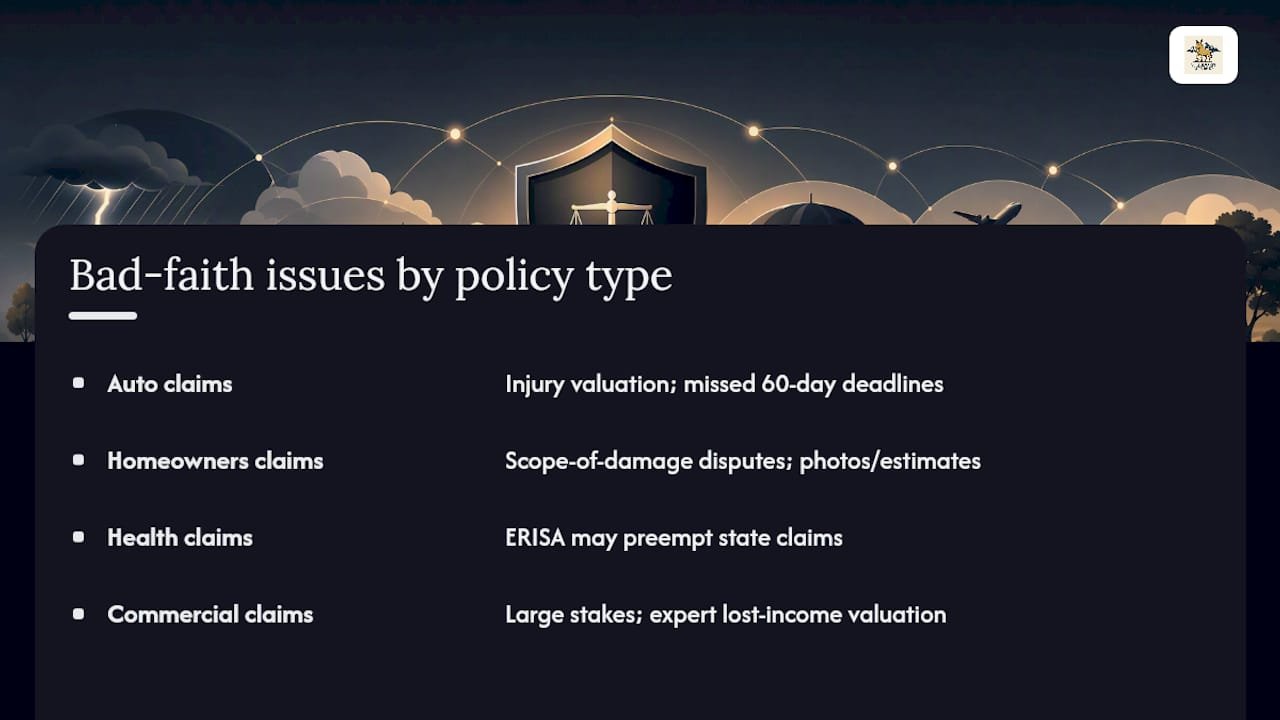
Auto, Home, Health, and Business Claims Handle Bad Faith Differently
The bad faith framework stays the same across policy types, but how it plays out on the ground shifts depending on what you’re insured for.
Auto claims frequently turn into disputes over injury valuation after a crash. Insurers lowball medical costs or argue an injury wasn’t caused by the accident, and because auto claims move fast, missed 60-day deadlines are common evidence.
Homeowners claims often involve disputes over the scope of damage, especially after storms or fires. Insurers sometimes send an adjuster who inspects quickly and undervalues the loss, or disputes whether damage was pre-existing. Documentation like photos, contractor estimates, and repair invoices carries heavy weight here.

Health insurance claims raise the ERISA question immediately. If your coverage is through an employer group plan, federal law may preempt Colorado’s statutory bad faith remedies, redirecting your case into a different legal framework with different deadlines and different available damages. Individual health policies purchased outside an employer plan generally stay under state bad faith law.
Commercial and business claims tend to involve larger dollar amounts and more sophisticated insurer defense, including business interruption disputes where insurers argue over causation or duration of the loss. These cases often need expert testimony on lost income or property valuation, which raises the stakes for hiring counsel early rather than negotiating solo.
Knowing which category your claim falls into shapes both your evidence strategy and which remedies are realistically on the table.
How Do You Negotiate a Bad Faith Settlement?
Negotiating with an insurer that’s already acted in bad faith requires a different posture than a normal claim negotiation. You’re not just asking for what the policy owes. You’re building leverage around the fact that the insurer broke its own duty.
Start by quantifying the full exposure: the covered benefit itself, the potential statutory doubling under C.R.S. 10-3-1116, and the attorney fees the insurer would owe if the case went to judgment. Insurers run these numbers internally too, and a demand letter that lays out that math clearly often moves negotiations faster than an emotional appeal.
Timing matters just as much as the numbers. Insurers tend to get more serious about settling once litigation has actually started and discovery requests are pending, because that’s when internal claim notes and investigator reports become discoverable. A demand sent before any documentation is secured carries less weight than one sent after you’ve already requested the claim file.
Avoid accepting a quick, informal offer meant to close the file before you’ve assessed the full value of your claim. Lowball settlement offers issued early in a dispute are themselves sometimes evidence of bad faith, particularly if they arrive before any real investigation happened.
Where the case involves genuine factual disputes (competing damage estimates, contested causation), mediation before formal suit can resolve things faster and cheaper than trial. But that only works when both sides have exchanged real documentation. Negotiating blind, without the claim file or a clear damages figure, almost always favors the insurer.
Does It Matter if You’re the Policyholder or a Third Party?
This distinction changes what remedies are actually available to you. A first-party claim is between you and your own insurer, over your own policy, for your own loss (your car, your house, your health claim). Colorado’s statutory bad faith remedies under C.R.S. 10-3-1115 and 10-3-1116 generally apply to first-party disputes.
A third-party claim looks different. If you were injured by someone else’s negligence, you’re not the insurer’s own policyholder. You’re a claimant against the at-fault party’s insurance. Colorado courts have historically limited direct statutory bad faith claims against a third-party insurer, since the contractual duty of good faith runs to the insurer’s own policyholder, not to outside claimants.
That doesn’t leave third-party claimants without leverage. If an at-fault party’s insurer acts unreasonably (lowballing a legitimate claim, dragging out negotiations without cause), that conduct can expose the insurer to liability through the policyholder, since an insurer that mishandles a third-party claim can end up owing its own insured for any judgment above policy limits. Practically, this means third-party disputes often get resolved through pressure on the at-fault party’s insurer to settle within limits, rather than a direct bad faith suit filed by the injured claimant.
Knowing which category you’re in early changes how a case gets built, and it’s one of the first questions worth raising with counsel.
A Note From StubbornAttorney
We’ve built our name on not backing down, and that’s exactly the mindset it takes to go up against an insurance company that’s stalling or lowballing your claim. If something about your insurer’s handling of your case feels off, reach out for a free case review. We’ll tell you straight whether you have a fight worth having.
— Ryan
How StubbornAttorney Handles Colorado Insurance Bad Faith Claims
Going up against an insurance company alone almost always ends with a smaller check than you deserve. Stubbornattorney represents Colorado policyholders on contingency, meaning there’s no fee unless we recover money for you, and a free case review costs nothing to find out where you stand.
In an initial review, the firm looks at your claim file, denial letters, and the timeline of your insurer’s response to spot exactly the kind of unreasonable delay or misrepresentation that supports a statutory or common-law claim. Ryan Malnar’s background as a former federal claims adjudicator means he already knows the internal playbook insurers use to justify a denial, and how to pick it apart.
Start with a free case review to find out whether your insurer crossed the line.
Sources
- C.R.S. 10-3-1116 — Remedies for unreasonable delay or denial (Justia)
- 3 CCR 702-5-1-14-4 (Colorado regulation) via Cornell
This article is general information, not a substitute for advice from a qualified lawyer. Consult a qualified legal professional about your own circumstances before acting on anything here.
FAQ
Which Insurance Companies Get the Most Complaints in Colorado?
The Colorado Division of Insurance tracks consumer complaints by company, but complaint volume alone doesn’t prove bad faith. It’s better used as one data point when researching a specific insurer’s claims-handling history.
Can I Sue My Insurance Company for Bad Faith in Colorado?
Yes. Colorado allows both statutory bad faith claims under C.R.S. 10-3-1115/1116 and common-law bad faith claims, each with different proof standards and remedies.
Is It Illegal for an Insurance Company to Negotiate in Bad Faith?
Yes. Colorado law treats unreasonable delay, denial, or unfair claim tactics as violations that can trigger civil liability, including statutory penalties and attorney fees.
How Much Is a Bad Faith Insurance Claim Worth in Colorado?
Statutory claims can recover two times the covered benefit plus attorney fees and costs, while common-law claims may add exemplary damages depending on the severity of the insurer’s conduct. The exact value depends heavily on your policy limits and the specific facts of your denial.
What’s the Difference Between a First-Party and Third-Party Bad Faith Claim?
A first-party claim involves your own insurer and your own policy, and it’s the main route for statutory bad faith remedies. A third-party claim involves someone else’s insurer and generally works through pressure on that insurer via its own policyholder rather than a direct statutory bad faith suit.