


How to Avoid Claim Mistakes: Colorado Injury Guide
The single most important thing you can do after an injury in Colorado is act fast and say little. Seek medical care within 24 hours, call police to the scene, photograph everything, collect witness names and numbers, verify your insurance information, and do not give a recorded statement to any adjuster until you have spoken with a lawyer. Here is the immediate checklist:
- Get medical care now. Even if you feel fine, see a doctor within 24 hours. Gaps in treatment are the first thing insurers use against you.
- Call police. A police report creates an official record that is hard to dispute later.
- Photograph the scene, vehicles, injuries, and road conditions before anything moves or gets cleaned up.
- Collect witness names and phone numbers on the spot.
- Scan or photograph your insurance card and the other driver’s card.
- Ask the adjuster only for a claim number. Nothing more.
- Decline any recorded statement until you have consulted a Colorado personal injury attorney.
- Stay off social media entirely until your claim is resolved.
Early contact with a lawyer preserves evidence and appeal rights. Stubbornattorney offers free case evaluations for injured Colorado victims.
Table of Contents
- How to avoid claim mistakes before they cost you money
- Top claim mistakes injured people make and how to fix each one
- Your post-injury checklist and timeline
- What to do if your claim is denied
- When should you call a Colorado personal injury lawyer?
- How Ryan Malnar’s claims experience protects your case
- Why claim preservation is the foundation of client care
- Stubbornattorney is the Colorado injury firm that fights from day one
- Useful sources for Colorado injury claim research
- FAQ
How to avoid claim mistakes before they cost you money
Small errors compound fast. A missed deadline can wipe out your right to appeal. An offhand comment to an adjuster can become a written record used to cut your settlement. Incomplete medical notes can cause a payer to treat a service as if it never happened, because payers treat undocumented services as services not performed.
The financial stakes are real. 69% of providers using AI in claims management reported measurable reductions in claim denials, which tells you how preventable most errors are with the right systems in place. For injured victims, the parallel is direct: the same categories of mistakes that sink medical billing claims also sink personal injury claims.
The downstream impacts stack up quickly:
- Lost appeal windows once a deadline passes, the claim may be unrecoverable.
- Underpayments that never show up in a denial report because the claim technically “paid.”
- Rework costs in time, documentation, and legal fees that dwarf the original error.
Understanding why insurance denies claims is the first step toward preventing it.
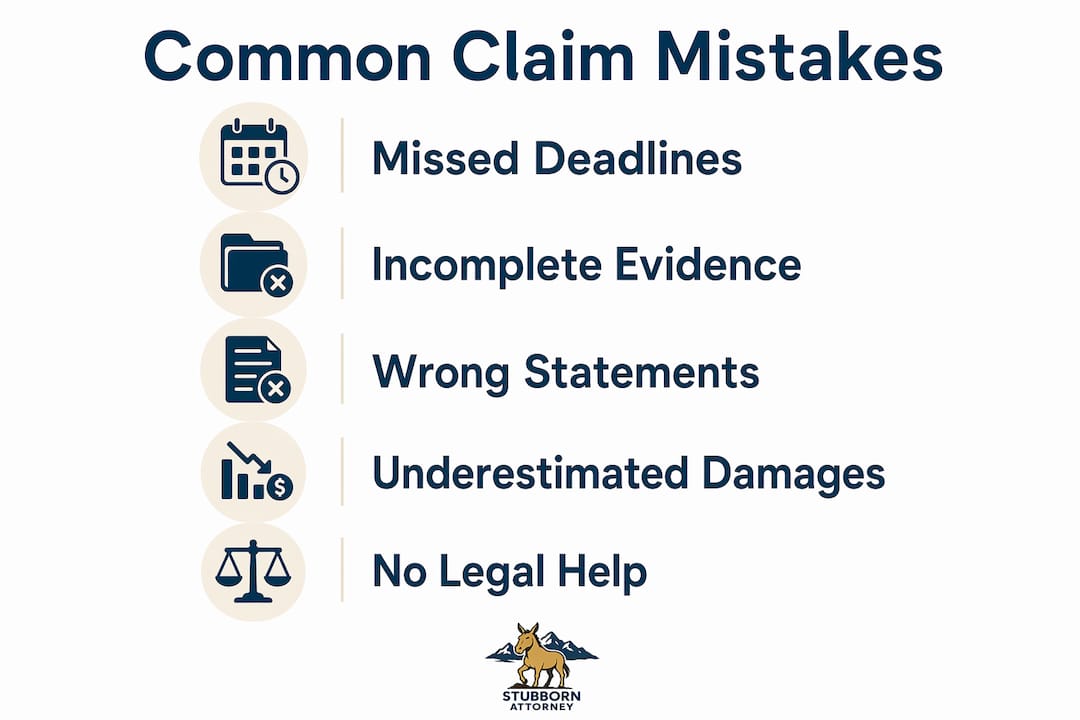
Top claim mistakes injured people make and how to fix each one
The most preventable denial causes cluster around documentation gaps, timing failures, and communication errors. Here are the ones that hurt Colorado injury victims most:
-
Incomplete or missing documentation. Vague medical notes kill claims. Ask your provider to document the specific mechanism of injury, every symptom, and why each treatment was medically necessary. A note that says “patient reports back pain” is far weaker than one that ties the pain directly to the accident.
-
Delayed medical care. Waiting days or weeks to see a doctor gives insurers a gap to exploit. They argue the injury was not serious or was caused by something else.
-
Failing to preserve physical evidence. Skid marks fade. Vehicles get repaired. Surveillance footage gets overwritten in 72 hours. Photograph and request everything immediately.
-
Wrong or incomplete insurer and policy information. Front-end errors in demographics and coverage account for roughly 30–40% of denials. Confirm the at-fault party’s insurer, policy number, and coverage limits before filing anything.
-
Giving a recorded statement too early. Adjusters are trained to ask open-ended questions. Anything you say gets locked in. Decline until you have legal counsel.
-
Social media activity. A single photo of you at a barbecue can be used to argue your injuries are exaggerated. Lock all accounts and post nothing.
-
Missed deadlines. Colorado’s statute of limitations for most personal injury claims is three years from the date of injury. Miss it and you lose your right to sue, period. Key Colorado claim deadlines vary by case type.
-
Misrepresenting or exaggerating injuries. Overstating damages is not just ethically wrong; it destroys credibility with adjusters and juries alike. Stick to documented facts.
-
Accepting a lowball first offer. First settlement offers rarely reflect full damages. Once you sign a release, you cannot go back.
Pro Tip: After any payment arrives, compare what you expected to receive against what actually came. This expected-versus-received analysis catches hidden underpayments that a simple “paid” status will never reveal.
Your post-injury checklist and timeline

| Timeframe | Actions to Take |
|---|---|
| First 24 hours | Medical visit, police report, scene photos, witness contacts |
| 24–72 hours | Request surveillance footage, notify your insurer of the accident |
| First two weeks | Follow all treatment plans, collect all medical records and bills |
| First 30 days | Confirm at-fault insurer’s policy limits, document lost wages |
| 30 days | Track all denial notices, consult a lawyer if insurer delays or denies |
What to say when notifying your insurer:
- “I am calling to report an accident that occurred on [date] at [location].”
- “I am not prepared to give a recorded statement at this time.”
- “Please provide me with the claim number and the adjuster’s direct contact.”
What to bring to your first lawyer consultation:
- Police report and accident photos
- All medical records and bills to date
- Your insurance card and the other party’s information
- Any insurer correspondence or denial letters
HFMA recommends resolving denials within a month to preserve appeal rights. If you receive a denial, do not wait.
A detailed car accident claim checklist covers additional documentation steps worth reviewing.
What to do if your claim is denied
Stop, gather, and rework before the appeal window closes. Beyond that window, the claim may be permanently unrecoverable.
- Read the denial letter carefully. Identify the exact reason code. Common reasons include missing documentation, coverage disputes, or late filing.
- Pull all supporting records. Medical notes, authorization evidence, and proof of timely filing.
- Submit a corrected claim or formal appeal with a cover letter that addresses the denial reason point by point.
- Track the payer-specific deadline. Each insurer has its own appeal window. Missing it ends your options.
- Escalate to legal counsel if the denial involves disputed liability, bad faith delay, or a coverage interpretation you cannot resolve alone.
Documents every appeal needs:
- Medical records that explicitly state medical necessity
- Prior authorization approvals (if applicable)
- Proof of timely filing (submission timestamps, certified mail receipts)
- A written timeline of all insurer communications
Tools like Traced can help preserve digital evidence and document claim timelines, which matters when you need to prove timely filing or reconstruct a communication record.
When should you call a Colorado personal injury lawyer?
Call a lawyer when any of the following apply:
- Your injuries required emergency care, hospitalization, or ongoing treatment
- The insurer disputes who was at fault
- You received a denial or a settlement offer that does not cover your medical bills
- You are losing wages and cannot return to work
- The insurer is delaying without explanation
- You are approaching the three-year Colorado statute of limitations
Legal representation in car accident claims matters most when insurers have legal teams and you do not. A personal injury lawyer handles evidence gathering, insurer negotiation, expected-versus-received payment analysis, appeal work, and litigation when needed. Stubbornattorney works on a contingency fee basis, meaning you pay nothing unless there is a recovery.
Pro Tip: Early lawyer involvement preserves evidence before it disappears and stops the clock on appeal windows you may not know are running.
How Ryan Malnar’s claims experience protects your case
Ryan Malnar spent years as a federal claims adjudicator before building a personal injury practice in Colorado Springs, recognized locally by KRDO and KKTV 11. That background shapes how Stubbornattorney approaches every case from day one.
Specific ways that inside knowledge protects clients:
- Anticipating documentation scrutiny. Ryan knows that payers treat any service not explicitly documented as a service not performed. The firm pushes providers to write notes that tie every treatment directly to the accident.
- Front-loading authorization evidence. Prior authorization gaps are a leading driver of denials. Stubbornattorney tracks authorization status from intake, not after a denial arrives.
- Catching underpayments. Most clients only notice when a claim is denied. Ryan’s team runs expected-versus-received analysis on every payment to catch the underpayments that never generate a denial letter.
The firm has settled hundreds of injury cases and recovered millions of dollars for Colorado clients, covering car, truck, motorcycle, pedestrian, bicycle, and slip and fall accidents.
Why claim preservation is the foundation of client care
Every client who walks through our door is already dealing with pain, medical bills, and uncertainty. The last thing they need is to lose compensation because of a paperwork error or a missed deadline. Protecting a claim from the first phone call is not a procedural nicety; it is the difference between a fair recovery and a write-off. Colorado clients deserve an attorney who treats their case with the same stubbornness a mule brings to a mountain trail. If you need help preserving your claim, reach out.
Stubbornattorney is the Colorado injury firm that fights from day one
When you are injured in Colorado and the insurer is already working against you, you need a lawyer who has been on both sides of the table. Stubbornattorney handles personal injury cases across Colorado, including car, truck, motorcycle, pedestrian, bicycle, and slip and fall accidents, on a contingency fee basis. No upfront legal fees. No payment unless you recover.
What to bring to your free consultation: police report, accident photos, medical records and bills, insurer correspondence, and your insurance card. Schedule your free case evaluation at Stubbornattorney.com and find out exactly what your claim is worth.
Useful sources for Colorado injury claim research
- Maryland Department of Health billing guidance on documentation standards
- MD Revenue Group: How to Reduce Claim Denials
- Experian Health: 7 Reasons for Claims Errors
- HFMA guidance on denial resolution timelines
Colorado-specific deadlines and statutes vary by case type. Confirm your filing windows with a Colorado attorney. The links above are reference material; they do not replace case-specific legal advice.
FAQ
What is the statute of limitations for injury claims in Colorado?
Most personal injury claims in Colorado must be filed within three years of the date of injury. Missing this deadline eliminates your right to sue.
What should I never say to an insurance adjuster?
Never give a recorded statement, admit fault, speculate about your injuries, or accept a settlement offer without legal review. Ask only for the claim number and the adjuster’s contact information.
How do I know if my claim was underpaid?
Compare the amount you expected to receive against what the insurer actually paid. This expected-versus-received analysis often reveals underpayments that a simple “paid” status never flags.
When should I appeal a denied claim?
Appeal immediately after receiving a denial letter. HFMA recommends resolving denials within a month to preserve appeal rights; beyond the payer-specific window, the claim may become unrecoverable.
Can Stubbornattorney help if my claim was already denied?
Yes. Stubbornattorney reviews denied claims, identifies the denial reason, and builds appeals or pursues litigation when warranted, all on a contingency fee basis with no upfront cost to you.