
How to Get an Accident Police Report Fast
An accident police report is the official document a law enforcement officer creates at the scene of a car crash, recording fault indicators, witness statements, and vehicle damage details. Knowing how to get an accident police report quickly is the single most important step you can take after a collision, because insurers and attorneys both rely on it to evaluate your claim. Most reports become available within 5–14 days and cost between $5 and $25 depending on your state and the method you choose. State agencies like the Department of Motor Vehicles, Departments of Public Safety, and local police departments all serve as official custodians of these records. Getting your copy from the right source, fast, protects your claim from the start.
How to get an accident police report: what you need first
Before you submit any request, gather the right information. Missing even one detail can delay your retrieval by days or weeks.
The most critical piece of information is your crash report number, sometimes called the incident number or case number. The responding officer typically gives you this at the scene or includes it on a business card. If you did not receive it, check your copy of the driver exchange form or contact the responding agency directly.
You will also need the following:
- Date, time, and exact location of the accident
- Full legal name of all drivers involved
- Driver’s license number and vehicle plate numbers
- Name of the responding law enforcement agency (city police, county sheriff, or state patrol)
- Your government-issued photo ID (driver’s license or state ID)
- Proof of involvement such as your insurance card or vehicle registration
The table below shows the most common documents required and why each one matters.
| Document | Purpose |
|---|---|
| Crash report number | Locates your specific report in the agency’s system |
| Government-issued photo ID | Verifies your identity as an involved party |
| Insurance card or registration | Confirms your connection to the accident |
| Date and location of crash | Narrows the search when no report number is available |
| Driver’s license number | Cross-references records in state DMV databases |
Knowing which agency responded is critical. A crash on a state highway may involve the Colorado State Patrol, while a city intersection crash falls under the local police department. If you are unsure, call your local non-emergency police line and provide the date and location. They will direct you to the correct agency.
Pro Tip: Write down the responding officer’s name and badge number at the scene. This makes it far easier to track down the report later, especially in large jurisdictions with multiple precincts.
What are the best methods to request your accident report?
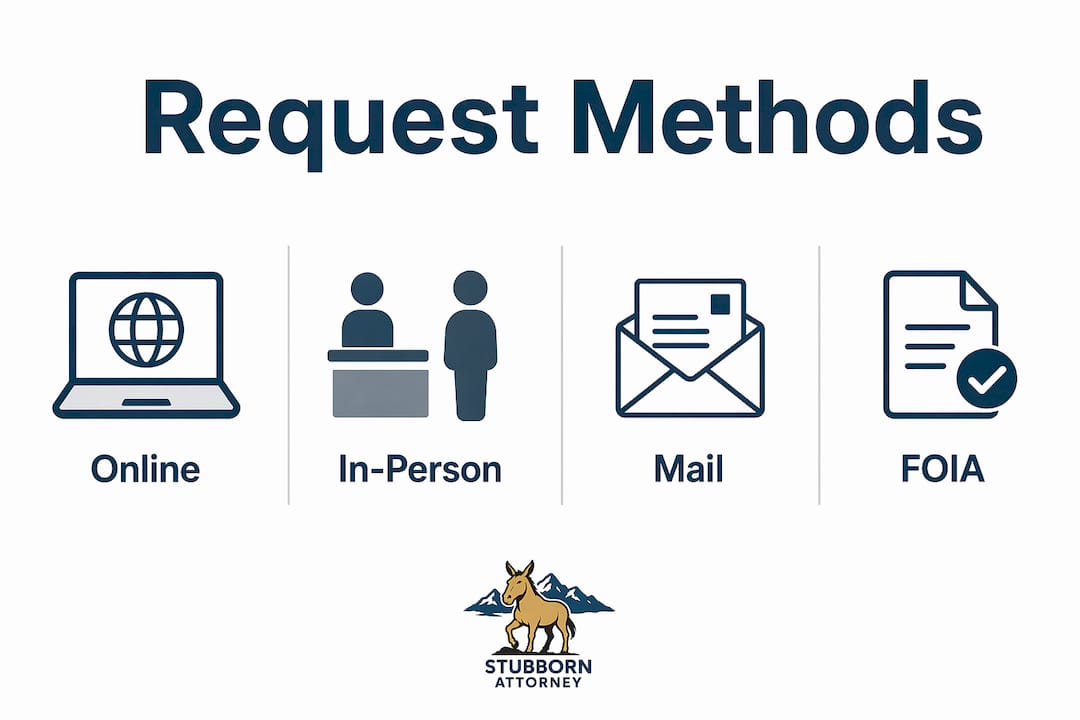
There are four main ways to obtain your report: online, in person, by mail, and through a Freedom of Information Act (FOIA) or public records request. Each method has a different cost, speed, and level of effort.
1. Online portal request
Most state DMV websites and many local police department websites now offer online report retrieval. You enter your crash report number, name, and date of accident, pay a small fee, and download the document. Official state and local sources are almost always cheaper than third-party “buy-a-report” websites, which add unnecessary fees on top of the base cost.
2. In-person request
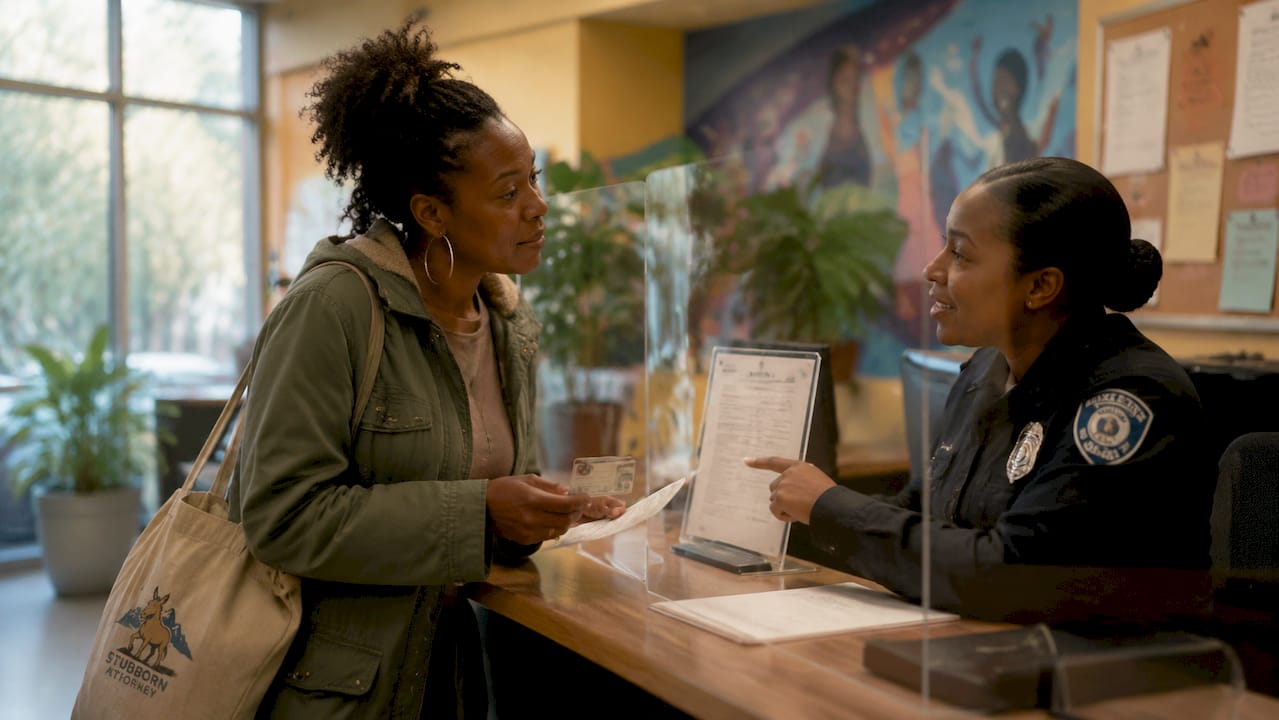
Visit the records division of the law enforcement agency that responded to your crash. Bring your photo ID and any identifying details about the accident. In-person requests are often processed the same day if the report is already filed. This method works best when you need the report urgently or want to ask questions about its contents on the spot.
3. Mail request
Some agencies, particularly county sheriffs and state patrol offices, accept written requests by mail. You typically send a completed request form, a copy of your ID, and a check or money order for the fee. Processing times by mail run longer, often 2–3 weeks, so use this method only when online or in-person options are unavailable.
4. FOIA or public records request
FOIA requests can be free but involve longer processing times, typically 5–21 business days, and require a formal written request citing the relevant state statute. This route works well if you want to waive fees or if the agency has not responded to standard requests. Every state has its own public records law, so look up your state’s specific statute before filing.
The table below compares the four methods at a glance.
| Method | Typical cost | Typical wait time | Best for |
|---|---|---|---|
| Online portal | $5–$25 | 5–14 days | Speed and convenience |
| In person | $5–$25 | Same day to 3 days | Urgent needs |
| $5–$25 | 2–3 weeks | Rural or limited-access agencies | |
| FOIA/public records | Free to low cost | 5–21 business days | Fee waivers, unresponsive agencies |
Pro Tip: Always check the official law enforcement agency website or your state DMV before using any third-party report service. Third-party sites often charge $20–$50 for a report you can get directly for $5 or less.
One important note on third-party services: they pull records from the same official databases, but they add a markup. They are not faster in most cases. The only scenario where they add value is if you are managing multiple reports across several states and want a single interface. For a single accident report, go directly to the source.
What should you do if your accident report is delayed or contains errors?
Delays and errors are more common than most people expect. Knowing how to handle them protects your insurance claim and your legal rights.
Common causes of delays
- The officer has not yet filed the report (standard filing windows run 24–72 hours after the crash)
- The accident involved multiple vehicles, injuries, or a fatality, which requires more thorough documentation
- Certain states like Massachusetts recommend waiting 4–12 weeks for research-heavy crash report requests
- The report is linked to an active criminal investigation
How to check your report status
Call the records division of the responding agency and provide your crash report number. Ask for an estimated completion date. If the report is more than 30 days overdue with no explanation, submit a formal written inquiry or a FOIA request to create a paper trail.
Correcting errors in your report
Errors like misspelled names, wrong timestamps, or incorrect vehicle descriptions do happen. You can append a formal clarification letter to the official record even if the original report cannot be changed. That appended statement becomes part of the official file and is reviewed alongside the original during insurance claims. The original text typically stays intact to preserve the integrity of the official record.
Important: You cannot rewrite the officer’s narrative. What you can do is submit a written statement of correction that gets attached to the report. Insurance adjusters and attorneys will see both documents.
When access is restricted
Reports tied to ongoing criminal investigations or fatalities are commonly withheld from public access for longer periods to protect case integrity. This is standard procedure, not an error. If your report falls into this category, an attorney can gain access through formal legal discovery, which bypasses the standard public records process.
Involved parties generally have fuller access to their own reports than the general public does. Privacy laws often restrict or redact sensitive details for third-party requesters. If you are a named party in the accident, state that clearly in every request you submit.
Pro Tip: If your insurance company is pressuring you to settle before you have reviewed the full police report, do not agree to anything. The report may contain details that significantly affect your settlement value.
When to bring in an attorney is a question many people ask too late. Complex accidents involving multiple vehicles or fatalities often require attorney involvement to obtain or correct reports without procedural missteps that could harm your claim. Handling these situations alone creates real risk.
How do accident police reports affect insurance claims and legal cases?
The police report is the first document an insurance adjuster reads when evaluating your claim. It serves as the first-pass fault assessment and directly shapes early settlement offers, even though it is not a final legal judgment. That distinction matters. A report that incorrectly assigns fault can reduce your settlement before you even speak to a negotiator.
Reports contain two layers of information that adjusters analyze:
- Narrative section: The officer’s written account of what happened, including contributing factors like speeding, distracted driving, or failure to yield
- Coded fields: Standardized data fields for weather conditions, road type, point of impact, and violation codes that feed directly into insurer fault algorithms
Accuracy in both layers matters. A single wrong violation code can shift fault percentages in ways that cost you thousands of dollars. This is why verifying your report for accuracy as soon as it becomes available is not optional. It is a financial decision.
Attorneys use police reports differently than adjusters do. Where an adjuster uses the report to calculate an opening offer, an attorney uses it to identify weaknesses in the opposing party’s position. Witness names listed in the report become deposition targets. Violation codes become evidence of negligence. The role of accident evidence in building a strong claim extends well beyond the report itself, but the report is always the starting point.
For contested claims, where both parties dispute fault, the police report carries even more weight. Adjusters and juries both treat it as an objective third-party account. Any error in the report that goes uncorrected can follow your case all the way to trial.
What I have learned after a decade of reviewing accident reports
After more than ten years handling personal injury cases in Colorado, I have read hundreds of police reports. The single biggest mistake I see is people waiting too long to request theirs.
Most people assume the insurance company will handle it. They will. But they will handle it in their own interest, not yours. By the time you realize the report contains an error or an unfavorable fault notation, weeks have passed and your window to correct it has narrowed.
The second mistake is using third-party report websites out of convenience. I understand the appeal. You are stressed, you are dealing with car repairs and medical appointments, and clicking one button feels easier. But going through official sources saves you money and gets you the same document faster in most cases.
The third thing I want you to understand is that the police report is not the final word. I have won cases where the initial report assigned fault to my client. Reports can be challenged, supplemented, and contextualized with additional evidence. But you have to act early. The longer you wait, the harder it becomes to gather the supporting evidence that counters a bad report.
My advice is simple: request your report the moment it becomes available, read every line carefully, and contact an attorney before you respond to any insurance settlement offer. The report is your foundation. Build on it correctly from the start.
— Ryan
When your police report points to a bigger legal fight
Once you have your report in hand, the real work begins. If the report contains errors, assigns disputed fault, or involves serious injuries, you need more than a document. You need someone who knows how to use it.
At Stubbornattorney, Ryan Malnar and his team have spent years reviewing police reports, identifying errors, and building personal injury claims that hold up under pressure. As a former federal claims adjudicator, Ryan knows exactly how insurers read these reports and where they look for reasons to reduce your payout. If your accident involved injuries and you are unsure what your report means for your claim, a free personal injury case review is the right next step. You can also learn more about how an auto collision attorney can strengthen your position before you accept any offer.
FAQ
How long does it take to get an accident police report?
Most reports are available within 5–14 days of the accident. Some states, like Massachusetts, may take 4–12 weeks for complex or research-heavy requests.
How much does it cost to get a police report after a car accident?
Fees typically range from $5 to $25 depending on the jurisdiction and request method. FOIA requests can be free but take longer to process.
Can I correct errors in my accident police report?
You cannot change the officer’s original narrative, but you can submit a formal clarification letter that gets appended to the official record and reviewed alongside the original during insurance claims.
Who can access my accident police report?
Involved parties have fuller access than the general public. Third-party requesters often receive redacted versions due to privacy laws.
When should I hire an attorney to help with my police report?
Complex accidents involving multiple vehicles or fatalities typically require attorney involvement to avoid procedural errors that could harm your claim. Consult an attorney before responding to any insurance settlement offer based on a disputed report.