

Dangerous Intersections in Colorado Springs: What the Crash Data Shows
The most dangerous intersections in Colorado Springs are the ones where high speeds, heavy traffic and red-light running meet, and the city’s own data is the best place to see which ones they are. Two recent fatal crashes, at North Academy Boulevard and Lehman Drive and at Dublin Boulevard and Union Boulevard, show how quickly an ordinary drive can turn into a life-changing event. If you were hurt at an intersection like these, the evidence that decides your claim starts disappearing within days. Our firm, Malnar Injury Law (now StubbornAttorney.com), represents injured people in Colorado Springs and across Colorado, and the sooner we can look at the scene, the better.
This guide explains what the public data says, how to look up any intersection yourself, what the city is changing, and what to do in the first days after a crash.
Table of Contents
- What the city’s data says about the problem
- Two recent crashes that show the pattern
- Why intersections cause so many serious crashes
- How to check any intersection yourself
- What the city is changing
- How to lower your own risk at a busy intersection
- If you were hurt at an intersection
- Why a lawyer changes how an intersection claim goes
- Our perspective
- Talk to us about your crash
- FAQ
- Sources
What the city’s data says about the problem
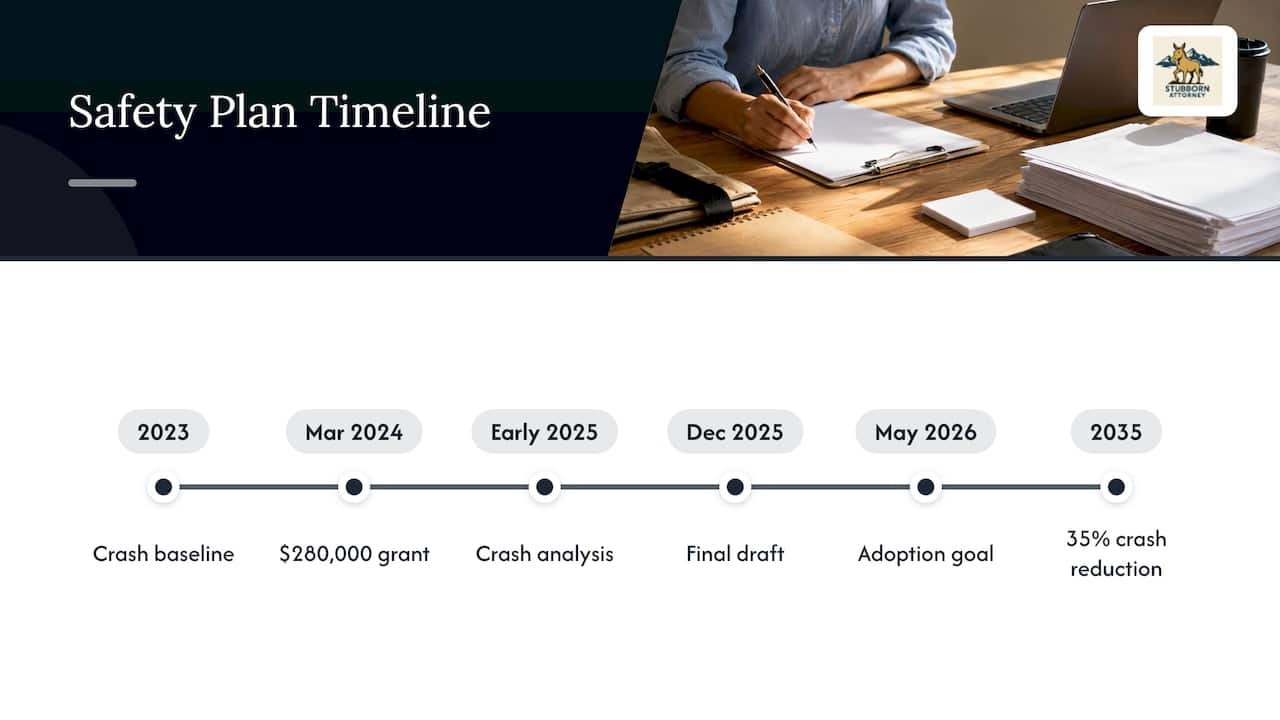
There is no single official list titled “the worst intersections.” What exists is better: a citywide safety plan built on crash data. Colorado Springs received a $280,000 federal Safe Streets for All grant in March 2024 to build its Transportation Safety Action Plan. The city says it analyzed crash data in early 2025, finished a final draft plan in December 2025, and aimed to adopt it in May 2026.
The reason for the plan is stated plainly on the same page: stakeholders noticed a significant rise in aggressive driving, serious-injury crashes and traffic fatalities over recent years. The plan’s goal, according to the Safe Streets COS page, is to cut serious-injury and fatal crashes by 35% by 2035, using 2023 as the baseline. It also identifies high-risk corridors and intersections from crash history, which the city calls its High-Risk Network.
For a driver, the takeaway is practical. Danger at an intersection is not a feeling or a rumor. It is measured by crash counts, severity and traffic volume, and the people who reach the worst outcomes are usually the ones hit by a driver who was speeding, distracted or running a signal.
Two recent crashes that show the pattern
The city publishes news releases on fatal crashes, and two from 2026 involve major intersections.
North Academy Boulevard and Lehman Drive. On April 22, 2026, a juvenile died and three other people were seriously injured. The city’s release says evidence suggests the southbound vehicle ran a red light, and speed is being investigated as a contributing factor. It was the city’s 16th traffic fatality of 2026, compared with nine at that point in 2025.
Dublin Boulevard and Union Boulevard. On July 5, 2026, a motorcycle struck a westbound pickup truck at this intersection, and the 20-year-old rider died. The city’s July 20 release lists speed as a possible factor and calls it the 31st traffic fatality of 2026, against 26 at that point in 2025.
A single crash does not make an intersection dangerous. But both releases describe the same ingredients: a signal, speed and vulnerable road users or passengers. Those ingredients are common at wide, multi-lane intersections where traffic moves fast right up to the stop line.
Why intersections cause so many serious crashes
At an intersection, vehicles travel on crossing paths. A driver who runs a red light, turns left across oncoming traffic or fails to yield puts the side of another vehicle in the line of impact, where there is little steel between the occupant and the collision. Motorcyclists, bicyclists and pedestrians have no protection at all.
The city’s own safety work points at the same behaviors. Its Safe Streets COS program rests on engineering, enforcement, education and community partnerships, and it includes red-light safety cameras and speed safety cameras. Red-light cameras are placed at select high-risk intersections chosen by crash history, traffic volume and documented safety concerns. The city’s traffic engineer, Todd Frisbie, said in the program’s launch release that even small reductions in speed can make a significant difference in how severe crashes involving pedestrians are.
Speed matters twice. It makes a crash more likely because drivers have less time to react, and it makes injuries worse because the force of impact rises with speed. Colorado Springs has several corridors with high posted limits. The city’s Freestyle Master Plan, for example, describes Woodmen Road as an Expressway with a 55 mph posted limit and Barnes Road as a Principal Arterial with a 45 mph limit. Every intersection on a road like that is a place where fast-moving traffic must stop, turn or cross.
How to check any intersection yourself
If you want to know how a particular intersection has performed, or you were hurt at one and want the crash history, three public sources help.
- The Colorado Springs Police Department open-data portal. It publishes a Crash Data by Date with Attributes dataset that anyone can query. You can filter by date and look at crash attributes near a given street.
- The Colorado Department of Transportation (CDOT). CDOT keeps a statewide crash database covering 2007 through 2026, built from the state’s DRIVES system. It notes that 2021 to 2026 data is subject to updates, and that crash data for a specific intersection or corridor can be requested through an open records request.
- The city’s Traffic Safety Dashboard. The Safe Streets COS page says the dashboard shows motor vehicle crash data from CDOT, and the city also posts a January 2026 COS Traffic Report as a PDF.
When you read the data, look at three things: how many crashes happened, how many involved injuries or deaths, and the time period covered. An intersection with many minor rear-end collisions is a different problem from one with fewer but more severe crashes. Because CDOT revises recent years, treat the latest numbers as provisional.
What the city is changing
The city has several efforts under way that affect specific intersections and corridors.
- Safe Streets COS. The program officially launched on May 13, 2026. Its list includes roadway and intersection safety improvements, school zone upgrades, trail crossing projects and speed and red-light camera programs.
- Safety demonstration projects. The city describes these as temporary, low-cost changes used to test roadway designs before permanent construction. Many focus on corridors and intersections flagged by the Transportation Safety Action Plan and the High-Risk Network, and some are paid for with the federal grant.
- Woodmen Road. The Woodmen Road Improvements project covers about six and a half miles from Powers Boulevard (SH 21) to US 24. It is in the planning phase and includes intersection improvements, a multiuse trail, drainage, bus transit accommodations and safety upgrades, funded mainly by the voter-approved Pikes Peak Rural Transportation Authority plus federal money. The project lists 719-220-5006 and info@WoodmenRd.com for questions.
- Powers Boulevard Extension. The extension from Highway 83 to Voyager Parkway is designed as an expressway with a new Highway 83 interchange and grade-separated crossings at several roads, so cross traffic does not meet at a signal. The project contact is 719-377-5166.
Improvements take years. Until they arrive, the drivers, riders and pedestrians who use these roads carry the risk.
How to lower your own risk at a busy intersection
You cannot control other drivers, but a few habits reduce exposure.
- Pause before you go on green. A beat of hesitation lets you see whether cross traffic is slowing. Red-light running is one of the factors in the April 2026 Academy and Lehman crash.
- Mind your speed on approach. Lower speed gives you time to react and lowers the force of any impact.
- Be extra careful with left turns. Wait until the gap is clear. Do not rush to beat the light.
- Watch for motorcycles and bicycles. They are narrower and harder to judge for distance. Our page on how riders can avoid accidents covers the rider side.
- Give pedestrians time. Crosswalk crashes raise their own liability questions, which we explain in who pays in a Colorado crosswalk accident.
If you were hurt at an intersection
A crash at a signal usually comes down to one question: who had the right of way? Each driver often says they had the green. That is why the first days matter.
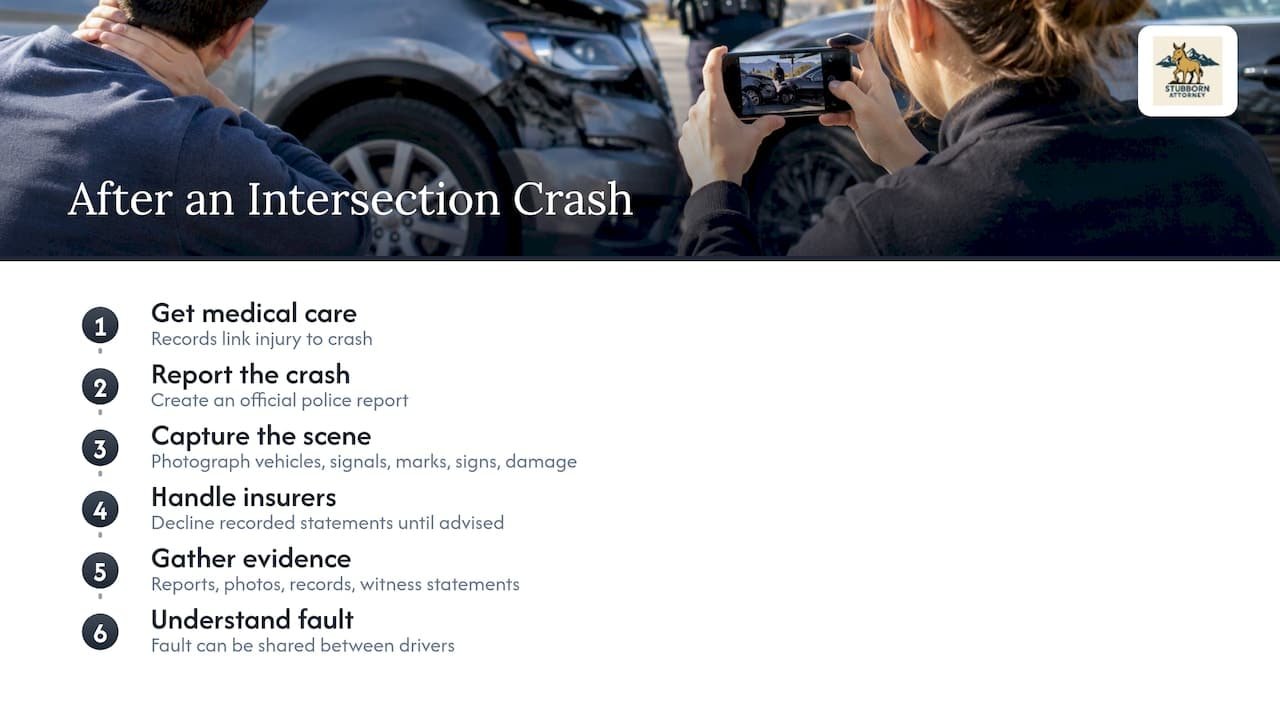
Get medical care first. Injuries such as whiplash can show up hours or days later. Your records also link the injury to the crash.
Report the crash. Call police so an official report exists. The report is often the first document an insurer reads.
Capture the scene. Photograph vehicle positions, signals, skid marks, traffic signs and damage. Note nearby businesses, since many have cameras that overwrite footage on a short cycle. Get names and numbers of witnesses.
Be careful with insurers. The other driver’s insurance company may call quickly and ask for a recorded statement. You can decline until you have advice. Our guide to the biggest mistakes after car accidents lists the ones that most often hurt claims.
Know what evidence counts. Police reports, photos, medical records, witness statements and, at signal crashes, sometimes camera or signal timing data all matter. We go through them in what evidence you need after a Colorado Springs car accident.
Understand fault. Intersection crashes often involve more than one driver, and fault can be shared. Our pages on fault in multi-car accidents and car accident liability factors explain how it is assigned.
If a commercial truck was involved, the questions multiply, since the carrier and driver may both be responsible. See what to know about truck accident attorneys in Colorado Springs. For motorcycle crashes, our page on what you can claim is a good start.
Why a lawyer changes how an intersection claim goes
An intersection claim is a dispute about what happened in a few seconds, and the insurer’s job is to pay as little as possible. Having someone on your side who knows how that evaluation works takes pressure off you while you recover.
Ryan Malnar practiced as a lawyer for over a decade and was a claims adjudicator and adjuster for the federal government before that, so he knows how large insurance companies and government agencies evaluate claims. The firm represents only injured people, and cases are handled directly by attorneys rather than passed along an assembly line.
The firm works on a contingency fee: you pay nothing unless there is a monetary recovery in your case. That matters when you are facing medical bills and missed work at the same time. Our overview of how a Colorado Springs accident attorney can help shows what that looks like day to day.
Our perspective
Every intersection in this city has a story the data only partly tells. The numbers show where crashes cluster. They do not show the family waiting in a hospital hallway, or the driver who keeps replaying the light turning.
What we see in the law is simple: the people hurt at intersections are usually the ones least prepared to fight an insurance company. They are injured, they are behind on bills, and the other side has a process built to minimize what they pay. I spent years on the claims side, and I know how that process looks from the inside. That is why we take injury cases only, and why our attorneys handle them personally.
We are stubborn on purpose. The mule is how we think about the work: steady, sure-footed and not easily turned around. When we take your case, we do not let go.
Ryan
Talk to us about your crash
If you were injured at an intersection in Colorado Springs, our team can review what happened and explain your options. We handle car accidents, motorcycle, bicycle, pedestrian and semi-truck crashes, wrongful death and more, and you pay nothing unless we recover money for you. Start with the car accident lawyer Colorado Springs page or visit StubbornAttorney.com to request a case review.
FAQ
Which Colorado Springs intersections have the most crashes?
The city identifies high-risk intersections through its Transportation Safety Action Plan and High-Risk Network, using crash data. You can query the police department’s public crash dataset and CDOT’s crash database for any intersection. Recent fatal crashes at Academy and Lehman and at Dublin and Union show the kind of locations where severe crashes happen.
What is the leading cause of crashes at intersections?
In Colorado Springs, the city points to aggressive driving, speed and red-light running as recurring factors. The April 2026 Academy and Lehman crash involved a suspected red-light violation with speed under investigation. CDOT’s dashboards break crashes down by cause and type if you want the statewide picture.
Can I get crash records for the intersection where I was hurt?
Yes. The Colorado Springs Police Department publishes crash data on its open-data portal. CDOT says intersection or corridor data can be requested through an open records request. A lawyer can also gather these records as part of building your claim.
What should I do first after an intersection crash?
Get medical care, make sure police create a report, photograph the scene and signals, and collect witness contact details. Avoid giving a recorded statement to the other driver’s insurer before you have advice. Then speak with an attorney who handles car accident cases in Colorado Springs.
How much does it cost to hire the firm?
We work on contingency, so you pay nothing unless there is a monetary recovery in your injury case. Our fee comes from a portion of the compensation awarded.
Sources
- Transportation Safety Action Plan, City of Colorado Springs
- Safe Streets COS, City of Colorado Springs
- Juvenile killed in serious crash on North Academy Boulevard, City of Colorado Springs
- Motorcyclist dies after July 5 crash near Dublin and Union Boulevard, City of Colorado Springs
- Safe Streets COS launch release, City of Colorado Springs
- Freestyle Master Plan, Colorado Springs
- Crash Data by Date with Attributes, Colorado Springs Police Department
- Crash Data, Colorado Department of Transportation
- COS Traffic Report, January 2026
- Woodmen Road Improvements, City of Colorado Springs
- Powers Boulevard Extension, City of Colorado Springs