

Diminished Value vs. Total Loss: Which Claim Applies to Your Car
The two claims are mutually exclusive. If the insurer declares your car a total loss, you are paid for the whole vehicle, and there is no separate diminished value claim. If the car is repaired and returned to you, a diminished value claim may cover what the accident history took off its market value. Which path you are on depends on one decision: whether the insurer calls the car repairable or not.
This guide explains how each claim works, how Colorado treats them, how the numbers are calculated, and what to do before and after the repair decision. It is written for drivers in Colorado and Colorado Springs, but the basic distinction holds across the country.
Table of Contents
- The difference in one table
- What a total loss claim actually pays
- How an insurer decides a car is a total loss
- What diminished value is and when it applies
- How diminished value is calculated
- Which situation are you in?
- Evidence checklist for each claim
- Mistakes that cost drivers money
- Our perspective
- When it makes sense to talk to a lawyer
- Talk to us about your Colorado car accident claim
- FAQ
- Sources
The difference in one table
| Total loss | Diminished value | |
|---|---|---|
| What happened | The insurer decides the car is not worth repairing | The car was repaired and you got it back |
| What you are paid for | The car’s actual cash value just before the crash | The drop in resale value caused by the accident history |
| Number of valuations | One: what it was worth before | Two: worth before and worth after repair |
| Who usually pays | Your insurer (collision) or the at-fault driver’s insurer | In Colorado, usually the at-fault driver’s liability insurer |
| Can you have both? | No | No |
The Nolo overview of car damage settlements draws the same line. Insurers declare a total loss when repair costs equal or come close to the vehicle’s value, and they typically pay its actual cash value before the damage. A diminished value claim arises when a repaired vehicle is worth less than it was before, and it equals the gap between the undamaged fair market value and the post-repair fair market value.
What a total loss claim actually pays
When a car is totaled, the insurer pays what the car was worth the moment before the crash, less any deductible if you are claiming on your own policy. That figure is called actual cash value (ACV). It is not what you paid for the car, and it is not what you still owe on the loan.
Travelers explains that the valuation rests on what comparable vehicles could have sold for immediately before the damage. It may account for enhancements, while routine maintenance generally does not raise the number. That is why a clean, well-documented car with a factory option package can be valued higher than a bare-bones listing of the same model.
What Colorado adds to a total loss payment
Colorado law gives total loss claims some structure that drivers often miss:
- Fees and tax. Under C.R.S. § 10-4-639, the insurer shall pay title fees, sales tax and any other transfer or registration fee associated with the total loss.
- A fair, consistent valuation method. The same statute requires insurers to use a fair and consistent method that considers the vehicle’s unique characteristics and a credible valuation source. It also bars using different credible sources only to land on the lowest amount payable.
- Written procedures and documentation. Under Colorado regulation 3 CCR 702-5-2-15-5, insurers must keep written valuation procedures. The claim file must name the valuation vendor and the methodology, and it must show they considered things like mileage, special finishes and accessories.
Those rules are your leverage. If the valuation report ignores your trim level, low mileage or new tires, you have a specific, statute-backed point to raise. We walk through the practical side in our guide to maximizing a Colorado total loss payout.
How an insurer decides a car is a total loss
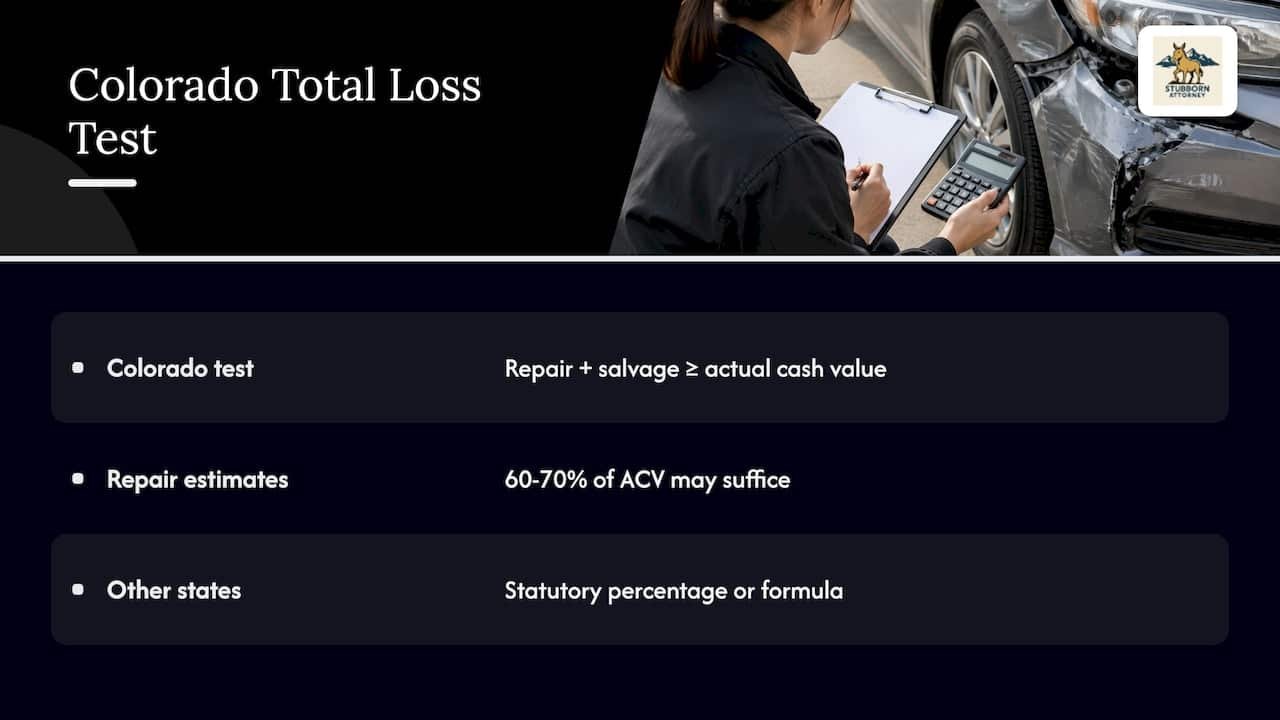
Many drivers have heard of a “70 percent rule.” Colorado does not work that way. According to a Colorado insurance explainer, the state uses the Total Loss Formula: if repair cost plus the car’s salvage value meets or exceeds its actual cash value, the car can be totaled. The same source notes that repair estimates of 60 to 70 percent of ACV can be enough when salvage values are high.
In plain terms, the same dent can total a car in one case and not in another. A newer, higher-value car with a modest salvage price is more likely to be repaired. An older car with a strong salvage market can be totaled over a mid-sized repair bill.
States differ here. Some set a statutory percentage and others use a formula, so advice you read from California or Texas may not apply to a crash on I-25.
The gray zone near the line
The hardest cases sit just under the total loss point. A car with a long repair order, often with structural work, comes back drivable but carrying a heavy accident history. Those are the cars where diminished value is largest.
Before repairs begin, ask the adjuster two questions:
- How close is this estimate to a total loss?
- What happens if a supplement (extra damage found during teardown) pushes it over?
A vehicle can be reclassified as a total loss partway through a repair, so you want to know the answer before the shop starts.
What diminished value is and when it applies
Even a flawless repair does not erase the accident from the car’s history. A buyer who sees a reported collision on a vehicle history report will usually pay less than for an identical car without one. Diminished value is that difference in dollars.
The Wall Street Journal’s guide to diminished value claims frames it as a claim based on lost fair market value after repair. It also notes that a totaled car does not go back on the standard resale market, which is why total loss and diminished value do not overlap.
So can you get diminished value if your car is totaled?
No. When the insurer pays the full pre-accident value, you have been paid for the whole vehicle. There is nothing left to value at a discount. The place to push, if you feel underpaid, is the ACV figure itself.
Colorado rules for diminished value
Colorado is a comparatively clear state for this claim, and it has been for a long time.
- Court decisions. In Trujillo v. Wilson (1948), the Colorado Supreme Court held that for a car substantially destroyed in a collision, the measure of damage is the difference between its value immediately before and after the damage, plus the reasonable expense of preserving or restoring it.
- Jury instructions. The Colorado Judicial Branch’s civil jury instructions (instruction 6:12) say a prevailing plaintiff is awarded both the reasonable cost of repair and any decrease in market value of the property as repaired. If repair cost plus the decrease exceeds the market value before the crash, the award is capped at that pre-crash value.
- Who you claim against. According to a Colorado insurance explainer, a third-party claim is available when another driver is at fault. You bring it against that driver’s liability insurer as part of the property damage claim. First-party diminished value claims under your own collision coverage are generally not available, citing Lovell v. State Farm.
The practical takeaway: if someone else caused the crash and your car was repaired, you likely have a diminished value claim to bring against their insurer. If you were at fault, your own policy generally will not pay it.
Time limits apply to property damage claims, and the right deadline depends on how the claim is characterized. Do not sit on it. Ask an attorney to confirm the deadline for your situation soon after repairs are finished.
How diminished value is calculated
This is where claims get contested. There is no single official formula. The NAIC’s Center for Insurance Policy and Research journal reports that the literature does not present a consistently accepted method, and that the process involves substantial subjectivity and professional judgment. Its authors also note that appraisers who charge a percentage of the settlement are controversial, because their fee rises with the number they produce.
Three approaches come up most often:
- The 17c formula. This is the insurer’s favorite. It multiplies 10 percent of the pre-accident retail value by a damage modifier and a mileage modifier. It traces back to a Georgia case (Mabry v. State Farm) and effectively caps the loss near 10 percent of pre-accident value. Per the Colorado explainer above, it is not binding in Colorado, and you can present an independent appraisal showing a higher figure.
- The market approach. Pre-accident value minus the appraised post-repair value, based on comparable sales. This mirrors the Colorado court standard of value before versus value after, and it is the number that holds up best as evidence.
- Independent professional appraisal. In Colorado, a comparable-sales appraisal of the pre-accident market value against the post-repair value of similar accident-history vehicles is described as the most effective method in the same explainer.
For scale, the NAIC paper reports that real-world diminished value is commonly about 10 to 20 percent of the direct physical damage loss. That is a range, not a promise. Mileage, age, model popularity and the type of damage (structural versus cosmetic) all move the figure.
A worked example
Suppose a 2022 crossover would have sold for $30,000 on the day before a rear-end collision caused by another driver. After a clean, documented repair, comparable cars with a reported accident are listing around $26,500.
- Market approach: $30,000 minus $26,500 is a $3,500 loss.
- 17c style estimate: 10 percent of $30,000 is $3,000 before modifiers, and the modifiers usually pull it lower, often well under $3,000.
The example is illustrative only, not a real case. It shows why the method matters: the insurer’s formula and the market evidence can sit hundreds or thousands of dollars apart, and the better-supported number is the one you can document.
Which situation are you in?
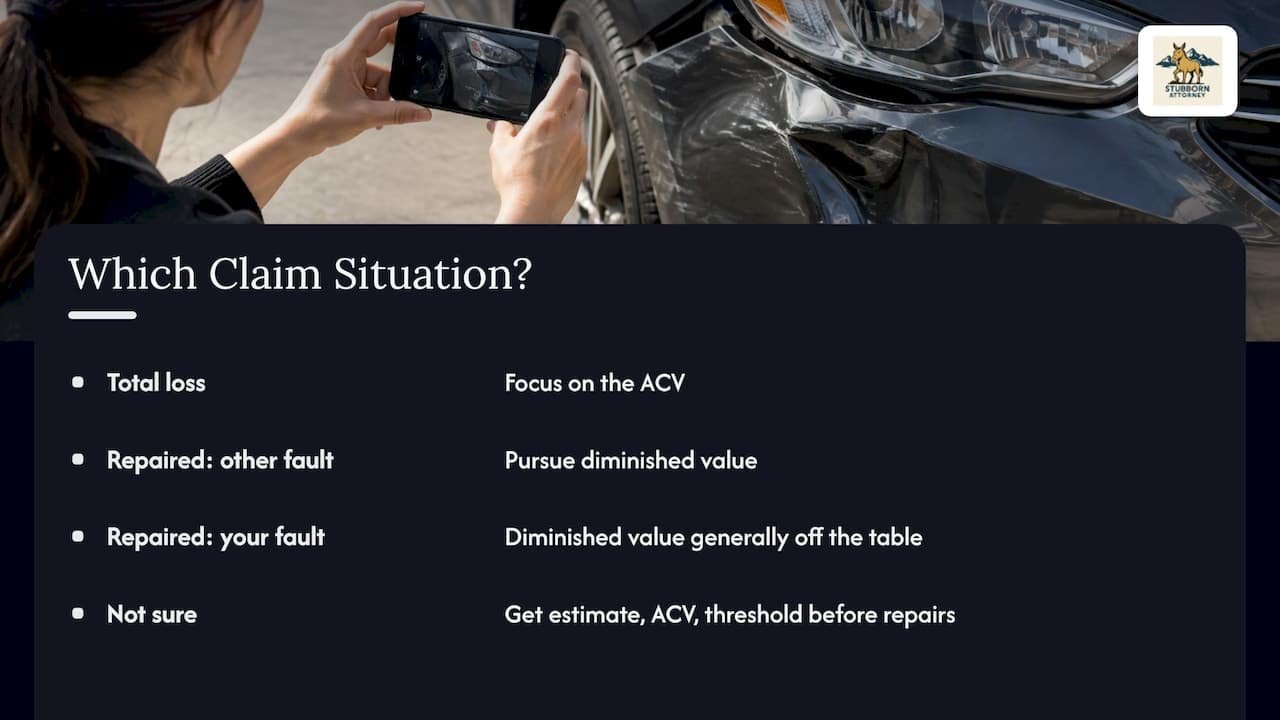
Your car was declared a total loss. Focus on the ACV. Request the insurer’s written valuation and check the vehicle identity, mileage, equipment, condition, comparable vehicles, adjustments and deductions. Targeted evidence beats a pile of paper, as AutoACV puts it. If the number is low, insurance.com’s guidance suggests researching similar vehicles selling in your area, documenting repairs, maintenance and upgrades, and considering an independent adjuster’s appraisal. If negotiation stalls, options include mediation, an attorney, or a complaint to the state insurance department.
Your car was repaired and another driver was at fault. You are in diminished value territory. Our overview of recovering Colorado diminished value covers the first documents to pull together.
Your car was repaired and you were at fault. Diminished value is generally off the table under Colorado’s third-party approach. Concentrate on making sure the repair is done right and the injury side of your claim, if any, is protected.
You are not sure yet. Ask the adjuster for the estimate, the ACV and the total loss threshold before approving repairs, as described above. Decisions made at the repair-or-total stage shape every claim that follows.
Evidence checklist for each claim
For a total loss dispute
- The insurer’s ACV report and any online valuations you ran
- Screenshots of comparable vehicles for sale in your area
- Pre-accident photos and maintenance records
- Receipts for options, upgrades, new tires or recent major service
- Title and registration
For a diminished value claim
- The final itemized repair invoice and any supplements
- Claim number, loss date and the police report if one exists
- Photos of the damage, the repair and the finished car
- A CARFAX or AutoCheck report showing the accident is reported
- Comparable sales of clean-history versus accident-history vehicles
- Dealer trade-in quotes that show the value gap
- The odometer reading at the time of the crash
- A written valuation, either your own calculation or a professional appraisal
A diminished value demand normally goes to the at-fault driver’s insurer after repairs. It should identify the vehicle and the claim, state the amount you are asking for, explain how you got it, attach the records and request a written response by a stated date. Keep a copy of everything you send.
Mistakes that cost drivers money
- Accepting the first ACV number. The first valuation is an opening position. Compare it against local comparables.
- Skipping the repair-versus-total conversation. Ask how close the estimate is before work starts.
- Settling the whole claim at once. Signing a release for property damage can close the door on later items. Read what you are signing.
- Relying on the insurer’s formula alone. A formula is an estimating method, not a legal standard in Colorado.
- Waiting too long. Photos, listings and records are easiest to gather soon after the repair.
If an offer comes in far below what you documented, our page on lowball insurance settlements in Colorado explains the next steps.
Our perspective
Ryan here. Over a decade as a lawyer, and before that years as a claims adjudicator and adjuster for the federal government, taught me how large insurance companies and agencies evaluate a claim. They work from formulas and templates. That is not a criticism of the people involved. It is simply how big systems process volume.
What that means for you is that a total loss offer or a diminished value number is where the conversation starts. The valuation usually has room in it: a missed option package, a comparable that does not match your car, a modifier applied the cheap way. The people who do well are the ones who document the car’s true condition and ask for the valuation in writing.
At Malnar Injury Law, now StubbornAttorney.com, we represent injured people, and car crash property damage is often tangled up with injury claims. Same crash, same insurer, same adjuster. When we take your case, we do not let go, and we handle cases directly rather than running them through a case mill. If your car trouble and your injuries are part of one story, it is better for one team to see the whole picture.
We work on contingency, so you pay nothing unless there is a monetary recovery in your injury case.
Ryan
When it makes sense to talk to a lawyer
You can handle a straightforward property damage claim yourself. Bring in a lawyer when:
- You were hurt in the crash. Injury claims and property claims often run with the same insurer, and what you say in one can affect the other.
- Fault is disputed. Colorado applies comparative negligence, and our guide to the 50 percent rule in Colorado comparative negligence explains how shared fault can reduce or bar recovery.
- The insurer will not move off a valuation you can show is wrong.
- Several vehicles are involved and fault is unclear.
If you are weighing the whole claim, our breakdown of how to estimate damages after a car accident and our look at Colorado car accident settlements show how the pieces fit together.
Talk to us about your Colorado car accident claim
If you were injured in a crash in Colorado Springs or anywhere in the state, we can review your case and explain your options. We represent injured victims of car, truck, motorcycle, bicycle and pedestrian accidents, and we help with insurance claims from the first call. See our car accident services or go straight to our Colorado Springs personal injury page to request a case review.
FAQ
Can I get diminished value if my car is totaled?
No. A total loss payment covers the vehicle’s value just before the accident, so you have been paid for the whole car. Diminished value only applies when the car is repaired and returned. If the total loss offer seems low, dispute the actual cash value instead.
Who pays diminished value in Colorado?
In Colorado, the claim is generally made against the at-fault driver’s liability insurer as part of the third-party property damage claim. Claims under your own collision coverage are generally not available. If you were the at-fault driver, expect no diminished value recovery.
At what percentage is a car considered a total loss in Colorado?
There is no fixed percentage in Colorado. Insurers use the Total Loss Formula, comparing repair cost plus salvage value with the car’s actual cash value. Depending on salvage prices, repair estimates well below 100 percent of value can lead to a total loss.
Do I need an appraisal to file a diminished value claim?
Not always, but a comparable-sales appraisal is the strongest support for your number, particularly against an insurer’s formula estimate. Repair invoices, a vehicle history report and dealer quotes also carry weight. Check any appraiser’s fee structure first, since percentage-of-settlement pricing is controversial.
Sources
- Car Accident Settlement for Property Damage: What’s Included (Nolo)
- Understanding Total Loss Insurance Claims (Travelers)
- C.R.S. Section 10-4-639
- 3 CCR 702-5-2-15-5 (Cornell LII)
- Colorado Diminished Value and Total Loss Rules
- Guide to Diminished-value claims (Wall Street Journal)
- Trujillo v. Wilson, 117 Colo. 430 (OpenJurist)
- Colorado Civil Jury Instructions, Chapter 6 (Colorado Judicial Branch)
- Automobile Diminished Value Claims (NAIC CIPR Journal)
- What Evidence Actually Matters in a Total-Loss Valuation (AutoACV)
- How to get the most money from insurance for a totaled car (insurance.com)