

Emergency Room Negligence in Colorado Springs: Your Rights
Emergency room negligence in Colorado Springs means a doctor, nurse or hospital failed to give care a reasonably careful professional would have given in the same situation, and that failure made your injury or illness worse. You can bring a claim, but you have to prove three things: the provider owed you care, the care fell below the standard, and the mistake actually caused harm. Colorado also sets a short filing window, generally two years from when you discover the injury and its cause, so the sooner you act, the more of your evidence is still intact.
This guide explains how those rules work in plain terms, which ER errors most often lead to claims, what to do in the days after a suspected mistake, and what a case realistically looks like.
Table of Contents
- What counts as emergency room negligence
- The errors that lead to the most claims
- Your rights when you walk into an ER
- Who can be held responsible
- How to prove an ER negligence claim
- What to do after suspected ER negligence
- Colorado’s deadline for ER negligence claims
- Damages limits in Colorado malpractice cases
- What to expect from a case
- Our perspective
- How we can help
- Questions to ask before you hire any lawyer for an ER case
- FAQ
- Sources
What counts as emergency room negligence
Not every bad outcome in an ER is negligence. People arrive critically ill or hurt, and some do not recover even with perfect care. The law asks a narrower question: did the provider act the way a reasonably careful professional of the same kind would have acted in similar circumstances? Colorado’s civil jury instructions describe the standard of care for medical professionals as an objective one, measured against that reasonably careful professional rather than against the best doctor in the country or against what the patient hoped for.
The setting matters to how a jury sees the case. Emergency physicians make fast decisions with limited history, often with no records and a waiting room full of other patients. Legal summaries of ER malpractice note that juries take this hectic environment into account. That does not excuse a missed heart attack or a wrong dose. It means the question is always what a careful ER provider should have done with the information and time available, not what hindsight now shows.
In practice, negligence in an ER usually falls into a few groups:
- Diagnostic errors: misreading a scan or lab result, or failing to order the test that a reasonable provider would have ordered.
- Medication errors: the wrong drug, the wrong dose, or ignoring a documented allergy.
- Delays: slow triage of a patient whose symptoms signal something serious.
- Premature discharge: sending someone home who needed admission, observation or a specialist.
- Communication breakdowns: critical information lost during a shift change or a handoff between departments.
That list comes from the same overview of common ER errors, and it matches what researchers see in claims data.
The errors that lead to the most claims
If you are trying to work out whether what happened to you fits a familiar pattern, the research is useful. A review of paid emergency department and urgent care malpractice claims found that the conditions most often involved were heart attack, aortic aneurysm, pulmonary embolism and appendicitis. These share a feature: early symptoms can look like something minor, yet a delay of hours can change the outcome.
A separate review of emergency medicine risk found that missed or delayed diagnoses were the most common allegation, at 47% of claims in one large study, and that 56% of claims in another review were diagnosis related. In other words, when ER cases go wrong, they most often go wrong at the moment someone decides what is causing your symptoms.
Here is how those patterns look in real life:
| Situation | What may have gone wrong | What usually decides the case |
|---|---|---|
| Chest pain sent home as heartburn | Heart tests not ordered, or results misread | Whether a reasonable provider would have tested further given your symptoms and history |
| Severe abdominal pain, discharged with pain medication | Imaging or labs skipped, appendicitis missed | How long the delay lasted and what happened to you in that time |
| Sudden leg swelling or shortness of breath | Blood clot not considered | Whether your symptoms called for clot screening |
| Wrong medication given | Allergy ignored, dose miscalculated | Charting of your allergies and the order written |
| Patient left unseen for hours | Triage misjudged how urgent the symptoms were | Triage notes and timestamps |
The table is a guide, not a verdict. Every claim turns on its own records.
Communication matters more than most people expect
One review of ER malpractice risk found that communication breakdown appears to predict litigation better than the injury itself. For patients, that is a practical clue. If nobody explained your diagnosis, nobody told you which symptoms should send you back, or your discharge papers say something different from what you were told aloud, write that down. Those gaps often point to where the real problem sits.
Your rights when you walk into an ER
A federal law called EMTALA protects every person who comes to a hospital emergency department. According to the Centers for Medicare & Medicaid Services, hospitals that take Medicare funds must offer an appropriate medical screening exam to anyone seeking emergency care, regardless of insurance. If you have an emergency medical condition that the hospital cannot stabilize with its own staff and facilities, it must offer an appropriate transfer to a hospital that can.
So if you were turned away, left without a real exam because of insurance or ability to pay, or moved to another facility while unstable, tell your lawyer. That conduct can be a separate problem from ordinary medical negligence, and it affects how the case is built.
Who can be held responsible
Colorado’s statute of limitations for these claims covers actions against a health-care institution or a licensed health-care professional, including physicians and nurses. In an ER case, that can mean several parties at once:
- The treating physician or physician assistant, for diagnostic and treatment decisions.
- Nurses, for triage, medication administration, monitoring and failing to escalate worsening symptoms.
- The hospital, for its own staffing, protocols and systems, and sometimes for the actions of staff it employs.
- Other professionals, such as a radiologist who misread an image the ER relied on.
Who employs the ER doctor is not always obvious. Some emergency physicians work for the hospital, others for an outside staffing group. Part of an early case review is working out exactly who was responsible for each decision, so the claim names the right parties.
How to prove an ER negligence claim
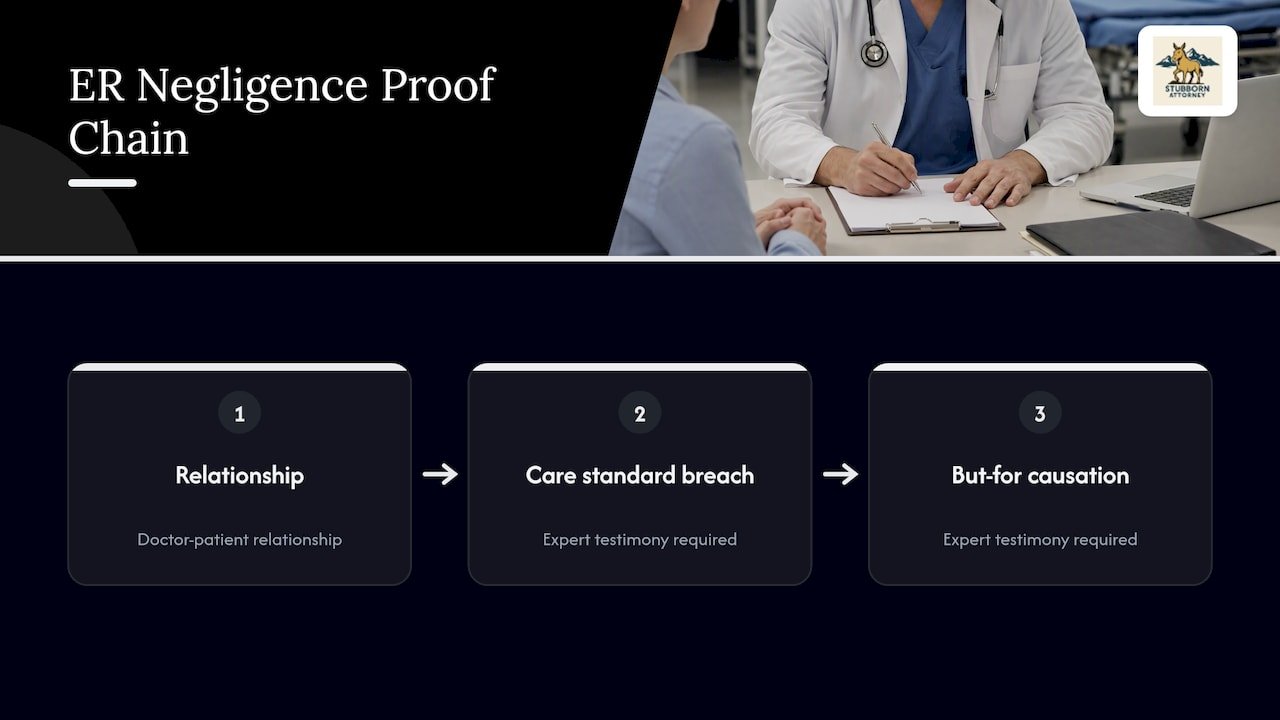
Colorado law requires you to show a chain of facts. According to the state’s civil jury instructions, a patient must prove that a doctor-patient relationship existed, that the provider breached the standard of care, and that the breach was the direct, “but-for” cause of the injury. Because these questions involve technical medical knowledge, Colorado law generally requires expert testimony on both the standard of care and causation.
Causation is where many cases are won or lost
A mistake alone is not enough. Summaries of ER malpractice law make the point that the breach must have caused or worsened the injury, and if the error did not change the outcome, the claim will likely fail.
Consider a simplified example. A patient with stroke symptoms is not scanned for three hours. If the scan, done on time, would have led to treatment that prevents lasting disability, the delay may be the cause of the harm. If the stroke was so severe that no treatment would have changed the result, the delay is still poor care but may not support compensation. A medical expert has to look at the timeline and say which of those is true.
What the experts do
A qualified physician reviews your records and answers two questions: what should a careful ER provider have done, and would that have changed what happened to you? Their opinion is the backbone of the case. A lawyer who handles these claims regularly will know which specialties to ask and what the records need to show before spending your time and a hospital’s attention on a weak claim.
What to do after suspected ER negligence
You do not need to be sure something was negligent to protect yourself. You only need to keep the facts from disappearing.
- Get medical care first. If you are still sick or hurt, see another provider, preferably one not affiliated with the same hospital. Your health comes before any claim, and a second opinion is also the fastest way to learn whether something was missed.
- Request your complete records. Ask the hospital for the full chart: triage notes, physician and nursing notes, orders, medication administration records, lab results, imaging reports and the actual images, discharge instructions and billing records. Federal privacy rules give you the right to request your records, and the request is free to make.
- Write your own timeline now. Note when you arrived, who you spoke to, what you were told, how long you waited and what you felt. Memory fades faster than records do.
- Keep everything you were given. Discharge papers, prescriptions, bills, wristbands, portal messages and any texts or emails with the hospital.
- Photograph visible injuries and keep a symptom log. Include pain levels, missed work and what you can no longer do.
- Do not post about it. Social media posts about your care or your recovery can be used by the defense.
- Talk to a lawyer before signing anything from the hospital’s insurer or risk management office, and before giving a recorded statement.
If the hospital sends bills or your health insurer asks for repayment, that is a separate issue that affects what you keep from any recovery. Our guide to Colorado subrogation rules explains how it works.
Colorado’s deadline for ER negligence claims
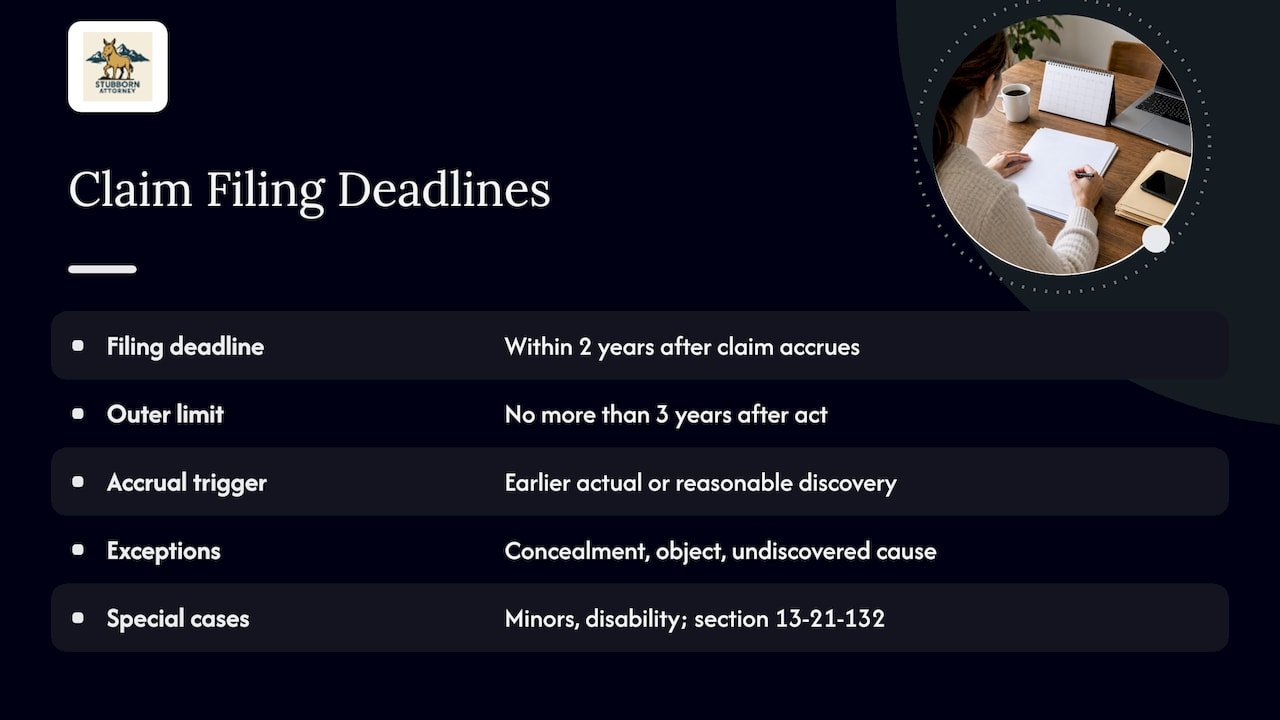
The clock is short. Under Colorado law, you must generally file within two years after the claim accrues and no more than three years after the act or omission. There are exceptions, including knowing concealment, a foreign object left in the body, an injury and cause that could not be discovered, certain young children, disability, and claims under section 13-21-132.
A malpractice claim accrues on the earlier of the date you discover the injury and its cause, or the date you should have discovered it with reasonable diligence. That is why waiting to “see how things go” is risky: the clock can start before you feel certain. Special deadlines also exist for minors and people with a legal disability, which can extend the period in some circumstances.
Two practical points. First, the three-year outer limit is not a goal. Records get harder to collect, witnesses move, and experts need time. Second, wrongful death claims after a fatal ER error have their own rules, so a family should not assume the deadline for a living patient applies. For more detail, see our page on Colorado medical malpractice deadlines and our guide to deadlines for Colorado injury claims.
Damages limits in Colorado malpractice cases
Colorado limits some categories of damages in medical malpractice cases. The legislature’s summary of House Bill 24-1472 states that the existing limit on noneconomic damages in medical malpractice actions was $300,000, rising in steps to $875,000 over five years beginning January 1, 2025. The same act raised the medical malpractice wrongful death limit incrementally to $1.575 million over five years.
Noneconomic damages cover things like pain, suffering and loss of enjoyment of life. They are different from your economic losses, such as medical bills and lost income, which are handled separately. Which limit applies to you depends on when your case was filed and the facts of the claim, so ask a lawyer to check it against your situation. Our page on medical malpractice in Colorado covers the caps and deadlines in more depth.
What to expect from a case
Be realistic going in. Among 6,779 closed adult emergency department and urgent care claims from 2001 to 2015, 65.9% were dropped, withdrawn or dismissed, and 7.4% of cases that went to trial ended in plaintiff verdicts. Those figures describe national claims, not any one firm’s results, but they explain why careful screening matters. Medical malpractice cases are expensive and technical, and the cases that succeed are the ones with clear records, a clear expert opinion and real, documented harm.
A typical path looks like this:
- Case review. A lawyer reads your records and timeline and decides whether the facts support a claim.
- Expert review. A qualified physician gives an opinion on the standard of care and on causation.
- Filing and discovery. If the case moves forward, both sides exchange records and take depositions.
- Negotiation or mediation. Many cases resolve here, after the defense has seen the expert evidence.
- Trial, if a fair resolution is not offered.
Our overview of the Colorado injury lawsuit timeline walks through each stage in more detail. Malpractice cases tend to take longer than a typical car crash claim because of the expert work.
Our perspective
Before I started representing injured people, I worked as a claims adjudicator and adjuster for the federal government. I know how large institutions and their insurers evaluate a claim, and what they look for when they want to say that nothing could have been done differently.
Here is what we tell people who call us after an ER visit that went wrong. First, trust the instinct that something is off, but let the records decide. Some of the most serious cases we see start with a patient who was simply told “it’s nothing” and later learned otherwise. Second, do not wait for the hospital to explain itself. Its priorities and yours are not the same, and the explanation you hear in the first weeks is rarely the whole story.
Third, we are selective for a reason. We represent only injured people, our cases are handled by attorneys rather than passed through a volume system, and we would rather tell you honestly that a claim is weak than take your hope and a year of your life. When we do take a case, we do not let go. That is what the mule on our brand stands for: steady, patient, and unwilling to quit on the hard stretch of the trail.
— Ryan
How we can help
We handle medical malpractice claims for people in Colorado Springs and across Colorado, alongside car, truck, motorcycle, pedestrian and slip and fall cases. Our work is on a contingency basis: you pay no attorney fees unless we recover money for you. If you are wondering whether what happened in an ER is worth a closer look, start with a free case review for personal injuries in Colorado Springs or read how we approach medical malpractice and injuries. Bring whatever you have: discharge papers, bills, your timeline. You do not need the full records to begin the conversation.
Questions to ask before you hire any lawyer for an ER case
Whatever firm you choose, ask these directly:
- Do you handle medical malpractice cases regularly, and who at the firm will actually work on mine?
- How do you decide whether to take a case, and when will I hear your decision?
- Who pays for expert review and records, and how are those costs handled if there is no recovery?
- How will fees and costs be taken from a settlement, and can I see that in writing?
- What is the filing deadline in my situation, and how are you tracking it?
A straightforward answer to each of those tells you a lot about how the firm will treat you later.
FAQ
Can I sue a Colorado Springs hospital for ER malpractice?
Yes, if you can show that the care fell below the standard a reasonably careful provider would have met and that the failure caused or worsened your injury. Colorado law allows damages actions against both health-care institutions and licensed professionals. You will generally need expert testimony to prove it, so an early review of your records is the first practical step.
How long do I have to file?
Generally two years after the claim accrues and no more than three years after the act or omission, with limited exceptions for concealment, foreign objects, undiscoverable injuries, certain children and disability. Accrual depends on when you discovered, or should have discovered, the injury and its cause. Do not rely on the outer limit; contact a lawyer as soon as you suspect a problem.
Is a misdiagnosis in the ER automatically malpractice?
No. Many conditions are hard to spot, and a wrong first diagnosis is not negligent if a careful provider could have reached the same conclusion. It becomes a claim when a reasonable provider would have ordered other tests or reached a different diagnosis, and the delay or error made your outcome worse.
What does it cost to hire us?
We work on a contingency fee basis, which means no client payment unless there is a monetary recovery in your case. Ask us during your case review how fees and case costs would be handled in your situation, and get it in writing.
What if the ER provider says it was nobody’s fault?
A hospital’s explanation is not the same as an independent medical opinion. Request your full chart and have it reviewed. The records, timestamps and test results often tell a clearer story than any conversation you had on the day.
Sources
- Colorado civil jury instructions, Chapter 15 (Colorado Judicial Branch)
- Emergency Room Mistakes & Legal Concerns (Justia)
- Emergency Department and Urgent Care Medical Malpractice Claims (PubMed Central)
- Mitigating Risk in Emergency Medicine (Emergency Medicine Clinics)
- Malpractice in Emergency Medicine: A Review of Risk (PubMed)
- Your rights in an emergency room under EMTALA (CMS)
- Colorado Revised Statutes Section 13-80-102.5 (Justia)
- Colorado Medical Malpractice Laws and Procedures (Nolo)
- HB24-1472 Raise Damage Limit Tort Actions (Colorado General Assembly)