

Colorado Auto Accident Lawyers: What Victims Must Know
Colorado auto accident lawyers are specialized personal injury attorneys who manage injury claims, negotiate with insurers, and fight for maximum compensation under Colorado’s distinct fault and damages laws. If you were hurt in a crash anywhere in the state, from a Denver freeway pile-up to a mountain highway collision near Colorado Springs, the legal rules that govern your recovery are unlike those in most other states. Ryan Malnar and the team at Stubbornattorney (formerly Malnar Injury Law) have settled hundreds of injury cases across Colorado, and this guide covers exactly what you need to know to protect your claim from day one.
How does Colorado’s modified comparative negligence affect your auto accident claim?
Colorado uses modified comparative negligence with a strict 50% bar for recovery. That single rule shapes every auto accident claim in the state, and understanding it is the difference between recovering full compensation and walking away with nothing.
Here is how it works in practice. If a jury finds you 25% at fault for a crash and awards $100,000 in damages, you collect $75,000. Your recovery is reduced by your exact fault percentage. But if your fault reaches 50% or more, you recover nothing at all. That threshold is the reason insurance adjusters work so hard to push your share of blame as high as possible during negotiations.

This is not a theoretical concern. Fault percentages directly affect settlement value, and every percentage point matters. An adjuster who shifts your fault from 20% to 35% on a $200,000 claim just saved their employer $30,000. Car accident attorneys in Colorado spend a significant portion of their work building the evidence that keeps fault percentages accurate and defensible.
Pro Tip: Document the scene thoroughly before vehicles are moved. Photos of skid marks, traffic signals, road conditions, and vehicle positions are the raw material that fault arguments are built from. Once the scene is cleared, that evidence is gone.
The key implications of Colorado’s comparative negligence system include:
- The 50% bar is absolute. There is no partial recovery if your fault equals or exceeds 50%.
- Insurers are financially motivated to inflate your fault percentage, even by small amounts.
- Every piece of evidence that establishes the other driver’s fault protects your recovery.
- Legal representation matters most in disputed-fault cases where the 50% threshold is in play.
- Colorado’s fault rules apply to both insurance negotiations and courtroom verdicts.
Understanding Colorado’s fault rules before you speak with any insurance representative is not optional. It is the foundation of your entire claim strategy.
What steps should you take immediately after an auto accident in Colorado?
The actions you take in the first 24 to 72 hours after a crash directly determine the strength of your claim. Most people underestimate how quickly critical evidence disappears and how fast insurance companies begin building their defense.
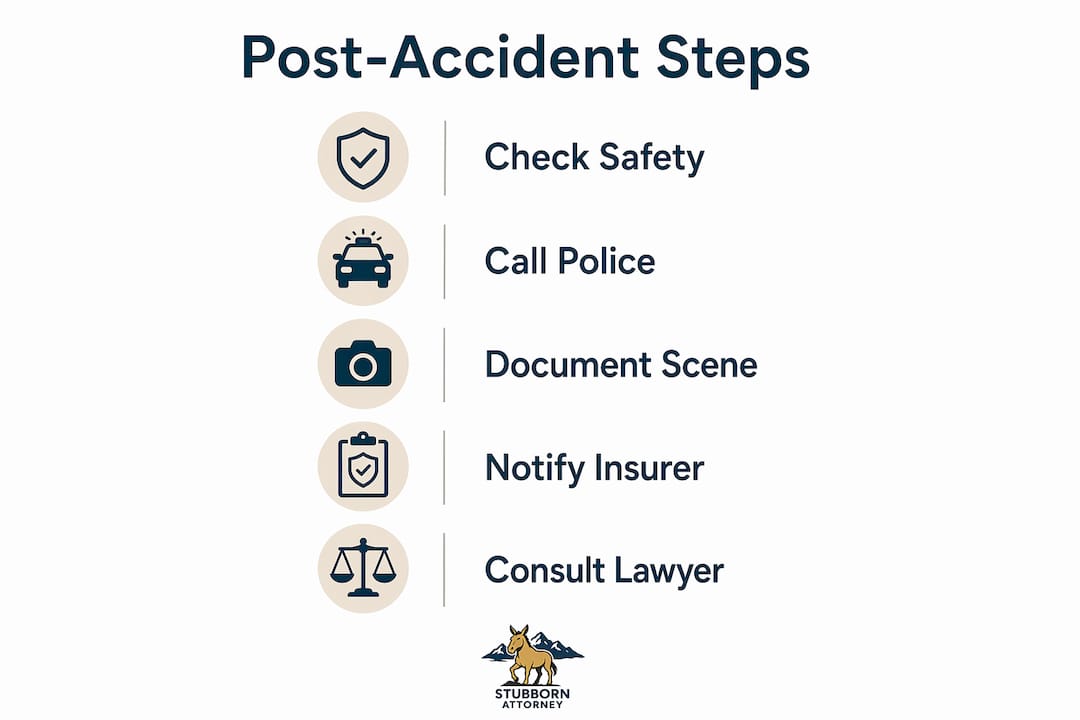
Follow these steps in order:
- Call 911 and report the accident. A police report creates an official record of the crash, the parties involved, and the officer’s initial observations about fault. Never skip this step, even for crashes that seem minor.
- Photograph everything at the scene. Capture vehicle damage, road conditions, traffic signs, weather, skid marks, and any visible injuries. Use your phone’s timestamp feature so images are date and time verified.
- Collect witness information. Names and phone numbers from bystanders are gold. Witness accounts from neutral third parties carry significant weight in disputed-fault cases.
- Seek medical attention immediately. Even if you feel fine, see a doctor the same day. Delayed treatment creates gaps in your medical record that insurers use to argue your injuries were not caused by the crash.
- Notify your insurance company that the accident occurred, but keep the conversation factual and brief. Do not speculate about fault or describe your injuries in detail at this stage.
- Do not give a recorded statement to the other driver’s insurer without speaking to an attorney first. Recorded statements can be used against you to limit your recovery later.
- Contact a Colorado auto accident lawyer as early as possible. Attorneys preserve evidence, communicate with insurers on your behalf, and prevent the procedural mistakes that kill otherwise strong claims.
Pro Tip: Use the Colorado car accident legal checklist to track every step after a crash. Missing even one item, like failing to get a police report number, can create complications weeks later when you are deep in the claims process.
Colorado personal injury claimants have three years from the injury date to file a lawsuit. Missing that deadline forfeits your right to recover damages regardless of how strong your case is. Three years sounds like a long time, but evidence degrades, witnesses become unavailable, and insurance companies use delay to their advantage.
What types of damages can you recover with Colorado auto accident lawyers?
Colorado law recognizes three broad categories of damages in auto accident claims. Knowing what you can recover, and what limits apply, helps you evaluate any settlement offer with clear eyes.
| Damage Category | What It Covers | Statutory Cap? |
|---|---|---|
| Economic damages | Medical bills, future medical costs, lost wages, lost earning capacity, property damage | No cap |
| Noneconomic damages | Pain and suffering, emotional distress, loss of enjoyment of life | Yes, capped by statute |
| Physical impairment and disfigurement | Permanent physical limitations, visible scarring | No cap |
Economic damages include medical expenses, lost wages, and property damage, and they carry no statutory ceiling. A serious spinal injury with years of future treatment costs can produce an economic damages claim well into the seven figures. These are calculated from bills, pay stubs, and expert medical testimony, so documentation is everything.
Noneconomic damages cover the human cost of an injury: the pain, the sleepless nights, the activities you can no longer do. Colorado caps these damages by statute, which means there is a legal ceiling on what a jury can award for pain and suffering regardless of how severe your experience has been. Physical impairment and disfigurement damages are treated separately and are not subject to that cap, which matters enormously in cases involving permanent disability or significant scarring.
Pre-judgment and post-judgment interest also applies in Colorado personal injury cases. When a case takes years to resolve, interest on the damages award can add a meaningful amount to the final recovery. An experienced Colorado personal injury lawyer accounts for this when valuing your claim and deciding whether a settlement offer is genuinely fair.
Colorado drivers must carry minimum liability coverage of $25,000 per person and $50,000 per accident. Those minimums frequently fall short of covering serious injuries, which is why attorneys also examine underinsured motorist coverage and other available sources of compensation.
How do Colorado auto accident lawyers handle insurance company tactics and settlement negotiations?
Insurance adjusters are not neutral parties. Their job is to close claims for as little money as possible, and they are trained to do it efficiently. Understanding their playbook is the first step to countering it.
The most common tactics adjusters use against unrepresented claimants include:
- Requesting early recorded statements before you understand the full extent of your injuries or the legal implications of what you say.
- Making fast, low settlement offers before your medical treatment is complete and the true cost of your injuries is known.
- Disputing medical necessity for treatments your doctor ordered, arguing that certain procedures were not related to the crash.
- Inflating your fault percentage using the comparative negligence system to reduce or eliminate your recovery.
- Delaying claim processing to pressure financially stressed claimants into accepting less than their claim is worth.
Legal representation produces significantly better outcomes than handling claims alone. Attorneys communicate directly with insurers, which removes the risk of an offhand comment being used to undermine your case. They also know the full value of a claim, including future medical costs and noneconomic damages that unrepresented claimants routinely undervalue.
When an attorney sends a demand letter, the tone of the negotiation changes. Insurers know that a represented claimant is prepared to litigate if necessary, and that changes what they put on the table. The decision between settling and filing suit is a strategic one, based on the strength of the evidence, the severity of the injuries, and the insurer’s willingness to negotiate in good faith. Experienced auto injury law firms in Colorado make that call based on data, not emotion.
How to choose the best Colorado auto accident lawyer for your case
Choosing the right attorney is not about finding the biggest billboard or the most aggressive TV commercial. The criteria that actually predict good outcomes are specific and worth examining carefully.
The qualities that separate effective car accident attorneys in Colorado from the rest:
- Colorado-specific experience. Auto accident law varies significantly by state. You want an attorney who knows Colorado’s comparative negligence rules, local court procedures in El Paso County, Denver, or wherever your case will be heard, and the specific insurance regulations that apply to your claim.
- A verifiable track record. Ask about settlements and verdicts in cases similar to yours. A lawyer who has recovered millions for injured clients, like Ryan Malnar at Stubbornattorney, brings credibility to the negotiating table that a newer attorney cannot match.
- Contingency fee representation. Most Colorado personal injury attorneys work on a contingency fee basis, meaning you pay nothing unless they win. This makes quality legal representation financially accessible regardless of your situation.
- Free initial consultations. A reputable attorney evaluates your case at no cost before you commit to anything. Use that consultation to assess whether the attorney listens carefully, explains things clearly, and seems genuinely invested in your outcome.
- Communication style and responsiveness. You will share sensitive medical and financial information with this person. If they are hard to reach or dismissive during the consultation, that pattern will continue throughout your case.
- Recognition and community standing. Attorneys recognized for top-rated legal excellence, like Ryan Malnar who has received community awards in Colorado Springs and coverage from KRDO and KKTV 11, have reputations built on real results.
The step-by-step claims process in Colorado has specific procedural requirements at each stage. An attorney who has handled dozens of similar cases in your jurisdiction will not miss a deadline or a filing requirement that could cost you your claim.
What I have learned after a decade of fighting Colorado auto accident claims
After more than ten years representing injured Coloradans, and before that, working as a claims adjudicator for the federal government, I can tell you the single most consistent mistake I see: people wait too long to get legal help, and they talk too much to the wrong people in the meantime.
The claimants who struggle most are the ones who gave a recorded statement to the other driver’s insurer within 48 hours of the crash, before they knew the full extent of their injuries, before they understood Colorado’s 50% fault bar, and before anyone had preserved the physical evidence. By the time they call me, the insurer already has a recorded version of events that contradicts their current account of the crash. That gap is very hard to close.
What I have found actually works is treating the first 72 hours after a crash as a legal evidence-gathering operation. Get medical attention. Document everything. Say nothing substantive to any insurer. Then call an attorney. The clients who follow that sequence consistently achieve better outcomes than those who try to manage the process themselves and call me only after the first offer disappoints them.
Fault allocation is the central battleground in Colorado claims. I have seen strong cases weakened because a claimant made an offhand apology at the scene that an adjuster later characterized as an admission of fault. I have also seen cases where thorough early documentation shifted the fault picture dramatically in our client’s favor. The difference between those two outcomes is almost always the quality of the evidence gathered in the first few days. When we take your case at Stubbornattorney, we do not let go. That is not a slogan. It is how we practice.
— Ryan
Injured in a Colorado crash? Stubbornattorney is ready to fight for you
Malnar Injury Law, now operating as Stubbornattorney, represents only injured victims across Colorado. Ryan Malnar’s background as both a personal injury attorney and a former federal claims adjudicator means he knows exactly how insurance companies evaluate and undervalue claims. The firm offers free case evaluations with no upfront costs, and representation is on a contingency fee basis. You pay nothing unless you win. If you want to understand what your claim may be worth, start by reviewing common personal injury case examples or go directly to a free case review with the Stubbornattorney team. The fight for your recovery starts the moment you reach out.
FAQ
What is modified comparative negligence in Colorado?
Colorado’s modified comparative negligence rule reduces your damages by your percentage of fault in a crash. If your fault reaches 50% or more, you recover nothing.
How long do I have to file an auto accident lawsuit in Colorado?
Colorado gives personal injury claimants three years from the injury date to file a lawsuit. Missing this deadline permanently forfeits your right to recover compensation.
Do Colorado auto accident lawyers charge upfront fees?
Most Colorado personal injury attorneys, including Stubbornattorney, work on a contingency fee basis. You pay attorney fees only if you win a settlement or verdict.
Should I give a recorded statement to the other driver’s insurance company?
No. Recorded statements to insurers can be used to limit your recovery later. Speak with a Colorado auto accident lawyer before providing any recorded statement to an opposing insurer.
What damages can I recover after a Colorado car accident?
You can recover economic damages like medical bills and lost wages, noneconomic damages like pain and suffering (subject to a statutory cap), and physical impairment damages, which carry no statutory cap under Colorado law.