

What Is Product Liability? Your Legal Rights Explained
Product liability is the legal responsibility that manufacturers, distributors, and sellers carry when a defective product causes injury or property damage to a consumer. Under U.S. law, liability can be pursued through strict liability, negligence, or breach of warranty, and each theory places different demands on what you must prove. Unlike a typical negligence case, strict liability means you do not have to show the manufacturer was careless. You only need to show the product was defective and that defect caused your harm. If you were hurt by a product that failed you, understanding these distinctions is the first step toward knowing whether you have a claim worth pursuing.
What is product liability and why does it matter?
Product liability is defined as the area of law that holds any party in a product’s supply chain legally accountable when that product causes harm. The term covers a wide range of situations, from a power tool with a cracked housing that causes a hand injury to a children’s toy with a choking hazard that was never disclosed on the packaging. The product liability definition under U.S. law is broad by design, because Congress and state legislatures recognized that injured consumers are rarely in a position to prove exactly how a manufacturer’s assembly line failed them.
The policy logic behind this area of law is direct: manufacturers who introduce potentially hazardous products into commerce are best positioned to bear the costs of associated injuries, including through insurance. That reasoning shifts the financial burden away from injured individuals and toward the parties who profited from putting the product on the market. For consumers, this means the law is structured to work in your favor, provided you can identify the right defect and connect it to your injury.
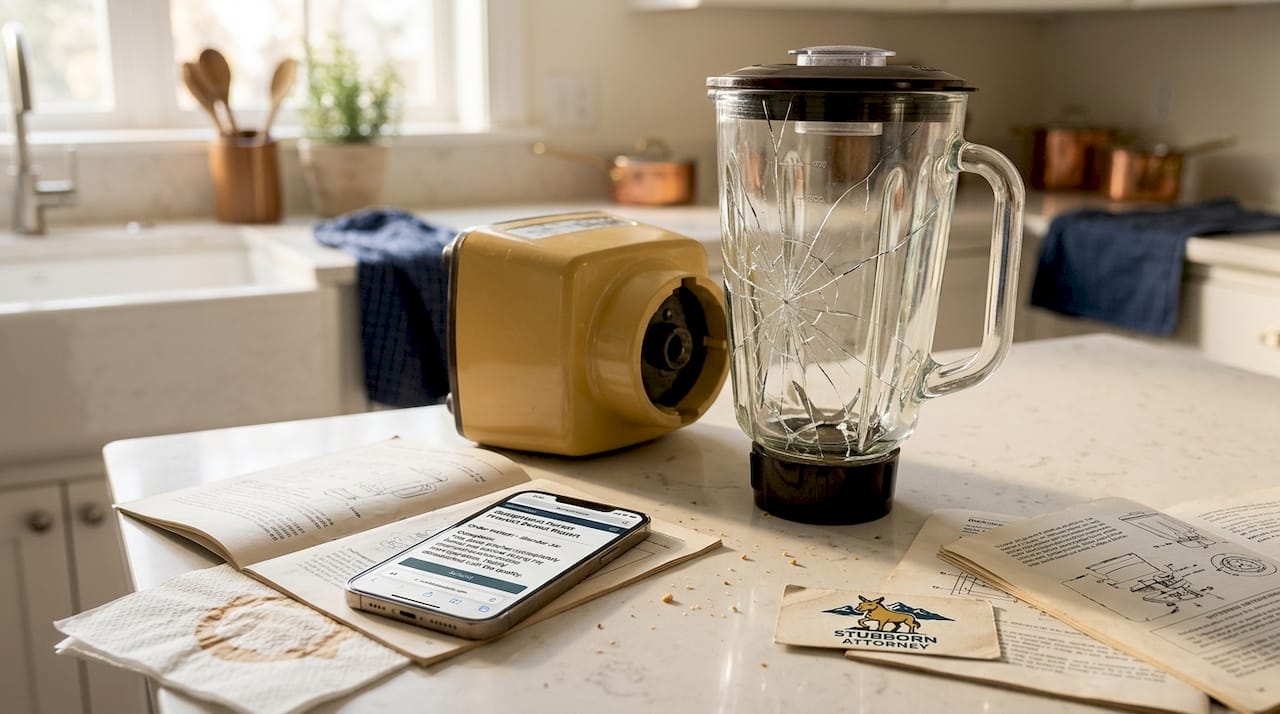
Product liability cases span industries including automotive, pharmaceuticals, medical devices, consumer electronics, and food. The Ford Pinto fuel tank cases in the 1970s, the Takata airbag recall affecting tens of millions of vehicles, and the Johnson & Johnson talcum powder litigation are all examples of product liability at scale. Each case turned on one of three recognized defect categories, which are explained in the next section.
What are the main types of product defects?
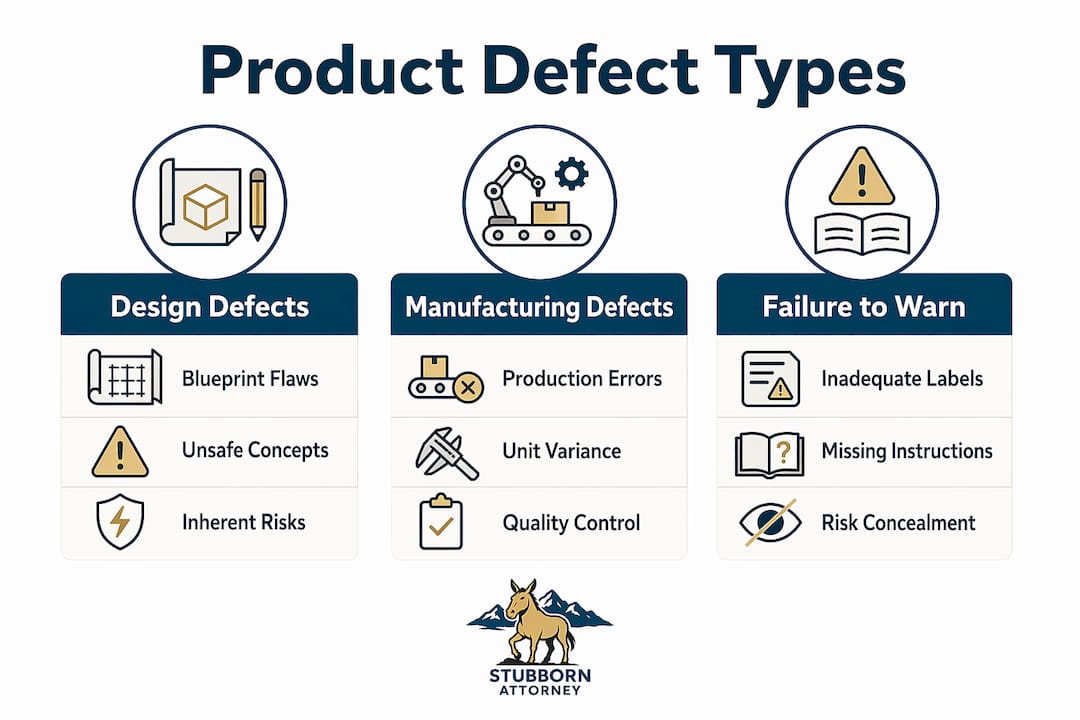
Legal claims in product liability cases typically fall under one of three defect categories. Identifying which category applies to your situation shapes every decision that follows, from the evidence you gather to the experts you retain.
Design defects
A design defect exists when the product’s blueprint is inherently unsafe, meaning every unit manufactured according to that design poses an unreasonable risk. The classic test courts apply is the “consumer expectation” standard: would an ordinary consumer expect the product to be this dangerous? A second test, the “risk-utility” standard, asks whether the risks of the design outweigh its benefits. The Takata airbag inflator is a textbook design defect case. The inflator used ammonium nitrate as a propellant, a material known to degrade over time and rupture violently. Every airbag built to that specification carried the same flaw.
Manufacturing defects
A manufacturing defect occurs when a specific unit deviates from the intended design during production. The design itself may be perfectly safe, but an error on the assembly line, a contaminated batch of materials, or a quality control failure produces a dangerous product. A bicycle with a frame weld that was not properly fused is a manufacturing defect. The design called for a solid weld; this particular unit did not receive one. Manufacturing defect cases often rely on inspection records, production logs, and metallurgical analysis to prove the deviation.
Failure to warn
Failure to warn, sometimes called a marketing defect, covers situations where a product carries risks that are not obvious to the average user and the manufacturer did not provide adequate warnings or instructions. Prescription drugs are the most litigated category here. A medication that causes serious side effects when combined with common over-the-counter drugs must carry a clear warning about that interaction. If it does not, and a patient is harmed, the pharmaceutical company faces liability even if the drug itself was properly designed and manufactured.
- Design defect: The entire product line is dangerous by concept.
- Manufacturing defect: One or more units deviate from a safe design during production.
- Failure to warn: The product lacks adequate safety information for foreseeable use.
Pro Tip: Document everything immediately after an injury. Photograph the product, preserve the packaging, and keep any receipts or purchase records. This evidence directly supports whichever defect category your attorney identifies.
How does product liability work legally in the U.S.?
Three legal theories govern product liability claims in the United States: strict liability, negligence, and breach of warranty. Attorneys often pursue multiple theories simultaneously to cover different evidentiary hurdles, because each theory has its own strengths depending on the facts of the case.
Strict liability
Strict liability is the most powerful tool available to injured consumers. Under this theory, courts focus on defectiveness and causation without requiring proof of how carefully or carelessly the manufacturer behaved. You do not need to show the company cut corners or ignored safety warnings. You need to show the product was unreasonably dangerous and that danger caused your injury. This distinction matters enormously in practice, because manufacturer conduct is notoriously difficult to prove without access to internal documents.
Negligence
Negligence requires you to prove the manufacturer owed you a duty of care, breached that duty through unreasonable conduct, and that breach caused your injury. This is a harder standard than strict liability, but it opens the door to punitive damages in cases where the manufacturer’s conduct was reckless or deliberate. The Ford Pinto litigation is the most cited example: internal documents showed Ford calculated it was cheaper to pay injury settlements than to fix the fuel tank, and that evidence supported punitive damage awards.
Breach of warranty
Breach of warranty claims arise when a product fails to perform as promised, either through an express warranty (a written or verbal guarantee) or an implied warranty (the legal assumption that a product is fit for its ordinary purpose). If a manufacturer advertises that a safety harness holds up to 400 pounds and it fails at 200 pounds, that is a breach of express warranty. Breach of warranty claims are particularly useful when strict liability is unavailable, such as in some commercial transactions between businesses.
What you must prove to win a product liability case
To succeed under strict liability, plaintiffs must prove three core elements:
- The defendant sold or manufactured the product.
- The product was defective at the time of sale.
- The defect caused the plaintiff’s injury.
Causation requires proving both cause-in-fact (the defect actually caused the harm) and proximate cause (the harm was a foreseeable result of the defect). Both elements typically require expert testimony to establish the technical link between the defect and the injury, and to rule out alternative causes.
| Legal theory | Must prove negligence? | Key focus | Best used when |
|---|---|---|---|
| Strict liability | No | Product defectiveness and causation | Defect is clear; manufacturer conduct is unknown |
| Negligence | Yes | Manufacturer’s unreasonable conduct | Internal documents show reckless behavior |
| Breach of warranty | No | Product failed to meet its promise | Express guarantee was made and broken |
Pro Tip: Potential defendants in a product liability case include manufacturers, component part suppliers, distributors, and retailers. Your attorney may name all of them initially, then narrow the focus as discovery reveals who bears the most responsibility.
How do U.S. and EU product liability laws compare?
Product liability laws differ significantly between the United States and the European Union, and those differences carry real consequences for consumers and manufacturers operating in global markets.
In the U.S., product liability law is primarily state law. There is no single federal product liability statute. States like California and New York have well-developed case law, while others rely more heavily on the Restatement (Third) of Torts as a guiding framework. This patchwork means that the same defective product can produce different legal outcomes depending on where the injury occurred.
The EU operates under a directive-based framework that harmonizes liability rules across member states. The original Product Liability Directive dates to 1985, but the 2026 Revised EU Product Liability Directive marks the most significant overhaul in four decades. The revised directive applies to products put into service on or after December 9, 2026, and it maintains strict liability while dramatically broadening the definition of what counts as a “product.”
The most consequential change is the expansion to cover software and artificial intelligence systems. Under the old directive, a software bug that caused a medical device to malfunction fell into a legal gray area. Under the new rules, that software is a product, and the company that developed it faces the same strict liability exposure as a hardware manufacturer. This matters for any U.S. company selling digital products or AI-powered devices in European markets.
| Feature | U.S. product liability | EU product liability (post-2026) |
|---|---|---|
| Legal basis | State tort law (no federal statute) | EU directive harmonized across member states |
| Liability standard | Strict liability, negligence, or warranty | Strict liability (primary standard) |
| Software and AI covered? | Inconsistent across states | Yes, explicitly covered from December 2026 |
| Who can be liable? | Manufacturers, distributors, retailers | Manufacturers, importers, authorized representatives |
| Burden of proof | Plaintiff bears full burden | Plaintiff burden, with some disclosure obligations on defendants |
For U.S. manufacturers exporting to Europe, the 2026 directive is not a distant regulatory concern. It is a live compliance deadline that requires reviewing product documentation, software update policies, and liability insurance coverage before products ship.
What consumers and businesses should know about product liability claims
Understanding how product liability claims actually unfold helps both injured consumers and businesses prepare for what lies ahead.
Common causes of product liability claims
Product liability claims arise across a wide range of product categories. Defective medical devices, contaminated food products, faulty automotive components, dangerous children’s toys, and malfunctioning power tools generate the highest volume of claims in the U.S. each year. Personal injury case examples frequently include product liability scenarios where a consumer had no warning that a product posed a serious risk.
Defenses manufacturers use
Companies facing product liability claims do not simply accept responsibility. Common legal defenses include assumption of risk, where the defendant argues the plaintiff knowingly used the product in a dangerous way, and federal preemption, where a company argues that federal regulatory approval of the product bars state tort claims. The preemption defense has been particularly effective in pharmaceutical cases, where FDA approval of a drug label has sometimes shielded manufacturers from failure-to-warn claims.
The role of product liability insurance
Businesses that manufacture or sell physical products carry product liability insurance to protect against claims of bodily injury or property damage. Insurance coverage mitigates financial risk and protects a company’s reputation when a product causes harm. For small businesses and startups, this coverage is not optional. A single serious product liability claim can exceed the net worth of a small company without it.
Practical steps for injured consumers
- Preserve the defective product and all packaging. Do not attempt repairs or modifications.
- Seek medical attention immediately and document all injuries and treatment costs.
- Record the product’s brand, model number, lot number, and purchase date.
- Identify all parties in the supply chain, including the retailer, distributor, and manufacturer.
- Consult a product liability attorney before speaking with the manufacturer’s insurance company.
Pro Tip: Statutes of limitations for product liability claims vary by state, typically ranging from two to four years from the date of injury. Missing this deadline ends your right to sue, regardless of how strong your case is.
The role of expert testimony in these cases cannot be overstated. Expert evidence is critical for establishing causation and ruling out alternative explanations for the injury, particularly under strict liability where the manufacturer’s conduct is not the central issue. Engineers, medical professionals, and industry specialists are routinely retained to explain to a jury exactly how a defect caused a specific harm.
What I’ve learned about product liability after a decade in injury law
After more than a decade handling personal injury cases in Colorado, including product liability claims, I have come to one firm conclusion: the gap between having a valid claim and winning that claim almost always comes down to how early you identify the defect category and how quickly you secure the right expert.
Most people who contact me after a product injury focus on the injury itself, which is understandable. But the legal question is not “how badly were you hurt?” It is “which defect caused the hurt, and can we prove it?” Identifying the defect category early shapes every piece of evidence you need to gather, from engineering analyses to production records to warning label histories. Wait too long, and critical evidence disappears.
I also want to push back on a common misconception: strict liability is not a guaranteed win for plaintiffs. It removes the burden of proving negligence, but it places strict requirements on proving defect and causation. I have seen cases where the injury was severe and the product was clearly dangerous, but the plaintiff could not establish that the specific defect caused the specific injury. That is where expert testimony becomes the deciding factor, and why you need an attorney who knows which experts to retain and how to use their findings effectively.
The emergence of software and AI as product liability targets is the most significant shift I have seen in this area of law. The 2026 EU directive formalizes what U.S. courts have been wrestling with informally. When an algorithm in a medical device makes a wrong recommendation and a patient is harmed, who is liable? The hardware manufacturer? The software developer? The hospital that deployed it? These questions do not have clean answers yet, but they are coming to courtrooms near you.
Injured by a defective product? Here’s how Stubbornattorney can help
If a defective product has injured you or someone you care about, you have legal rights worth protecting. At Stubbornattorney, we represent injured victims across Colorado with the same tenacity that defines everything we do. We know how insurance companies evaluate these claims because Ryan Malnar spent years as a federal claims adjudicator before becoming an attorney. That inside knowledge is what we bring to every case. Start with a free case review to understand your options with no obligation. You can also review common personal injury cases to see whether your situation matches claims we have successfully resolved. When we take your case, we do not let go.
FAQ
What is the product liability definition in simple terms?
Product liability is the legal obligation of manufacturers, distributors, and sellers to compensate consumers harmed by defective products. It covers injuries caused by design flaws, manufacturing errors, and inadequate warnings.
What are the three types of product liability claims?
The three types are design defect claims, manufacturing defect claims, and failure-to-warn claims. Each defect category requires different evidence and supports different legal arguments in court.
Do I have to prove the manufacturer was negligent?
No. Under strict liability, you do not need to prove negligence. You must show the product was defective, the defect existed at the time of sale, and the defect caused your injury.
How does product liability work if multiple companies were involved?
Liability can extend to every party in the supply chain, including the manufacturer, component suppliers, distributors, and retailers. Your attorney will typically name all potential defendants and narrow the focus as evidence develops through personal injury claims discovery.
Does product liability cover software and digital products?
In the U.S., coverage of software under product liability law varies by state and remains unsettled in many jurisdictions. The EU’s 2026 Revised Product Liability Directive explicitly covers software and AI, applying to products put into service on or after December 9, 2026.