

Bodily injury liability in Colorado: what it covers and why you need it
TL;DR:
- Bodily injury liability insurance pays for injuries caused to others, not the policyholder.
- Colorado minimum coverage limits are often insufficient for serious injuries or multi-person crashes.
- Additional coverage like MedPay and UM/UIM are crucial to fully protect yourself in accidents.
Most Colorado drivers assume their car insurance will take care of medical bills if they get hurt in a crash. That assumption can be expensive. Bodily injury liability insurance, often called BIL, works the opposite way from what many people expect. It pays for injuries you cause to other people, not for your own recovery. Understanding exactly how BIL works, what Colorado law requires, and what happens when coverage runs short could be the difference between a manageable situation and a financial crisis that follows you for years.
Table of Contents
- What is bodily injury liability insurance?
- Colorado’s minimum bodily injury liability limits
- What bodily injury liability does NOT cover
- How much bodily injury liability coverage do you really need?
- Claims, lawsuits, and protecting yourself
- What most Colorado drivers get wrong about liability coverage
- Need legal help after a Colorado accident?
- Frequently asked questions
Key Takeaways
| Point | Details |
|---|---|
| BIL protects others | Bodily injury liability insurance pays for injuries to others if you cause an accident. |
| State minimums may fall short | Colorado’s minimum required limits often won’t cover serious accidents, leading to high out-of-pocket risk. |
| Coverage gaps exist | BIL does not pay for your own injuries or car damage, so extra coverage is often needed. |
| Asset protection matters | Having higher limits can help shield your savings and property from lawsuits. |
| Legal help can bridge gaps | A Colorado personal injury attorney can help you understand claims and maximize compensation after a crash. |
What is bodily injury liability insurance?
Bodily injury liability insurance is the part of your auto policy that steps in when you cause a crash and someone else gets hurt. The key word is someone else. Your BIL coverage pays to help the injured party, not you. Many drivers confuse this with their own health coverage or medical payments coverage, so the distinction matters from the moment you sign your policy.
According to the Colorado DOI, bodily injury liability covers medical bills, lost wages, pain and suffering, legal defense, and funeral costs for others injured when you are at fault in a car accident. That is a broad list, and each category can carry a serious price tag on its own.
Here is a breakdown of what BIL typically covers for the injured party:
- Medical bills: Emergency room treatment, surgery, hospitalization, physical therapy, follow-up care
- Lost wages: Compensation for income the injured person could not earn during recovery
- Pain and suffering: Damages for the physical pain and emotional distress caused by the accident
- Legal defense costs: Attorney fees and court costs if the injured party sues you
- Funeral and burial expenses: In the tragic event that someone dies in the crash
What BIL does not cover is just as important. Your own injuries, damage to your own car, and property you destroy are all outside the scope of this coverage. There are many types of car accident claims in Colorado, and BIL is only one piece of a much larger puzzle.
Your BIL coverage is essentially a financial shield for other people after you cause an accident. Think of it as the insurance that protects others from the consequences of your mistake, and protects you from the lawsuits that would follow without it.
The reason BIL matters so much for your personal financial security is simple: without it, every dollar the injured person needs comes directly from your pocket. If they sue and win, the court can go after your savings, your home equity, and even your future wages. BIL is what stands between a bad accident and a judgment that wrecks your finances for years.
Colorado’s minimum bodily injury liability limits
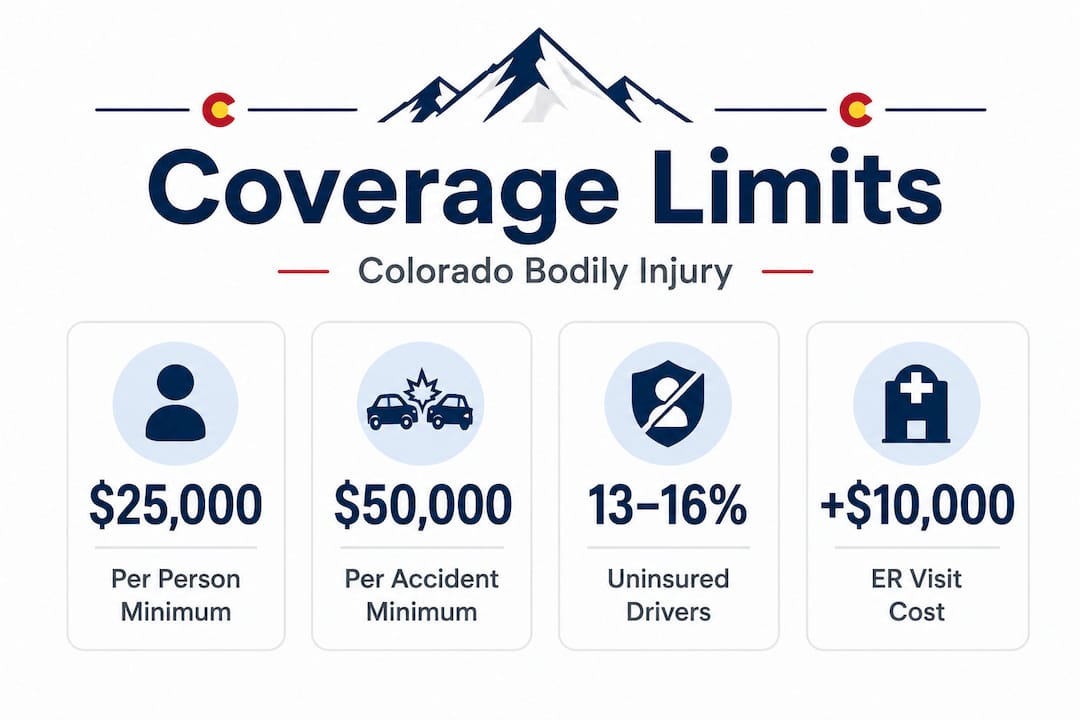
Colorado law does not let you skip BIL coverage. Every driver who registers a vehicle in the state must carry at least the statutory minimums. Those minimum required limits are $25,000 per person and $50,000 per accident, and those numbers remain unchanged for 2026.
Here is what those numbers actually mean in practice. If you cause a crash and one person is injured, your insurance will pay up to $25,000 toward their damages. If multiple people are hurt in the same crash, your policy pays up to $50,000 total, regardless of how many people need compensation. So if three people are each injured badly, they share that $50,000 pool among themselves.
How the numbers play out with real accident costs:
| Coverage type | Per-person limit | Per-accident limit | Average ER visit cost | Serious injury estimate |
|---|---|---|---|---|
| Colorado minimum | $25,000 | $50,000 | $3,500 to $12,000 | $50,000 to $500,000+ |
| Recommended coverage | $100,000 | $300,000 | Covered | Better protected |
| High-asset recommended | $250,000+ | $500,000+ | Covered | Significantly protected |
A single emergency room visit for a broken bone, whiplash with imaging, or a head injury can easily run from $10,000 to $30,000 before physical therapy, follow-up visits, or specialist consultations are added. One serious injury can consume the entire per-person limit before the injured person even leaves the hospital.
Colorado also has a notable rate of uninsured and underinsured drivers. Estimates put that rate somewhere between 13% and 40% depending on the region and study. That means a significant portion of drivers sharing the road with you either carry no insurance at all or carry limits too low to fully compensate you if they cause an accident.
Reviewing your car accident legal checklist after any crash can help you understand where you stand before you engage with insurance companies. Knowing what Colorado requires, and what it actually costs to make someone whole after an injury, reveals why the state minimum is often just a starting point rather than a finish line.
What bodily injury liability does NOT cover
This is where drivers are most often blindsided. Colorado law is clear that BIL protects against claims for injuries caused by the at-fault driver, but it does not cover the policyholder’s own injuries or property damage. You need separate coverages for those, and most people do not think about that distinction until after an accident happens.
Here is a numbered list of what your BIL coverage will not pay for:
- Your own injuries: If you are hurt in the crash you caused, BIL will not help. You need health insurance, MedPay, or personal injury protection to cover yourself.
- Your family members’ injuries: Relatives living in your household are typically excluded from your own BIL coverage.
- Damage to your vehicle: Collision coverage handles repairs to your car, not BIL.
- Damage to your own property: If you drive through your garage door, that is on your homeowner’s policy.
- Intentional acts: If you deliberately cause harm with your vehicle, BIL coverage is void.
- Non-covered vehicles: Vehicles not listed on your policy may not be covered at all.
There are also edge case exclusions that trip people up. Policy language around intentional acts, excluded drivers, and vehicles not listed on the declaration page can all create gaps that insurers use to deny claims. Colorado courts have held in various cases that statutory definitions of “insured” can sometimes override strict policy exclusions, particularly for permissive users, but that is complex territory that often requires legal review.
Pro Tip: Consider adding MedPay and uninsured/underinsured motorist (UM/UIM) coverage to your policy. MedPay covers your own medical bills regardless of fault, while UM/UIM kicks in when the driver who hurt you carries little or no insurance. These are not expensive add-ons, and they fill two of the largest gaps BIL leaves behind.
When claims exceed your BIL limits, the injured party does not simply absorb the difference. They have the legal right to pursue the remaining amount directly from you. If you only carry $25,000 per person but the injured driver racks up $90,000 in medical costs plus lost wages, you could face a $65,000 personal judgment. Understanding your potential exposure around personal injury compensation types helps you see why coverage choices are not just about premiums.
How much bodily injury liability coverage do you really need?
Experts consistently say the Colorado state minimum is not enough for most people. Industry guidance recommends limits of 100/300/100, meaning $100,000 per person, $300,000 per accident, and $100,000 in property damage liability. That is four times the state minimum on the per-person side. There are good reasons those recommendations exist.
Consider two scenarios. In the first, you tap someone’s bumper at low speed in a parking lot. They have minor soft tissue soreness, visit urgent care once, and the matter settles for $3,000. Your minimum coverage handles that easily. In the second scenario, you run a red light and T-bone another car at 40 miles per hour. Two adults are transported by ambulance, one has a fractured pelvis requiring surgery and months of rehabilitation, and the other misses six weeks of work as a nurse. Medical costs alone easily exceed $120,000, and lost wages push the total well past $150,000. Your $25,000 per-person limit covers a fraction of that.
Three signs you need coverage beyond the Colorado minimum:
- You own significant assets, including a home, investments, or retirement accounts, that could be targeted in a lawsuit
- You regularly drive in high-traffic areas, during rush hour, or in conditions that raise the chance of a serious multi-vehicle accident
- You have family members on your policy who are newer drivers or who drive long distances frequently
| Scenario | BIL limit | Injury cost | Your personal exposure |
|---|---|---|---|
| Minimum coverage, minor injury | $25,000 | $8,000 | $0 |
| Minimum coverage, serious injury | $25,000 | $95,000 | $70,000+ |
| Recommended coverage, serious injury | $100,000 | $95,000 | $0 |
| Minimum coverage, multi-car pileup | $50,000 total | $180,000 combined | $130,000+ |
The financial and legal risks of being underinsured are not theoretical. Colorado courts regularly enter judgments against at-fault drivers whose policies fell short. Those judgments follow you. Wage garnishment and liens on property are real tools creditors and plaintiffs use to collect. Understanding why pursuing an injury case matters can help injured parties see the value in their claim, and it should also help at-fault drivers understand the severity of what they face without adequate coverage.
Premiums for higher limits are often far less expensive than people expect. Going from $25,000 to $100,000 per-person coverage typically adds only a modest amount to your monthly premium, often less than a single lunch out. The protection that increase provides is vastly disproportionate to the cost.
Claims, lawsuits, and protecting yourself
When a crash happens and injuries are involved, the process moves quickly and the stakes are high. Knowing the typical sequence of events can help you protect yourself and make better decisions.
Immediately after a crash, the at-fault driver’s insurance company opens a claim and assigns an adjuster. That adjuster’s job is to evaluate the total damages and determine how much the policy will pay. Injured parties negotiate with the adjuster, submit medical records and bills, and either settle or proceed toward litigation if a fair agreement is not reached.
Here is what to do right after a crash to protect yourself:
- Call law enforcement and wait for a report to be filed
- Exchange insurance, license, and registration information with all involved parties
- Document everything with photos, including vehicle positions, damage, road conditions, and any visible injuries
- Gather contact information from any witnesses
- Notify your own insurance company promptly, even if you were not at fault
- Avoid making statements that admit fault at the scene or to the other driver’s insurer
- Consult a personal injury attorney before signing any release or settlement agreement
When BIL limits leave gaps, the injured party’s options include pursuing UM/UIM coverage on their own policy or filing a civil lawsuit directly against the at-fault driver. Colorado follows a modified comparative fault rule, which means the percentage of fault assigned to each party directly affects how much compensation the injured person can recover. If an injured driver is found 20% at fault, their total recovery is reduced by 20%. If they are more than 50% at fault, they recover nothing.
Pro Tip: If you are an injured party and the at-fault driver has only minimum coverage, consult a personal injury attorney before accepting any settlement. Settling quickly often means giving up your right to additional compensation, even if your medical costs increase later. An attorney can review the injury compensation workflow with you and identify whether additional sources of recovery, including your own UM/UIM coverage, are available.
Understanding real-world case outcomes helps you calibrate what is realistic in your situation. Claims that seem straightforward often become complicated once full medical records are reviewed, liability disputes emerge, or insurance companies push back on the value of pain and suffering damages.
What most Colorado drivers get wrong about liability coverage
Here is the hard truth that attorneys see play out in real cases far too often: carrying the state minimum does not mean you are protected. It just means you are legal. Those are two very different things.
Many drivers treat the $25,000 per-person limit as a meaningful shield. It is not, at least not in any accident involving serious injury. A single hospitalized person with a spinal injury, a head trauma, or a major orthopedic repair can generate medical bills that blow past $25,000 before they leave the intensive care unit. When that happens, your insurance company closes its checkbook at the policy limit, and the injured party’s attorney turns directly to you.
Financially, that means your savings, your home’s equity, your investment accounts, and even a portion of your future income can all become targets. Colorado allows judgment liens against real property, and creditors can pursue wage garnishment after a civil judgment. A $75,000 judgment against someone carrying minimum-limit coverage is not hypothetical. It is a pattern that shows up in personal injury practices throughout the state every single year.
There is a second blind spot that catches people off guard. Many drivers do not realize that their own UM/UIM coverage is equally as important as their BIL. If someone with no insurance or only minimum coverage hits you and causes serious injuries, your BIL coverage does nothing to help you. Your UM/UIM coverage is the only policy that steps up. In a state where a meaningful share of drivers carry inadequate coverage, relying solely on BIL is a gap in your plan.
The uncomfortable reality is that insurance companies are not your advocates, on either side of a claim. They are businesses managing risk and minimizing payouts. Whether you are the at-fault driver or the injured party, you are navigating a system designed to settle claims efficiently for the insurer, not necessarily fairly for you. Understanding the full timeline of an injury lawsuit before you are in that position gives you an important advantage.
The smartest thing any Colorado driver can do is review their current policy with an honest eye toward what a real accident could actually cost, then compare that number to their current limits. If those numbers do not match, the coverage needs to change. And if you are already dealing with the aftermath of a crash, getting legal guidance early can mean the difference between a fair outcome and a settlement that leaves you short.
Need legal help after a Colorado accident?
Whether you were injured by an at-fault driver or you are facing a claim against your own policy, navigating Colorado’s insurance system without guidance is risky. At Malnar Injury Law, operating as StubbornAttorney.com, we represent only injured victims. That means every resource, every strategy, and every ounce of persistence we bring is working for you. Start by reviewing your situation with our Colorado car accident legal checklist, and explore real case examples to understand what outcomes are possible. When you are ready to talk, we are here to listen. We have settled hundreds of injury cases and recovered millions of dollars for people across Colorado. Learn more about your rights after injury and take the first step today.
Frequently asked questions
Does bodily injury liability pay for my own medical bills in Colorado?
No, BIL covers injuries to others when you are at fault; your own injuries require separate coverage like MedPay, health insurance, or personal injury protection.
What’s the difference between BIL and uninsured motorist coverage?
BIL pays for injuries you cause to others, while UM/UIM coverage pays for your injuries when the at-fault driver lacks adequate insurance, which is a real concern in Colorado given the state’s high uninsured driver rate.
Can someone sue me if my bodily injury liability limits are too low?
Yes, if your coverage limits fall short of the total damages, the injured party can pursue a civil lawsuit to recover the difference directly from your personal assets.
What are Colorado’s minimum bodily injury liability insurance requirements in 2026?
Colorado’s minimums are $25,000 per person and $50,000 per accident, and these requirements remain unchanged for 2026.
Does bodily injury liability cover passengers in my own car?
In most cases, BIL does not cover your own passengers; policy exclusions apply to the policyholder’s household, and separate MedPay or health coverage would be needed for passengers related to you or living in your home.