

How injury documentation protects your Colorado accident claim
TL;DR:
- Injury documentation is essential for establishing causation and supporting fault in Colorado claims.
- Consistent medical records, photos, symptom logs, and bills strengthen injury claims significantly.
- Delaying treatment or gaps in records can be exploited to reduce or deny compensation.
Most people walk away from a car accident thinking their injuries speak for themselves. They figure the damage to their vehicle, the police report, and a trip to urgent care will be enough to get fair compensation. That belief is one of the most costly mistakes you can make under Colorado law. The reality is that injury documentation is not just helpful — it is often the deciding factor in whether your claim gets paid, reduced, or denied entirely. This guide breaks down exactly what to document, how to do it, and why the smallest gap in your records can give an insurance company the opening it needs to undercut everything you are owed.
Table of Contents
- How Colorado’s injury claims system makes documentation critical
- What counts as injury documentation — and why consistency matters
- Step-by-step guide to documenting car accident injuries
- Common mistakes and pitfalls: What most claimants overlook
- Why most people underestimate injury documentation — and lessons learned
- Take the next step: Strengthen your claim with expert support
- Frequently asked questions
Key Takeaways
| Point | Details |
|---|---|
| Colorado law demands records | Accurate injury documentation is critical under Colorado’s comparative negligence rules. |
| Gaps weaken your claim | Any delay or inconsistency in treatment can reduce compensation or eligibility. |
| Consistency proves causation | Detailed, ongoing records link injuries and their impact directly to your accident. |
| Actionable steps matter | Following a clear documentation process ensures stronger and more credible claims. |
How Colorado’s injury claims system makes documentation critical
Colorado operates under a legal framework called modified comparative negligence, and this rule has a direct impact on whether you receive any compensation at all. Under this system, your ability to recover damages depends on your share of fault in the accident. If you are found to be 50% or more at fault, you collect nothing. If you are found to be, say, 30% at fault, your compensation is reduced by that 30%. This makes the evidence you gather — including injury documentation — a high-stakes part of every Colorado claim.
What many claimants do not realize is that injury records do more than prove you were hurt. They help establish causation, meaning they show that the accident caused the injury rather than some pre-existing condition or unrelated event. They also support the timeline of events, which affects fault determination. Insurance adjusters are trained to look for anything that weakens causation or places more fault on you. Solid documentation closes those doors.
Under Colorado’s 50% fault bar, injury documentation directly supports fault determination and is often the clearest evidence that your injuries resulted from the accident, not some other cause. This distinction matters enormously in contested claims where the other party’s insurer is trying to shift fault onto you.
Think about what happens without strong records. An insurer argues that your neck pain existed before the crash, or that you must not have been seriously hurt because you waited two weeks to see a doctor. Without documentation to counter those arguments, you are left hoping the adjuster takes your word for it. That is not a strategy.
To understand how documentation fits into the broader picture, it helps to study the injury compensation workflow that applies to Colorado personal injury cases. You should also get clear on the car accident claim types that apply to your situation, since different claim types carry different documentation burdens.
| Claim factor | With documentation | Without documentation |
|---|---|---|
| Causation | Clearly tied to accident date | Easy to dispute |
| Fault assignment | Supported by evidence | More open to interpretation |
| Severity of injury | Detailed and credible | Speculative or dismissed |
| Compensation eligibility | Stronger position | Reduced or denied |
| Insurance negotiation | Evidence backs your demand | Adjuster controls the narrative |
The table above is not hypothetical. These differences play out in real claims every week in Colorado. The gap between a documented and undocumented injury claim is often the gap between a settlement that covers your losses and a settlement that barely covers your medical bills.
What counts as injury documentation — and why consistency matters
Now that you understand why documentation is vital, let’s get specific about what counts as injury documentation and why even small gaps can do serious damage to your claim.
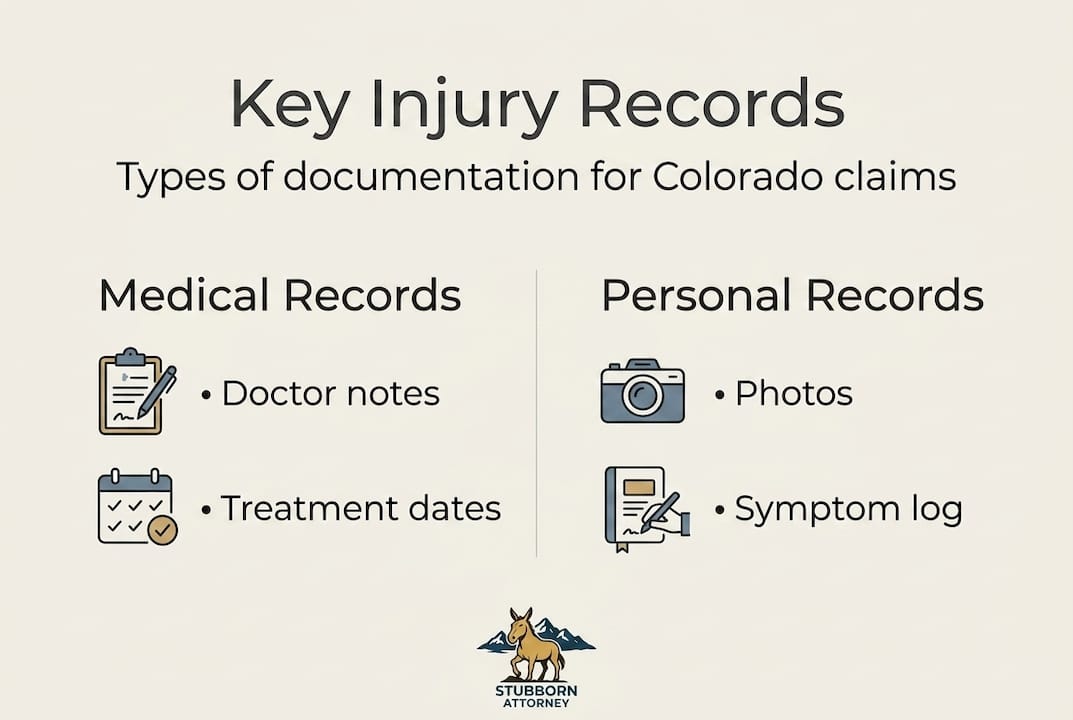
Accepted forms of documentation fall into several categories, and the strongest claims use all of them together:
- Medical records: These include emergency room reports, primary care visit notes, specialist evaluations, diagnostic imaging results (like MRI or X-ray reports), physical therapy records, and prescription records. Every provider you see should generate written records tied to the accident.
- Photographs: Take photos of your visible injuries, including bruises, lacerations, swelling, and any physical changes you notice over time. Date-stamped photos taken immediately after the accident and at regular intervals afterward are powerful evidence.
- Daily symptom logs: A handwritten or typed journal where you record how you feel each day, what activities you could not do, how pain levels fluctuated, and how your injuries affected your sleep, work, and daily life. These logs capture functional impact in a way that medical records often cannot.
- Provider notes and referrals: Written instructions from your doctor, referrals to specialists, and any communications about your diagnosis or treatment plan all contribute to a complete picture of your injuries.
- Bills and receipts: Out-of-pocket expenses, copays, medication costs, and any services you had to hire because of your injuries (like home cleaning or childcare) are all relevant to your claim.
The issue that sinks so many claims is not that victims fail to collect any of these records. It is that they collect some and miss others, or they stop collecting them too soon. Gaps in treatment are something insurance companies actively look for. When an adjuster sees that you visited the doctor three times in the first two weeks and then stopped, they argue that you must have recovered. If your symptom log stops after the first month, they argue your injuries were minor and short-lived.
Consistent records do something critical: they show functional impact and causation over time. They prove that your injuries were not just a temporary inconvenience but a sustained problem that affected your life. That is the kind of evidence that moves a claim forward.
“Consistent medical treatment and thorough documentation are not just good habits — they are the foundation of every successful injury claim. When records align with your reported symptoms, the story of your injury becomes impossible to dismiss.”
Pro Tip: Keep a small notebook or use a notes app on your phone to record how you feel every single day. Include pain levels on a scale of 1 to 10, activities you had to skip or modify, how long you slept, and any emotional or cognitive symptoms like anxiety or trouble concentrating. Even entries that seem minor can fill gaps that an insurance adjuster would otherwise exploit.
Before you file anything, run through the car accident legal checklist designed for Colorado victims. Understanding compensation after a crash also helps you see what types of losses require what types of records. And when you are choosing representation, look for the qualities in injury lawyers that indicate someone who understands documentation strategy at a deep level.
Step-by-step guide to documenting car accident injuries
Having set the stage for what counts as documentation, here is exactly how to collect and organize evidence from the moment of impact through your medical follow-ups.
-
Photograph everything at the scene. If you are physically able, take photos of the accident scene from multiple angles, both vehicles, road conditions, traffic signs, and any visible injuries on your body before you leave. Natural light is best. Get as many angles as possible. These scene photos may be the only visual record of the exact conditions at the time of impact.
-
Call 911 and get a police report. A police report establishes an official record of the accident. It documents the time, location, weather conditions, and preliminary fault assessment. Request the report number before you leave and follow up to get the full written report within a few days.
-
Seek medical attention immediately, even if you feel fine. Many serious injuries — including concussions, soft tissue damage, internal bleeding, and spinal injuries — do not produce obvious symptoms right away. Adrenaline can mask pain for hours after an accident. The sooner you see a provider, the stronger your causation argument becomes. “Same day or next day” is the gold standard. Waiting even a few days gives insurers ammunition to argue your injury came from somewhere else.
-
Tell your provider specifically that you were in a car accident. Make sure the medical records from your first visit explicitly state that your injuries are being evaluated in connection with a motor vehicle accident. If the provider’s notes do not make that connection, request a correction. This language is essential for linking your injuries to the crash.
-
Request written notes and discharge instructions at every visit. Do not leave any appointment without written documentation of what was found, what was recommended, and what your follow-up plan is. If a provider gives verbal instructions only, ask for them in writing.
-
Start your daily symptom log immediately. Begin the same day as the accident if possible. Record your symptoms, pain levels, mood, energy, sleep quality, and any activities you had to limit or abandon because of your injuries. Be specific. “My lower back pain was a 7 out of 10 today. I could not sit at my desk for more than 15 minutes. I had to ask my neighbor to carry groceries” is far more useful than “I was in pain.”
-
Keep all records organized in one place. Use a dedicated folder, binder, or digital folder to store every document related to your injury. This includes medical records, bills, insurance correspondence, your symptom log, and photos.
-
Follow up with every referral and return for every scheduled appointment. Missing appointments looks bad. It signals to insurers that your injuries were not serious enough to prioritize care. Attend every visit, and when you do, bring your symptom log to share with your provider.
As treatment gaps are the most exploited weakness in Colorado injury claims, building a consistent treatment record from day one is the most protective thing you can do for your case. For a deeper look at the overall timeline of a claim, the injury lawsuit timeline provides a clear picture of what to expect.

| Documentation type | When to collect | Why it matters |
|---|---|---|
| Accident scene photos | Immediately | Establishes conditions and initial injuries |
| Police report | Day of accident | Official fault and event record |
| Emergency medical records | Day of accident | Ties injuries to crash date |
| Symptom log | Daily, starting day one | Shows functional impact over time |
| Follow-up visit notes | Every appointment | Tracks severity and treatment progress |
| Bills and expenses | Ongoing | Supports economic damages calculation |
| Specialist reports | As referred | Establishes severity and long-term impact |
Common mistakes and pitfalls: What most claimants overlook
Now that you know how to document properly, here is where people go wrong — and how even small oversights can cost you everything.
The most common and damaging mistake is delaying the initial medical evaluation. People think they will wait and see how they feel. Maybe the pain goes away on its own. Maybe it is just soreness. But from a legal standpoint, every day that passes between the accident and your first medical visit is a day an insurance adjuster can use to argue that your injuries are not related to the crash. Delays in seeking care are routinely used to deny claims or slash settlement offers in Colorado.
Here is a list of the most frequently overlooked mistakes and how to correct them:
- Skipping non-obvious symptoms: Headaches, sleep problems, mood changes, memory issues, and anxiety can all be symptoms of accident-related injuries like concussions or post-traumatic stress. If you do not report and document these symptoms, they will not be part of your claim.
- Letting your symptom log lapse: Many people are diligent in the first week and then stop logging. A gap in your journal is easy for an insurer to exploit. Set a daily reminder on your phone if you need to.
- Stopping treatment early: Feeling better is good, but stopping treatment before your provider officially discharges you is risky. Insurers interpret early treatment stoppage as a sign that your injuries were minor, which reduces what they are willing to pay.
- Not updating records after setbacks: If you have a good week followed by a painful relapse, that pattern needs to be in your records. Injury recovery is rarely linear. Documenting the ups and downs accurately reflects the real impact of your injuries.
- Failing to document how injuries affect your daily life: Medical records show what is physically wrong. Symptom logs show how it affects your actual life. Both are necessary. A doctor’s note that you have a herniated disc does not automatically convey that you can no longer coach your kid’s soccer team or perform your job duties. You have to document that yourself.
- Not communicating with your attorney about documentation: Your legal team needs to know what you have and what you are still collecting. Do not assume they will gather everything on their own.
Pro Tip: Do a documentation review at three key stages: right after your first medical appointment, at the one-month mark, and before any settlement discussions begin. Look for gaps in your log, missing records from any provider, and any expenses you have not yet documented. Catching these gaps early gives you time to fill them.
Reviewing injury case examples from Colorado can show you concretely how these documentation failures played out for real claimants. Understanding why pursuing your injury case matters in the first place also reinforces why putting in this effort is worth it.
Why most people underestimate injury documentation — and lessons learned
After more than a decade of handling personal injury claims in Colorado, including time as a former claims adjudicator for the federal government, I have seen one pattern repeat itself more than any other: people assume their case is obvious. They believe the accident was clearly the other driver’s fault, the injuries are real, and a fair settlement is inevitable. That belief costs them.
Here is the uncomfortable truth. Insurance companies are not trying to give you a fair outcome. They are trying to give you the smallest outcome they can justify. And their adjusters are very, very good at finding inconsistencies in injury records. A one-week gap in treatment, a symptom log that stops in week three, a medical record that does not mention “motor vehicle accident” in the cause field — these are all gifts to the other side.
The myth that minor injuries do not need documentation is particularly dangerous. A soft tissue injury that heals in six weeks can still result in thousands of dollars in lost wages, medical bills, and out-of-pocket costs. But if you did not document it consistently, you will have a very hard time justifying those numbers at the negotiating table. Colorado’s comparative negligence system adds another layer of complexity, because even a minor documentation inconsistency can be used to argue that you share more fault for the accident, reducing your recovery.
The claimants who get the best outcomes are not necessarily the ones with the most severe injuries. They are the ones with the cleanest, most consistent documentation. They saw a doctor right away. They kept thorough logs. They followed up on every referral. They saved every bill. When it came time to negotiate, their records told a clear and compelling story that was very difficult for an insurance company to pick apart.
That is what we fight for. When we take a case, we do not let go. And the most powerful tool we have to fight with is the documentation you build starting on day one.
Take the next step: Strengthen your claim with expert support
Strong injury documentation is your foundation, but knowing what to do with it is a different skill entirely. At Malnar Injury Law (now StubbornAttorney.com), we help Colorado accident victims understand exactly how their records support or weaken their claim — and what to do about it before it is too late. If you are unsure whether your documentation is complete, start by reviewing the legal checklist for accident claims we have put together for Colorado victims. From there, you can explore the resources on reasons to pursue your injury case and connect with our team to maximize your claim potential through a free case evaluation. You have already done the hard part by surviving the accident. Let us make sure the documentation you build reflects that.
Frequently asked questions
What happens if I delay seeing a doctor after my accident in Colorado?
Delays weaken your claim because insurers use gaps in treatment to argue your injuries may not be related to the accident. Even a few days without medical attention can be used to reduce or deny compensation.
Can inconsistent records really affect my payout in Colorado?
Yes, inconsistent documentation can directly reduce your settlement or eliminate your recovery entirely. Under Colorado’s 50% fault bar, any inconsistency that shifts fault toward you can have serious financial consequences.
Which types of records are most important for car accident injury claims?
Medical records, provider notes, photographs, and daily symptom logs are the most critical, because together they establish causation and functional impact. Consistent records showing ongoing treatment and symptoms are especially hard for insurers to dispute.
Does Colorado law treat minor injuries differently when it comes to documentation?
No. All injuries require thorough documentation regardless of perceived severity. Under the 50% fault bar, gaps or lack of detail in even minor injury records can affect fault assignment and reduce your final compensation.