

Colorado wrongful death claims: Your rights and damages
TL;DR:
- Wrongful death in Colorado requires proof of negligence, recklessness, or intentional conduct causing death.
- Survivors’ filing rights depend on timing, with specific rules for spouses, children, and parents.
- Most wrongful death cases settle for hundreds of thousands to millions, based on evidence and damages.
Not every tragic death qualifies as a wrongful death claim under Colorado law, and that distinction matters enormously for grieving families. Many people assume that if a loved one died unexpectedly or in an accident, they automatically have legal grounds to sue. That is rarely true. Colorado law requires proof that another party’s negligence, recklessness, or intentional conduct caused the death. Understanding this distinction is the first step toward knowing whether your family has a viable claim, what compensation you may recover, who is legally eligible to file, and what procedural pitfalls can quietly sink an otherwise strong case.
Table of Contents
- Understanding wrongful death in Colorado
- Common grounds and scenarios for wrongful death claims
- Damages and compensation in Colorado wrongful death cases
- Navigating procedure and legal complexities
- A fresh perspective on Colorado wrongful death cases
- Next steps: Colorado resources for wrongful death claims
- Frequently asked questions
Key Takeaways
| Point | Details |
|---|---|
| Wrongful death defined | Colorado law considers wrongful death a civil claim when a person dies due to another’s negligence or misconduct. |
| Comparative negligence rule | Damages are reduced if the victim was partly at fault; no recovery if their fault is 50% or greater. |
| Damages and caps | Certain caps and exceptions apply for government and medical cases, but punitive damages remain uncapped. |
| Settlement trends | Over 95% of wrongful death cases settle before trial, often ranging from $500,000 to $1 million or more. |
| Legal complexities | Colorado claims involve strict deadlines and special procedures, especially for government and medical defendants. |
Understanding wrongful death in Colorado
Wrongful death, in the simplest terms, means a death caused by someone else’s legal fault. Colorado defines wrongful death under C.R.S. § 13-21-202 as a death resulting from a wrongful act, neglect, or default that would have entitled the deceased person to sue had they survived. That last part is important. If the decedent could not have filed a personal injury lawsuit, the survivors likely cannot file a wrongful death claim either.
This is where the common misconception gets costly. A person can die in a car crash and the crash can be nobody’s fault in a legal sense. Weather conditions, a sudden medical emergency, or pure chance can cause fatal accidents without creating legal liability. Wrongful death requires a defendant, meaning a person, company, or government entity, whose conduct fell below the accepted standard of care.
Who can file a wrongful death claim in Colorado
Colorado law is very specific about who has the right to file, and the rules shift based on timing. Here is how eligibility breaks down:
- Year one after death: Only the surviving spouse may file. If there is no surviving spouse, the deceased’s children or designated heirs may file.
- Year two after death: The surviving spouse, children, and parents all gain the right to file.
- No spouse or children: Parents of the deceased may file.
- Estate claims: The personal representative of the estate may also file in some situations, particularly for survival claims that recover damages the decedent suffered before death.
If multiple family members are eligible at the same time, they typically must agree on how to proceed or consolidate their claims. Competing filings from different family members can create serious legal complications, so getting the qualities of personal injury lawyers right from the start matters more than most families realize.
Modified comparative negligence and what it means for your case
Colorado applies what is called modified comparative negligence. Under C.R.S. § 13-21-111, if the deceased person was partly responsible for their own death, your damages are reduced by that percentage. If the decedent is found to be 30% at fault, you recover only 70% of the total damages. But if the decedent is found to be 50% or more at fault, the claim is barred entirely. No recovery at all.
This rule has enormous practical consequences. Defense attorneys and insurance companies routinely work to inflate the decedent’s share of fault. Every piece of evidence, from cell phone records to toxicology reports to prior driving history, can be used to push that percentage up. Understanding your exposure under comparative negligence before filing is critical.
Pro Tip: Document everything immediately after your loved one’s death. Photos, witness contacts, police reports, and medical records all help establish the facts before evidence disappears. Starting the injury lawsuit timeline correctly is far easier than trying to correct gaps later.
The standard two-year statute of limitations (the legal deadline for filing) applies to most wrongful death claims in Colorado. But exceptions exist, particularly for cases involving government defendants or minors, which we address in detail below. Families who wait too long because they are grieving, or because they believe a settlement is imminent, sometimes lose their right to sue entirely. Colorado courts are not sympathetic to missed deadlines.
If you are unsure whether a death qualifies, reviewing a car accident legal checklist or speaking directly with an attorney who can assess the specific facts is always the right starting point. And the reasons to pursue injury case go beyond money, including accountability, safety changes, and justice for your family.
Common grounds and scenarios for wrongful death claims
Having outlined eligibility and basic rules, let’s examine common circumstances where wrongful death claims arise. The grounds for a wrongful death claim generally fall into three broad categories: negligence, recklessness, and intentional harm. Each carries different legal standards and, importantly, different potential for damages including punitive damages (additional money meant to punish the wrongdoer).
The most common causes of wrongful death claims in Colorado
-
Car and truck accidents. Motor vehicle crashes remain the leading cause of wrongful death claims statewide. Distracted driving, drunk driving, excessive speed, and commercial trucking violations all generate significant litigation. A family whose loved one was killed by a distracted semi-truck driver on I-25 may have claims against both the driver and the trucking company.
-
Medical malpractice. When a doctor, hospital, or healthcare provider fails to meet the accepted standard of care and a patient dies as a result, that qualifies as wrongful death. Examples include surgical errors, misdiagnosis of a treatable condition, medication errors, and anesthesia mistakes. Medical malpractice cases are expensive and complex because defendants have institutional resources and expert witnesses.
-
Defective products. When a product fails due to a design defect, manufacturing defect, or inadequate warning and someone dies as a result, the manufacturer and seller can be held liable. Defective airbags, faulty industrial equipment, and contaminated medications have all generated Colorado wrongful death claims.
-
Premises liability. Property owners have a legal duty to maintain reasonably safe conditions. Deaths resulting from unmarked hazards, inadequate security, or structural failures can form the basis for a wrongful death claim. Amusement parks, ski resorts, and commercial properties are common defendants.
-
Government negligence. Deaths caused by government employees or on government property create a distinct legal path with its own procedural requirements and damage caps, covered in detail below.
The difference between negligence and recklessness matters significantly for your case outcome. Negligence means someone failed to act as a reasonable person would. Recklessness means they consciously disregarded a known risk. Recklessness opens the door to punitive damages, which can dwarf the compensatory award.
Consider the landmark 2025 Glenwood Caverns case, which underscores how high the stakes can reach when recklessness is proven:
“The 2025 Glenwood Caverns wrongful death lawsuit resulted in a $205 million verdict for the death of a six-year-old child, including $82 million in non-economic damages and $123 million in punitive damages, based on the jury’s finding that the amusement park acted recklessly in operating its ride.”
That verdict is extraordinary, but it illustrates an important principle: when a defendant’s conduct is egregious, Colorado juries are willing to deliver massive punitive awards. Most families should not expect anything close to that figure, but the case demonstrates why identifying recklessness early in your investigation matters.
Reviewing case examples and outcomes from similar Colorado situations helps establish realistic expectations. In practice, the vast majority of wrongful death cases settle before trial. Realistic settlement ranges for serious wrongful death claims often fall between $500,000 and $1 million or more, depending on the facts, though cases involving exceptional negligence or significant economic losses can reach far higher figures. Working with an attorney who has the right qualities of personal injury lawyers in Colorado means understanding both the realistic range and the upside potential.
Damages and compensation in Colorado wrongful death cases
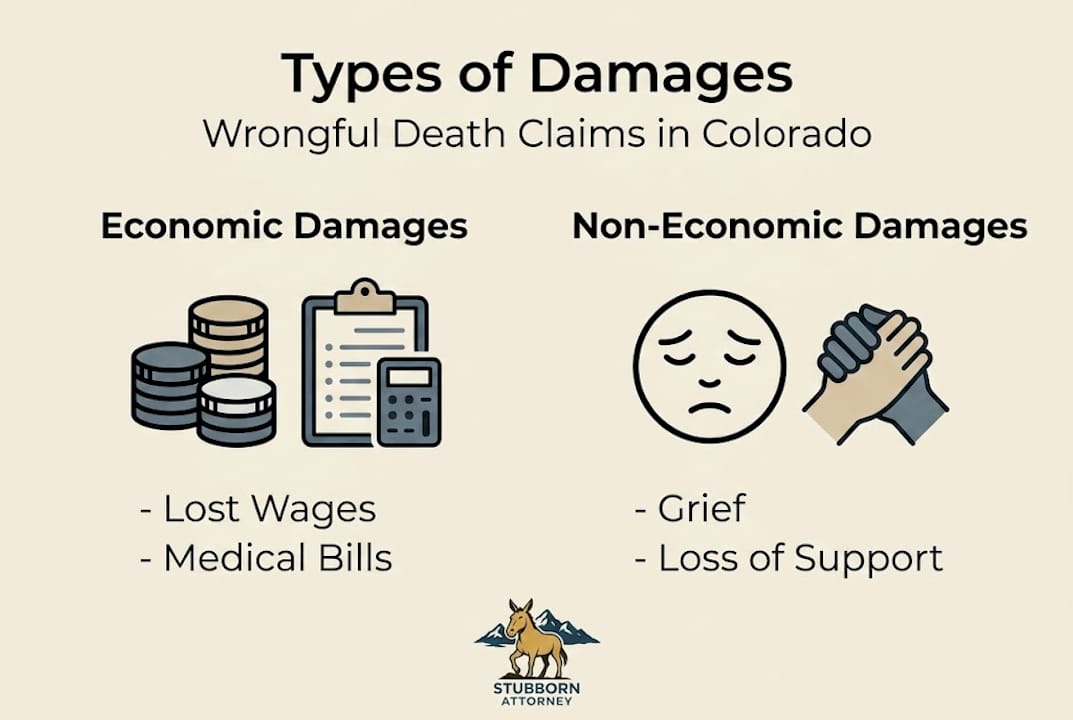
After seeing typical cases, let’s break down how damages and compensation are determined. Colorado wrongful death law allows surviving family members to recover two broad categories of damages: economic and non-economic. Each works differently, and each is subject to different rules.

Economic damages
Economic damages cover the measurable financial losses caused by the death. These are not capped in wrongful death cases and can include:
- Lost income and future earning capacity the decedent would have provided
- Lost benefits such as health insurance, pension contributions, and retirement savings
- Medical expenses incurred before death
- Funeral and burial costs
- Value of household services the decedent provided
Calculating economic damages in a wrongful death case requires forensic economists and vocational experts who can project the decedent’s lifetime earnings, adjust for inflation, and account for benefits. A skilled laborer who dies at 35 represents decades of lost wages. A stay-at-home parent’s economic value includes the cost of replacing childcare, cooking, home maintenance, and other services.
Non-economic damages
Non-economic damages cover grief, loss of companionship, pain and suffering experienced by survivors, and the emotional impact of losing a family member. Colorado does cap these in some circumstances, which is where families are often surprised.
| Category | Cap applies? | Current limit |
|---|---|---|
| Standard wrongful death (non-economic) | No cap in most cases | Unlimited |
| Government defendant (non-economic) | Yes | $387,000 per person (adjusted) |
| Medical malpractice wrongful death | Yes (phased increase) | Up to $1.575M |
| Felonious killing exception | Cap lifted | Unlimited |
| Economic damages | No cap | Unlimited |
| Punitive damages | Not capped by statute | Tied to compensatory award |
The felonious killing exception is one of the most important and least understood rules in Colorado wrongful death law. If the death was caused by a felony, the non-economic damage cap is removed entirely. This creates a significant strategic decision in cases that involve criminal conduct, because characterizing the defendant’s behavior appropriately can dramatically change the potential recovery.
Punitive damages
Punitive damages are awarded to punish genuinely reckless or malicious conduct and to deter similar behavior by others. They are separate from compensatory damages and not subject to the same caps. In Colorado, punitive damages generally cannot exceed the amount of compensatory damages awarded, but that still leaves enormous room in high-value cases. The $123 million punitive award in the Glenwood Caverns case reflects what is possible when a jury is truly outraged by the defendant’s conduct.
Reviewing a full injury compensation types guide helps families understand all available recovery categories before they sit down with an attorney. Many families focus only on funeral costs and lost wages when there are often substantial additional damages available. Understanding financial compensation after crash scenarios helps illustrate how each category adds up in practice.
A realistic look at settlement values
More than 95% of wrongful death cases in Colorado resolve through settlement rather than trial. Settlement amounts depend on the strength of the liability evidence, the defendant’s insurance coverage or assets, the economic value of the decedent’s life, the age and number of surviving dependents, and whether punitive damages are realistically available. Cases with clear liability and strong economic damages tend to settle at the higher end.
Navigating procedure and legal complexities
To ensure claims aren’t lost to procedural mistakes, we outline key legal complexity and deadlines next. Wrongful death litigation in Colorado involves multiple procedural requirements that go beyond simply filing a complaint. Missing any one of them can severely damage or eliminate your claim.
Statute of limitations
The standard deadline for filing a wrongful death claim in Colorado is two years from the date of the decedent’s death. This is firm. Courts rarely grant exceptions. If you believe a loved one’s death may have involved negligence, consulting an attorney well before the two-year mark is essential because building a strong case takes time.
Government defendants: special rules
When a death involves a government employee, a government vehicle, or a government-owned property, entirely different rules apply. You must file a formal notice of claim within 182 days of discovering the injury (or the death). Failure to file this notice on time typically bars the claim permanently. After filing, you must wait for the government to respond before you can proceed to court.
Government defendants in Colorado also benefit from damage caps. Under the Colorado Governmental Immunity Act, non-economic damages against government defendants are capped at $387,000 per person, adjusted periodically. Total recovery per incident is also limited. These caps make early case valuation especially important when government entities are involved.
Here is a comparison of standard wrongful death procedures versus government wrongful death procedures:
| Requirement | Standard claim | Government claim |
|---|---|---|
| Statute of limitations | 2 years from death | 2 years, but notice required first |
| Pre-filing notice | Not required | 182-day notice required |
| Non-economic cap | None (standard cases) | $387,000 per person |
| Punitive damages | Available | Generally not available |
| Expert review required | Case-specific | Often yes |
Medical malpractice wrongful death
Medical malpractice wrongful death claims carry their own additional requirements. Colorado requires a certificate of review, which is a statement from a qualified expert attesting that the claim has merit, filed within 60 days of the complaint. Failure to file this certificate results in dismissal. Medical malpractice claims also face phased damage caps reaching $1.575 million for non-economic damages under current Colorado law, though economic damages remain uncapped.
Common procedural pitfalls
- Waiting too long to consult an attorney, leaving insufficient time to gather evidence
- Missing the 182-day government notice window because the family did not know it applied
- Failing to obtain the required certificate of review in medical malpractice cases
- Allowing comparative negligence arguments to go unchallenged because evidence was not preserved
- Filing in the wrong court or jurisdiction
Colorado’s modified comparative negligence rule adds another layer of procedural complexity because the defense will aggressively pursue evidence of the decedent’s fault from day one. Accident reconstruction experts, phone records subpoenas, and employment history requests are all common tactics designed to raise the decedent’s fault percentage above 50%.
Pro Tip: If a government vehicle or employee was involved in your loved one’s death, do not wait. The 182-day notice clock starts running immediately, and missing it is almost always fatal to the claim. Review the full injury lawsuit timeline with an attorney as soon as possible.
Families dealing with premises liability deaths, like a fatal slip and fall on commercial property, face a different set of evidentiary challenges. The slip and fall injury guide for Colorado victims covers those specific complexities. And understanding car accident claim types helps families involved in vehicle-related deaths navigate their specific options.
A fresh perspective on Colorado wrongful death cases
After more than a decade handling injury cases in Colorado, including as a former federal claims adjudicator who has seen how large insurers and government agencies evaluate these claims from the inside, here is the honest truth most articles won’t say plainly.
The $205 million Glenwood Caverns verdict gets headlines. It should. But families who walk into consultations expecting similar results often leave disappointed, not because their loss is less real, but because the legal path to a verdict that size is extremely narrow. That jury found recklessness. The facts were undeniable and the victim was a child. Those cases are not the norm.
What I see every day are wrongful death case outcomes that quietly, without any headlines, deliver meaningful compensation because the attorney built an airtight claim on the details: every medical bill documented, every lost benefit calculated, every witness preserved. Most clients ultimately care more about a fair result that actually arrives than a theoretical massive verdict that never materializes.
Here is what I want you to understand: caps don’t limit punitive damages, and they don’t limit economic damages. The real limit in most cases is the quality of the evidence and the completeness of the claim. An expert review of the latest wrongful death payouts confirms that high verdicts are the exception, not the baseline, and that the gap between a thorough claim and a sloppy one is measured in hundreds of thousands of dollars. Focus on building the complete case. That is where the real difference is made.
Next steps: Colorado resources for wrongful death claims
If you believe a loved one’s death may have involved negligence or recklessness, the most important step you can take right now is getting your facts in front of an attorney who knows Colorado law and knows how insurance companies and government entities evaluate these claims from the inside.
At Malnar Injury Law, now at StubbornAttorney.com, we represent only injured victims and their families. We have settled hundreds of injury cases and recovered millions of dollars for Colorado families, including those navigating the most complex wrongful death situations. We know what adjusters look for, what juries respond to, and how to build a claim that does not leave money on the table.
Review real personal injury case outcomes to understand what Colorado families have actually recovered. Start your injury case evaluation to learn what your specific situation may be worth. And use our detailed compensation guide to understand every category of damages available to your family. We don’t let go.
Frequently asked questions
Who can file a wrongful death claim in Colorado?
In Colorado, the surviving spouse has exclusive rights during the first year after death; after that, children and parents may also file if no spouse exists or if the spouse chooses not to act.
What is the statute of limitations for wrongful death claims in Colorado?
The deadline is generally two years from the date of death, but families pursuing claims against government defendants must also file a formal notice of claim within 182 days of discovering the death, which is a much tighter window.
Are there caps on damages for wrongful death cases in Colorado?
Economic damages and punitive damages are not capped, but government and medical malpractice defendants benefit from non-economic damage caps, and the felonious killing exception removes the non-economic cap when criminal conduct caused the death.
How are settlements and verdicts determined in Colorado wrongful death cases?
Settlement amounts depend on liability strength, economic loss, available insurance, and whether punitive damages apply; over 95% of cases resolve before trial, with many serious claims settling between $500,000 and $1 million or more.