

Colorado injury compensation workflow: Step-by-step guide
TL;DR:
- Colorado injury claims involve multiple stages from reporting to negotiation, requiring timely action.
- Accurate documentation and proper filing are crucial for maximizing compensation and avoiding delays.
- Legal support helps victims navigate the process, negotiate better settlements, and prevent common pitfalls.
One moment you’re going about your day, and the next you’re in the emergency room wondering how you’re going to pay your bills, deal with your employer, and navigate a legal process you’ve never faced before. That feeling of being completely overwhelmed is something almost every injured victim in Colorado knows. The good news is that the injury compensation workflow has a clear structure, and once you understand each stage, you can protect your rights and recover what you’re truly owed. This guide walks you through every phase, from the moment of injury all the way through final payout, so nothing catches you off guard.
Table of Contents
- Understanding the injury compensation workflow in Colorado
- Preparing your case: Essential steps and documentation
- Filing and managing your injury claim: Step-by-step process
- Verifying and negotiating your compensation: What to expect
- A fresh perspective: Common pitfalls and smarter shortcuts in Colorado injury claims
- How Colorado injury attorneys can streamline your compensation workflow
- Frequently asked questions
Key Takeaways
| Point | Details |
|---|---|
| Know the workflow | Understanding each stage in Colorado’s injury compensation process improves your chances of success. |
| Document everything | Accurate, thorough records and official forms are essential for maximizing your payout. |
| Watch for deadlines | Missing filing dates or requests can jeopardize your claim, so keep calendar reminders for each step. |
| Negotiate with confidence | Use official guidelines and professional support to ensure your compensation is fair and accurate. |
| Legal help matters | A skilled attorney can help streamline the workflow and avoid costly mistakes. |
Understanding the injury compensation workflow in Colorado
The injury compensation workflow in Colorado is not a single straight line. It’s a series of connected stages, and skipping even one can cost you real money. Think of it like a mountain trail: you have to take each switchback in order, or you risk losing your footing entirely.
At its core, the workflow exists to make sure injured victims receive fair compensation for medical costs, lost wages, and other damages caused by someone else’s negligence or a workplace accident. The Colorado Department of Labor and Employment offers verified guidance on injury compensation procedures, and understanding their role early puts you in a much stronger position.
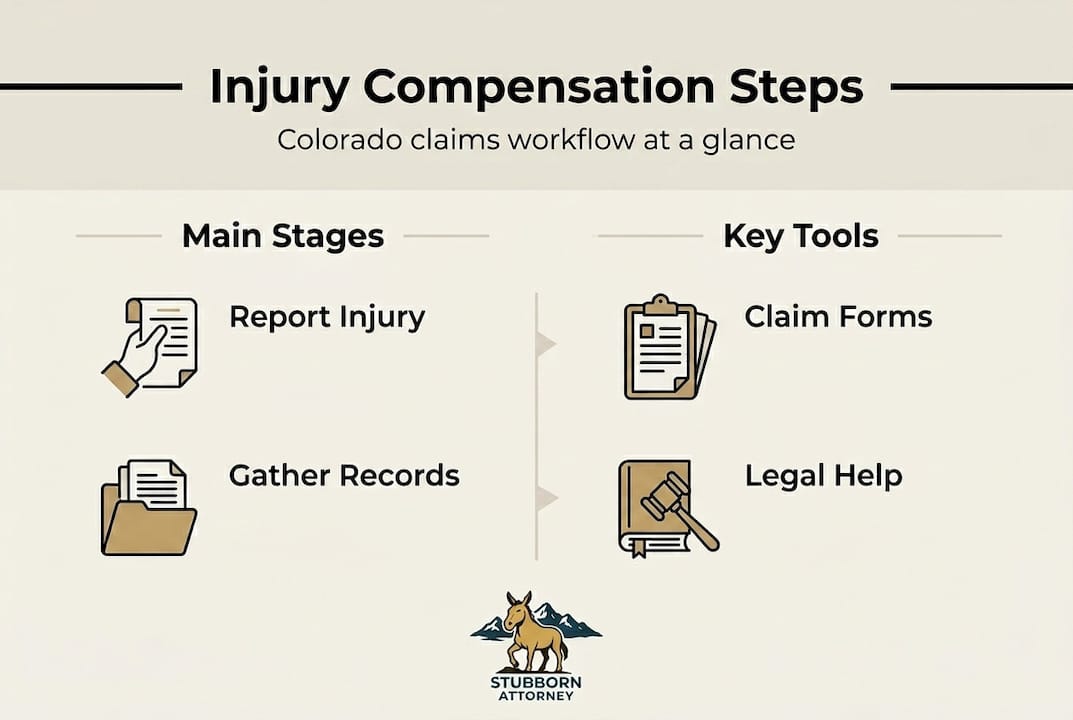
The five main stages of the workflow are:
- Reporting: You notify your employer, the at-fault party, or the relevant insurer as soon as the injury occurs.
- Medical care: You seek prompt treatment and begin building your medical record.
- Documentation: You collect every piece of evidence, from photos and witness statements to bills and official reports.
- Claim filing: You submit the correct forms to the right agency or insurer within Colorado’s deadlines.
- Negotiation or legal action: You or your attorney negotiate a settlement, or the case moves toward a formal hearing.
Not every injury claim follows the same path, though. Workers’ compensation claims, car accident claims, and general personal injury cases each involve different agencies, insurers, and legal rules.
| Claim type | Filed with | Key agency | Deadline |
|---|---|---|---|
| Workers’ compensation | Employer’s insurer | CDLE/Division of Workers’ Compensation | 10 days to report injury |
| Car accident claim | At-fault driver’s insurer | Colorado DOI | 3-year statute of limitations |
| General personal injury | At-fault party’s insurer or court | Colorado courts | 3-year statute of limitations |
For car accident claim types, Colorado follows a fault-based system, meaning the driver who caused the crash is responsible for covering damages. That’s a critical distinction from a workers’ comp claim, which is a no-fault system where your employer’s insurer pays regardless of who caused the accident.
Here is a number that should motivate you to follow the workflow carefully: Colorado victims may recover up to 85% of their medical expenses with proper documentation in place. That number drops dramatically when records are incomplete or deadlines are missed. The workflow is not just bureaucratic box-checking. It is the mechanism that turns your pain and losses into real, verified compensation.
Understanding this big picture before you dive into the details means you’ll approach every step with purpose rather than confusion.
Preparing your case: Essential steps and documentation
Preparation is where most cases are actually won or lost. By the time you sit across from an insurance adjuster or walk into a negotiation, the quality of your preparation has already determined much of the outcome.
Here is the step-by-step prep process every Colorado injury victim should follow:
- Document your injuries immediately. Take dated photos of visible injuries, the accident scene, and any property damage. The sooner you do this, the harder it is for anyone to challenge your account.
- Seek medical treatment right away. A gap in treatment is one of the first things adjusters look for. Even if you feel okay, get evaluated. Some injuries, like soft tissue damage or concussions, show up hours or days later.
- Report to your employer or insurer. For workplace injuries, Colorado law requires you to notify your employer within four days. For car accidents, notify your insurer promptly regardless of fault.
- Request and complete Colorado official forms. Official paperwork matters. Missing or incorrect forms can delay or invalidate your claim.
- Verify employer coverage before filing. Colorado victims must verify employer coverage before submitting a workers’ comp claim, as uninsured employers create a different legal path.
Once you have started gathering materials, you need to know exactly which documents carry the most weight.

| Document | Where to get it | Why it matters |
|---|---|---|
| Medical records and bills | Your healthcare providers | Proves injury severity and costs |
| Accident or incident report | Employer, police, or property owner | Official record of how the injury happened |
| Wage records or pay stubs | Your employer or HR | Establishes lost income claim |
| Witness statements | At the scene or shortly after | Corroborates your version of events |
| Official claim forms | CDLE or insurer | Required to formally open your claim |
| Photos and videos | Your phone or surveillance footage | Visual evidence that is hard to dispute |
Using a legal checklist for accidents is one of the smartest moves you can make early in this process. It keeps you organized and ensures nothing falls through the cracks. When choosing a lawyer to help you, look for someone who asks detailed questions about your documentation right from the first conversation. That’s a sign they understand what actually wins cases.
Pro Tip: Create a dedicated folder, physical or digital, for every document, email, and text message related to your injury. Record the date, time, and name of every person you speak with about your claim. This habit alone can be the difference between a strong case and a weak one.
Timely and accurate prep work is not optional. It’s the foundation that every later step depends on.
Filing and managing your injury claim: Step-by-step process
Once your preparation is solid, it’s time to file. This stage feels intimidating to a lot of people, but it becomes manageable when you break it into clear actions and stay organized.
Colorado gives you several options for filing, depending on your claim type:
- Online: Many workers’ comp and insurer claims can be started digitally through the CDLE portal or your insurer’s website.
- In person: You can visit a CDLE office or your employer’s HR department to submit paperwork directly.
- By mail: Official claim forms can be mailed, but this adds processing time, so always use certified mail and keep a copy.
Here is how to move through the filing process without creating problems for yourself:
- Get the correct forms. Use the official claim forms provided by the CDLE, as CDLE official forms streamline the filing process and reduce errors.
- Fill out every field completely. Partial submissions cause delays. If a field doesn’t apply, write “N/A” rather than leaving it blank.
- Attach all supporting documents. Every form should be accompanied by your medical records, accident report, and any wage information requested.
- Submit before the deadline. Missing a filing deadline can end your claim before it starts. Colorado’s workers’ comp system has strict timelines, and courts rarely grant exceptions.
- Confirm receipt. Whether you file online or by mail, get written confirmation that your claim was received. Screenshot or print confirmation emails.
- Respond quickly to information requests. Insurers and legal teams often request additional records or clarifications. A slow response can be interpreted as lack of cooperation and used against you.
The single most common reason injury claims stall in Colorado is incomplete paperwork. One missing signature or absent document can push your timeline back by weeks.
Pro Tip: Set calendar reminders for every deadline connected to your claim, including response windows for insurer requests, medical appointment follow-ups, and any scheduled hearings. Cross-check your forms against the CDLE guides before submitting.
Think carefully about reasons to pursue compensation every time the process feels frustrating. Your medical bills are real. Your lost wages are real. The paperwork burden is temporary, but the compensation you recover will matter for years. Reviewing financial compensation after a crash can remind you of the full value you may be entitled to, including categories many victims forget to claim.
Quick filing reminders:
- Double-check every date, name, and dollar amount on your forms
- Never sign a release or settlement offer without fully understanding it
- Keep your insurer and attorney updated on any changes to your medical status
- Never give a recorded statement to the opposing insurer without legal guidance
Verifying and negotiating your compensation: What to expect
Filing your claim is not the finish line. What happens next determines whether you walk away with fair compensation or leave money on the table. This stage is where having a clear strategy makes a real difference.
Compensation in Colorado injury cases is typically calculated based on these factors:
- Medical costs: Current bills plus estimated future treatment
- Lost wages: Income you’ve already lost plus reduced earning capacity going forward
- Pain and suffering: A multiplier applied to economic damages in many cases
- Property damage: Repair or replacement costs for vehicles and other property
- Out-of-pocket expenses: Travel to medical appointments, prescription costs, and similar expenses
The CDLE compensation guidelines provide a backbone for understanding what you’re entitled to, but real-world negotiation often goes beyond what the forms capture. CDLE/DWC guidelines help verify that the numbers you’re offered actually reflect your documented losses.
| Outcome factor | Without legal support | With legal support |
|---|---|---|
| Average settlement amount | Lower, often near minimum offer | Significantly higher in most cases |
| Claim processing time | Longer due to errors and delays | Faster with organized, complete filings |
| Likelihood of underpayment | Higher | Lower, with active negotiation |
| Risk of signing unfair releases | High | Reduced with attorney review |
Looking at real case outcomes in Colorado shows a consistent pattern: victims who understand negotiation basics and have professional support recover more than those who accept the first offer. Review Colorado compensation details to understand the full picture of what you may be owed.
Negotiation tips that work:
- Never accept the first offer. Insurers routinely open low to test whether you’ll push back.
- Present a detailed demand letter backed by every document in your file.
- Stay calm and factual. Emotional arguments rarely move adjusters. Numbers and records do.
- Know your minimum acceptable number before negotiations begin.
Documents to check for accuracy before accepting any offer:
- Your itemized medical bills and records
- Wage loss calculations and pay stubs
- Any insurer worksheets or valuation summaries they provide
- Official CDLE or DWC determination letters
- The release agreement itself, word by word
If your payout seems lower than your documented losses justify, don’t sign anything yet. Request a written explanation of how the amount was calculated and compare it line by line against your records. This is where having an attorney who knows how to read these calculations is invaluable.
A fresh perspective: Common pitfalls and smarter shortcuts in Colorado injury claims
Here is something most guides won’t tell you: filling out the right forms correctly is necessary, but it’s not enough. I’ve spent years on both sides of injury claims, first as a federal claims adjudicator and now as an injury attorney in Colorado. That experience showed me exactly how adjusters think and where victims consistently leave money behind.
The biggest mistake injured victims make is treating their claim like a form-completion exercise. Forms create a record. They don’t make your case. What actually moves the needle is the quality and depth of your medical documentation and the credibility of your witness accounts. A detailed physician’s narrative explaining how your injuries affect your daily life is worth far more than a stack of billing statements alone.
Another overlooked shortcut: use template demand letters as a starting framework, not a final product. Customize every detail to your specific injuries, losses, and circumstances. Generic letters get generic responses.
The Colorado Department of Labor and Employment provides an excellent backbone for procedure, but local knowledge of how Colorado adjusters and courts actually behave gives you a decisive edge. Official guides tell you the rules. Experience tells you how the game is actually played.
Pro Tip: Don’t wait for a denial letter to start communicating. Proactively reach out to your adjuster, confirm they have everything they need, and create a written record of every interaction. Adjusters are more careful with claimants who are clearly organized and engaged.
Mistakes to avoid and quick wins:
- Don’t delay medical treatment, gaps hurt your credibility
- Don’t post about your injury or activities on social media
- Do get a personal injury lawyer involved early, even for a free consultation
- Do request written confirmation of every conversation with your insurer
- Don’t assume the first settlement offer reflects your actual damages
How Colorado injury attorneys can streamline your compensation workflow
Working through the injury compensation workflow alone is possible. But doing it with experienced legal support is faster, less stressful, and statistically more likely to result in full compensation. At Malnar Injury Law, we know exactly how large insurers evaluate your claim because we’ve worked inside that system. We’ve settled hundreds of injury cases and recovered millions of dollars for people who were once exactly where you are right now.
Our team can help you build a complete case file from day one, catch errors before they become costly, and negotiate with the persistence that defines everything we do. Start with our legal checklist to see where your case stands. Read through the reasons to start your case if you’re still unsure whether to move forward. When you’re ready to take action, reach out to a personal injury attorney at Malnar Injury Law for a free case evaluation. We don’t let go once we take your case.
Frequently asked questions
What is the first step in the Colorado injury compensation workflow?
The first step is reporting your injury and documenting all relevant details using official forms from the Colorado Department of Labor and Employment. Acting quickly creates a strong foundation for everything that follows.
How can I verify if my employer is covered for injury claims?
Colorado victims can verify employer coverage through the CDLE’s online tools and should also request written confirmation from their HR department or the employer’s insurance carrier.
What documents are crucial when filing an injury claim in Colorado?
Key documents include medical records, accident reports, employer communications, wage records, and official claim forms from the CDLE. Missing any of these can delay or reduce your compensation.
How long does Colorado’s compensation workflow usually take?
Timelines vary based on case complexity, but most injury compensation cases in Colorado resolve within a few months when all paperwork is accurate, complete, and submitted on time. The CDLE workflow guidance outlines expected processing windows for different claim types.
What if my compensation is lower than expected?
Verify all payout calculations against your documented losses using CDLE compensation guidelines and request a written breakdown from your insurer. If the numbers don’t align, consult an attorney before signing any release.