

Why attorneys fight insurance companies: get fair payouts in Colorado
TL;DR:
- Insurance companies in Colorado often offer lowball settlement offers and delay payments to reduce costs.
- Hiring an attorney increases settlement amounts by approximately 35% and leverages Colorado’s bad faith laws.
- Early legal intervention, including filing complaints and lawsuits, enhances victims’ chances of fair compensation.
When you file an injury claim in Colorado, the insurance company is not on your side. That might sound blunt, but the numbers back it up. Lowballs appear in 60% of claims, meaning most accident victims receive an initial offer that is far below what their case is actually worth. If you accept that first offer without legal help, you could be leaving thousands of dollars on the table permanently. The good news is that an experienced attorney can shift the balance. This guide breaks down the tactics insurers use, why attorneys push back so hard, how legal representation changes your results, and what Colorado law gives you the power to do when an insurer treats you unfairly.
Table of Contents
- Understanding the insurance company’s playbook
- Why attorneys challenge insurers: Core motivations
- How an attorney changes the outcome: Impact on your case
- The legal landscape: Colorado rules and strategies
- Red flags: When you should consult an attorney
- The uncomfortable truth about insurance fights in Colorado
- Connect with experienced Colorado attorneys for real results
- Frequently asked questions
Key Takeaways
| Point | Details |
|---|---|
| Insurers limit payouts | Most insurance companies use tactics that undervalue or deny claims after accidents. |
| Attorneys improve outcomes | Research shows hiring a lawyer can increase your compensation by 35 percent or more. |
| Colorado laws protect victims | Colorado enforces strict standards and allows double or punitive damages for unfair denials. |
| Take action early | If you spot any red flags, contacting an attorney quickly improves your chances for fair recovery. |
Understanding the insurance company’s playbook
Most people assume that after an accident, filing a claim is a straightforward process. You report the crash, submit your medical bills, and receive a fair check. That is rarely how it works. Insurance companies are corporations with one core priority: protecting their bottom line. Understanding how they operate is the first step toward protecting yourself.
Here are the most common tactics insurers use to reduce or deny your claim:
- Lowball offers: The insurer opens with a number far below your actual damages, counting on you to accept quickly before you understand what your case is truly worth.
- Delay tactics: By stretching out the investigation and payment process, adjusters hope you grow frustrated or desperate enough to accept less.
- Claim denial: Insurers may outright reject valid claims, citing vague policy language or alleging contributory fault on your part.
- Recorded statement traps: Adjusters ask for recorded statements early, then use your own words to minimize your claim later.
- Disputing medical necessity: Even with a doctor’s recommendation, insurers may argue that certain treatments were not strictly necessary.
Colorado law holds insurers to what is called an “objective reasonableness” standard. This means a claims decision must be reasonable based on what the insurer knew at the time of denial, not what they learned later. In practice, this matters enormously because it prevents insurers from retroactively justifying a bad decision with information they gathered after the fact.
“An insurer cannot hide behind facts discovered after an unreasonable denial to make that denial seem acceptable. The clock starts when they make the call.” — Colorado bad faith case law principle
Yet even with this protection in place, attorneys boost settlements 35% on average when they represent injured victims versus those who go it alone. That gap exists because most unrepresented claimants don’t know these standards exist, let alone how to enforce them. Adjusters are trained professionals who handle hundreds of claims a year. They know exactly which levers to pull. When you’re navigating types of car accident claims for the first time after an injury, you are at a serious disadvantage without someone equally skilled in your corner.
The insurer’s goal is not to be your enemy. It’s simply to close your file for as little money as possible. Recognizing that shift in perspective changes how you approach everything that follows.
Why attorneys challenge insurers: Core motivations
Knowing how insurance companies operate helps explain why Colorado attorneys go the extra mile for their clients. It is not just about collecting a fee. There are real legal, financial, and ethical forces driving an attorney to fight hard on your behalf.
Here is why a skilled injury attorney pushes back against insurers:
- Leveling the playing field: Adjusters have training, data, and corporate resources. Your attorney brings equal firepower, including case law, expert witnesses, and litigation experience.
- Double damages and punitive awards: Under Colorado’s bad faith statutes, if an insurer unreasonably delays or denies a valid claim, courts can award double the covered benefit amount plus attorney fees. That financial risk motivates serious negotiation.
- Precedent-setting power: Strong cases build a body of law that deters future insurer misconduct. An attorney isn’t just fighting for you. They are shaping the rules for the next victim.
- Leverage from verdicts: Large verdicts become negotiating tools. A 2025 brain injury bad faith verdict reached $145 million, a figure that sends a clear message to insurers about what juries are willing to do.
- Case law as ammunition: Colorado courts have ruled in favor of claimants 88% of the time in bad faith insurance cases, giving attorneys strong legal footing from day one.
When an attorney walks into a negotiation knowing those statistics and carrying that precedent, the conversation changes. The insurer’s legal team knows the exposure. They know what juries in Colorado have done. That knowledge is why offers go up when an attorney gets involved.
Pro Tip: Don’t wait until the insurer has already denied your claim to call a lawyer. The best time to involve an attorney is before you give any recorded statement or sign anything. Early involvement protects evidence and preserves your strongest negotiating position.
There is also an ethical dimension here that matters. Understanding why pursue an injury case is about more than money. It is about holding a corporation accountable for treating you like a number on a spreadsheet when you were genuinely hurt. Attorneys who represent only injured victims, as we do at Malnar Injury Law, stay on one side of that line by design. That focus sharpens the fight. The financial compensation in Colorado you are owed covers your medical care, lost wages, and the real impact this injury has had on your life. An attorney who understands that does not settle for less.
How an attorney changes the outcome: Impact on your case
Understanding your attorney’s motivations leads to the next logical question: what is actually different when a lawyer steps in? The answer shows up clearly in the data and in the real experience of clients across Colorado.
Represented vs. unrepresented claim results
| Factor | Without an attorney | With an attorney |
|---|---|---|
| Initial offer accepted | Often yes | Rarely without review |
| Settlement value | Frequently undervalued | Average 35% higher |
| Bad faith leverage | Rarely used | Actively pursued |
| Trial readiness | Not applicable | Signals serious risk to insurer |
| Knowledge of DOI process | Usually none | Fully utilized |
The difference is not subtle. Attorneys raise settlements 35% on average, and that figure does not account for cases where legal pressure results in a claim being reopened entirely after an improper denial.

$26.4 million recovered for Colorado claimants
The Colorado Division of Insurance (DOI) recovered $26.4 million in 2023 and 2024 from insurers who mishandled claims. That money went back to people just like you. It happened because those claims were challenged, not accepted at face value.
Pro Tip: When an attorney is prepared to go to trial, insurers take notice immediately. A lawyer who has a history of taking cases to verdict is a fundamentally different opponent than one who always settles. That trial-readiness alone often drives higher pre-trial offers.
When you look at Colorado case outcomes, a pattern becomes clear: cases with early attorney involvement tend to resolve at higher values and in less time than those where victims tried to negotiate alone. Part of that is knowledge. Part of it is the ability to read the injury lawsuit timeline and know exactly when to apply pressure, when to file, and when to wait. Insurers use delay as a weapon. Attorneys use deadlines as leverage. That role reversal is powerful.
Ryan Malnar spent years as a federal government claims adjudicator before becoming an attorney. That background means he has literally sat on the other side of the table, evaluating exactly what large organizations look for when deciding how little to pay. That inside knowledge changes how cases get built and how negotiations unfold.
The legal landscape: Colorado rules and strategies
With the difference an attorney makes in outcomes clear, it is important to understand the unique legal processes and options under Colorado law. Knowing these tools helps you see why early action matters so much.
The objective reasonableness standard
Colorado courts evaluate insurer behavior using the objective reasonableness standard. This means the insurer’s conduct is judged based on what a reasonable person would have done with the information available at the time. In Soicher v. State Farm, the court confirmed that facts discovered after an initial denial cannot be used to justify that denial retroactively. In plain terms: if the insurer made a bad call when they first reviewed your claim, they cannot clean it up later by pointing to new evidence.
Colorado Division of Insurance (DOI) complaints
| Action | Purpose | When to use it |
|---|---|---|
| DOI complaint | Creates official record, triggers review | Before or alongside lawsuit |
| Bad faith lawsuit | Seeks double damages and fees | After unreasonable denial or delay |
| Demand letter | Signals intent and sets deadlines | Early in dispute |
| Mediation | Can resolve without full trial | Mid-dispute, insurer agreeable |
Filing a DOI complaint is a strategic move, not just a bureaucratic step. It creates a paper trail that demonstrates the insurer’s pattern of behavior, and it signals that you are not going away. Colorado law, explained further in resources covering insurance denial laws, gives the DOI real authority to investigate and sanction insurers.
Here is when to use each tool:
- File a DOI complaint when you have experienced unexplained delays or a denial that lacks a clear, documented reason.
- Pursue a bad faith lawsuit when the insurer has repeatedly failed to meet reasonable timelines or denied a clearly covered claim.
- Use both together for maximum leverage, especially in cases involving serious injuries or large claimed amounts.
Reviewing a car accident checklist right after your crash ensures you gather the documentation that supports every step of this process. Records matter. Timestamps matter. Every contact with the insurer should be logged.
Red flags: When you should consult an attorney
With a clear roadmap of Colorado law, you can be proactive. Here is how to recognize the moment to call a lawyer, before you have already lost ground.
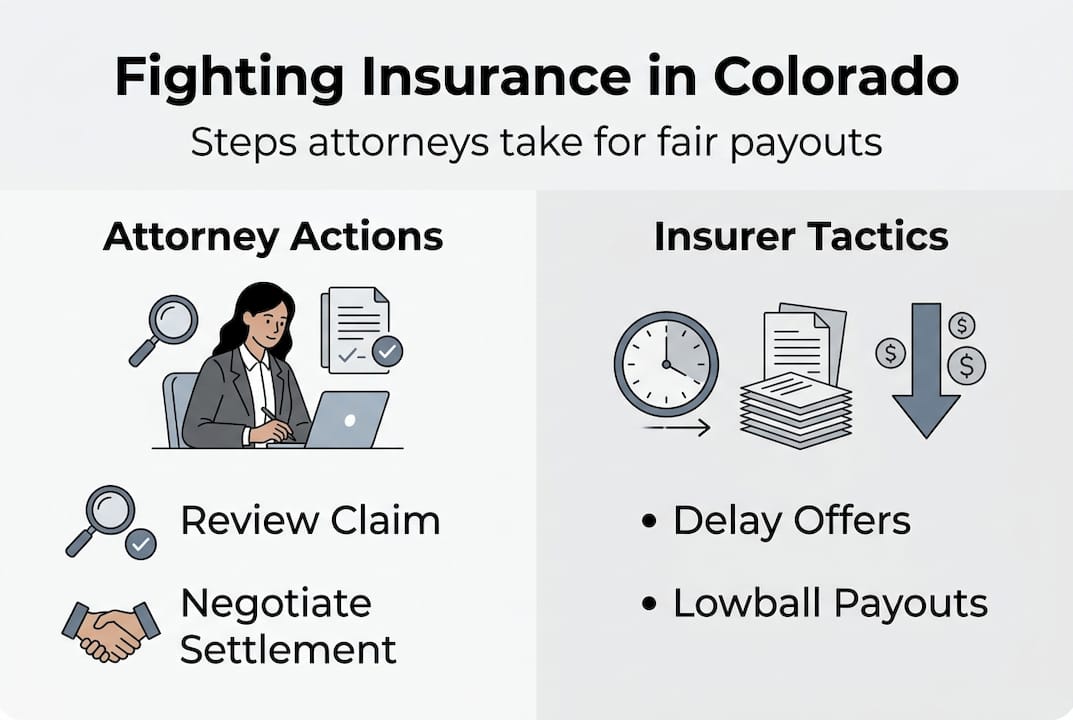
Research shows that 60% of initial claims are met with lowball or delayed offers. That means the odds are already against you from the first contact. Knowing the warning signs helps you act before the situation worsens.
Warning signs that demand immediate attorney consultation:
- Payment has been delayed without explanation. An insurer that drags out a response without giving you a clear reason is not conducting a thorough investigation. They are stalling.
- Your claim was denied but no specific policy language was cited. Vague denials are often designed to discourage you. A legitimate denial comes with chapter and verse from your policy.
- The adjuster is pushing you to settle fast. Quick settlement pressure is a red flag. It usually means the insurer knows your claim is worth more than they are offering.
- You received confusing or contradictory paperwork. Dense legal language is used intentionally. If you cannot understand why they paid what they paid, that confusion is worth investigating.
- Your medical treatment is being questioned. If an adjuster disputes your doctor’s recommended care, that is a sign the insurer is building a case to reduce your payout, not help you recover.
At each of these points, here is what to do:
- Gather every record: medical bills, accident reports, photos, and correspondence.
- Log every phone call with the insurer: date, time, name of the person you spoke with, and what was said.
- Do not sign any release or settlement agreement without legal review.
- Contact an attorney immediately for a free evaluation.
Pro Tip: Time limits matter in Colorado. The statute of limitations for personal injury claims is generally three years, but certain deadlines related to insurance disputes can arrive much sooner. Acting early keeps all your options open.
Understanding the qualities of a good injury lawyer helps you choose someone who will recognize these red flags and respond to them with speed and precision.
The uncomfortable truth about insurance fights in Colorado
Most articles about insurance disputes frame this as a simple conflict: the victim wants more money, the insurer wants to pay less. But that framing misses something important.
Insurance companies are not simply greedy. They are strategically patient. Their entire business model depends on a predictable fact: most people will not escalate. Most people will accept a lowball offer, move on, and never realize how much they left behind. The insurer does not need to win every case. They just need you to give up before you ever find out what your case is really worth.
The “friendly” adjuster who calls to check on your recovery is not a bad person. But they are following a corporate script designed to keep the conversation warm while the clock runs and evidence gets stale. That warmth is a strategy. It works because it feels personal, and most people are reluctant to go from a polite conversation to a legal dispute.
What we have seen in practice is that the clients who wait the longest to seek help are often the ones who trusted that process the longest. By the time they reach out, witnesses have become harder to locate, medical records are incomplete, and the insurer has already built a file full of notes that favor their position. Looking at real-world case outcomes from Colorado, the cases that shifted most dramatically in the client’s favor were nearly always the ones where an attorney got involved before the insurer had time to build that narrative. Early action is not aggressive. It is smart.
Connect with experienced Colorado attorneys for real results
If you recognize any of these challenges in your own situation, it is time to consider your next step. At Malnar Injury Law, we represent only injured victims, never insurance companies. We know exactly how insurers build their cases because our founder spent years as a federal claims adjudicator before switching sides for good. That inside knowledge drives every case we take.
We have settled hundreds of injury claims and recovered millions of dollars for people across Colorado. The reasons to pursue your injury case are real: your medical bills, your lost income, your recovery. You deserve an attorney who is as stubborn as the challenge in front of you. Contact us today for a free case evaluation and find out exactly what your claim may be worth.
Frequently asked questions
What are the most common insurance tactics after a Colorado accident?
Insurers often delay responses, make lowball settlement offers, or deny valid claims without citing specific policy language. Lowball offers appear in 60% of claims, making early legal review essential.
Does hiring an attorney really increase my settlement?
Yes. Studies show that attorneys raise settlements 35% on average compared to unrepresented claims, and the difference is often far greater in serious injury cases.
How do Colorado laws protect accident victims from unfair insurance practices?
Colorado applies an objective reasonableness standard to insurer conduct and can award double or even punitive damages when a company unreasonably denies or delays a valid claim.
What should I do if my claim was denied or payment delayed?
Act quickly by gathering all paperwork, logging every communication with the insurer, and contacting a Colorado injury attorney for a free review of your rights and options.
Is it better to file a DOI complaint or go straight to a lawsuit?
Filing a Division of Insurance complaint first creates a documented record and often produces leverage that strengthens any subsequent bad faith lawsuit.