

Injury case evaluation: maximize your claim potential
TL;DR:
- An injury case evaluation assesses legal merit and estimates fair compensation for accident victims.
- Proper preparation, including documentation and clear facts, is crucial for an accurate assessment.
- A thorough evaluation leads to realistic expectations and stronger bargaining power in settlements.
Most Colorado accident victims assume their personal injury claim is straightforward. File a report, see a doctor, wait for a check. But that assumption leaves serious money on the table every single year. A professional injury case evaluation is the step most people skip, and it’s often the difference between a fair settlement and a lowball offer you’re pressured to accept. Whether you were rear-ended on I-25 or T-boned at a busy Colorado Springs intersection, understanding how attorneys review and value your claim changes everything about how you approach it. This guide breaks down exactly what a case evaluation involves, how it works, what factors matter most, and how you can prepare to get the most out of yours.
Table of Contents
- What is an injury case evaluation?
- How injury case evaluation works: The step-by-step process
- Key factors lawyers assess during your injury case evaluation
- Why getting your case evaluation right matters
- How to prepare for your own injury case evaluation
- Our perspective: What most people get wrong about case evaluation
- Connect with the right legal support for your injury case evaluation
- Frequently asked questions
Key Takeaways
| Point | Details |
|---|---|
| Essential first step | A professional case evaluation is crucial for understanding your injury claim’s potential. |
| Evidence-driven process | Providing thorough documentation makes your evaluation faster and more accurate. |
| Colorado-specific issues | Unique factors in Colorado, like comparative fault rules, impact how your case is evaluated. |
| Preparation pays off | Bringing the right documents and information maximizes your case’s outcome. |
| Second opinions matter | It’s wise to get a second legal opinion if you’re unsure about your first evaluation. |
What is an injury case evaluation?
An injury case evaluation is a professional legal review of the facts surrounding your accident, the injuries you sustained, and the potential compensation you may be entitled to receive. It is not the same as a quick phone call where an attorney tells you whether you have a case. It goes much deeper than that.
The goal of a true evaluation is twofold. First, it determines whether your case has legal merit. Second, it estimates what that case might actually be worth. As Malnar Injury Law puts it, an injury case evaluation is the first step in determining if a claim has legal merit and estimating potential compensation. Those two things, merit and value, are what drive every decision your attorney will make going forward.
Many people confuse a consultation with a case evaluation. A consultation is simply an initial meeting where you describe what happened and an attorney decides whether they want to work with you. A case evaluation is a structured, analytical process. It involves reviewing documents, applying Colorado law, assessing fault, estimating damages, and identifying potential obstacles to recovery.
For Colorado residents, this distinction matters because state laws are specific. Colorado follows a modified comparative fault rule, meaning your compensation can be reduced if you share any percentage of fault for the accident. An evaluation that does not account for this nuance can dramatically underestimate or overestimate your claim’s value. Understanding why consider an injury claim under Colorado law is a foundational part of this process.
Here is what a thorough injury case evaluation typically covers:
- Accident facts: What happened, when, where, and who was involved
- Injury documentation: Current diagnosis, treatment history, and future medical needs
- Liability analysis: Who is legally at fault under Colorado statutes
- Financial losses: Medical bills, lost wages, property damage, and pain and suffering
- Insurance coverage: Available policies that could pay your claim
- Legal risks: Any factors that might reduce or eliminate your compensation
A qualified attorney who understands the qualities of a good injury attorney will approach evaluation as a strategic exercise, not a formality. The evaluation and settlement basics from Justia confirm that a thorough early review sets the tone for every negotiation that follows.
“The difference between a consultation and a real case evaluation is like the difference between a weather forecast and a full climate analysis. One gives you a feeling. The other gives you a plan.”
How injury case evaluation works: The step-by-step process
Understanding what case evaluation is sets the stage, but what does this process consist of from start to finish? Case evaluations in Colorado typically begin with a fact-gathering phase and often use a structured, stepwise approach. Here is how that plays out in practice.
1. Initial intake and fact collection
You share the basic details of your accident with the attorney or their team. This includes the date, location, parties involved, and a description of how the accident occurred. This is your first chance to get the full story on record.
2. Document review
The attorney examines the evidence you provide. Police reports, medical records, photographs of the scene, insurance correspondence, and witness statements all get reviewed carefully. Missing documents at this stage slow everything down.
3. Injury and damage assessment
Your injuries are analyzed in the context of your treatment and prognosis. The attorney looks at current medical bills, ongoing treatment needs, and how your injuries affect your work and daily life.
4. Liability determination
Using the evidence available, the attorney forms an initial opinion on who is at fault and to what degree. This is where Colorado’s comparative fault rules come into play.
5. Compensation estimation
The attorney uses the data collected to estimate a range of potential compensation. This includes economic damages like medical costs and lost wages, and non-economic damages like pain and suffering. Tools for case value estimation help set realistic expectations at this stage.
6. Strategy and recommendation
The attorney tells you whether the case is worth pursuing, what approach makes the most sense, and what timeline you might expect.
| Stage | What happens | Common delay cause |
|---|---|---|
| Intake | Facts collected | Incomplete accident details |
| Document review | Evidence analyzed | Missing police or medical records |
| Damage assessment | Injuries quantified | Ongoing treatment not documented |
| Liability review | Fault determined | Unclear accident circumstances |
| Compensation estimate | Value range set | Unknown insurance policy limits |
| Strategy discussion | Plan formed | Client unavailable for follow-up |
Pro Tip: Bring a written timeline of everything that happened from the moment of the accident through your most recent medical appointment. Attorneys who have a clear chronology move through the evaluation process faster and with greater accuracy.
The most common mistake people make is showing up without any documentation. No police report, no medical records, no photos. That forces attorneys to work from memory alone, which produces vague estimates and weak strategies.
Key factors lawyers assess during your injury case evaluation
After learning about the process, it is critical to get specific. What exactly do lawyers look for when evaluating your case? Attorneys consider liability, damages, available insurance, and jurisdictional factors as the core pillars of any Colorado personal injury evaluation.
Liability is the starting point. In Colorado, fault is not always clear-cut. Even a rear-end collision can involve shared fault if the car in front stopped suddenly without warning. The attorney will examine the police report, witness accounts, traffic laws, and sometimes accident reconstruction data to assign fault percentages.
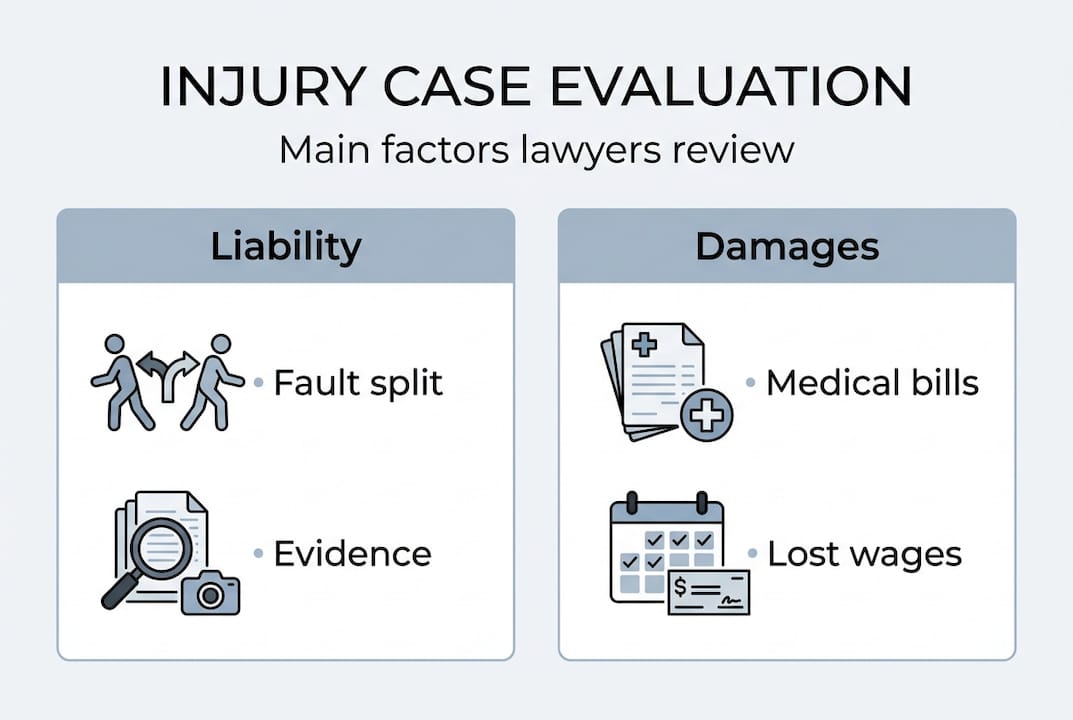
Damages cover everything you lost. Economic damages include your medical bills, lost income, and out-of-pocket costs. Non-economic damages address your pain, emotional distress, loss of enjoyment of life, and similar losses. Colorado does not currently cap non-economic damages in most car accident cases, which means these figures can be significant.
Here is a comparison of how attorneys view different damage types:
| Damage type | What it includes | Ease of calculation |
|---|---|---|
| Medical bills | ER visits, therapy, prescriptions | High, based on records |
| Lost wages | Missed work, reduced earning capacity | Moderate, needs documentation |
| Pain and suffering | Physical and emotional impact | Lower, requires expert support |
| Property damage | Vehicle repairs or replacement | High, based on estimates |
| Future medical costs | Ongoing care, surgeries | Lower, needs medical prognosis |
Insurance coverage is often the limiting factor in real-world settlements. Even if your damages are substantial, recovery is shaped by what insurance policies are available. The attorney will identify all potentially applicable coverage, including the at-fault driver’s liability policy, your own uninsured or underinsured motorist coverage, and any umbrella policies. The Colorado Division of Insurance sets the minimum required coverage limits in the state.
Factors that can complicate your evaluation include:
- Pre-existing conditions: A prior back injury does not bar your claim, but it does require careful documentation to show the accident made things worse
- Comparative fault: If you were 20% at fault, your recovery is reduced by 20% under Colorado law
- Statute of limitations: Colorado generally gives you three years from the date of accident to file a personal injury lawsuit, and missing this deadline ends your claim entirely
- Gaps in treatment: Extended periods without medical care can be used by insurers to argue your injuries were not serious
Using the Colorado legal checklist can help you confirm that none of these factors have been overlooked before your evaluation begins.
Why getting your case evaluation right matters
With the factors on the table, it is time to understand why the accuracy and method of your case evaluation truly matter. A proper evaluation is fundamental for determining realistic outcomes and avoiding wasted time pursuing weak cases, as noted in our guide on choosing a skilled lawyer.

Think about what happens when an evaluation is done poorly. A client hears “you have a great case” without any real analysis behind it. They hold out for a large settlement that was never realistic. Months pass, medical bills pile up, and eventually they accept a low offer out of desperation. This is not a rare scenario. It happens regularly when evaluations are rushed or performed by attorneys who lack specific Colorado personal injury experience.
On the other hand, a thorough evaluation does several powerful things. It gives you a realistic settlement range so you know what to expect. It identifies weaknesses in your case early, so your attorney can address them before an insurer exploits them. It builds a negotiation foundation based on real numbers, not guesswork.
Pro Tip: Ask your attorney to explain the specific factors that most strongly support your claim and the two or three issues that could reduce your recovery. If they cannot answer that question clearly, that tells you something important about the quality of the evaluation.
The lawyer’s case evaluation perspective from AllLaw reinforces that strong evaluations lead to stronger settlements because they shift negotiating power toward the injured party.
“Insurance adjusters count on claimants not knowing what their case is actually worth. A well-documented evaluation takes that advantage away from them.”
Consider two Colorado car accident victims with similar injuries. One gets a thorough evaluation that documents all future medical costs and lost earning capacity. The other gets a brief review focused only on current bills. The first victim’s attorney can support a demand three times higher because the evaluation captured the full picture. The quality of the evaluation is not a formality. It is a strategic asset.
How to prepare for your own injury case evaluation
Knowing why a proper evaluation matters, here is how you can get the most out of your own case review. Preparation ensures that your attorney has all the information needed to accurately assess and maximize your claim, and that starts before you ever walk into the office.
Follow these steps to get ready:
-
Gather your police report. If you have not already requested it, contact the law enforcement agency that responded to your accident. This document establishes the official record of what happened.
-
Collect all medical records. Include emergency room records, follow-up visit notes, imaging results, and any physical therapy documentation. If treatment is ongoing, bring the most recent records available.
-
Compile your insurance information. Bring your own auto insurance policy, the other driver’s insurance information, and any correspondence you have already received from insurance companies.
-
Document your out-of-pocket expenses. Keep receipts for prescriptions, co-pays, transportation to appointments, and any assistive devices you purchased. These costs are part of your claim.
-
Write a detailed accident timeline. Note the date, time, location, weather conditions, and a step-by-step account of what happened before, during, and after the collision.
-
Record your symptoms and limitations. Keep a simple journal noting your pain levels, activities you can no longer perform, and how your injuries affect your work and home life.
Understanding the range of exploring claim options available to Colorado accident victims helps you go into your evaluation with context. Knowing what types of claims exist, from property damage to pain and suffering, helps you communicate more clearly with your attorney.
Pro Tip: Write down every question you want answered before the meeting. Attorneys work faster when clients are focused. Questions about compensation details, timelines, and case risks are all fair game and should be addressed during your evaluation.
Working with injury attorneys who understand Colorado’s specific legal landscape is essential. The working with injury attorneys guide from Nolo explains how attorney-client partnerships function and what you should expect from the process. Being an organized, prepared client gives your attorney the tools to fight harder and smarter on your behalf.
Our perspective: What most people get wrong about case evaluation
With practical steps in hand, here is a candid take from our team on what truly defines a successful case evaluation, and where most people go wrong before they even reach the negotiating table.
The biggest myth we encounter is that every accident automatically leads to a large settlement. People hear stories of big payouts and assume the same is waiting for them. The reality is that case value depends entirely on provable facts, documented damages, and available insurance. A strong evaluation reveals this truth early, which is actually a gift. It prevents you from making major financial decisions based on a settlement that may never arrive.
The second mistake is underestimating how much documentation matters. People tell us they have “a perfect story” about their accident. Stories do not win cases. Documented evidence does. Medical records, bills, witness names, and photographs are what transform a story into a legal claim.
We also see clients hold back information during evaluations because they worry it will hurt their case. Pre-existing injuries, prior claims, even a minor traffic violation near the time of the accident. Transparency with your attorney is always better than surprises surfacing later. Insurers conduct thorough investigations, and hidden information becomes a liability when it comes out during negotiations.
A second opinion on your case evaluation is never a bad idea. Reviewing the injury lawsuit timeline in Colorado helps you understand what lies ahead, regardless of which attorney you choose. The goal is to give yourself the best possible foundation for whatever comes next.
Connect with the right legal support for your injury case evaluation
You now understand what a real injury case evaluation looks like, why it matters, and how to prepare for one. The next step is putting that knowledge to work with an attorney who approaches your case with the tenacity it deserves. At Malnar Injury Law, pursuing your Colorado injury case starts with a free, in-depth evaluation designed to give you real answers, not vague reassurances. We have settled hundreds of injury cases and recovered millions of dollars for people just like you, all because we refuse to let go once we take your case. If you are ready to understand what your claim is actually worth, finding a top lawyer who knows Colorado law is your most important move. Contact our Colorado injury attorneys today to schedule your free case evaluation and take the first step toward the recovery you deserve.
Frequently asked questions
What does a Colorado injury case evaluation cost?
Most reputable injury firms offer evaluations at no charge to you. Many personal injury attorneys provide free initial consultations and evaluations, though complexity can affect the process.
How long does an injury case evaluation take?
An initial evaluation can often be completed in a single meeting if you bring the right documents. Evaluation duration varies but moves significantly faster when full documentation is available from the start.
Can I get a second opinion on my injury case evaluation?
Yes, and you should feel completely comfortable doing so. Clients are encouraged to seek second opinions on legal matters, especially when a claim’s value is uncertain or disputed.
What documents do I need for an injury case evaluation?
Bring accident reports, medical records, insurance policy details, and receipts for any costs you incurred. Accident victims should gather as much documentation as possible before meeting with an attorney to speed up the process.
Is a case evaluation the same as a consultation?
No, they are different things. A consultation is an introductory meeting, while case evaluation involves a deeper, structured analysis of your claim’s facts, damages, and legal potential.
Recommended
- Why pursue an injury case? Key reasons for Colorado victims
- Types of car accident claims: Your guide to Colorado options
- Top personal injury case examples and outcomes in Colorado
- Colorado injury lawsuit timeline: Steps & what to expect
- Maximise your compensation in Scotland: injury claim guide | Scotland Claims Injury Lawyers