

Colorado Ski Lift Accident? $12.4M Verdict and What Victims Should Do
Colorado’s most consequential lift accidents in recent years share a pattern: initial findings blame the rider, but deeper investigations sometimes uncover mechanical or installation faults instead. The Keystone fall that killed Donovan Romero, the Crested Butte case that ended in a $12.4 million jury verdict, and Vail’s Little Eagle ejection all followed that arc. The legal takeaway is blunt: liability waivers no longer guarantee resorts immunity when evidence points to an ANSI standards violation.
Table of Contents
- What Recent Colorado Ski Lift Accidents Reveal
- What Caused the Colorado Ski Lift Crack and Other Failures?
- How Many Ski Lift Accidents Happen in Colorado Each Year?
- Can You Sue a Ski Resort After a Colorado Ski Lift Injury?
- What to Do After a Colorado Ski Lift Accident
- Should Colorado Require Restraint Bars on Ski Lifts?
- Why Documentation Decides These Cases
- How Stubbornattorney Helps After a Colorado Ski Lift Accident
- Sources
- FAQ
What Recent Colorado Ski Lift Accidents Reveal
Every major Colorado ski lift accident from the past two seasons tells a slightly different story, but together they show how quickly an incident can move from a local news brief to a courtroom precedent.
- Keystone’s Ruby Express chair, December 2024. A young rider fell from the lift; ski patrol reached him within minutes, and Donovan Romero later died from his injuries. The Colorado Passenger Tramway Safety Board’s initial report attributed the fall to rider error, a conclusion his family has since pushed back against publicly.
- Crested Butte’s Paradise Express, March 2022. Annie Miller fell and was paralyzed. Her case went to trial in 2025, and a jury sided with her, awarding $12.4 million after finding lift attendants had violated safety standards.
- Vail’s Little Eagle lift, January 25, 2026. Two passengers were ejected mid-ride. A state investigation later traced the cause to a component installed incorrectly back in 2007, not the riders themselves.
- Winter Park’s gondola, holiday season 2024. A structural crack forced a shutdown mid-mountain. Rescue crews lowered 174 passengers by rope over roughly five hours, and nobody was hurt.
- Powderhorn and earlier Vail stoppages. Mechanical shutdowns have prompted rope evacuations of more than 50 riders at a time, using the same basic rescue protocol resorts train for every season.
That range, from a fatal fall to a mechanical stoppage with zero injuries, is the real picture of ski lift risk in Colorado: rare, but not uniform, and not always what the first headline says.
What Caused the Colorado Ski Lift Crack and Other Failures?
Investigators found two very different failure modes behind these incidents, and the distinction matters enormously for anyone trying to understand fault.
On the mechanical side, the Little Eagle case is the clearest example. The Colorado Passenger Tramway Safety Board determined a part had been installed with the wrong orientation nearly two decades earlier, leaving swing clearance of only 7.6 to 9 degrees where ANSI B77.1 requires 15 degrees. That gap is small enough that a standard visual inspection would likely never catch it. Detecting it requires measured clearance testing or engineering acceptance review, not a walk-through.
Fast fact: A defect hidden since 2007 didn’t surface until it caused an ejection in 2026, nearly 20 years of routine inspections that missed it.
On the human-error side, most Colorado falls trace back to riders adjusting boots or bindings mid-ride, sitting improperly, or leaving the restraint bar up. Reporting on the state’s fall data confirms the majority of falls fit this category, though mechanical failures do occur and have caused fatalities before, including a 2016 death at Granby Ranch.
When a mechanical or installation cause is confirmed, corrective action typically follows a set path:
- Reinstallation or replacement of the faulty component
- Measured clearance testing before the lift reopens
- A formal report filed with the Safety Board documenting the fix
The line between “rider error” and “mechanical failure” isn’t just a technical detail. It’s often the entire basis for whether a victim has a viable negligence claim.
How Many Ski Lift Accidents Happen in Colorado Each Year?
Colorado has logged an average of roughly 14 lift-fall injuries per season since 2019–20, with the 2024–25 season running higher at around 18 reported falls.
By the numbers: ~14 average lift-fall injuries per season across Colorado since 2019, against tens of millions of lift rides taken statewide each winter.
That average sounds small until you consider how many rides it’s measured against, and it sounds larger than it should when you remember most falls result in bruises, not broken bones. A few things worth knowing about how the numbers work:
- Fatalities are rare and tend to make headlines precisely because of that rarity, not because fatality counts are climbing.
- A death that occurs weeks after the initial fall, as with the Romero case, can complicate how and when it gets logged in a given season’s statistics.
- National industry figures from the NSAA’s aerial ropeway data consistently frame chairlifts as one of the safest forms of mechanized transport per mile traveled.
- Reporting delays and jurisdictional gaps between resorts and the Safety Board mean a given season’s published count can undercount incidents that get resolved or reclassified later.
Raw counts also don’t distinguish between a minor slip caught by the restraint bar and a fall that ends in surgery, so treat any single-number “accident rate” with some skepticism.
Can You Sue a Ski Resort After a Colorado Ski Lift Injury?
The Colorado Ski Safety Act has long shielded resorts from claims tied to the “inherent risks” of skiing, and the liability waivers printed on the back of every lift ticket reinforced that shield for decades. Mechanical lift failure, though, generally falls outside what courts treat as an inherent risk of the sport itself.
The Annie Miller verdict is the clearest signal yet that a signed waiver doesn’t end the conversation. A Gunnison County jury awarded her $12.4 million after finding lift attendants had violated ANSI safety standards, not Miller. That finding matters because it shows juries are willing to look past waiver language and ask a narrower question: did the operator follow the standard of care it owed riders?
That has direct consequences for how future cases get argued:
- A case built on documented ANSI violations, like the Little Eagle installation error, has a fundamentally different legal footing than one where the resort’s incident report simply says “rider error.”
- Comparative negligence still applies in Colorado, so a rider who left a restraint bar up may see their own recovery reduced even in a case with mechanical contributing factors.
- Colorado law caps certain noneconomic damages, which is part of why the Miller award was later adjusted after trial rather than paid at the jury’s original figure.
- Filing deadlines matter and start running from the date of the incident, not the date an investigation concludes, so waiting on a Safety Board report before consulting a lawyer can cost valuable time.
- Fatal falls, like Romero’s, open a separate legal path through Colorado’s wrongful death statutes, with different damages and different deadlines than a standard injury claim.
The practical upshot: an initial Safety Board finding of “rider error” is not the final word on liability. It’s a starting point that a skilled attorney and an independent engineering review can, and sometimes should, challenge.
What to Do After a Colorado Ski Lift Accident
If you or someone you love has been hurt on a lift, the first hours and days shape what a claim can later prove.
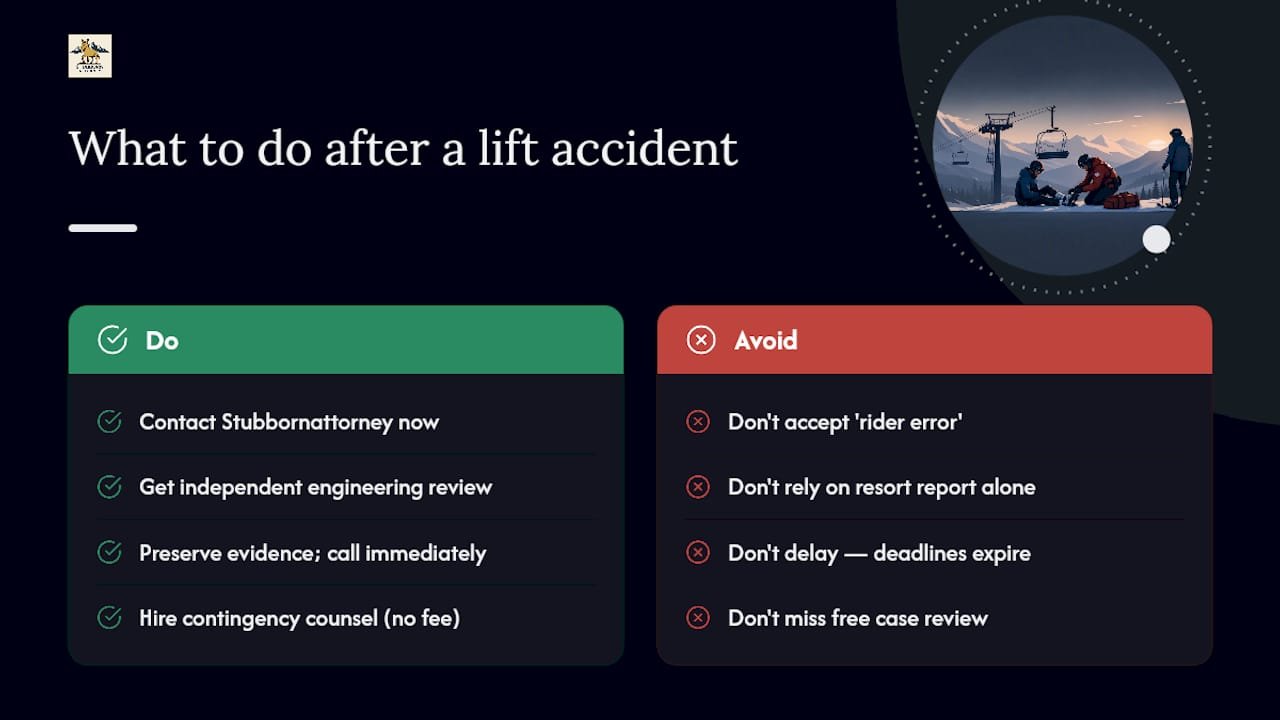
- Get medical care immediately, even if the injury seems minor. Ski patrol reports and ER records become the backbone of any future claim.
- Photograph everything at the scene: the lift chair, restraint bar position, the terrain below, and any visible damage to hardware.
- Get names, not just impressions. Collect contact information from witnesses on the lift and in line, since memories fade fast and resorts don’t always share witness lists voluntarily.
- Request the incident report from the resort and, where applicable, from the Colorado Passenger Tramway Safety Board, in writing and as soon as possible.
- Hold off on recorded statements to the resort’s insurer until you understand how the statement could be used against you later.
- Keep every bill and communication, including texts or emails from resort staff, insurance adjusters, or claims representatives.
- Talk to a personal injury attorney before the investigation closes. An attorney can bring in an independent engineer to challenge a “rider error” label, the same way the Little Eagle and Miller cases eventually surfaced facts the initial reports didn’t capture.
Pro Tip: Ask the resort in writing for a copy of the lift’s maintenance and inspection log from the past 12 months. Resorts aren’t always required to hand it over voluntarily, but a written request creates a paper trail your attorney can use if the records later go missing or get “reviewed” before release.
Should Colorado Require Restraint Bars on Ski Lifts?
Colorado currently encourages restraint bar use but doesn’t require it, and that gap has become the center of a real policy fight. Donovan Romero’s mother is publicly pushing for a state law mandating restraint bars on every lift, arguing that voluntary guidance failed her son.
- The ski industry has generally favored keeping restraint bars optional, citing rider comfort and loading speed on chairs.
- Mandatory-use legislation would require either a Ski Safety Act amendment or a new Passenger Tramway Safety Board rule.
- Investigators have also flagged acceptance testing and measured swing-clearance checks, not just annual visual inspections, as a fix for installation errors like the one found at Little Eagle.
Whether that pressure turns into an actual statute is still an open question heading into the next legislative session.
Why Documentation Decides These Cases
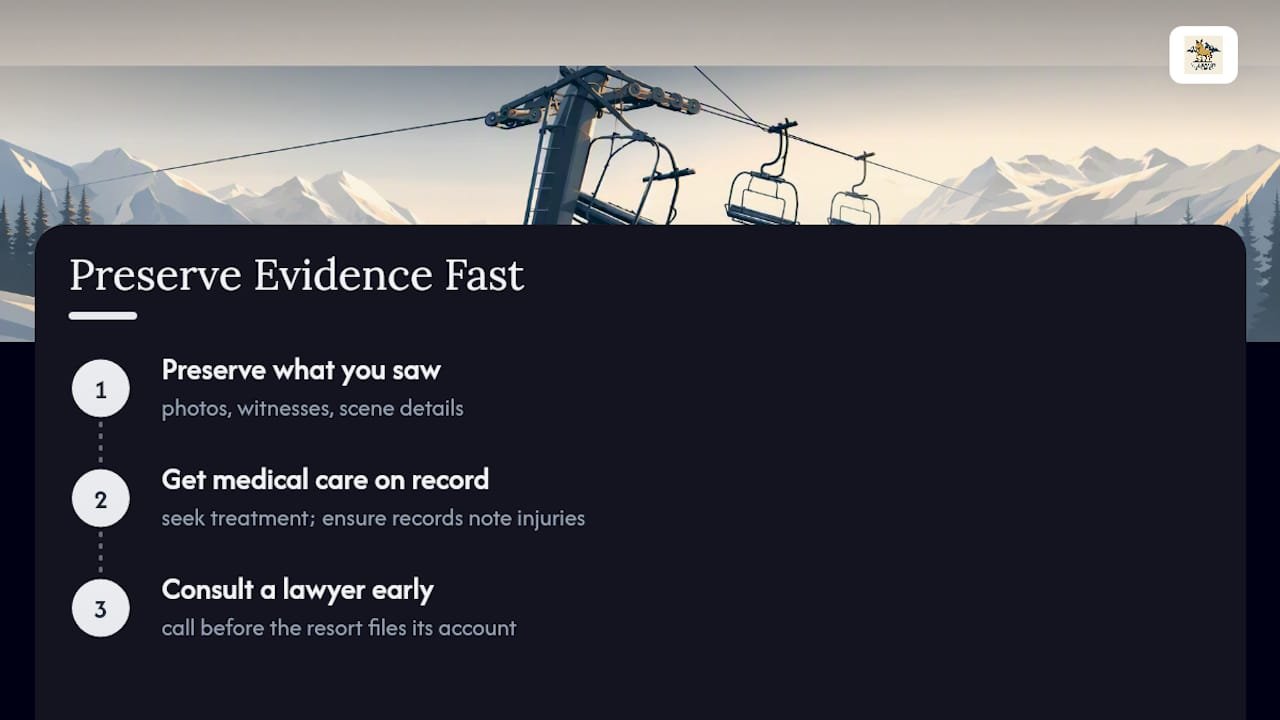
Most people assume a Safety Board finding of “rider error” is objective and final. It usually isn’t the whole story. Initial reports get written fast, often before engineers have measured a single clearance angle, and resorts have an obvious interest in a conclusion that keeps liability off their books.
What actually changes outcomes is evidence collected before memories fade and hardware gets serviced. My decade in personal injury practice, and my years before that evaluating claims for the federal government, taught me the same lesson from both sides of the table: whoever documents first usually wins the argument later. If you or a family member has been hurt on a Colorado lift, preserve what you saw, get medical care on record, and talk to a lawyer before the resort’s version of events becomes the only version on file.
— Ryan
How Stubbornattorney Helps After a Colorado Ski Lift Accident
Stubbornattorney investigates Colorado ski lift accidents the way the cases above demanded: independent engineering review, not just acceptance of a resort’s internal report. When a client’s fall gets labeled “rider error” too quickly, we push back with the same kind of evidence that turned the Little Eagle and Miller cases around. Our work includes accident investigation, negotiation with resort insurers, litigation when a fair settlement isn’t on the table, and wrongful death representation for families who’ve lost someone in a lift fall.
We work on contingency, so there’s no fee unless we recover money for you, and the initial case review is free. If you’ve been hurt on a lift anywhere in Colorado, reach out to our personal injury team today before evidence disappears and deadlines start working against you.
Sources
This article draws on Colorado Passenger Tramway Safety Board investigation findings, ANSI B77.1 standards and NSAA industry data, and reporting from the Colorado Sun, CBS Colorado, Summit Daily, AP News, and KUNC. Each source is linked above at the point where its specific finding is discussed.
This article is general information, not a substitute for advice from a qualified lawyer. Consult a qualified legal professional about your own circumstances before acting on anything here.
- Chairlift falls occur every year in Colorado, but fatal falls are extremely rare compared to the number of riders — KUNC
- 174 Colorado skiers and snowboarders rescued after a gondola crack — AP News
- Colorado investigation shows improperly installed ski lift parts caused accident at Vail Resort — CBS News
- Jury awards $12.4 million to paralyzed skier who sued Vail Resorts — The Colorado Sun
- A born-and-raised Coloradan died after falling from a chairlift. His mom wants a state law requiring restraint bar use. — Summit Daily
FAQ
What caused the Colorado ski lift crack at Winter Park?
A structural crack developed in the Winter Park gondola during the 2024 holiday season, prompting an evacuation of 174 riders by rope over roughly five hours with no reported injuries.
How many people were rescued from the Colorado ski lift?
The largest recent evacuation involved 174 people lowered from the Winter Park gondola, while a separate mechanical stoppage at Powderhorn required rescuing more than 50 riders.
How many ski lift accidents happen per year in Colorado?
Colorado has averaged about 14 lift-fall injuries per season since 2019–20, with fatalities remaining rare relative to the volume of riders.
Are ski lift falls usually caused by rider error or mechanical failure?
Most falls are attributed to rider behavior, like adjusting bindings or leaving the restraint bar up, but confirmed mechanical and installation failures, like the Vail Little Eagle incident, do occur and can change a case’s legal outcome entirely.
Can a ski resort be held liable after a Colorado ski lift accident?
Yes. The Miller verdict shows a jury can find a resort liable despite a signed waiver when evidence shows attendants violated ANSI safety standards.