

What Is a Third-Party Claim? How to File and Win
A third-party insurance claim is a request you file with the at-fault driver’s insurance company — not your own — asking that insurer to pay for your vehicle damage, medical bills, lost wages, or other accident-related costs. The term “third party” simply means you are the outsider: the insurer’s contract is with its own policyholder (the driver who hit you), not with you.
If you were just in a crash and you believe the other driver caused it, here is what to do right now:
- Call the police if there are injuries, significant damage, or any dispute about what happened. A police report is one of the most useful documents you will have.
- Preserve evidence before you leave the scene: photograph damage, skid marks, traffic signs, and injuries. Get the other driver’s name, license number, plate, and insurance information. Collect witness names and phone numbers.
- Notify your own insurer that the accident happened, even if you plan to file against the other driver’s policy. Most policies require prompt notice.
Pro Tip: Never admit fault at the scene, even if you feel partly responsible. Stick to factual descriptions of what happened and let the adjusters sort out liability. Also, start a written log of every symptom, doctor visit, and expense from day one — gaps in that timeline are one of the most common reasons adjusters reduce settlement offers.
Table of Contents
- How does a third-party liability claim actually work?
- How does a third-party claim differ from a first-party claim?
- How do state rules change the third-party claim process?
- How to file a third-party claim step by step
- What documents and evidence do insurers typically request?
- What happens after you file?
- What if the at-fault driver is uninsured or underinsured?
- Will a third-party claim affect your own insurance rates?
- When should you contact a personal injury lawyer?
- What most people get wrong about third-party claims
- Stubbornattorney can help you fight for a fair settlement
- Authoritative sources and further reading
- FAQ
How does a third-party liability claim actually work?
Three parties are involved in every third-party auto claim: you (the claimant), the at-fault driver (the insured), and the at-fault driver’s insurance company. That insurer’s primary legal duty runs to its own policyholder, not to you. Keep that in mind from the first phone call.

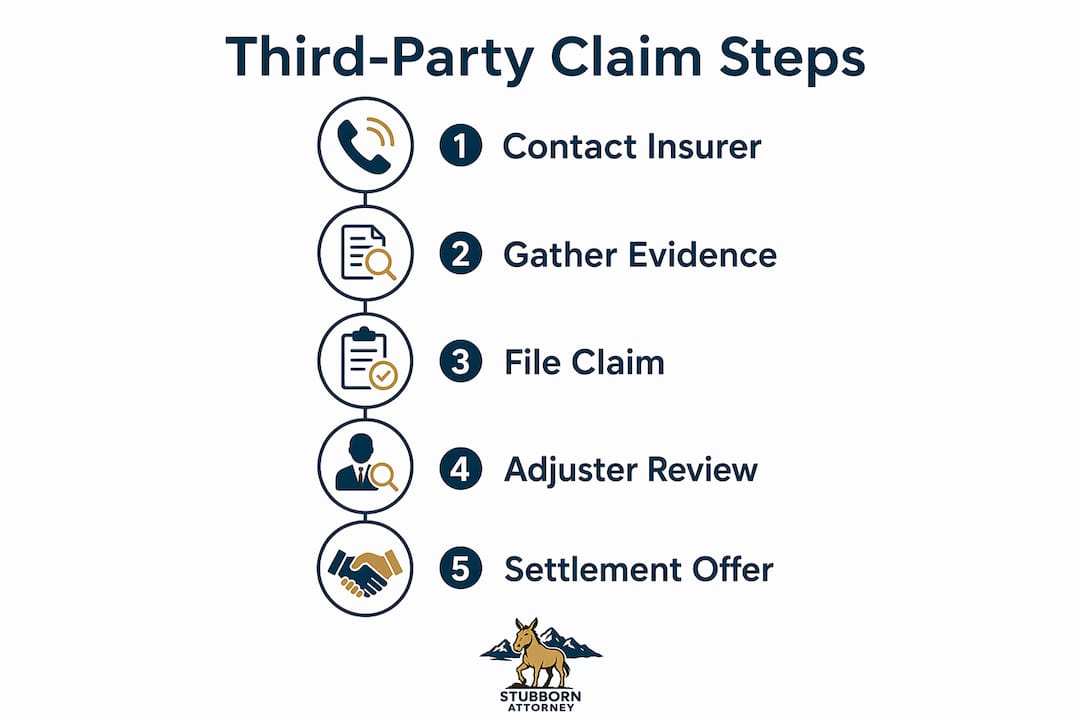
The process follows a fairly predictable sequence. You contact the at-fault driver’s insurer, open a claim, and provide your account of the crash. The insurer assigns an adjuster, who investigates fault, reviews the police report, inspects the vehicle, and requests medical records. Based on that review, the adjuster either makes a settlement offer, requests more information, or denies the claim.
Coverage under a standard liability policy can include vehicle repairs, medical bills, rental car costs, and lost wages, all up to the policy’s limits. That ceiling matters. If the at-fault driver carries $25,000 in bodily injury liability and your medical bills reach $60,000, the insurer will pay no more than $25,000 on that policy alone. Knowing the other driver’s limits early helps you plan whether you need to tap your own uninsured/underinsured coverage or consider other options.
Pro Tip: Document every medical appointment, prescription, and therapy session with dates and provider names. Adjusters are trained to look for gaps between the crash date and the start of treatment. A continuous, well-dated medical timeline makes it much harder to argue your injuries were pre-existing or unrelated.
How does a third-party claim differ from a first-party claim?
The distinction comes down to whose policy you are filing against and what relationship you have with that insurer.
- First-party claim: You file with your own insurer under your own policy. The insurer owes you contractual duties — good faith, prompt investigation, fair payment. Examples: collision coverage for your car, MedPay for your medical bills, or a comprehensive claim for hail damage.
- Third-party claim: You file with the other driver’s insurer. That insurer owes its primary duties to its policyholder, not to you. You are a claimant, not a customer. The Illinois DOI puts it plainly: the other insurer’s job is to protect its insured, which means it may push back harder on your claim.
Three practical examples:
(A) First-party only makes sense. Your car is damaged in a hit-and-run and the other driver is never identified. You file under your own collision coverage because there is no identifiable third party to pursue.
(B) Clear third-party scenario. Another driver runs a red light and T-bones your car. Fault is unambiguous. You file a third-party claim against their liability policy for vehicle repairs and medical bills.
© Both routes used together. The at-fault driver has minimal liability limits. You use your own PIP or MedPay to cover immediate medical costs while the third-party claim is being investigated. If the other driver’s limits fall short, you then file under your own underinsured motorist (UIM) coverage.
One practical note: bodily injury liability on the at-fault driver’s policy can also cover legal defense costs if you sue that driver — which means the insurer has a financial stake in minimizing your payout.
How do state rules change the third-party claim process?
Whether you can file a third-party claim immediately, or must go through your own insurer first, depends heavily on your state’s system.
| System | How it works | Third-party claim timing | Litigation threshold |
|---|---|---|---|
| At-fault (tort) | The driver who caused the crash pays. You may file a third-party claim right away. | Immediate | File suit when damages exceed policy limits or insurer denies |
| No-fault (PIP) | Your own PIP coverage pays your medical bills first, regardless of fault. | Restricted until threshold met | Must meet a “serious injury” or dollar threshold to sue |
At-fault states (including Colorado) let you go straight to the other driver’s insurer. Fault is determined by the adjuster’s investigation, and you can negotiate or litigate if the offer is inadequate.
No-fault states (Colorado Springs , Michigan, New York, and others) require you to use your own Personal Injury Protection (PIP) coverage for medical expenses first. You can only step outside that system and pursue a third-party claim or lawsuit if your injuries meet a defined threshold, usually a serious injury or a dollar amount of medical bills. Check your state’s insurance department website for the exact threshold — it varies significantly.
Colorado follows an at-fault system, so injured drivers here can file a third-party claim against the responsible driver’s insurer without first exhausting PIP. Colorado also allows drivers to add optional MedPay coverage for immediate medical cost coverage regardless of fault.
Pro Tip: Every state has a statute of limitations on personal injury claims, typically two to three years from the date of the crash. Missing that deadline almost always bars your claim permanently. Check your state’s deadline early and calendar it — do not assume you have unlimited time to decide.
How to file a third-party claim step by step
Follow these steps in order. Skipping early steps tends to create documentation gaps that slow or reduce your settlement.
- At the scene: Call 911 if there are injuries or significant damage. Exchange insurance information with the other driver. Photograph everything: damage, positions of vehicles, road conditions, visible injuries, and any traffic control devices.
- Collect witness information: Get names and phone numbers of anyone who saw the crash. A brief written statement from a witness, taken at the scene, carries more weight than a recollection gathered weeks later.
- File a police report: Even if officers do not respond, many states allow you to file a report at your local precinct or online. The report number is one of the first things an adjuster will ask for.
- Notify your own insurer: Call your insurer within 24–48 hours. Most policies require prompt notice of any accident, even if you are not at fault and plan to pursue the other driver’s policy.
- Contact the at-fault driver’s insurer: Call their claims line and open a third-party claim. When you speak to the adjuster, keep it factual: “I was involved in a collision on [date] at [location]. The other driver, [name], is insured with your company. I am filing a third-party claim for vehicle damage and personal injuries.” Ask for a claim number and the adjuster’s direct contact information before you hang up.
- Submit your documentation: Provide the police report, photos, witness contact information, your vehicle repair estimate, and any medical records or bills you have so far. You can supplement with additional medical records as treatment continues.
- Track everything: Keep a log with the claim number, adjuster name, every call date, and what was discussed. Follow up in writing (email is fine) after significant conversations so there is a record.
For a more detailed injury claim checklist, Stubbornattorney has a step-by-step guide built specifically for Colorado accident victims.
What documents and evidence do insurers typically request?
Adjusters need enough information to establish fault, connect your injuries to the crash, and calculate damages. The stronger your file, the less leverage the insurer has to delay or reduce your offer.

Standard documents insurers ask for include: the police report, photos of vehicle damage and the accident scene, the other driver’s name, license number, plate, and insurance details, witness names and contact information, repair estimates from a licensed shop, medical records and bills tied to the crash, and pay stubs or employer documentation if you are claiming lost wages.
Two items claimants often handle poorly: witness statements and medical timelines.
For a witness statement, keep it short and factual. Something like: “I was standing at the corner of [X] and [Y] at approximately [time]. I observed a [color/make] vehicle traveling [direction] run the red light and strike the vehicle driven by [claimant name].” Date it, have the witness sign it, and include their phone number.
For a medical timeline, list every visit chronologically: date, provider, complaint, and treatment. Connect each entry back to the crash. Practitioners treat a well-built claim file as evidence packaging — a coherent causal narrative that ties each expense and treatment to the accident date, which reduces the insurer’s ability to label care as unrelated.
Pro Tip: Create one folder, digital or physical, that holds every document in date order. Label each item with the date and what it relates to. When an adjuster calls asking for “the ER records from the day of the crash,” you can find them in 30 seconds instead of hunting through a pile.
Whether or not you have a police report, you can still file an insurance claim — though having one makes the process considerably smoother.
What happens after you file?
Once you open a third-party claim, the insurer’s clock starts. Here is the typical sequence, though exact timing varies by state and insurer:
- Acknowledgment: The insurer confirms receipt of your claim, usually within a few business days.
- Adjuster assignment: An adjuster is assigned to investigate fault and damages. They may contact you for a recorded statement — you are not required to give one, and it is worth consulting an attorney before you do.
- Investigation: The adjuster reviews the police report, inspects the vehicle, and requests medical records. This phase can take weeks to months depending on injury complexity.
- Offer or denial: Once the adjuster has enough information, they issue a settlement offer or a denial letter.
Your options at each stage:
- Accept and settle: Sign the release and receive payment. Note that signing typically waives all future claims from this accident.
- Counteroffer: If the offer is too low, respond in writing with your documented damages and a higher demand.
- Request reassessment: If the insurer disputes fault, ask for the written basis of their decision and provide additional evidence.
- File a complaint: State insurance departments handle bad-faith or unreasonable delay complaints. The Texas Department of Insurance and similar agencies in every state accept formal complaints that can prompt faster insurer action.
- Prepare for litigation: If the insurer denies or lowballs and negotiations stall, filing suit may be the only path to fair compensation.
One warning worth repeating: statutes of limitations are real deadlines. In Colorado, the general personal injury statute of limitations is three years from the date of the crash. Other states differ. If you are approaching that window without a resolution, consult an attorney immediately.
What if the at-fault driver is uninsured or underinsured?
The at-fault driver’s insurer will only pay up to the policy’s limits. When damages exceed those limits, or when the other driver has no insurance at all, you need to look at your own policy.
Illustrative scenario: Your medical bills total $80,000. The at-fault driver carries $25,000 in bodily injury liability. The insurer pays the full $25,000. You still have $55,000 in uncompensated losses. That gap is exactly what underinsured motorist (UIM) coverage is designed to fill.
Coverages to check in your own policy:
- Uninsured motorist (UM): Covers you when the at-fault driver has no insurance.
- Underinsured motorist (UIM): Covers the gap when the at-fault driver’s limits are too low.
- MedPay: Pays your medical bills regardless of fault, up to a set limit, and can bridge the gap while a third-party claim is pending.
- PIP: Required in no-fault states; covers medical expenses and sometimes lost wages from your own policy.
- Collision: Covers your vehicle repairs regardless of fault, subject to your deductible.
- Health insurance: Can cover medical bills, though your health insurer may have a subrogation right to recover from any settlement.
If the at-fault driver has no assets and minimal insurance, you may technically have the right to sue them personally. In practice, collecting a judgment against an uninsured driver with no assets is difficult. Understanding how to estimate your damages before deciding whether to pursue that route is worth the time.
Will a third-party claim affect your own insurance rates?
Filing a third-party claim against someone else’s policy does not directly trigger a rate increase on your own policy. You are not the one making a claim on your coverage. That said, the accident itself gets recorded, and your insurer will know about it.
Here is where it gets more nuanced:
- If your insurer pays out under your own coverage (collision, MedPay, or UIM) and then pursues subrogation against the at-fault driver’s insurer, your rates could still be affected depending on your policy terms and state rules.
- If the at-fault driver’s insurer disputes fault and claims you were partially or fully responsible, that insurer may open a claim against you. At that point, your own insurer gets involved to defend you.
- Fault findings matter. An insurer that determines you were partially at fault may reduce your recovery under comparative negligence rules and may report the finding in ways that affect your renewal.
Pro Tip: If an insurer denies fault or shifts liability onto you, ask for the written basis of that decision immediately. Keep a record of every conversation, every letter, and every email. That paper trail becomes critical if you need to challenge the finding or if litigation follows.
What to watch for:
- A denial letter citing your partial fault
- A reservation-of-rights letter from your own insurer
- A demand letter or lawsuit from the other driver’s insurer
- Any communication suggesting you may be liable for the other driver’s damages
If any of these appear, treat it as a red flag and get legal advice before responding.
When should you contact a personal injury lawyer?
Some third-party claims resolve cleanly: clear fault, modest damages, cooperative adjuster, fair offer. Many do not. Here are the situations where legal help typically changes the outcome.
Red flags that justify calling a lawyer:
- Serious injuries requiring surgery, hospitalization, or long-term treatment
- Medical bills approaching or exceeding the at-fault driver’s liability limits
- The insurer disputes fault or claims you were partially responsible
- The insurer delays, ignores your calls, or issues a lowball offer without explanation
- You receive a lawsuit threat or a demand letter
- The other driver was uninsured or underinsured
Attorneys who handle personal injury cases typically work on a contingency fee, meaning you pay nothing unless they recover money for you. At a first consultation, bring your police report, claim numbers, photos, medical records, and any correspondence from the insurer. The attorney will assess liability, coverage, and damages and tell you whether the case warrants representation.
What a lawyer actually does: packages your evidence into a formal demand letter, negotiates with the adjuster, handles all insurer communications, and files suit if the insurer refuses a fair settlement. That last step matters because legal representation changes the insurer’s calculus. An insurer that knows you have counsel willing to litigate tends to settle more seriously.
Ryan Malnar, the attorney behind Stubbornattorney, spent years as a claims adjudicator and adjuster for the federal government before representing injured victims in Colorado. That background means he has sat on both sides of the table and knows exactly how insurers evaluate claims.
Pro Tip: If you are unsure whether your situation warrants a lawyer, most personal injury attorneys offer a free initial consultation. Use it. You will leave knowing whether you need representation or whether you can handle the claim yourself.
What most people get wrong about third-party claims
The biggest mistake I see is treating a third-party claim like a transaction rather than a case. People call the adjuster, describe the crash, and then wait for a fair offer. That is not how it works. The adjuster’s job is to resolve the claim for as little as possible, within the policy terms. That is not a criticism — it is just the reality of how insurance economics function.
Three things that consistently hurt claimants: incomplete records (especially gaps in medical treatment), accepting an early settlement before the full extent of injuries is known, and failing to connect the medical timeline to the crash date. An adjuster who cannot see a clear line from the collision to your treatment has every incentive to argue the injuries were pre-existing or unrelated.
The practical fix is simple but requires discipline. Treat your claim file like a case file from day one. Every receipt, every appointment, every symptom note goes in one place, dated and organized. Do not settle until your treating physician has given you a clear picture of your long-term prognosis. And if the insurer is pushing hard for a quick resolution, that pressure is usually a signal that they know the claim is worth more than they are offering.
If any of the red flags in the section above apply to your situation, a free consult with a personal injury attorney costs you nothing and may save you from a settlement you will regret.
Stubbornattorney can help you fight for a fair settlement
When the at-fault driver’s insurer is slow, disputing fault, or offering far less than your documented damages, you need someone who knows how insurers think. Stubbornattorney, the Colorado personal injury firm behind this guide, works exclusively on behalf of injured victims on a contingency fee basis. You pay nothing unless there is a recovery.
A free case review covers your liability picture, the coverage available, and whether your claim is worth pursuing with legal help. When you call or submit a form, bring what you have: police report, claim numbers, photos, medical records, and any repair estimates. No file is too early or too messy to evaluate.
For a free case review, contact Stubbornattorney today. If you want to understand what your claim could be worth before you call, the injury case evaluation page walks through the key factors that affect settlement value in Colorado.
Authoritative sources and further reading
Use these resources to verify state-specific rules, coverage requirements, and filing procedures:
- Your state’s insurance department: Every state has one. Search “[your state] department of insurance” for complaint procedures, coverage minimums, and filing deadlines. The Texas Department of Insurance is a good example of the kind of consumer guidance these agencies publish.
- Texas Office of Public Insurance Counsel (OPIC): Clear plain-language explanation of first-party vs. third-party claim definitions.
- Illinois Department of Insurance: Detailed procedural guidance on filing against another driver’s insurer, including insurer duties and documentation requirements.
- Colorado Revised Statutes / 3 CCR 702-5: Colorado-specific regulations governing third-party claimant rights, rental vehicle timelines, and payment deadlines.
- Roman Insurance — auto insurance guidance: Step-by-step overview of submitting an auto insurance claim, useful for understanding the filing process.
- National Association of Insurance Commissioners (NAIC) and Insurance Information Institute (III): Both publish free consumer guides on coverage types, state minimums, and claim rights.
Check state-specific deadlines and policy minimums directly with your state’s insurance department — requirements vary enough that general guides can mislead.
FAQ
What does “third-party claim” mean in insurance?
A third-party insurance claim is a request you file with another driver’s insurance company, asking their insurer to pay for your damages after that driver caused an accident. The Texas OPIC defines it simply: a claim you file against another person’s insurance policy.
What is an example of a third-party claim?
A driver runs a stop sign and hits your car. You file a claim with that driver’s liability insurer for your vehicle repairs and medical bills. That is a third-party claim. The at-fault driver’s bodily injury liability covers your costs up to the policy’s limits.
Is it better to file a third-party claim or use your own insurance?
It depends on fault and coverage. If the other driver is clearly at fault, a third-party claim avoids using your own deductible and keeps your claims history cleaner. If fault is disputed or the other driver is uninsured, your own collision, MedPay, or UM/UIM coverage may be the faster path to payment.
What is the difference between a first-party and a third-party claim?
A first-party claim is filed with your own insurer under your own policy; a third-party claim is filed with someone else’s insurer. The key difference is the contractual relationship: your insurer owes you direct duties of good faith, while the other driver’s insurer owes its primary duties to its own policyholder, not to you.
When should I hire a lawyer for a third-party claim?
Hire a lawyer when injuries are serious, when medical bills approach the at-fault driver’s policy limits, when the insurer disputes fault or delays unreasonably, or when you receive a lawsuit threat. Stubbornattorney offers a free case review for Colorado accident victims with no obligation.
This article is general information, not legal advice. Laws and insurance requirements vary by state. Confirm current rules with your state’s insurance department or a licensed attorney for your specific situation.