


10 Insider Evidence Items That Win Preexisting Condition Crash Claims
Yes, you can recover for injuries a crash aggravates, but you have to prove the accident caused the worsening and document the gap between your before and after. Insurers fight these claims hard because pre-existing conditions give them an easy excuse to blame your pain on old age or an old injury instead of the collision. The claims that hold up share one thing: a clean medical paper trail showing exactly what changed the day of the crash.
Table of Contents
- Preexisting Condition Car Accident Claims: Aggravation vs. Causation
- The Eggshell Plaintiff Rule and How Aggravation Damages Get Decided
- How Insurers Attack Preexisting Injury Claims and What Beats Them
- Which Conditions Tend to Worsen After a Crash
- How Stubbornattorney Builds Aggravation Cases
- What Insiders Know About Aggravation Claims
- When to Call Stubbornattorney for a Free Case Evaluation
- Sources
- FAQ
Preexisting Condition Car Accident Claims: Aggravation vs. Causation
A pre-existing condition is any health issue that existed before the crash, whether you were actively treating it or it was sitting dormant without symptoms. That distinction matters more than most people realize.
- Symptomatic condition: You were already seeing a doctor, taking medication, or living with pain from a prior back injury, old surgery, or arthritis.
- Asymptomatic predisposition: You had a degenerative disc or healed fracture that never bothered you until the crash triggered it.
Causation means the accident created a brand-new injury with no prior history. Aggravation means the crash worsened something that was already there. The law treats these differently: with aggravation, you can only recover for the increment of harm added by the collision, not for your baseline condition before the wreck. Courts call this apportionment, and it is the central fight in most preexisting injury car accident cases. Filing deadlines for personal injury claims vary by state; it is important to check your state’s statute of limitations early since evidence and witness memory fade fast.
The Eggshell Plaintiff Rule and How Aggravation Damages Get Decided
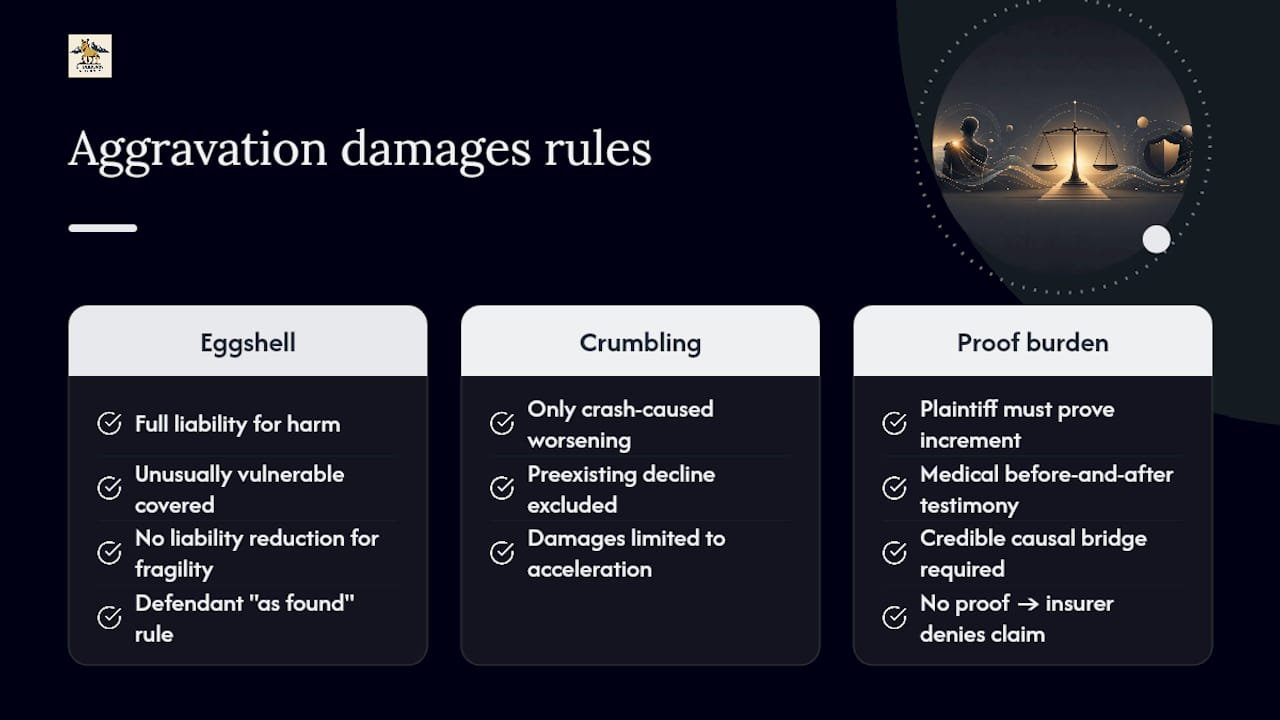
The eggshell plaintiff rule (also called the thin skull rule) is the legal backbone of every aggravation claim. It says a defendant is liable for the full extent of harm they cause, even if the victim was unusually vulnerable to injury before the crash ever happened, according to the Legal Information Institute at Cornell Law. In plain terms, a driver who rear-ends you doesn’t get a discount on liability just because you happened to have a fragile spine.
An insurer cannot reduce your compensation simply because you were more susceptible to injury than an average person. The defendant takes the plaintiff as they find them.
Courts distinguish this from the “crumbling skull” scenario, where a condition would have deteriorated on its own regardless of any accident. In a crumbling skull case, the defendant only owes damages for the acceleration or worsening actually caused by the crash, not for the inevitable decline that was already coming. Juries rely on model instructions to draw that line. New Jersey’s aggravation-of-preexisting-disability instruction tells jurors explicitly that a plaintiff may recover for aggravation, but damages must be limited to the extent the condition was actually made worse by the defendant’s conduct. California’s CACI 3927 works the same way, walking jurors through how to separate preexisting impairment from crash-caused harm.
The burden sits entirely on you, the plaintiff, to prove that increment. You need medical testimony that identifies what your condition looked like before the wreck and what it looks like now, with a credible bridge between the two. Without that bridge, an insurer will argue every symptom you have was already there, and a jury has no instruction that helps you if the proof isn’t on the table.
How Insurers Attack Preexisting Injury Claims and What Beats Them
Adjusters have a playbook for these claims, and it rarely changes. They request broad medical record releases hoping to dig up any old complaint that lets them blame your pain on degeneration instead of the crash. They point to gaps in treatment as proof you weren’t really hurt. They push for an independent medical exam designed to find a doctor who will attribute your symptoms to age or prior injury rather than the collision, according to Muhareb Law Group’s analysis of preexisting condition tactics.
Beating that strategy takes a specific evidence timeline, built in this order:
- Pre-accident baseline records showing your condition and symptom level before the crash.
- Emergency room or first-treatment notes documenting what hurt immediately after impact.
- Treating physician causation statements that directly link the worsening to the collision.
- Comparative imaging (X-rays, MRIs) taken before and after, when available.
- Physical therapy and specialist notes tracking your recovery or lack of it.
- Medication changes showing new prescriptions or increased dosages.
- Work restriction documentation from your doctor.
- Personal symptom logs noting pain levels and limitations day to day.
- Witness statements about your condition before and after the crash.
- Bills, denial letters, and correspondence from the insurer.
Keep treating consistently and tell every provider clearly what changed and when. Never sign a blanket medical authorization that lets an insurer pull your entire lifetime health history. And never accept a fast, low settlement offer before a doctor has documented the full scope of the aggravation.
Pro Tip: Ask your treating physician to write one sentence that says the crash “aggravated” or “accelerated” your condition. That single causation phrase, dated and signed, is often worth more than a stack of imaging.
Which Conditions Tend to Worsen After a Crash
Some conditions show up in aggravation claims more than others, and each needs its own kind of proof.
- Spine and neck degeneration: Comparative imaging before and after is the strongest evidence, since degenerative discs often look similar on paper but feel completely different in symptoms.
- Prior back or joint surgeries: Pre- and post-treatment notes from the same surgeon or specialist carry the most weight.
- Arthritis: A documented jump in pain, mobility loss, or medication use right after the crash makes the aggravation visible.
- Healed fractures: Fresh imaging showing new stress or reinjury at the old fracture site is critical.
- PTSD and other mental-health conditions, including migraines: Therapy records and medication changes tied to a specific post-crash date matter most.
An asymptomatic predisposition that suddenly turns symptomatic after a crash, like a disc bulge you never knew about until your neck locked up the next morning, often makes the strongest aggravation claim of all. There’s no prior complaint for an insurer to point to, just a clear before-and-after.
How Stubbornattorney Builds Aggravation Cases
Ryan Malnar built Stubbornattorney on a decade of injury law experience combined with a previous career as a federal claims adjudicator, which means he has seen these denial tactics from the other side of the table. That background shapes how the firm handles a preexisting injury car accident claim from day one.
A lawyer earns their fee on cases like this by controlling what the insurer actually sees and how the story gets told.
- Limiting medical record disclosures to what’s relevant, rather than handing over a full lifetime history.
- Retaining treating physicians or independent experts to write clear causation opinions.
- Building the before-and-after medical timeline into a coherent narrative for adjusters or a jury.
- Negotiating apportionment directly instead of accepting the insurer’s first framing.
- Litigating when the insurer refuses to budge on a fair aggravation value.
You should strongly consider calling a lawyer when medical costs are climbing, when a doctor mentions permanent impairment, when the insurer disputes causation outright, or when your claim involves complex apportionment between old and new damage. Before you make that call, save every record you have, keep every treatment appointment, and preserve texts or emails from the other driver’s insurer.
What Insiders Know About Aggravation Claims
Adjusters weigh one document more than almost anything else: a treating physician’s written causation statement. Vague notes get discounted fast. One tactic most claimants never think to use is asking for a time-limited, condition-specific medical release instead of signing the insurer’s blanket form.
— Ryan
When to Call Stubbornattorney for a Free Case Evaluation
If a crash aggravated a condition you were already living with, some lawyers may take that kind of case on contingency, meaning you owe nothing unless money is recovered for you. Bring your pre-accident medical history, ER and specialist records, therapy notes, medication lists, and any denial letters the insurance company has already sent. That paperwork lets an attorney spot the apportionment argument before the insurer builds it against you.
If the aggravation has cost you new medical bills, lost income, or lasting limitations, a free case evaluation is the fastest way to find out what your claim is actually worth. Stubbornattorney reviews the records, flags the gaps an insurer will exploit, and tells you plainly whether you have a case worth pursuing.

Sources
The eggshell skull rule explainer from Cornell Law lays out the doctrine itself. New Jersey’s model jury instruction on aggravation shows the exact apportionment language courts use. Healthcare defines “pre-existing condition” in plain medical terms, which is useful for separating insurance jargon from injury-law usage.
This article is general information, not a substitute for advice from a qualified lawyer. Consult a qualified legal professional about your own circumstances before acting on anything here.
- Eggshell skull rule — Legal Information Institute (Cornell Law)
- 8.11F Aggravation Of The Preexisting Disability (New Jersey jury instruction example)
- What Is Disability Aggravation and How Is It Proven? — LegalClarity
- Preexisting Injury After a Michigan Crash — Michigan Legal Center
FAQ
What counts as a pre-existing injury after a car crash?
A pre-existing injury is any diagnosed or symptomatic health condition, or even a dormant, asymptomatic one, that existed before the collision occurred.
Will insurance pay to fix damage to a pre-existing condition?
Insurance typically pays only for the incremental worsening the crash caused, not for restoring you to a healthier baseline than you had before the accident, based on how courts apportion aggravation damages.
How do insurance companies determine if damage was pre-existing?
Adjusters compare your pre-accident medical records against post-crash treatment notes and imaging, looking for gaps in care or prior complaints they can use to argue the injury already existed, a pattern detailed by LegalClarity’s breakdown of aggravation proof.
What should you avoid saying to your insurance company after an accident?
Avoid minimizing your pain, guessing about injuries you haven’t had evaluated, or admitting fault, and never sign a broad medical authorization before speaking with a lawyer.
Does a pre-existing condition automatically ruin my car accident claim?
No. A preexisting injury does not automatically defeat a claim; the real fight is almost always over causation and how much the crash actually worsened your condition, according to the Michigan Legal Center.