

3 Evidence Rules That Prove a Minor Impact Soft Tissue Claim
Yes, a low-speed, low-damage crash can cause real soft-tissue injuries, and insurers know it even when their letters say otherwise. The gap between winning and losing a minor impact soft tissue claim almost always comes down to three things: getting evaluated fast, keeping consistent medical records, and having a treating provider willing to connect your symptoms to the crash. Skip any of those, and even a legitimate injury starts looking optional to an adjuster.
Table of Contents
- What Is a Minor Impact Soft Tissue (MIST) Claim?
- Why Do Insurers Dismiss or Undervalue MIST Claims?
- Can Soft-Tissue Injuries Show Up on an X-Ray or MRI?
- What Evidence Do You Need to Prove a MIST Claim?
- What Is the Average Payout for Soft-Tissue Damage?
- How Do You Respond to Common Insurer Defenses?
- What Should You Do After a Low-Damage Crash?
- Why Persistence Changes the Outcome of a MIST Claim
- Sources
- FAQ
What Is a Minor Impact Soft Tissue (MIST) Claim?
“MIST” is an insurance industry label, not a medical diagnosis. Adjusters use it to flag claims where vehicle damage looks minor, on the theory that low property damage means low or no injury. The medicine doesn’t support that shortcut, but the label sticks anyway because it’s cheap to apply and hard for claimants to argue against without documentation.
The injuries behind a typical MIST claim include:
- Whiplash-associated disorders (WAD) affecting the neck’s muscles, ligaments, and joints
- Cervical and lumbar sprains or strains from sudden acceleration-deceleration forces
- Shoulder soft-tissue injuries, including rotator cuff strain
- Contusions and bruising from seatbelt or airbag contact
Soft tissue injuries like these are frequently caused by acceleration-deceleration forces, and symptoms can take days or even weeks to fully surface. That delay is exactly what fuels insurer skepticism, and exactly why early clinical notes matter so much later.
Why Do Insurers Dismiss or Undervalue MIST Claims?
Insurers run claims through a segmentation process that flags cases below a certain vehicle-damage dollar threshold for accelerated, reduced settlement handling. It’s a volume tactic, not a medical judgment, but it’s applied at scale across thousands of claims every year.
Adjusters lean on a short list of familiar arguments: minimal property damage means minimal injury, a preexisting condition explains your pain, or a delay in seeking treatment proves you weren’t really hurt. None of these hold up on their own, but they work often enough that insurers keep using them. Claims handlers may also point to normal X-rays as if that settles the question, when in reality plain imaging frequently shows nothing even in confirmed soft-tissue injuries. The goal of these tactics is speed: get a low offer accepted before you’ve built a real record and before an attorney gets involved.
Can Soft-Tissue Injuries Show Up on an X-Ray or MRI?
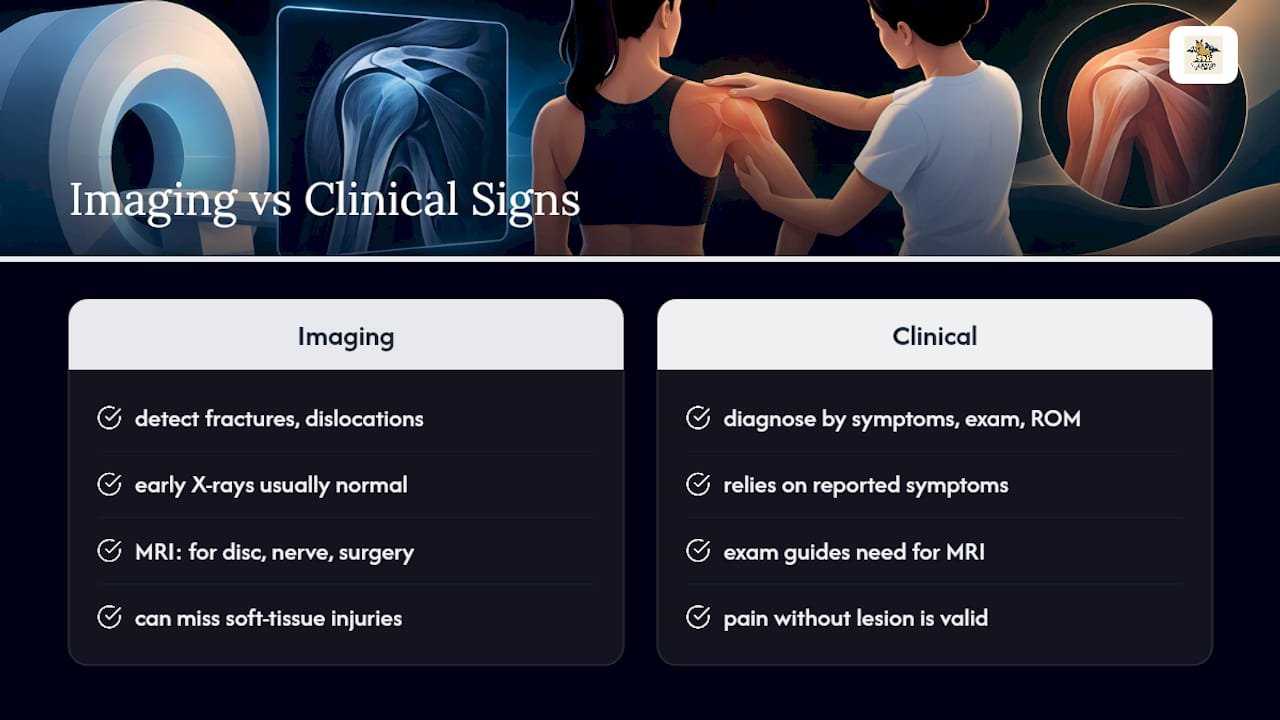
Usually not, and that’s the part insurers count on you not knowing. Whiplash-associated disorder is primarily a clinical diagnosis, built on your reported symptoms, physical exam findings, and range-of-motion testing rather than a scan. Early X-rays are typically normal because they’re designed to detect fractures and dislocations, not strained ligaments or inflamed soft tissue.
MRI has a role, but a selective one. It’s most useful when a provider suspects disc involvement, nerve compression, or an injury severe enough to warrant surgical evaluation, not as a routine first step for a strained neck. One controlled study even found no MRI or EMG detectable structural cervical damage in volunteers exposed to very low-speed rear impacts, even though most still reported transient pain. That finding cuts both ways: it shows imaging has real limits, and it shows pain without a visible lesion is still a documented, reportable symptom.
Clinical literature built on frameworks like the Quebec Task Force classification recognizes that WAD outcomes are notably heterogeneous. Two people in the same collision can have wildly different recovery timelines, which is one more reason a single normal scan should never be read as proof nothing happened.
What Evidence Do You Need to Prove a MIST Claim?
Timing beats everything else. Get evaluated within 24 to 72 hours, because delayed injury symptoms are common with soft-tissue trauma, but the longer you wait, the easier it becomes for an adjuster to argue your pain came from something else.
After that first visit, the case is built on consistency:
- Attend every scheduled physical therapy or follow-up appointment, without gaps
- Keep a daily symptom and activity journal noting pain levels, sleep disruption, and tasks you can no longer do
- Save every medical bill, prescription record, and work-absence note in one place
- Ask your treating provider directly whether they can state, in the record, that your symptoms are consistent with the collision
That last point, a treating-physician nexus opinion, is often the single most persuasive piece of the entire file. Biomechanical crash reconstructions can support a case in select circumstances, but courts and insurers weigh them alongside clinical evidence, never as a substitute for it. Avoid the pitfalls that quietly kill claims: unexplained treatment gaps, inconsistent statements about your limitations, and social media posts that contradict what you told your doctor.
Pro Tip: Photograph your bruising, swelling, or visible injury every few days during the first two weeks. Adjusters discount verbal pain descriptions far more than they discount a dated photo timeline showing the injury change over time.
For a fuller walkthrough of what to gather and when, see this evidence checklist for injury cases.
What Is the Average Payout for Soft-Tissue Damage?
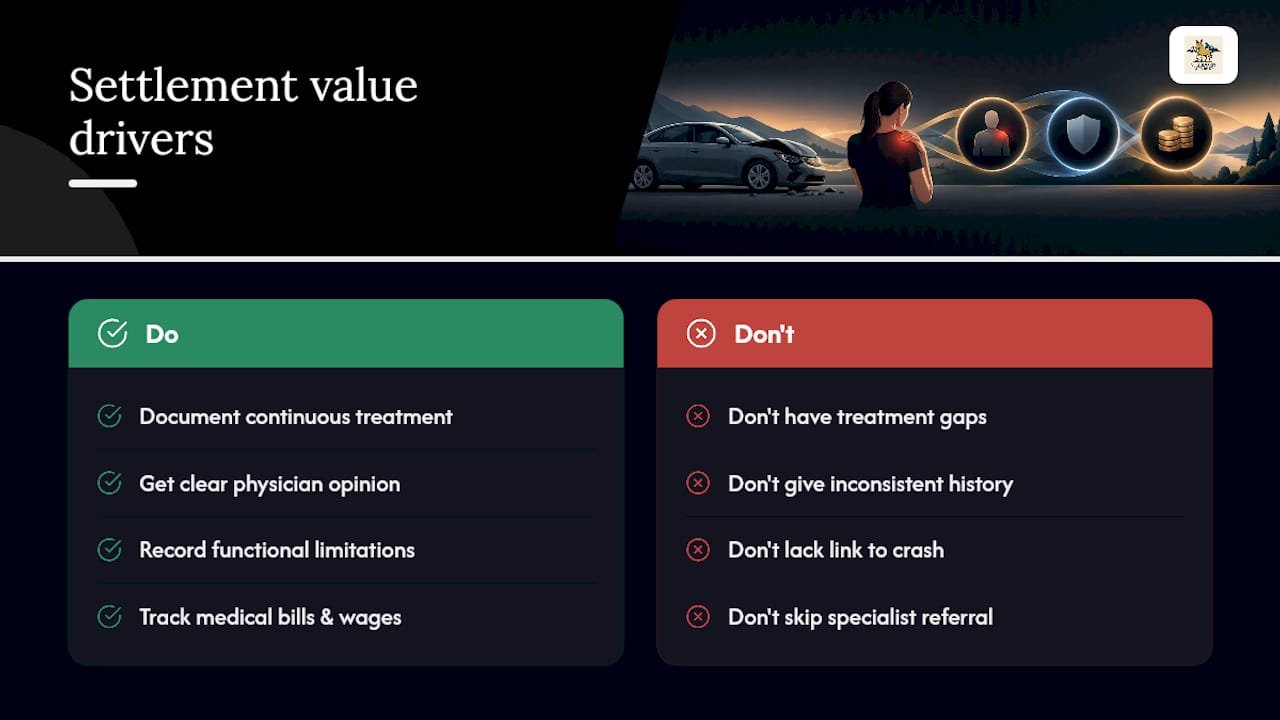
There’s no single number, because settlement value tracks treatment length and documented impact, not the accident itself. A soft-tissue injury resolved in a few weeks with basic physical therapy settles very differently than one requiring months of care, injections, or a referral to a specialist.
Two categories drive the final figure. Economic damages cover medical bills, lost wages, and any future treatment a doctor projects you’ll need. Non-economic damages cover pain and suffering, disrupted sleep, and the everyday tasks the injury has taken off the table, from lifting your kids to sitting through a full workday.
Settlement value tends to rise with longer treatment duration, documented functional limitations, and a clear physician opinion linking symptoms to the crash. It drops fast when there’s a treatment gap, inconsistent medical history, or no clear tie between the collision and the diagnosis. Reviewing factors that affect settlement amounts before you talk to an adjuster gives you a much clearer sense of where your own case likely falls.
How Do You Respond to Common Insurer Defenses?
Three defenses show up in nearly every MIST file: minimal vehicle damage, a preexisting condition, and a delay in seeking care. Each one sounds reasonable in isolation, and each one falls apart against a well-documented record.
Against the “no damage, no injury” argument, point to the research showing little consistent correlation between crash severity metrics and long-term whiplash outcomes. Against the preexisting-condition argument, a direct comparison between your pre-crash and post-crash medical records, showing new symptoms or a clear worsening, does the rebutting for you. Against delayed care, contemporaneous notes from your first visit describing exactly when and how symptoms started matter more than any explanation offered after the fact.
If the insurer schedules an independent medical exam (IME), treat it as an adversarial evaluation, not a neutral one, and have your attorney review the resulting report line by line. When an adjuster won’t move off a lowball number despite solid documentation, litigation becomes the leverage that finally gets a case taken seriously.
What Should You Do After a Low-Damage Crash?
- Prioritize safety first, then photograph the scene, all vehicles’ damage, and any visible injuries before anything gets moved or repaired.
- Exchange information with every driver involved and collect contact details from any witnesses on scene.
- Seek medical evaluation immediately, describing every symptom in detail, even ones that feel minor, so they’re on record from day one.
- Follow the treatment plan exactly, attending every referral and physical therapy session your provider recommends.
- Start a daily journal tracking pain, sleep, and activities you can no longer manage.
- Save every document, including bills, pharmacy receipts, and any note from work about missed shifts.
- Be careful with insurers, especially recorded statements to the other driver’s carrier, before you’ve spoken with an attorney.
- Consult an attorney early, bringing your medical records, photos, and journal to the first meeting so they can assess the claim’s real strength.
For a more detailed version of this sequence, review these 10 steps to strengthen your injury claim.
Why Persistence Changes the Outcome of a MIST Claim
Before practicing personal injury law, Ryan Malnar worked as a claims adjudicator for the federal government, which means he’s seen the segmentation playbook from the inside. That background changes how a case gets built from day one: knowing exactly which documentation an adjuster will try to dismiss lets a claimant close those gaps before the insurer ever raises them.
Minor impact soft tissue claims rarely resolve quickly, and a fair number take months of back-and-forth before an insurer offers a number that actually reflects the injury. Persistence, not speed, is what moves these cases. If you’re weighing whether your claim is worth pursuing, Stubbornattorney’s case evaluation reviews your medical records and documentation at no cost, and the firm’s personal injury services cover car accidents, whiplash, and related soft-tissue cases across Colorado on a contingency basis, meaning there’s no fee unless you recover compensation.
— Ryan
Sources
For deeper reading: Cleveland Clinic on diagnosis, PMC on WAD prognosis, PLOS One on crash-severity correlation, Frontiers on imaging limits, and OrthoInfo on treatment.
This article is general information, not a substitute for advice from a qualified lawyer. Consult a qualified legal professional about your own circumstances before acting on anything here.
- Soft tissue injury – Cleveland Clinic
- Motor vehicle crash reconstruction: Does it relate to the heterogeneity of whiplash recovery? – PLOS One
FAQ
What Is the Average Payout for Soft-Tissue Damage?
There’s no fixed average because value depends on treatment length, documented limitations, and how clearly a provider links your symptoms to the crash. Cases with brief recovery and minimal care typically settle lower than those involving months of therapy or specialist referrals.
How Long Does It Take for Soft-Tissue Damage to Heal?
Healing time varies by grade and injury type. Reviews of whiplash and soft-tissue recovery show mild strains often improve within weeks, while more significant sprains can take months, and early mobilization tends to support better recovery than prolonged rest.
Is It Worth Filing a Claim for Minor Damage?
Yes, if the crash caused real symptoms, since vehicle damage and injury severity often don’t correlate. Research on crash reconstruction shows low-speed impacts can still produce genuine, lasting whiplash symptoms worth documenting and pursuing.
What Are Some Examples of Minor Soft-Tissue Injuries?
Common examples include cervical and lumbar strains, whiplash-associated disorders, shoulder soft-tissue injuries, and contusions from seatbelt or airbag contact. Most are diagnosed clinically rather than through imaging, since X-rays and MRIs frequently show nothing even when the injury is real.