
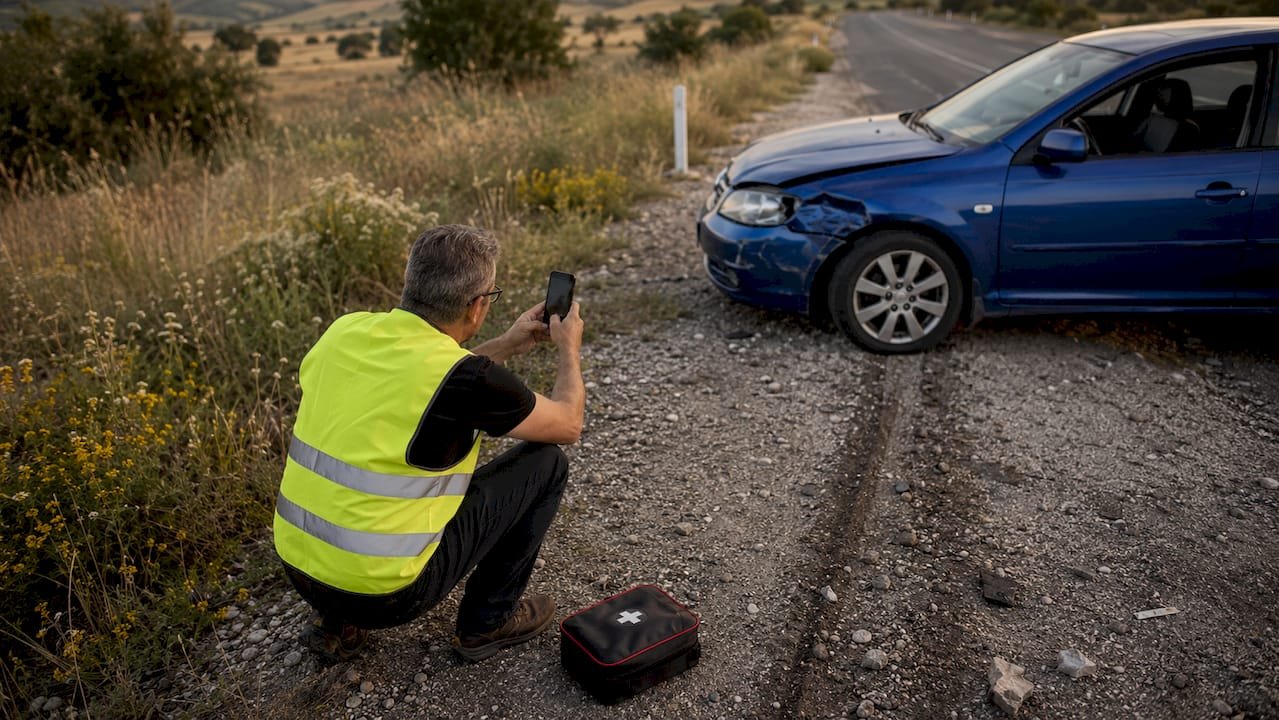
How to Gather Accident Evidence After a Crash
Accident evidence is the documented record of facts, conditions, and injuries that determines who pays and how much after a car collision. Knowing how to gather accident evidence starts the moment your car stops moving, and every minute you delay costs you proof. The Texas Department of Insurance, FindLaw, and Justia all confirm that evidence collection begins at the scene and continues through medical treatment and official reporting. Your smartphone, a calm head, and a clear process are the only tools you need to build a case that holds up against an insurance adjuster or in a Colorado courtroom.
How to gather accident evidence: tools and preparation
The right preparation turns a chaotic crash scene into an organized record. You do not need specialized equipment. You need a charged smartphone, a working camera app, and a basic understanding of what information matters most.
Here is what to have ready before you ever need it:
- Smartphone or dedicated camera. Your phone handles photos, video, and voice memos in one device. Make sure it has adequate storage and is charged above 50% when you drive.
- Notebook and pen. Digital notes can fail if your phone dies or gets damaged. A physical notepad in your glove compartment is a reliable backup.
- Note-taking app. Google Keep, Apple Notes, or any simple app works for recording details quickly. Voice-to-text is especially useful when your hands are shaking.
- Understanding of what to record. The Texas Department of Insurance recommends writing down the accident date, time, location, weather conditions, and a plain-language description of what happened.
- Safety awareness. Before you document anything, move to a safe location away from traffic. Turn on hazard lights, check for injuries, and call 911. No photo is worth stepping into a live lane.
The mindset matters as much as the tools. Shock and adrenaline are real. They distort memory within hours of a traumatic event. Evidence gathering ideally begins on the day of the accident because details fade fast and physical conditions at the scene change or disappear entirely. A skid mark washes away in the next rainstorm. A witness walks away in ten minutes. Treat the scene like a crime scene, because for insurance purposes, it is.
Pro Tip: Set up a dedicated folder on your phone labeled with the accident date before you leave the scene. Drop every photo, video, and screenshot directly into it so nothing gets buried in your camera roll.
Step-by-step: documenting the scene and vehicle damage
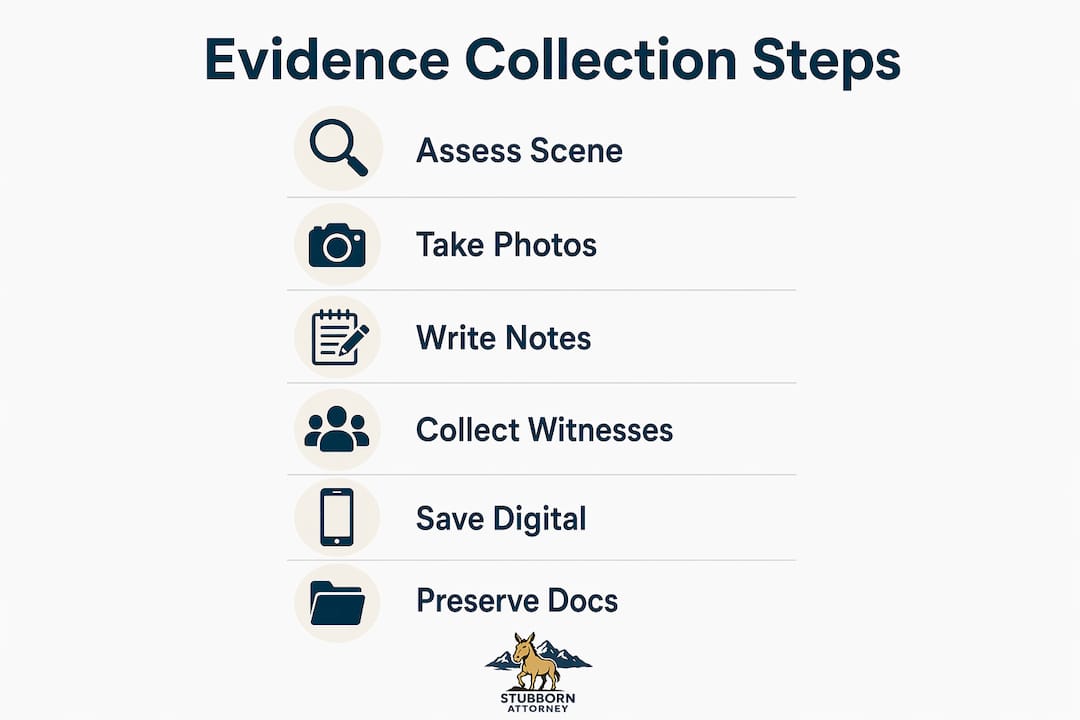
Once you are safe and emergency services are called, start collecting accident proof immediately. Work from wide to close: capture the full scene first, then move in for details.
-
Photograph the entire scene from multiple angles. Walk a wide perimeter and shoot the positions of all vehicles before anything moves. Include road signs, traffic signals, lane markings, and any nearby landmarks that establish location. Photos of traffic signals and road layout often clarify fault in ways that police reports cannot.
-
Capture close-up damage on every vehicle. Photograph each point of impact, crumple zones, broken glass, and deployed airbags. Get the license plates of all vehicles involved in the same frame as the damage where possible.
-
Document road conditions and environmental factors. Skid marks, debris fields, potholes, wet pavement, ice, and poor lighting all contribute to fault analysis. Photograph these before emergency crews or traffic clear them away.
-
Record a narrated video walkthrough. Walk the scene while recording video and describe what you see out loud. Say the time, the weather, the direction each car was traveling, and any visible injuries. This creates a timestamped, spoken record that photos alone cannot replicate.
-
Photograph the other driver’s documents. The Texas Department of Insurance advises photographing the other driver’s insurance card and license rather than copying numbers by hand. This eliminates transcription errors and creates a verifiable image record.
-
Note your own physical condition. Photograph any visible injuries on yourself or your passengers immediately. Bruising, cuts, and swelling can worsen over hours, but early photos establish the initial impact.
-
Record the responding officer’s information. Write down the officer’s name, badge number, and the report number they assign. You will need these to order the police report for your insurance claim or attorney.
Pro Tip: If your phone has a burst mode or live photo feature, use it on fast-changing conditions like smoke, leaking fluids, or shifting debris. Static shots miss what burst mode catches.
One thing most people miss: documentation includes written notes, not just photos. Write a plain-language account of the accident sequence while it is fresh. Include what you were doing, what you saw, and what happened in the order it occurred. This narrative becomes your anchor when your memory shifts weeks later under the pressure of an insurance interview.
How to collect witness information and digital evidence
Witnesses are among the most powerful assets in any accident claim, and most people walk away from the scene without a single contact name. Approach witnesses calmly and directly. Tell them you were involved in the accident and ask if they would be willing to share their contact information.
Here is what to collect from each witness:
- Full name and phone number. A name without a number is useless. Confirm the number by calling it while you are still at the scene.
- Email address. Insurance adjusters and attorneys often prefer written statements. An email address makes follow-up possible weeks later.
- A brief verbal account. Ask the witness to describe what they saw in their own words while you record audio on your phone. Do not coach or lead them. Let them speak freely.
- Their location during the accident. A witness standing at a bus stop 30 feet away carries more weight than one who was driving past at speed.
Beyond human witnesses, digital evidence is often decisive. Nearby businesses frequently have exterior surveillance cameras pointed at parking lots, intersections, or storefronts. Act quickly to request CCTV footage because many systems overwrite recordings within 24 to 72 hours. Walk into the business, explain you were in an accident outside, and ask to speak with a manager about preserving the footage.
Dashcam footage follows the same urgency. Digital evidence can be overwritten rapidly, so save your dashcam files to a separate drive or cloud storage the same day. Do not rely on the camera’s loop recording to hold the file. Copy the original file and back it up in at least two locations, such as Google Drive and a USB drive kept at home.
Organizing digital evidence matters as much as collecting it. Create a folder structure with subfolders for photos, videos, witness contacts, and dashcam files. Label each file with the date and a brief description. Disorganized evidence is nearly as damaging as missing evidence when an attorney or adjuster needs to reconstruct the timeline quickly.
Obtaining and preserving official and medical documentation
Official documents and medical records form the backbone of any insurance claim or personal injury case. Photos prove what happened at the scene. Documents prove what it cost you.
| Document type | Where to get it | Why it matters |
|---|---|---|
| Police report | Local law enforcement agency, online portal, or in person | Establishes official account of fault, parties, and conditions |
| Emergency room records | Hospital medical records department | Links injuries directly to the accident date |
| Diagnostic test results | Ordering physician or hospital | X-rays, MRIs, and CT scans prove internal injuries insurers cannot see |
| Treatment plans | Primary care or specialist physician | Shows ongoing injury impact and required care |
| Prescription receipts | Pharmacy or patient portal | Documents medication costs tied to accident injuries |
| Repair estimates | Auto body shop | Establishes vehicle damage value for property claims |
| Insurance communications | Your own records | Creates a paper trail of adjuster interactions and offers |
Seek medical attention promptly after any accident, even if you feel fine. Delayed treatment gives insurance companies a direct argument that your injuries were not caused by the crash. Whiplash, concussions, and soft tissue injuries often surface 24 to 72 hours after impact. A same-day or next-day medical visit creates a timestamp that ties your diagnosis to the collision.
Keep all medical records and bills in one place from the start. This includes every ER visit, specialist appointment, physical therapy session, and prescription. The goal is to build what experienced personal injury attorneys call a “damages linkage file.” A well-organized damages linkage file connects the collision mechanism to your diagnoses, treatment timeline, total costs, and any lost wages. That connection is what converts a stack of documents into a dollar figure an insurer must take seriously.
Create a dedicated accident evidence folder that holds every document in one place, both physical and digital. Use a binder with labeled tabs for physical papers and a mirrored folder structure in cloud storage. This single habit prevents the most common evidence disaster: losing a critical document months after the accident when you need it most.
Common mistakes that weaken your accident evidence
Most people do not lose their claims because they lacked evidence. They lose because they made avoidable mistakes in the days and weeks after the crash.
- Relying solely on the police report. Police reports are starting points, not complete records. Independent photos and videos of traffic signals, road layout, and scene context routinely contradict or expand on what an officer recorded from a brief on-scene interview.
- Delaying medical care. Every day between the accident and your first medical visit is a day an insurer can argue your injury came from somewhere else. Prompt care is both a health priority and a legal one.
- Failing to back up digital files. A cracked phone screen or a stolen vehicle can wipe out your entire photo record. Back up to cloud storage and a physical drive within 24 hours of the accident.
- Not logging communications. Every call with an insurance adjuster, every repair shop estimate, and every missed workday should be logged with the date, time, and a brief summary. This log becomes evidence of bad faith if an insurer delays or lowballs your claim.
- Giving a recorded statement without legal advice. Insurance adjusters are trained to ask questions that produce answers used against you. You are not required to give a recorded statement before speaking with an attorney.
Pro Tip: Set a weekly calendar reminder for the first two months after your accident to update your evidence folder with new medical bills, treatment notes, and any communications from insurers or repair shops. Consistency beats memory every time.
The first hours and days post-accident are the highest-risk window for evidence loss. Physical conditions change, witnesses become unreachable, and digital files overwrite. Treat the 72 hours after a crash as a dedicated evidence preservation window and work through the steps above with that urgency in mind.
What I’ve learned from a decade of accident claims
I have reviewed hundreds of accident files over my career, first as a federal claims adjudicator and then as a personal injury attorney in Colorado. The single most consistent pattern in weak claims is not missing photos. It is missing context. A photo of a dented bumper tells me nothing about speed, road conditions, or fault. A photo of that same bumper alongside a wet road, a missing stop sign, and a skid mark tells me a story I can take to an insurer or a jury.
The second pattern I see constantly is the gap between the accident date and the first medical visit. I have watched legitimate injury claims get slashed or denied because a client waited four days to see a doctor. Insurers do not give the benefit of the doubt. They look for gaps and use them. When you see a doctor the same day or the next morning, you close that gap before it opens.
Here is the piece of advice I give every client before they leave my office after an initial consultation: treat your evidence like your health. You would not ignore a broken bone and hope it heals on its own. Do not ignore a missing witness statement or an unbacked dashcam file and hope it does not matter. It will matter. The clients who come to me with organized folders, timestamped photos, and complete medical records from day one consistently reach better outcomes than those who reconstruct their case from memory six months later.
If you are reading this after an accident in Colorado, the steps to gather accident details are not complicated. They just require you to act before the scene changes, before the witnesses leave, and before the adrenaline fades and you convince yourself everything will work out without documentation. It rarely does.
— Ryan
How Stubbornattorney can help you build a stronger claim
Evidence collection is the foundation, but knowing what to do with that evidence is where legal experience makes the difference. At Stubbornattorney, Ryan Malnar and his team work with accident victims across Colorado to review, organize, and deploy evidence in ways that maximize claim value. As a former federal claims adjudicator, Ryan knows exactly how insurance companies evaluate files and where they look for weaknesses. If you have been in a crash and want to know whether your evidence is strong enough, start with a free personal injury case review and get a direct answer from an attorney who has been on both sides of the claims process. You can also explore common personal injury case examples to understand how cases like yours typically unfold.
FAQ
What should I photograph first at an accident scene?
Start with wide-angle shots of all vehicle positions before anything moves, then photograph license plates, visible damage, road signs, skid marks, and weather conditions. The Texas Department of Insurance specifically recommends capturing street signs and the other driver’s insurance card and license as photo records.
How long do I have to collect accident evidence in Colorado?
Physical evidence at the scene disappears within hours, and digital files like dashcam footage can overwrite within 24 to 72 hours. Start collecting immediately and treat the first 72 hours after the crash as your critical preservation window.
Does a police report replace my own evidence?
No. Police reports alone are insufficient because they reflect a brief on-scene interview, not a full investigation. Your own photos, videos, and witness contacts provide context and detail that official reports routinely miss.
Why does prompt medical care matter for my claim?
Delayed treatment gives insurers grounds to argue your injuries were not caused by the accident. A same-day or next-day medical visit creates a documented timestamp that directly ties your diagnosis to the collision date.
How should I organize all my accident documents?
Create a dedicated evidence folder with separate sections for photos and videos, the police report, medical records and bills, insurance communications, repair estimates, and a running log of expenses and missed work. Mirror this structure in cloud storage so nothing is lost if physical copies are damaged.