

The Role of Negligence in Car Accidents Explained
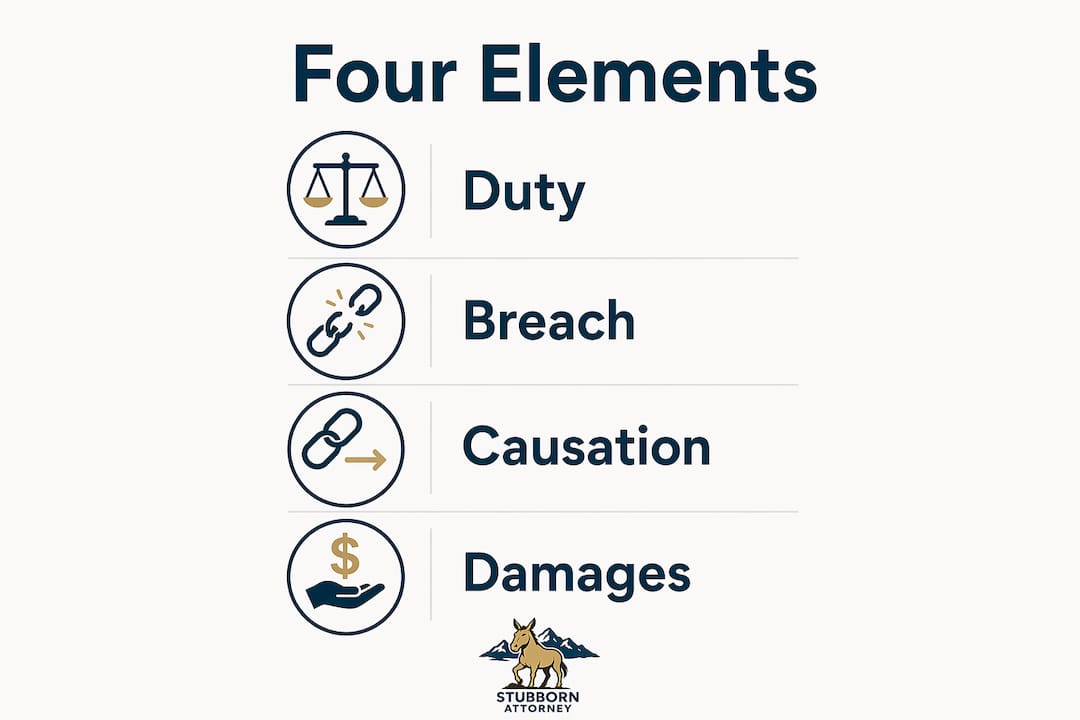
Negligence in car accidents is defined as a driver’s failure to exercise reasonable care, creating legal liability when that failure directly causes harm to another person. This legal standard, formally called tort negligence, does not require intent to injure. Negligence focuses on careless conduct, not malicious behavior, which means even an ordinary lapse in attention can expose a driver to serious legal consequences. Understanding how negligence works is the difference between recovering full compensation and walking away with nothing. The four core elements — duty of care, breach, causation, and damages — must all be proven for a claim to succeed, and failing any single element collapses the entire case.
What are the four elements of negligence in car accidents?
Every negligence claim in a car accident case rests on four legal pillars. Each one must be established with evidence. Miss one, and the claim fails regardless of how serious the injuries are.
Duty of care
Every licensed driver in the United States carries a legal duty of care toward other road users. This duty requires operating a vehicle in the way a reasonably careful person would under similar conditions. It applies to every driver on every road, whether on a Colorado mountain highway or a suburban street in Colorado Springs. The duty is automatic. You do not need a contract or a prior relationship with the other driver for it to exist.

Breach of duty
A breach occurs when a driver’s conduct falls below that reasonable standard. Speeding through a school zone, texting while driving, running a red light, or driving under the influence of alcohol all qualify as breaches. The breach does not need to be dramatic. Failing to signal before a lane change or following too closely can satisfy this element just as effectively. What matters is that the driver deviated from what a careful, prudent person would have done.
Causation
Causation is where many claims get complicated. Proving causation requires two tests: the “but-for” test (would the injury have occurred but for the defendant’s breach?) and the proximate cause test (was the harm a foreseeable result of that breach?). A driver who runs a red light and T-bones your vehicle satisfies both tests cleanly. A driver who was speeding three miles away when you hit a pothole does not. Foreseeability is the limiting principle that keeps liability from expanding infinitely.
Damages
Damages are the quantifiable losses you suffered because of the breach. These include medical bills, lost wages, property damage, and pain and suffering. Punitive damages are rare and require proof of willful or malicious conduct, such as a drunk driver who knowingly got behind the wheel. Standard auto insurance policies typically do not cover punitive damages, which means collecting them often requires going after personal assets.
Pro Tip: Document every expense from day one. Medical co-pays, prescription costs, mileage to appointments, and even days of missed work all count as damages. A detailed log from the start of your recovery is far more persuasive than reconstructed records months later.
How does negligence per se affect proving fault in car accidents?
Negligence per se is a legal shortcut that benefits injured drivers. When a defendant violates a traffic law, that violation is treated as automatic proof of breach of duty, without requiring the plaintiff to argue what a “reasonable driver” would have done. Traffic law violations presumptively establish breach under this doctrine, which significantly simplifies the liability analysis.
Common violations that trigger negligence per se include:
- Speeding above posted limits or driving too fast for road conditions
- Running red lights or stop signs, which is one of the leading causes of intersection collisions
- Driving under the influence of alcohol or drugs, in violation of state DUI statutes
- Illegal lane changes without signaling or checking blind spots
- Distracted driving violations where state law prohibits handheld device use while driving
- Failure to yield at crosswalks or merge points
The doctrine does not eliminate the need to prove causation and damages. A driver who ran a red light three blocks from your accident did not cause your crash simply by breaking a law. The injury must match the violation’s protective purpose for negligence per se to apply. A speeding law exists to prevent speed-related collisions. If the defendant was speeding and rear-ended you, the connection is direct. If the defendant was speeding but the crash happened because your tire blew out, the statutory violation does not establish causation.
The practical impact on insurance claims is significant. When a police report documents a traffic citation against the other driver, adjusters and defense attorneys face a much harder argument on breach. That citation becomes a powerful piece of evidence that shapes settlement negotiations from the very first conversation.
What are the different state rules on shared fault and how do they impact compensation?
Most real-world car accidents involve some degree of shared responsibility. A driver may have been speeding, but the other driver may have failed to check their mirrors before merging. States use three distinct systems to handle this shared fault, and the system your state uses directly determines how much compensation you can recover.
| Fault System | Rule | Recovery Example |
|---|---|---|
| Pure comparative negligence | Recover damages minus your fault percentage, regardless of how high your fault is | 80% at fault: recover 20% of damages |
| Modified comparative negligence | Recover damages minus your fault percentage, but only if your fault is below a threshold (usually 50% or 51%) | 49% at fault: recover 51% of damages; 51% at fault: recover nothing |
| Contributory negligence | Any fault on your part bars all recovery | 1% at fault: recover nothing |
Colorado follows modified comparative negligence with a 50% threshold. If you are found 50% or more at fault for the accident, you cannot recover any damages. If you are 30% at fault, your award is reduced by 30%. This system creates real stakes around how fault is allocated, because a shift of even a few percentage points can mean the difference between a meaningful recovery and no recovery at all.
Some states bar recovery entirely if the claimant is even 1% at fault. Alabama, Maryland, North Carolina, and Virginia still use contributory negligence. In those states, insurance adjusters have a powerful incentive to find any evidence of fault on your part, because even a minor contribution defeats your entire claim.
Pro Tip: Never admit fault at the accident scene, even casually. Saying “I didn’t see you” or “I should have braked sooner” can be used to assign comparative fault that reduces or eliminates your recovery. Stick to exchanging information and let the investigation determine fault.
The Georgia 50% fault rule, explained in detail by the Jewkes Firm, illustrates how modified comparative negligence plays out in practice. A plaintiff found 49% at fault still recovers, but one found 51% at fault walks away empty-handed. That one-percent margin is why fault disputes in car accident cases are fought so aggressively.
How can injured parties effectively prove negligence after a car accident?
Strong negligence claims are built in the first hours after a crash, not months later in a law office. The evidence that proves causation is often physical, temporary, and gone within days. Here is how to protect your claim from the moment the collision happens.
-
Photograph everything at the scene. Skid marks, debris fields, and traffic signal positions are transient evidence that disappears quickly. Capture the positions of all vehicles, road conditions, weather, and any visible injuries before anything is moved. These images directly support the causation element of your claim.
-
Get the police report. A responding officer’s observations carry significant weight with insurance adjusters and juries. If the officer issues a citation to the other driver, that citation supports negligence per se. Request a copy of the report as soon as it is available, typically within a few days of the accident.
-
Collect witness information. Independent witnesses who saw the crash have no stake in the outcome. Their statements corroborate your account and counter the other driver’s version of events. Get names, phone numbers, and brief written accounts while memories are fresh.
-
Seek medical attention immediately. Failing to document injuries promptly weakens the link between the crash and your damages. A gap in medical treatment gives insurance adjusters grounds to argue that your injuries were pre-existing or unrelated to the accident. Go to the emergency room or urgent care the same day, even if you feel only mild discomfort.
-
Preserve all records and communications. Keep every medical bill, prescription receipt, repair estimate, and correspondence with the insurance company. This paper trail documents your damages and shows the full financial impact of the crash.
-
Consult an attorney before speaking to the other driver’s insurer. Insurance adjusters work to minimize payouts by attributing partial fault to claimants. A recorded statement made without legal guidance can be used to shift blame and reduce your award. An experienced personal injury attorney knows exactly what adjusters are looking for and how to counter those tactics. You can review what evidence you need for a car accident claim before that first call.
Pro Tip: If you are physically able, use your phone to record a brief video at the scene narrating what you see. Describe road conditions, the other driver’s behavior, and your own injuries out loud. Video timestamps and metadata are harder to dispute than written notes made later.
What I’ve learned about negligence claims after a decade of fighting them
After more than ten years handling personal injury cases in Colorado, and years before that as a federal claims adjudicator, I can tell you that the legal standard for negligence is straightforward on paper. In practice, it is a different fight entirely.
The element that trips up most claimants is not duty or breach. It is causation. Insurance companies do not typically argue that their driver was careful. They argue that the crash did not cause your injuries, or that your injuries were pre-existing, or that you would have been fine if you had sought treatment sooner. I have seen adjusters pull medical records going back five years looking for any prior back complaint to undermine a legitimate spinal injury claim.
The second pattern I see constantly is claimants who underestimate how strategically insurance adjusters operate. These are professionals trained to minimize payouts. They are not on your side, and they are not neutral fact-finders. Every question they ask in a recorded statement is designed to elicit an answer that reduces your recovery. The moment you accept a quick settlement offer, you waive your right to pursue further compensation, even if your injuries turn out to be more serious than initially diagnosed.
Early legal advice is not a luxury in these cases. It is the single most effective way to avoid the mistakes that permanently damage a claim. The evidence window closes fast. Witnesses forget. Skid marks fade. Surveillance footage gets overwritten. By the time most people realize they need help, the best evidence is already gone.
My honest advice: treat the first 48 hours after a crash as the most legally consequential period of the entire case. Document everything, say nothing to the other insurer, and get a lawyer on the phone before you give any recorded statement.
— Ryan
How Stubbornattorney can protect your negligence claim
Negligence claims in car accident cases are not won on sympathy. They are won on evidence, legal strategy, and knowing exactly how insurance companies evaluate fault. At Stubbornattorney, Ryan Malnar and the team bring over a decade of personal injury experience and direct knowledge of how insurers think, because Ryan spent years as a federal claims adjudicator before becoming a plaintiff’s attorney. That background means your case is built to withstand the exact arguments adjusters use to reduce your award. Whether your case involves disputed fault, a negligence per se violation, or a complex shared-fault calculation under Colorado law, the team fights to recover every dollar you are owed. Review common personal injury case examples to see how these claims play out, or go directly to the Colorado Springs personal injury page for a free case evaluation.
FAQ
What is negligence in a car accident?
Negligence in a car accident is a driver’s failure to exercise reasonable care, resulting in harm to another person. It requires proving four elements: duty of care, breach of that duty, causation, and quantifiable damages.
What does “duty of care” mean for drivers?
Duty of care is the legal obligation every driver carries to operate their vehicle in a reasonably safe manner. This duty exists automatically toward all other road users and does not require any prior relationship between the parties.
How does negligence per se simplify a car accident claim?
Negligence per se means that a driver who violates a traffic law, such as speeding or running a red light, is presumed to have breached their duty of care. The injured party still must prove that the violation caused the specific injury and that damages resulted.
Can I recover compensation if I was partly at fault?
In most states, yes. Under pure or modified comparative negligence systems, your damages are reduced by your percentage of fault. Colorado uses modified comparative negligence, meaning you can recover as long as you are less than 50% at fault.
Why do I need a lawyer for a negligence claim?
Insurance adjusters are trained to minimize payouts by attributing partial fault to claimants, which directly reduces or eliminates your recovery. An experienced personal injury attorney counters those tactics, preserves critical evidence, and negotiates from a position of legal knowledge rather than urgency.