


72 Hours Can Cost Your Claim: State Fault vs No Fault Rules
If you’re hurt in a car accident, the fault vs no fault question decides one thing above all else: who pays your medical bills first. In at-fault states, you or your provider bills the other driver’s insurance company, and someone has to prove who caused the crash. In no-fault states, you file with your own insurer’s Personal Injury Protection first, no blame required, but you usually give up the right to sue for minor injuries. Property damage almost always stays fault-based no matter where you live.
Table of Contents
- At-Fault Systems: How Liability Actually Gets Decided
- No-Fault Systems: PIP Comes First, Lawsuits Come Later
- Which States Are No-Fault, Choice, or At-Fault?
- How to File a Claim: First-Party, Third-Party, and Everything In Between
- Can You Sue in a No-Fault State? Understanding Tort Thresholds
- Weighing the Trade-Offs: No-Fault vs At-Fault
- What to Do Right After a Crash to Protect Your Claim
- Why an Attorney’s Perspective on Fault Changes the Outcome
- The Part of This Debate Most Guides Get Wrong
- Get a Free Case Review From Stubbornattorney
- Where to Verify State-Specific Rules
- Sources
- FAQ
At-Fault Systems: How Liability Actually Gets Decided
Most states run on a tort system: the driver who caused the crash owes the other party for damages, and that debt gets paid through the at-fault driver’s bodily injury and property damage liability coverage. There’s no PIP requirement here. Instead, an insurance adjuster (or eventually a jury) decides who was negligent, and that finding drives every dollar that moves.
Fault gets established through police reports, witness statements, dashcam footage, and traffic citations. Adjusters weigh all of it before assigning a percentage of blame, and that percentage matters more than most drivers realize because of how states handle shared fault:
- Pure comparative negligence (California, New York): you can recover damages even if you’re 99% at fault, just reduced by your share.
- Modified comparative negligence (most states, including Colorado): you recover only if you’re less than 50% or 51% at fault, depending on the state’s cutoff.
- Contributory negligence (a small handful, including Virginia and Maryland): if you’re even 1% at fault, you may recover nothing at all.
Getting blamed for a crash carries a real cost beyond the claim itself. Industry data suggests drivers with an at-fault accident on their record see average premium increases of about 34%, and that jump tends to stick around for three to five years.
No-Fault Systems: PIP Comes First, Lawsuits Come Later
No-fault flips the order of operations. Instead of pointing fingers, you file a claim with your own insurer under your Personal Injury Protection coverage, and it pays out regardless of who caused the wreck. That’s the entire point: get medical bills paid fast without waiting on a liability fight.
PIP typically covers a defined set of costs, though limits vary sharply by state:
- Medical treatment, from ER visits to physical therapy
- A percentage of lost wages while you’re out of work
- In some states, funeral expenses or replacement services like childcare
Filing deadlines are unforgiving. Missing a PIP filing window or letting treatment gaps pile up is one of the most common reasons insurers deny benefits outright. And no-fault doesn’t touch your car. Property damage claims still run through the traditional fault-based process, either through your own collision coverage or a claim against the other driver. If your insurer pays out and later proves the other driver was at fault, it can pursue subrogation to recover what it spent.
Which States Are No-Fault, Choice, or At-Fault?
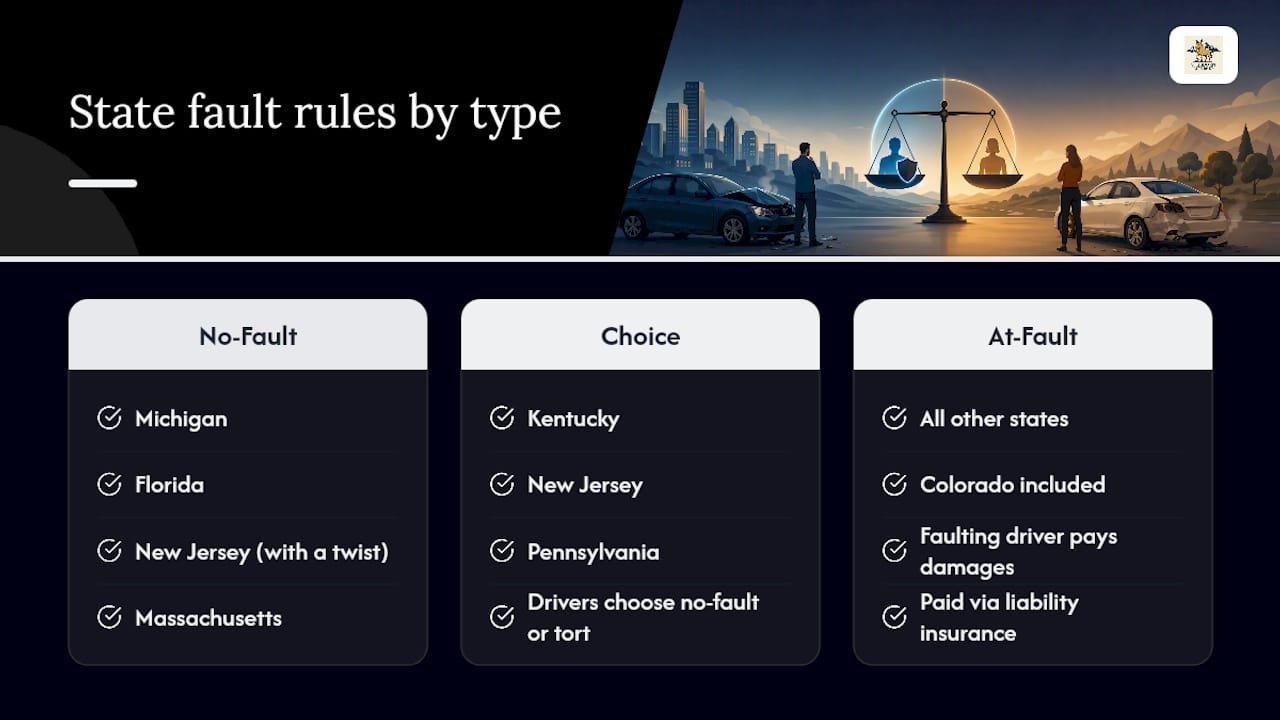
Several states currently run mandatory no-fault systems, including Michigan, Florida, New Jersey (with a twist, covered below), Massachusetts, Minnesota, and Hawaii. Michigan built one of the strictest versions in the country, requiring PIP with limited lawsuit rights, largely because state lawmakers wanted to guarantee unlimited medical coverage for catastrophic injuries without endless litigation over blame.
Three states occupy a middle ground worth understanding on its own: Kentucky, New Jersey, and Pennsylvania let drivers choose between a no-fault policy and a traditional tort policy when they buy coverage. That choice isn’t locked in forever, either. Consumers in choice states should revisit it at renewal, especially after a move or a change in driving habits, because the policy you picked years ago may not fit your situation now.
Everywhere else, including Colorado, the standard at-fault tort model applies: the driver who caused the crash is financially responsible for the other party’s damages, paid through liability insurance rather than your own PIP-style coverage.
State rules shift, and insurers sometimes describe coverage differently than the statute does. Before you assume anything about your claim, check your state insurance department’s website or call your agent and ask directly whether you’re in a no-fault, choice, or at-fault state.
How to File a Claim: First-Party, Third-Party, and Everything In Between
The claims process splits into two tracks, and knowing which one applies to your bill saves weeks of confusion.
- First-party claims go to your own insurer. This is how PIP works in no-fault states, and it’s also how you’d use your own collision coverage for vehicle repairs regardless of which system your state follows.
- Third-party claims go against the other driver’s liability insurer. In at-fault states, this is how you recover for injuries. In no-fault states, it’s how you handle property damage and how you pursue the at-fault driver once your injuries clear the tort threshold.
- Subrogation happens quietly in the background. If your insurer pays your medical bills or repairs your car, it may turn around and seek reimbursement from the at-fault driver’s insurer. You typically don’t have to do anything for this step, but it can affect any deductible reimbursement you’re owed.
Pro Tip: Keep every receipt, treatment note, and mileage log from day one. Adjusters lean hard on gaps in documentation to justify a denial or a lowball offer, and thin paperwork is the single most preventable reason a valid PIP claim gets rejected.
Can You Sue in a No-Fault State? Understanding Tort Thresholds
No-fault doesn’t mean no lawsuits, ever. It means your right to sue is gated behind a tort threshold, and states use one of two versions. A verbal threshold requires your injury to meet a specific description in the statute, things like death, permanent disfigurement, or a serious, permanent limitation of a body function. A monetary threshold requires your medical bills to exceed a set dollar amount before you can step outside PIP and sue.
Either way, the exact language varies by state and gets interpreted differently by courts. If your injury looks serious enough to clear the bar, don’t assume based on a friend’s experience in a different state. Check your state’s actual statute, or have someone who reads them for a living check it for you.
Weighing the Trade-Offs: No-Fault vs At-Fault
Neither system is free of downsides, and the right one for you depends entirely on what happened and how badly you were hurt.
- No-fault advantages: faster medical payments, fewer disputes over minor fender-benders, less courtroom backlog for small claims.
- No-fault drawbacks: capped PIP benefits, restricted lawsuit rights, and critics point to fraud and rising medical costs as chronic pressure points.
- At-fault advantages: full access to tort damages, including pain and suffering, and a more direct path to compensation for vehicle repairs.
- At-fault drawbacks: slower payouts when liability is contested, and a real risk of walking away with nothing in a contributory negligence state.
What to Do Right After a Crash to Protect Your Claim
The first 72 hours shape everything that follows, whether you’re filing PIP or building a fault case.
- Get medical attention immediately, even if you feel fine. Adrenaline masks soft-tissue injuries for days.
- Document the scene: photos of vehicle damage, road conditions, skid marks, and visible injuries, plus a copy of the police report.
- File your PIP claim right away if you’re in a no-fault or choice state, since delayed filing is one of the most common reasons insurers deny benefits.
- Start a third-party claim for property damage or, in at-fault states, for your injuries.
Pro Tip: Call an attorney the moment fault is disputed, your injuries look serious enough to clear a tort threshold, or an insurer starts stalling. Those three situations are exactly where a claims history and legal pressure change the outcome.
Reviewing your rights after a crash before you talk to any adjuster keeps you from saying something that gets used against your claim later.
Why an Attorney’s Perspective on Fault Changes the Outcome
Ryan Malnar has practiced personal injury law for over a decade and previously worked as a federal claims adjudicator, which means he’s seen both sides of these files. The recurring pitfalls he flags: missed PIP filing deadlines, injuries that get under-documented in the first two weeks, and evidence that disappears before anyone realizes it mattered for a tort threshold. An attorney’s real value shows up in exactly those gaps, pushing back on denied PIP claims, building the record a threshold requires, and knowing when a case is strong enough to litigate against the at-fault driver.
The Part of This Debate Most Guides Get Wrong
Most explainers treat fault vs no-fault like a binary switch: one system protects you, the other one doesn’t. That’s not how it plays out in practice. No-fault states still let you sue once your injury clears the threshold, and at-fault states still leave plenty of people undercompensated because proving blame takes time most injured drivers don’t have.
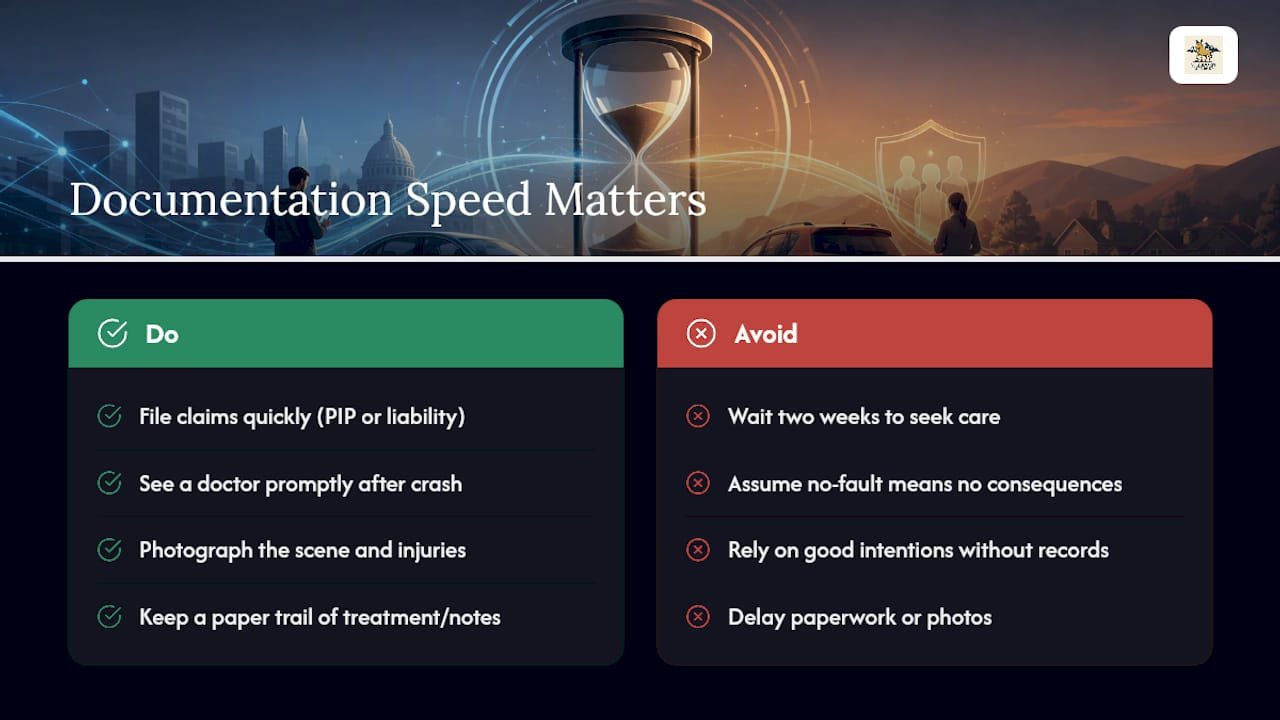
The bigger issue is that people confuse “no-fault” with “no consequences.” Your insurer still evaluates your PIP claim the same way an adjuster would evaluate a liability claim: skeptically, and against a clock. The idea that no-fault removes responsibility from the equation is a myth; it just moves the paperwork to a different desk.
If there’s one thing worth prioritizing over everything else in this article, it’s documentation speed. Whether you’re filing PIP in Michigan or building a liability case in Colorado, the drivers who lose benefits or leverage are almost always the ones who waited two weeks to see a doctor or didn’t photograph the scene. The legal system rewards paper trails, not good intentions.
— Ryan
Get a Free Case Review From Stubbornattorney
Figuring out fault vs no fault on your own is one thing. Fighting an insurance company that’s already decided how little it wants to pay is another. Stubbornattorney works Colorado car accident cases, including motorcycle, pedestrian, and semi-truck crashes, on contingency, so you owe nothing unless we recover money for you. That matters most when fault is disputed, when a PIP claim gets denied over a technicality, or when your injuries are serious enough to clear Colorado’s legal thresholds for a lawsuit. If any of that sounds like your situation, review our services and reach out for a free case evaluation. There’s no cost to find out where you stand.
Where to Verify State-Specific Rules
For legal definitions, check the Cornell Law Wex entry on no-fault. For a state-by-state breakdown of no-fault versus choice states, see Liberty Mutual’s guide. For consumer-facing claims guidance, AutoInsurance.com covers premium impacts in plain language, and vehicle repair questions are well covered by Auto Glass Kings’ guide for U.S. drivers.
This article is general information, not a substitute for advice from a qualified lawyer. Consult a qualified legal professional about your own circumstances before acting on anything here.
Sources
- Background on: No-fault auto insurance | III
- Autoinsurance
- no fault | Wex | US Law | LII / Cornell Law
FAQ
Who pays for car repairs in a no-fault state?
Property damage almost always stays fault-based even in no-fault states. You either use your own collision coverage or file a claim against the at-fault driver’s property damage liability.
What are the disadvantages of no-fault insurance?
The main drawbacks are capped PIP benefit limits, restricted rights to sue for minor injuries, and industry concerns about fraud and rising medical costs driving up premiums over time.
Are no-fault insurance states better than at-fault states?
Neither system is objectively better. No-fault gets medical bills paid faster with less litigation, while at-fault states preserve fuller access to damages like pain and suffering when liability is clear.
Why is Michigan a no-fault state?
Michigan adopted no-fault to guarantee prompt medical payment after a crash without forcing every injured driver into a lawsuit to prove blame, though the tradeoff is a limited right to sue for lesser injuries.
How do I know if I can sue after a crash in a no-fault state?
It depends on whether your injury meets your state’s tort threshold, either a verbal description like permanent disfigurement or a monetary minimum in medical bills. Checking your state’s exact statute, or having an attorney review your case, is the only reliable way to know.