

How Much Does a Lawyer Cost? U.S. Rates Explained
Most U.S. adults hiring a private attorney for the first time will pay somewhere between $150 and $500 per hour, with a national average that Clio’s Legal Trends data places in the $250–$350 range depending on practice area and state. Contingency fees, the model used in most personal injury cases, typically involve the lawyer taking a significant percentage of the recovery. Retainers commonly require an upfront deposit that varies widely by case complexity and attorney.
Three numbers matter most before you sign anything:
- National average hourly rate: generally falls within a moderate range depending on practice area, with corporate and IP attorneys often charging higher rates
- Contingency fee range: common for personal injury cases to involve a lawyer’s percentage of the recovery, increasing if the case goes to trial
- Typical retainer deposit: varies substantially by case type, with routine matters requiring a lower deposit and complex litigation requiring a higher one
The single most important budgeting rule: focus on estimated total hours, not the hourly rate alone. A $200/hour attorney who needs 80 hours costs more than a $350/hour attorney who resolves the same matter in 30. Understanding what drives total cost before your first meeting puts you in a far stronger position to evaluate any quote you receive.
Pro Tip: Ask every attorney you interview for an estimated hour range, not just a rate. That range, multiplied by the hourly fee, gives you a working budget ceiling.
Table of Contents
- What are the main types of lawyer fee arrangements?
- How much do lawyers charge by state and metro area?
- How does your practice area change the cost of legal help?
- How do retainers, billing increments, and invoices actually work?
- How do you estimate your total legal costs before hiring?
- What are your options if you cannot afford standard attorney fees?
- How do you know when a fee is unreasonable, and what can you do about it?
- What the contingency model actually means for injury clients
- Injured in Colorado? Get a free case evaluation
- FAQ
What are the main types of lawyer fee arrangements?
The billing model shapes your financial exposure more than the hourly rate does. FindLaw’s overview of legal fee types identifies five common structures, and knowing which one applies to your matter tells you a lot about what to expect on your bill.
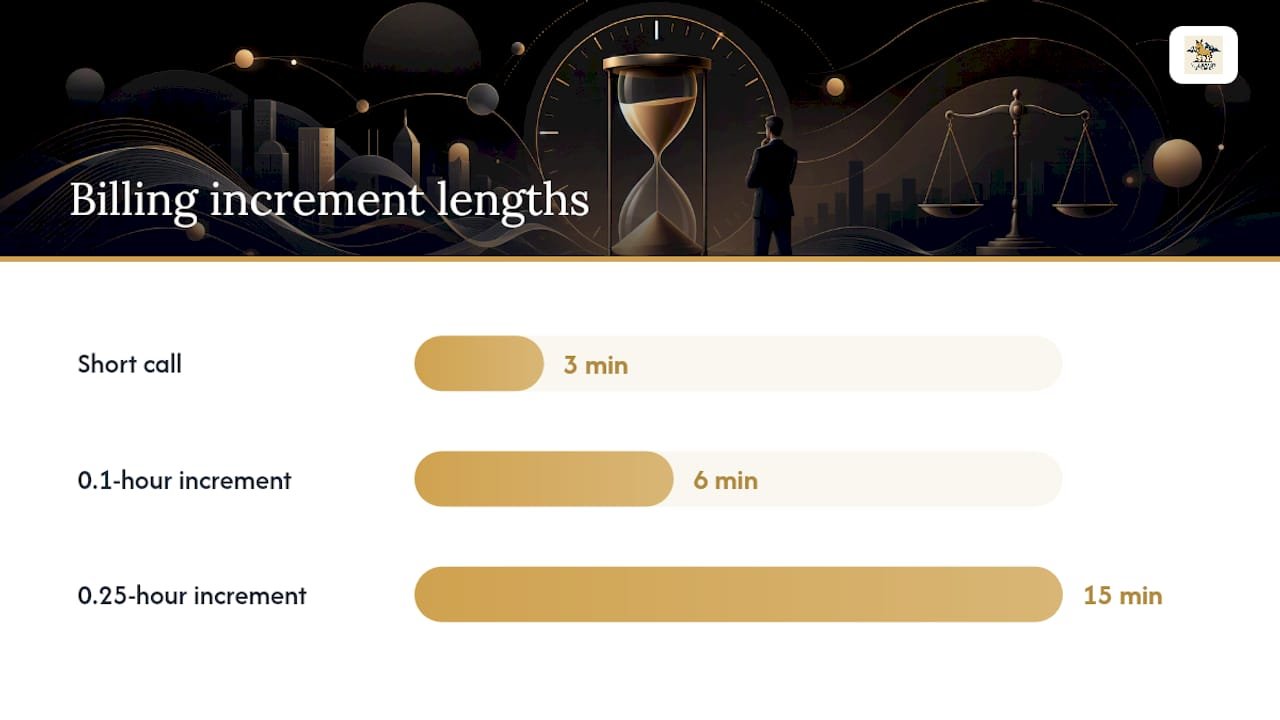
Hourly billing is the default for most contested matters: litigation, criminal defense, complex family law, and business disputes. You pay for every unit of time the attorney and their staff spend on your case. Billing increments matter here. Many firms bill in 0.1-hour (6-minute) units, which means a two-minute phone call still costs you 0.1 hours. A firm that bills in 0.25-hour increments charges you 15 minutes for that same call.
Flat fees are common for predictable, bounded tasks: drafting a simple will, handling an uncontested divorce, filing a trademark application, or managing a straightforward real estate closing. You pay a fixed amount regardless of how long it takes. The risk is yours if the matter turns complicated and the attorney needs to renegotiate.
Contingency fees shift the financial risk to the attorney. You pay nothing upfront; the lawyer takes a percentage of the recovery if you win. This model is standard in personal injury, workers’ compensation, and some employment discrimination cases. Contingency fee mechanics vary by contract, but the typical structure is 33% if settled before filing, rising to 40% if the case goes to trial. Under ABA Model Rule 1.5, contingency fees are prohibited in criminal defense and most domestic relations matters.
Retainers are deposits, not fees. A special (trust) retainer sits in a client trust account and is drawn down as work is billed. An availability (general) retainer pays the attorney to remain available to you, regardless of hours worked. The distinction matters because unearned funds in a trust retainer must be returned to you if the representation ends early.
Hybrid arrangements combine elements. A criminal defense attorney might charge a flat fee for arraignment and pre-trial motions, then shift to hourly if the case goes to trial. A business attorney might charge a monthly retainer for general counsel access, then bill hourly for major transactions.
Before signing any fee agreement, confirm these points in writing:
- Scope of representation (exactly what work is covered)
- Billing increment used (0.1 vs. 0.25 hour)
- How expenses are handled (billed separately, advanced by the firm, or deducted from recovery)
- Refund policy for unused retainer funds
- Billing frequency and invoice format
Pro Tip: For matters with predictable phases, ask whether the attorney will cap fees for each phase separately. A capped discovery phase, for example, gives you a ceiling without requiring the attorney to guess the full case cost upfront.
How much do lawyers charge by state and metro area?
Geography is one of the strongest predictors of attorney cost, often more so than experience level. Statista’s data on hourly rates by metropolitan region shows that major coastal metros command a significant premium over mid-size inland cities and rural markets. The gap between a San Francisco or New York attorney and a practitioner in a mid-size Midwest city can easily be $150–$200 per hour for comparable work.
The table below shows representative state tiers based on aggregated industry data from Clio Legal Trends and Statista. These are general market ranges, indicating that hourly rates tend to be higher in major coastal metros, somewhat lower in large inland metros, less in mid-size cities, and often lowest in small cities or rural areas.
A few things drive these differences. Overhead costs (office rent, staff salaries, malpractice insurance) are substantially higher in coastal metros. Demand concentration matters too: a city with a large financial sector or tech industry generates more high-complexity corporate and IP work, which pulls average rates up across the board. Local attorney experience also plays a role, since attorneys who handle high-volume local practice areas develop efficiencies that can offset a higher rate.
It’s worth noting that some federal proceedings use schedule-based fees rather than market rates. The U.S. Court of Federal Claims’ Attorneys’ Forum Rate Fee Schedule sets specific hourly benchmarks for certain federal matters, which can differ substantially from what the same attorney charges private clients.
When vetting a quoted rate, compare it against the tier for your specific metro, not the national average. A $400/hour quote in rural Montana is a red flag. The same rate in Manhattan is unremarkable.
How does your practice area change the cost of legal help?
Practice area is often the single biggest cost variable, more predictive than state or attorney experience level. Clio’s practice-area data shows corporate and intellectual property attorneys consistently at the high end of the hourly spectrum, while juvenile law and workers’ compensation tend to sit at the lower end.
Here is what typical fee structures look like across common practice areas:
- Personal injury: Almost always contingency fee arrangements where the lawyer takes a percentage of the recovery, with no upfront cost to the client. Expenses (medical records, expert witnesses, filing fees) are usually advanced by the firm and deducted from the settlement. Why legal representation matters in these cases comes down to the attorney’s ability to maximize the recovery, not just navigate the process.
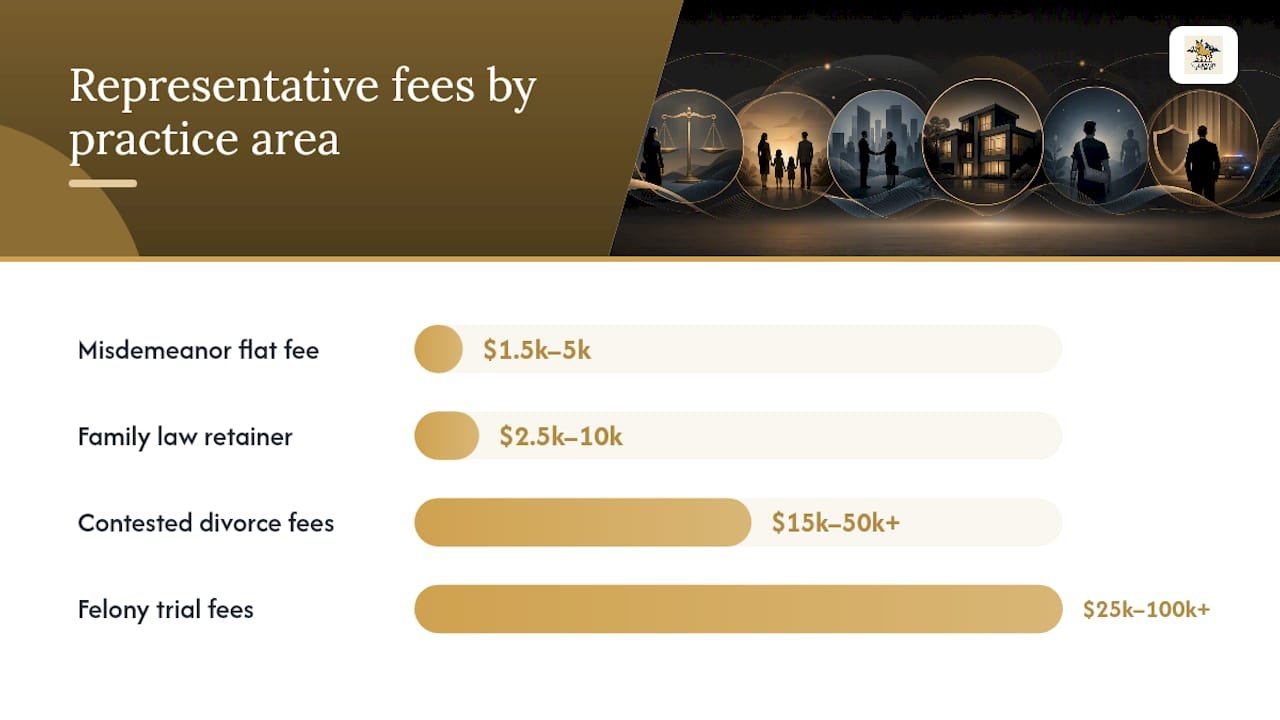
- Criminal defense: Hourly or flat fee, depending on complexity. A misdemeanor defense might run $1,500–$5,000 flat. A felony trial can reach $25,000–$100,000+ in attorney fees alone, before expert costs.
- Family law (divorce, custody): Typically hourly, with retainers of $2,500–$10,000 to start. Contested divorces with property disputes or custody battles can run $15,000–$50,000+ in total fees.
- Immigration: Flat fees are common for defined filings (green card application, naturalization). Removal defense shifts to hourly and can be expensive given the federal court complexity.
- Corporate / business law: Hourly, often $300–$600+/hour at mid-size firms. Startup formation packages are sometimes flat-fee. M&A and securities work can reach $500–$1,000+/hour at large firms.
- Intellectual property: Patent prosecution runs $8,000–$15,000+ in flat fees for a utility patent application. IP litigation is hourly and among the most expensive categories in law, with complex patent trials costing millions.
- Estate planning: Simple wills and powers of attorney are usually flat-fee, often $300–$1,500 for a basic package. Trust administration and contested probate shift to hourly.
- Bankruptcy: Chapter 7 consumer bankruptcy typically runs $1,000–$3,500 flat. Chapter 11 business reorganization is hourly and can reach six figures.
The reason rates diverge so sharply comes down to what the work actually requires. Patent litigation demands attorneys with technical degrees. Federal criminal defense requires deep familiarity with federal sentencing guidelines. Complex corporate deals involve teams of attorneys billing simultaneously. For car accident cases in Colorado Springs , attorney charges follow a similar contingency structure to what you’d see in Colorado and most other states, though state-specific caps and rules can affect the exact percentage.
How do retainers, billing increments, and invoices actually work?
Most clients sign a fee agreement, hand over a retainer check, and then receive invoices that feel opaque. Understanding the mechanics prevents surprises.
A special (trust) retainer is deposited into a separate client trust account, which the attorney is ethically prohibited from commingling with operating funds. As work is performed, the attorney transfers earned fees from the trust account to their operating account. If the retainer runs out, you typically replenish it. If representation ends with funds remaining, those unearned funds must be returned to you. Cornell Law’s Wex overview of attorney’s fees covers the ethical rules governing these accounts in detail.
A general (availability) retainer works differently. You pay to secure the attorney’s availability for a period, and that fee is earned upon receipt, regardless of how many hours are actually worked. These are more common in ongoing business relationships than in one-time litigation matters.
Billing increments are where many clients get surprised. If your attorney bills in 0.1-hour units, every email reply, every brief phone call, every document review gets rounded up to the nearest 6 minutes. A 3-minute call costs you 6 minutes of billing. Over a complex case with dozens of short communications, those increments add up fast. Some firms still use 0.25-hour (15-minute) increments, which is even more aggressive for short tasks.
Blended rates appear when a firm bills a single rate for all timekeepers on your matter, averaging the partner rate and associate rate. This can work in your favor if the partner does most of the work, or against you if junior associates handle routine tasks at a blended rate higher than their actual billing rate.
Paralegal and legal assistant time is typically billed at $75–$150/hour, well below attorney rates. Ask whether your firm itemizes paralegal time separately or rolls it into attorney billing.
Questions to ask at intake:
- What is your billing increment?
- Do you bill paralegal time separately, and at what rate?
- How often will I receive invoices?
- What is your policy on refunding unused retainer funds?
- Do I need to approve expenses above a certain threshold?
Pro Tip: Request a written agreement that requires your approval for any single expense over $500. This prevents surprise expert-witness invoices or deposition costs from appearing on your bill without warning.
How do you estimate your total legal costs before hiring?
The formula is straightforward:
Estimated total = (hourly rate × estimated hours) + expected expenses
For contingency matters: Estimated net recovery = gross settlement × (1 minus contingency %) minus expenses
Here is how that plays out in practice:
- Add expected expenses — For a contested family law matter, add $500–$2,000 for filing fees and records. For litigation with expert witnesses, add $5,000–$20,000+.
For a worked example: a moderately contested divorce with one property dispute and no custody issues. Attorney rate: $275/hour. Estimated hours: 30–50. Expected expenses: $1,500. Working budget: $9,750–$15,250 before the buffer. With a 25% buffer: $12,200–$19,000. That range gives you something real to plan around. Choosing the right legal representation from the start affects both the hour estimate and the outcome.
Pro Tip: Ask whether the attorney offers limited-scope representation (also called “unbundled” legal services) for discrete phases like document review or court appearances only. Paying for targeted help on the hardest parts while handling simpler tasks yourself can cut total costs by 30%–50% on the right matter.
What are your options if you cannot afford standard attorney fees?
The cost of hiring a lawyer is a real barrier for many people, but several paths exist that don’t require paying $300/hour out of pocket.
- Legal aid organizations: Federally funded through the Legal Services Corporation, legal aid provides free civil legal help to income-eligible individuals. Coverage typically includes housing, family law, benefits, and consumer issues. Find your local office through lawhelp.org or your state bar’s referral directory.
- Law school clinics: — Accredited law schools operate supervised clinics in criminal defense, immigration, family law, and other areas. Work is done by students under licensed attorney supervision. Quality is generally solid; availability is limited.
- Pro bono representation: — Many state bars have pro bono programs matching attorneys with low-income clients. The American Bar Association’s Model Rule 6.1 encourages attorneys to provide at least 50 hours of pro bono service annually, though it is aspirational rather than mandatory.
For disability claims specifically, finding specialized counsel early makes a real difference. A local disability attorney can often take Social Security cases on contingency, with fees capped by federal regulation.
Pro Tip: A single paid consultation with a private attorney, often $150–$300, can give you enough strategic guidance to handle a simpler matter yourself. Ask specifically: “What are the three most important things I need to do in this case?” That one hour can save you thousands.
How do you know when a fee is unreasonable, and what can you do about it?
Not every high bill is a legitimate one. ABA Model Rule 1.5 requires that attorney fees be reasonable and that the basis of the fee be communicated to the client, preferably in writing. The rule lists specific reasonableness factors: the time and labor required, the novelty and difficulty of the questions, the skill needed, the customary fee in the locality, the experience of the attorney, and the results obtained.
If a bill feels wrong, here is the process:
- Request an itemized invoice. You are entitled to see exactly what was billed, when, and by whom. Vague entries like “legal services” or “file review” without time detail are a red flag.
- Ask for a written explanation. Send a letter or email identifying specific entries you dispute and asking the attorney to explain them. Document everything.
- Negotiate directly. Many billing disputes resolve at this stage. Attorneys generally prefer to reduce a disputed entry than lose a client relationship or face a formal complaint.
- Request fee arbitration. Most state bars offer voluntary or mandatory fee arbitration programs. This is faster and cheaper than litigation. The State Bar of California’s guidance notes that California requires written fee agreements for matters expected to exceed $1,000, which is a useful standard to apply regardless of your state.
- File a state bar complaint. Reserved for serious misconduct: commingled client funds, fabricated billing entries, or fees that are grossly disproportionate to the work performed. A complaint triggers a formal investigation.
Common billing red flags:
- Block billing (lumping multiple tasks into one time entry with no breakdown)
- Duplicate entries for the same task on the same day
- Billing for time spent on internal firm administration unrelated to your matter
- Paralegal tasks billed at attorney rates
- Unexplained “miscellaneous” expense charges
The Cornell Law Wex entry on attorney’s fees covers the ethical framework governing fee disputes and client fund handling in more detail.
What the contingency model actually means for injury clients
Most of the fee discussion above applies to hourly and flat-fee matters. Personal injury is different, and the difference is worth saying plainly.
When Ryan Malnar takes an injury case at Stubbornattorney, the client pays nothing upfront. No retainer. No hourly clock running. The firm advances the costs of building the case, including medical record retrieval, expert consultations, and filing fees, and recoups those expenses from the settlement. If there is no recovery, there is no fee. That model exists because injured people shouldn’t have to choose between paying rent and hiring a lawyer.
What that also means: the attorney’s financial interest is directly aligned with yours. A higher settlement means a higher fee. There is no incentive to run up hours on a case that isn’t going anywhere. Ryan spent years as a federal claims adjudicator before practicing law, which means he evaluates cases the same way the other side does. He knows which injuries generate strong claims and which facts create exposure. That perspective shapes how Stubbornattorney approaches every case from the first conversation.
The questions listed throughout this article, about billing increments, expense handling, and fee reasonableness, are the right questions to ask any attorney. At Stubbornattorney, the answers are straightforward: contingency fee, expenses advanced by the firm, no recovery means no charge, and a free case evaluation to start.
Injured in Colorado? Get a free case evaluation
If you were hurt in a car accident, truck collision, motorcycle crash, or slip and fall in Colorado, the cost of hiring a lawyer is $0 upfront. Stubbornattorney handles personal injury cases on a pure contingency basis: you pay nothing unless the firm recovers compensation for you.
Ryan Malnar and the Stubbornattorney team have settled hundreds of injury cases and recovered millions of dollars for Colorado clients, all without asking anyone to pay out of pocket to get started. The firm serves Colorado Springs, Pueblo, Burlington, Simla, and surrounding communities.
Start with a free case evaluation for your personal injury matter. For other legal matters, representation terms vary, and a consultation will clarify what applies to your situation. You can also review common personal injury case examples to see whether your situation fits the firm’s practice.
This article provides general information about attorney fees in the United States and is not legal advice. Fee structures, rules, and costs vary by state, case type, and individual circumstances. Consult a licensed attorney in your jurisdiction for guidance specific to your matter.
FAQ
A reasonable fee depends on practice area, location, and case complexity. Hourly rates of $250–$350 are typical for most markets and matter types, while major metro attorneys in complex fields often charge $400–$600+. Under ABA Model Rule 1.5, reasonableness is judged against local custom, the difficulty of the matter, and the results obtained.
Is $400 an hour a lot for a lawyer?
In most mid-size U.S. cities, $400/hour is on the high end for general practice but within normal range for experienced litigators, IP attorneys, or corporate counsel. In major metros like New York or San Francisco, $400/hour is closer to average for a mid-career associate at a large firm.
How do I get a lawyer if I cannot afford one?
For personal injury cases, a contingency-fee attorney costs nothing upfront. For civil matters, legal aid organizations serve income-eligible clients at no charge. Criminal defendants who cannot afford counsel are entitled to a public defender. State bar referral services often connect people with attorneys offering reduced-fee consultations.
What does a contingency fee actually mean for my case?
A contingency fee means the attorney takes a percentage of your recovery, typically 33% if settled before filing and up to 40% if the case goes to trial, and nothing if you lose. Expenses are usually advanced by the firm and deducted from the settlement. Stubbornattorney handles Colorado personal injury cases on exactly this model.
How much does it cost just to talk to a lawyer?
Initial consultations range from free to $400+, depending on the attorney and matter type. Personal injury attorneys almost universally offer free consultations. For other practice areas, expect $100–$300 for an initial meeting, though many attorneys credit that fee toward future work if you hire them.