

72 Hours to Compel Insurer Policy Info After a Colorado Dooring
Under Colorado law, a motorist who opens a car door into a cyclist’s path can be held legally responsible for the resulting crash. If you’ve been doored, your first priorities are getting to safety, seeking medical attention, and documenting the scene before evidence disappears. From there, the process runs through Colorado’s crash-reporting system, the driver’s insurance policy, and, if needed, a personal injury claim.
Table of Contents
- What to Do at the Scene of a Bicycle Dooring Accident
- What Does Colorado Law Say About Opening a Car Door?
- How Do I Report a Bicycle Dooring Crash in Colorado?
- Who Pays for a Bicycle Dooring Accident in Colorado?
- What Should I Do in the Days After a Dooring Crash?
- How Ryan Malnar and StubbornAttorney.com Help Dooring Victims
- Prevention Is a Two-Way Street
- Get a Free Case Evaluation After a Colorado Dooring Crash
- Sources
- FAQ
What to Do at the Scene of a Bicycle Dooring Accident
The minutes right after a dooring crash decide how strong your claim will be later. Adrenaline masks pain, memories fade fast, and vehicle damage gets fixed within days if nobody stops it. Work through these steps in order.
- Get out of traffic. Move yourself and your bike to the curb or sidewalk if you’re physically able. Getting doored often throws a rider into the traffic lane, and a second vehicle strike is the real danger in these crashes.
- Call 911 if you’re hurt at all, even if the injury seems minor. Road rash, wrist fractures, and concussions from dooring crashes routinely feel manageable in the moment and turn out to be serious once the swelling sets in.
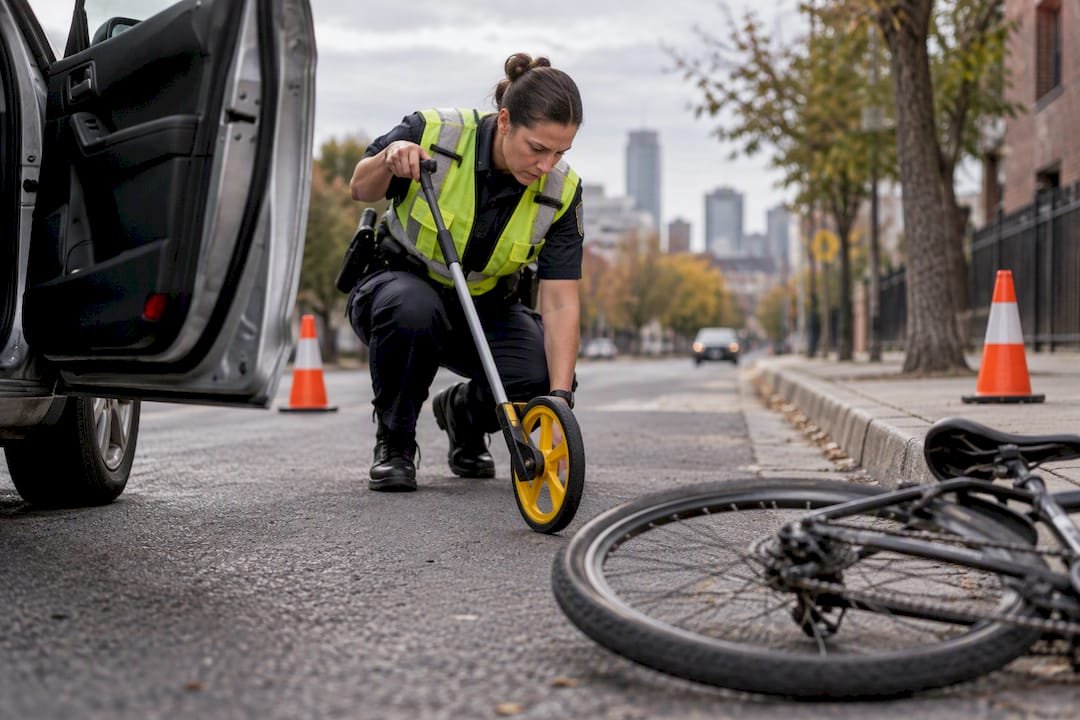
- Ask for police, not just a swapped phone number. A responding officer documents the scene independently, which matters far more than most riders realize.
- Photograph everything before anyone moves their vehicle: the open door itself, the door’s position relative to the bike lane or parked lane, the license plate, your bike’s damage, road markings, and any visible injuries.
- Collect witness information. Pedestrians and other drivers who saw the door open are often the deciding factor when a driver later claims the cyclist “swerved into” the door.
Once the immediate scene is handled, a few smaller details protect your claim later:
- Save the torn or bloodied clothing you were wearing. Don’t wash it.
- Leave your bike unrepaired until it’s been photographed and, ideally, inspected.
- Get the driver’s name, insurance company, and policy number directly, don’t rely on a verbal exchange.
Pro Tip: If the driver or a bystander suggests “no need to call the cops, let’s just handle it,” insist anyway. A police-investigated report carries far more weight with insurance adjusters than a verbal agreement that can be denied later.
What Does Colorado Law Say About Opening a Car Door?
Colorado law places the legal burden squarely on the person opening the door, not the cyclist riding past it. Under C.R.S. § 42-4-1208, a driver or passenger may not open a vehicle door into moving traffic unless it can be done safely and without interfering with other traffic, including bicycles. That single statute is usually the backbone of a dooring claim: the driver had a legal duty to check before opening the door, and failing to check is what created the crash.
Colorado’s three-foot passing law reinforces the same principle from the other direction. Drivers passing a cyclist must leave at least three feet of clearance, and CDOT’s cyclist guidance makes clear that this buffer exists precisely because cyclists need room to maneuver around hazards like opening doors, potholes, and debris. If a rider was hugging the door zone because a passing car left no room to shift left, that context matters for fault.
As of 2026, Colorado law under HB26-1237 reinforces that drivers may not park or stand in a bike lane and must yield right-of-way to cyclists using one. That’s directly relevant when a dooring happens along a marked bike lane, since a vehicle stopped or parked improperly in that lane compounds the driver’s exposure.
A few points worth knowing before you assume a case is open and shut:
- The Safety Stop law, which lets cyclists treat certain stop signs as yields, has no bearing on dooring fault. A driver can’t use “the cyclist didn’t fully stop” as a defense to opening a door unsafely.
- Local municipalities, including Colorado Springs and Denver, sometimes layer additional bike lane ordinances on top of state law, so check municipal code where the crash happened.
- Marked, painted door zones (increasingly common on newer Denver and Boulder bike lanes) can strengthen a claim if the door opened directly into that marked buffer.
How Do I Report a Bicycle Dooring Crash in Colorado?
You have two very different reporting options, and picking the wrong one can quietly weaken your claim. Colorado law under C.R.S. § 42-4-1601 requires drivers involved in a crash to report it to the agency with jurisdiction, and that duty applies whether the crash involved two cars or a car and a cyclist.
The stronger path is getting an officer to the scene and generating a law-enforcement-investigated crash report. The weaker path is filing an online “counter report” after the fact.
- Insist on an officer response if anyone is injured, if the driver disputes fault, or if there’s meaningful property damage to your bike or gear.
- Understand what a counter report actually is. According to the Colorado State Patrol, online counter reports are not investigated by law enforcement and exist mainly for record-keeping. They carry a witness account, not an officer’s independent findings.
- Request your copy promptly. Reports and records can be obtained through the Colorado Department of Revenue’s crash records system, and officer-investigated reports typically take up to ten working days to process.
- Keep the report number. You’ll need it when you contact insurance adjusters or an attorney.
Pro Tip: If police tell you the crash “doesn’t meet the threshold” for an in-person response, ask directly whether you can still file for an investigated report rather than defaulting to the online counter report. The distinction is worth pushing on.
Why does this matter so much? An officer’s report includes independent observations, sometimes a diagram of the door’s position and your bike’s final resting spot, and often a citation if the driver is found at fault. A counter report is just your account, unverified. Adjusters know the difference, and so do defense attorneys if the case ever goes to litigation.
Who Pays for a Bicycle Dooring Accident in Colorado?
The at-fault driver’s auto insurance is typically the first source of payment in a Colorado dooring claim, since drivers carry liability coverage that responds to injuries and property damage they cause. What you can recover depends on the severity of your injuries and how clearly the evidence establishes the driver opened the door unsafely.
Damages available in a dooring case generally include:
- Medical bills, from the ambulance ride to physical therapy months later
- Lost wages if you missed work recovering
- Pain and suffering tied to the physical and emotional toll of the crash
- Property damage to your bike, helmet, and gear
Cross the 50% threshold and you recover nothing, so how the crash is documented directly affects the math.
One of the most overlooked steps in these cases involves finding out what the driver’s policy actually covers.
Most injured cyclists never learn they can compel an insurance company to disclose policy limits and coverage details before settlement talks even begin. That single step, requesting insurer policy information under the Colorado Division of Insurance process, often reveals commercial or umbrella coverage a claimant would otherwise never know existed.
Under § 10-3-1117, C.R.S., a claimant or their attorney can formally request an insurer’s automobile policy information, and the Colorado Division of Insurance generally expects a response within thirty calendar days. Settlement timing tends to track evidence quality: cases with a police report, clear photos, and complete medical records settle faster and for more than cases built on a counter report and a memory.
What Should I Do in the Days After a Dooring Crash?
Evidence has a shelf life. A bruise fades, a car gets repaired, a witness moves out of state. The window right after your crash is when your claim gets built or quietly falls apart.
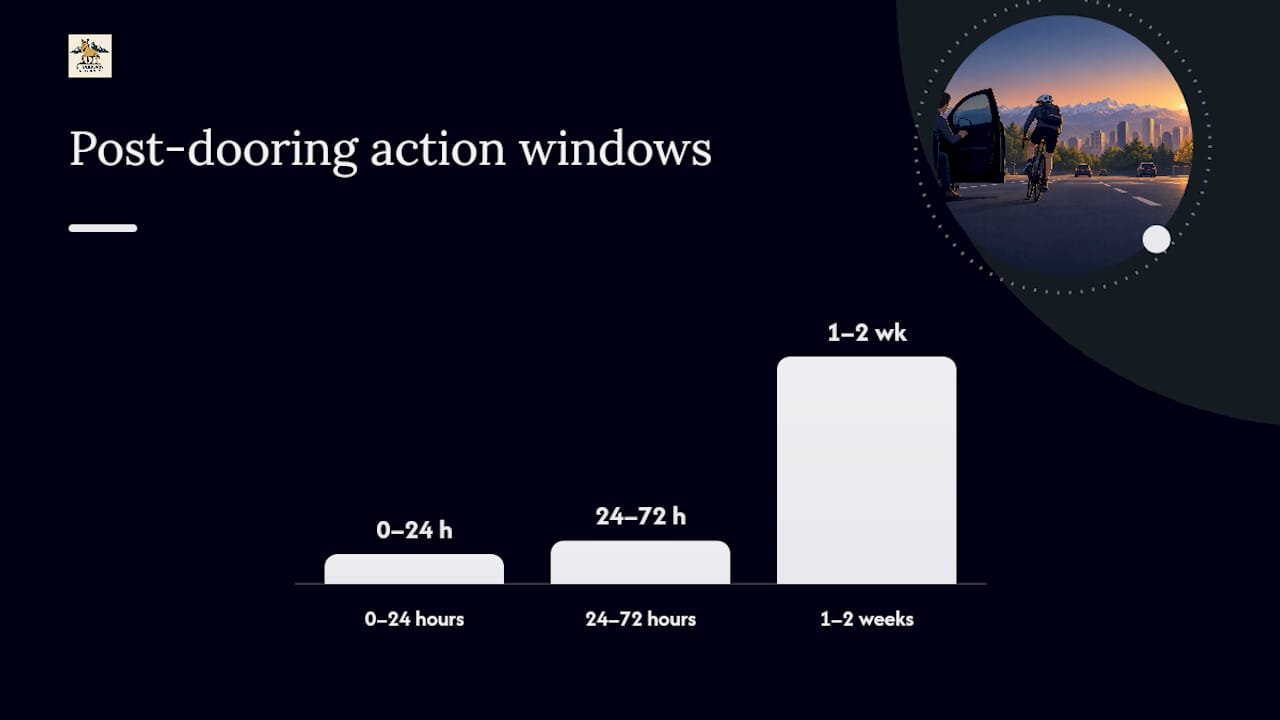
- 0 to 24 hours: Get medical care even if you feel “mostly fine.” Photograph the scene, your injuries, and your bike. Collect names and phone numbers from anyone who saw it happen. Request an officer respond if one hasn’t already.
- 24 to 72 hours: Request your copy of the crash report. Start a simple daily log of symptoms, since soreness that shows up on day three still counts. Set your damaged bike and gear aside without repairing or cleaning them.
- 1 to 2 weeks: If injuries linger or the driver’s insurer disputes fault, request the driver’s policy information through the Division of Insurance process and consider talking to an attorney before giving any recorded statement.
A few things to avoid entirely: don’t tell the driver or their insurer “I’m fine” or “it wasn’t a big deal,” don’t get your bike repaired before it’s documented, and don’t delete text messages or app notifications tied to the crash, even ones that seem irrelevant.
Pro Tip: Insurance adjusters often call within 48 hours hoping to get a quick, casual statement while you’re still shaken up. You’re not required to give one on the spot, and a brief “I’ll follow up once I’ve spoken with my doctor” protects you without shutting the door on cooperation.
How Ryan Malnar and StubbornAttorney.com Help Dooring Victims
An attorney’s job in a dooring claim starts where most cyclists hit a wall: getting the insurance company to actually show its cards. This includes gathering scene evidence, formally requesting the driver’s policy information under Colorado’s statutory process, negotiating directly with adjusters trained to minimize payouts, and filing suit if a fair settlement never materializes.
Ryan Malnar built StubbornAttorney.com, the new brand home of Malnar Injury Law, on more than a decade of personal injury work in Colorado, combined with a background as a former federal claims adjudicator. That means Ryan has sat on the other side of the table, evaluating claims the way insurers do, and knows exactly where adjusters try to undervalue a bicycle case.
What working with the firm looks like:
- Direct attorney involvement in your case, not a call center handing you off between departments
- A contingency-fee structure, meaning you pay nothing unless the firm recovers money for you
- A free case evaluation to assess your claim before you commit to anything
- Support pursuing insurer policy disclosure under § 10-3-1117 to uncover coverage a driver’s basic policy might not reveal
If your dooring crash left you facing medical bills and an insurance company that won’t return calls, a Colorado Springs bicycle accident lawyer can take that pressure off your plate directly.
— Ryan
Prevention Is a Two-Way Street
Cyclists can reduce dooring risk by riding a few feet outside the door zone whenever traffic allows, scanning parked cars for occupants, and treating any car with brake lights or a running engine as a door about to open. Drivers carry equal responsibility. The Dutch reach, opening a car door with the far hand, forces your body to turn and check your mirror before the door swings out, and it’s one of the simplest habits that prevents a crash entirely.
Street design plays a role too. Painted door-zone buffers and protected bike lanes, which Bicycle Colorado points to as effective interventions, physically separate cyclists from the danger zone. If you’ve spotted a stretch of road in your city with no buffer and heavy parking turnover, reporting it to your local planning department is a legitimate way to push for change, not just a formality.
Get a Free Case Evaluation After a Colorado Dooring Crash
Filing an insurance claim alone after a dooring crash means negotiating against a company whose entire job is minimizing what they pay you. StubbornAttorney.com handles that fight directly, with attorneys who personally work your case instead of passing you through a call center, and you pay nothing unless the firm recovers compensation on your behalf.
If you were doored anywhere in Colorado, from Colorado Springs to Pueblo, a free case evaluation is the fastest way to find out what your claim is actually worth. Bring whatever you have: photos from the scene, your crash report number, medical records, and the driver’s insurance information if you collected it. Nothing you share during that consultation gets used against you, and there’s no obligation to sign anything afterward. You can start with a phone call or the intake form on the firm’s site, and a real member of the team will walk you through next steps the same day.
This article is general information, not a substitute for advice from a qualified lawyer. Consult a qualified legal professional about your own circumstances before acting on anything here.
Sources
- HB26-1237
- Crash Information | Colorado State Patrol
- Process for a Claimant or a Claimant’s Attorney to Request Commercial or Personal Automobile Policy Information from an Insurer
- Information for Bicyclists | CDOT
FAQ
What Are the New Bicycle Laws in Colorado?
Colorado’s HB26-1237 strengthens protections for cyclists by reinforcing that drivers can’t park or stand in a marked bike lane and must yield right-of-way to cyclists using one, according to the state legislature. This works alongside existing statutes like the three-foot passing rule and the door-opening duty under C.R.S. § 42-4-1208.
Which State Has the Most Cyclist Fatalities?
Cyclist fatality rates vary by state and are typically tracked at the national level rather than compared directly in Colorado-specific legal resources. What matters for Colorado riders is that state law, including the duty-to-check-before-opening-a-door rule and the three-foot passing law outlined by CDOT, exists specifically to prevent the kinds of crashes that lead to serious injury or death.
Which City in the USA Is the Most Bike-Friendly?
Bike-friendliness rankings shift year to year and depend on the criteria used, so there’s no single definitive answer. Within Colorado, cities like Boulder and Denver have invested heavily in protected bike lanes and painted door-zone buffers, infrastructure that groups like Bicycle Colorado point to as effective at reducing dooring risk.
Is There a Way to Cycle Across Colorado?
Yes, Colorado has extensive road cycling routes and organized long-distance rides across the state, though route safety depends heavily on following the rules that apply to sharing the road with vehicles. Riders planning longer routes should still know their rights under state law, including the three-foot passing rule and protections against unsafe door openings referenced in CDOT’s cyclist guidance.
What Should I Do Immediately After a Dooring Crash in Colorado?
Get to safety, call 911 if you’re injured, and photograph the scene before anything is moved or repaired. Then request a police response for an investigated crash report rather than relying solely on an online counter report, since Colorado State Patrol confirms counter reports aren’t investigated and carry less weight in a claim.