

Recorded Statement vs. Written Statement After a Car Accident
A recorded statement is a live, taped interview that you answer on the spot. A written statement is a document you prepare, review and send on your own time. After a car accident in Colorado, the written route gives you far more control, and you can usually decline a recorded statement to the other driver’s insurance company. Your own insurer is a different case, because your policy may require you to cooperate with its investigation.
This guide explains how the two formats differ, who can ask for each, how they can shape a claim, and what to say (and not say) if an adjuster calls you while you are still hurting. It is general information, not legal advice for your case.
Table of Contents
- What a recorded statement is, and what a written statement is
- Side-by-side comparison
- Who can ask for a statement, and do you have to give it?
- What to do in the first hours and days
- How each type of statement can affect your claim
- What to avoid saying, and what is safe to say
- Correcting a mistake or an incomplete answer
- When a lawyer-backed statement makes sense
- Our perspective
- If you have been hurt in a Colorado crash
- FAQ
- Sources
What a recorded statement is, and what a written statement is
When an adjuster says, “I just need to get your side on the record,” they usually mean a recorded statement. The adjuster calls, starts a recording, confirms you know it is being recorded, and asks a series of questions about the crash, your injuries, your car, your medical care and your day-to-day life. You answer in real time, with no chance to look anything up or reword a sentence.
A written statement is the opposite in almost every practical way. You (or your lawyer) put the facts on paper or in an email, read them over, check them against the police report, photos and medical records, and send them when you are satisfied. According to one claims-writing guide, a written statement can be revised and verified before submission, while a recorded statement is answered live and becomes a permanent part of the claim file with no editing afterward.
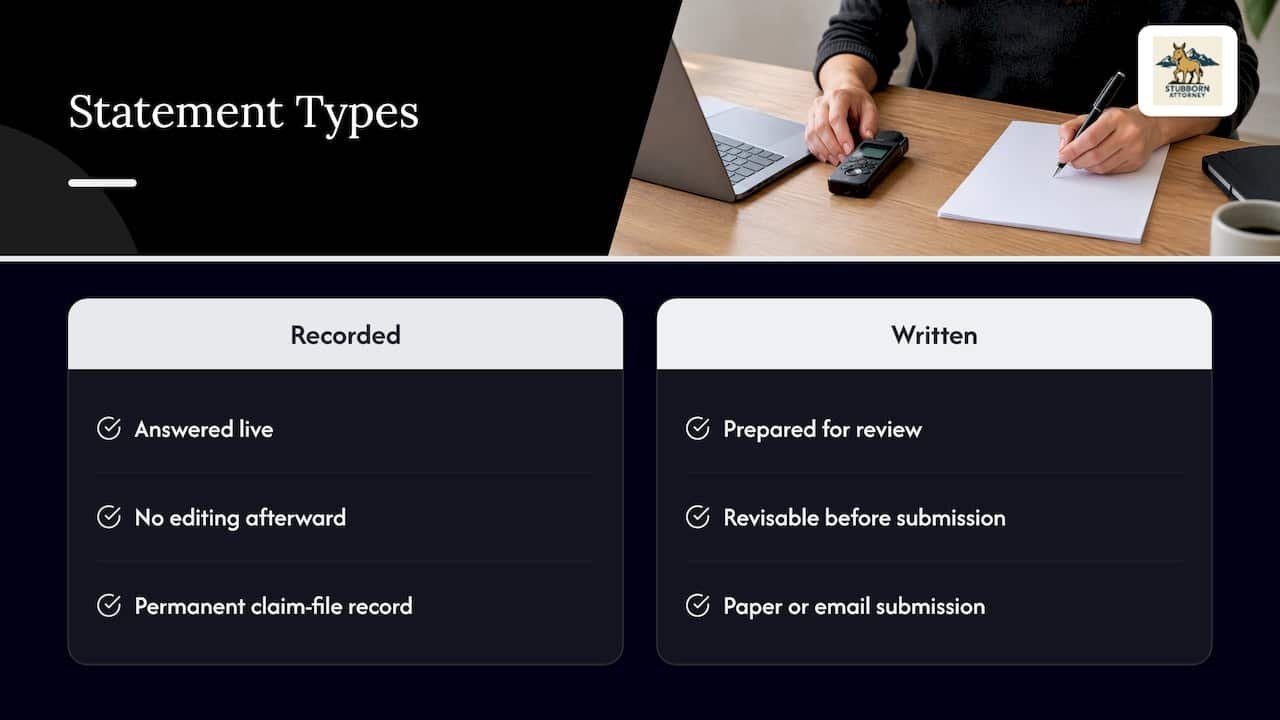
That difference sounds small. In a claim, it is the whole story.
Why the format matters
An adjuster’s job is to evaluate and, where possible, limit what the company pays. A recording captures everything: the pauses, the “I think,” the “I’m fine, I guess,” the guess about speed that turns out to be wrong. Months later, a single offhand answer can be quoted back to you as if it were a firm statement of fact.
A written statement carries the same facts, but only the facts you chose to include, in the words you chose.
Side-by-side comparison
| Recorded statement | Written statement | |
|---|---|---|
| How it is given | Live phone or video interview, taped | Document or email you prepare |
| Time to think | None; you answer as questions come | As much as you need |
| Checking facts first | Hard to do mid-call | Easy: police report, photos, medical records |
| Editing | Not possible after the call | Possible before you send it |
| Scope | The adjuster steers with follow-ups | You decide what is included |
| Risk of guessing or speculating | High | Low |
| Attorney review | Only if arranged before the call | Simple to arrange |
| Typical use | Insurer investigating fault and injuries | Giving the basic facts without being interviewed |
Who can ask for a statement, and do you have to give it?
The answer depends on whose insurance company is asking.
The other driver’s insurer
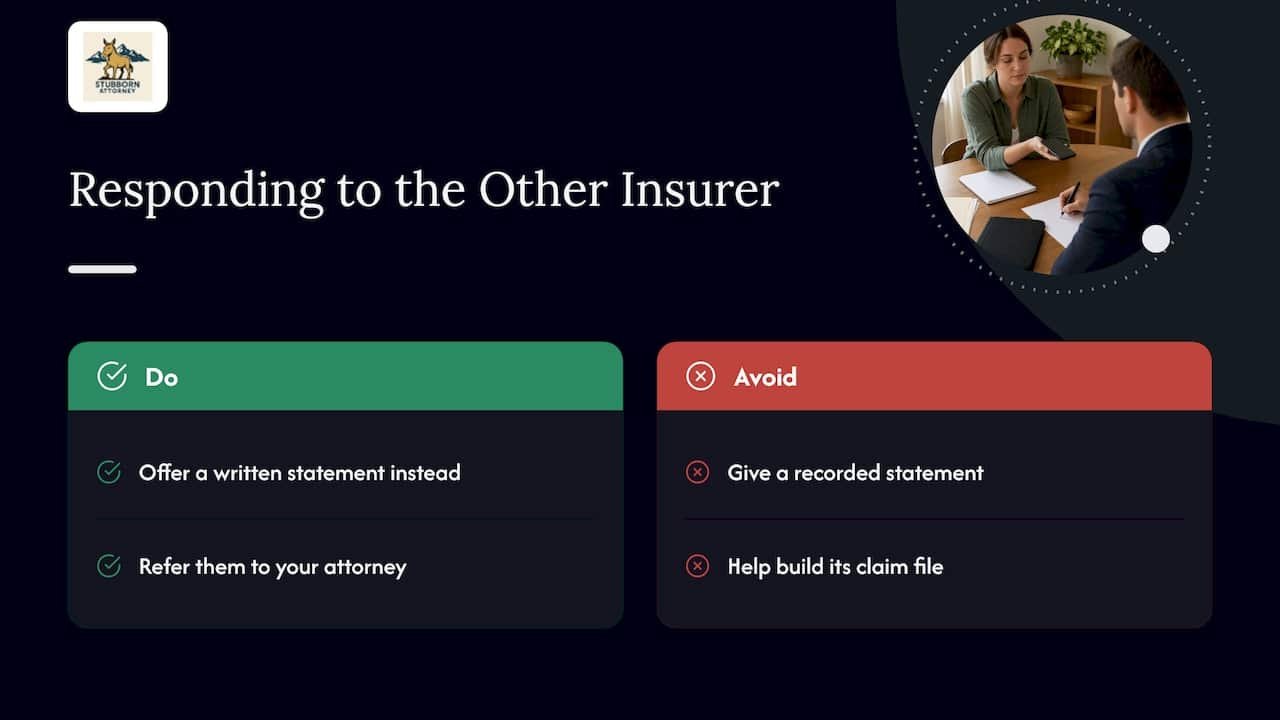
The at-fault driver’s insurance company is not your insurer. It owes you no contract duty, and its adjuster is working to resolve the claim against its own customer. Guidance on this point is consistent: you can refuse a recorded statement to the other party’s insurer. If they call, you can also offer a written statement instead or refer them to your attorney.
The Colorado Supreme Court has also described how the relationship works. In Lazar v. Riggs, the court stated that an insurer owes its insured, but not a third party with a claim against that insured, a duty to adjust claims in good faith. In plain terms, the other driver’s insurer is not obligated to look out for you, and you are not obligated to help it build its file.
Your own insurer
Your own insurer is different. Many policies contain a cooperation clause, and that clause may require participation in the claims investigation, which can include a recorded statement depending on the policy. Read your policy’s duties-after-loss section, or ask your agent where it appears.
Cooperating does not mean going in unprepared. Guidance for this situation suggests that if your own insurer asks, you can negotiate the format, ask for time, and ask to have your attorney present. Refusal, where it makes sense, should be targeted and based on whose insurer is asking, not a blanket rule.
A quick decision guide
- The at-fault driver’s insurer calls: decline the recording politely. Offer to have your attorney contact them, or to send basic written facts.
- Your own insurer calls: report the accident promptly with basic facts. If they ask for a recorded interview, say you want to schedule it and talk to your lawyer first.
- A third insurer you do not recognize calls (for example, the insurer of another vehicle in a multi-car crash): treat it like the at-fault insurer until you know who it is and why it needs a statement. Our guide to fault in multi-car accidents explains why several insurers may be involved.
What to do in the first hours and days
The first call often comes before you have seen a doctor, and sometimes before the swelling, stiffness or headache has fully set in. That is a poor moment to describe your injuries on tape.
For Colorado specifically, one Colorado-focused guide recommends notifying your own insurer with minimal factual information, such as the fact that you were in an accident and are being evaluated. It also advises not giving the at-fault driver’s insurer a recorded statement until you have hired a Colorado car accident lawyer.
A practical sequence:
- Get medical care first. Your health comes before any phone call.
- Notify your own insurer. Give the date, place, vehicles involved and the fact that you are being evaluated. Skip fault and injury detail.
- Do not agree to a recording on the first call. “I’m not able to do that today” is a complete answer.
- Collect your records. Police report, photos, witness names, medical paperwork. Our Colorado car accident legal checklist and our guide on what to do immediately after a car accident in Colorado walk through this.
- Talk to a lawyer before any recording. If one is unavoidable, ask your lawyer to arrange the terms.
If you are unsure how the crash should be reported to authorities, see our step-by-step guide on how to report a car accident in Colorado.
How each type of statement can affect your claim
Both formats can help or hurt, but they carry different kinds of risk.
Risks of a recorded statement
- Guessing becomes a fact. “I was going about 35, maybe 40” can be treated as an admission, even if the event data later shows otherwise.
- Early injury descriptions get locked in. Saying “I’m okay” on day two, before whiplash or a concussion shows itself, can be replayed when your treatment runs longer than the call suggested.
- Leading questions. Questions about prior injuries, activities and medical history can be framed to suggest that your pain predates the crash.
- Fault language. Phrases like “I didn’t see him until the last second” can be used to assign you a share of fault, which can reduce what you recover.
- No take-backs. There is no edit button once the call ends.
Risks of a written statement
A written statement is safer, but it is not harmless. Anything you send can be quoted later, so the same discipline applies:
- Keep it to verifiable facts.
- Do not include opinions about fault, speculation about what the other driver was thinking, or a detailed medical forecast.
- Do not send it before you have compared it with the police report and your photos.
- Have a lawyer review it if injuries are involved.
Where statements can be used
Statements taken by an insurer are not automatically secret. In Lazar, the Colorado Supreme Court held that the insurer had not shown on that record that the statements were protected as work product. To claim that protection, an insurer must show the statements were prepared to defend a specific claim when litigation was imminent or already filed. The practical lesson is to assume that anything you say to an adjuster could someday be requested and read by the other side.
Timing also matters in a bigger sense. Statements are one part of a process that can take months, and our partners in the insurance world have laid out a useful overview of the insurance claims timeline from filing to payment. Understanding where a statement fits helps you resist pressure to “wrap this up today.”
What to avoid saying, and what is safe to say
For the at-fault insurer, the safest posture is to decline recording altogether. Even so, you can confirm basic facts that identify the claim, such as your name and the date of the accident, while not describing how the crash happened, discussing fault, detailing injuries or speculating.
Safe to say
- Your name, contact information and the date and location of the accident.
- That you are being evaluated or treated, without describing the extent of your injuries.
- That you have an attorney, or are speaking with one, and that they can answer further questions.
- “I’m not comfortable giving a recorded statement. Please send your questions in writing.”
Better left unsaid
- “I’m fine” or “I’m not hurt.” Say “I’m still being evaluated” if that is true.
- Estimates of speed, distance or timing.
- Apologies or comments such as “I should have seen him.”
- Anything about prior injuries, other accidents, or your medical history.
- Your theory of why the crash happened.
- Social media posts about the crash or your activities. Adjusters do look.
If a call turns into an interview
You can end it at any point. Something as simple as “I’d like to stop here and have my attorney follow up” works. You do not need to explain, argue or stay on the line to be polite.
Correcting a mistake or an incomplete answer
If you already gave a recorded statement and realize something was wrong or missing, do not wait and hope it goes unnoticed.
- Write down what you said and what is incorrect while it is fresh.
- Gather the documents that show the accurate facts: records, photos, repair estimates.
- Tell a lawyer promptly. An attorney can send a written clarification so the correction is also part of the file.
- Do not argue by phone. Put corrections in writing, dated, and keep a copy.
A correction does not erase the recording, but it puts the accurate version beside it. Because the audio stays in the file, the earlier you correct, the better.
When a lawyer-backed statement makes sense
Sometimes a recorded statement cannot be avoided, such as when your own policy requires it. That does not mean you should walk in alone. A lawyer can:
- Review the policy language to confirm what you are actually required to provide.
- Prepare you for the questions likely to come up.
- Set limits on topics and length before the call.
- Be present on the call and object or pause the interview if needed.
- Follow up with a written summary of what was covered.
We explain how this works on our page about a lawyer-backed recorded statement for insurance. If an insurer is already pushing back on what you are owed, our pages on lowball settlement offers in Colorado and insurance bad faith in Colorado cover what comes next.
If you are searching for the right firm in the first place, our overview of Colorado auto accident lawyers explains what to look for, and our list of the biggest mistakes after car accidents covers errors that go beyond statements.
Our perspective
Insurance companies are not villains in every case, but they are businesses, and a recorded statement is a business tool. I spent time as a claims adjudicator and adjuster for the federal government, and I have been a lawyer for over a decade. I know how large insurance companies and government agencies evaluate a claim, and I know what an adjuster is listening for when you answer “How are you feeling today?”
That is why we start with a simple rule for our clients: you do not have to do this alone, and you do not have to do it on their schedule. We handle the calls with the other side’s insurer, we help you decide how to respond to your own insurer, and when a statement is truly needed, we prepare it carefully and put it in writing wherever we can.
At Malnar Injury Law, now StubbornAttorney.com, we represent only injured people. Our cases are handled directly by attorneys, not passed through a case mill. We chose the mule as our symbol because mules are persistent and reliable, and that is how we approach every claim: we do not let go.
Ryan
If you have been hurt in a Colorado crash
If an adjuster has asked for a recorded statement, you do not need to answer today. We represent injured people in car, motorcycle, semi-truck, bicycle and pedestrian accidents, as well as slip and fall, wrongful death and other injury claims. Our work is contingency-based, which means you pay nothing unless there is a monetary recovery in your case. Look over our personal injury services or reach out through StubbornAttorney.com and we can take over the calls with the insurance company.
FAQ
Can I give a written statement instead of a recorded one?
Often, yes, especially with the other driver’s insurer, which has no claim on your cooperation. Guidance says you can offer a written statement instead or refer the insurer to your attorney. Keep it to basic, verifiable facts and have a lawyer review it if you were injured.
Do I have to give a recorded statement to my own insurance company?
Possibly. Many policies include a cooperation clause that may require taking part in the claims investigation, depending on the policy wording. Read the clause, ask to schedule the interview, and talk to a lawyer about terms before you agree.
What should I say if the at-fault driver’s insurer calls me?
Confirm only basic identifying details, then decline to be recorded. Say you are still being evaluated and that questions can go to your attorney or be sent in writing. Do not discuss fault, injuries or how the crash happened.
What if I already gave a recorded statement and got something wrong?
Write down what was inaccurate, gather documents showing the correct facts, and contact a lawyer quickly. A written clarification can put the accurate account in the claim file next to the recording. Do not try to fix it in another phone call.
Sources
- How to Write an Insurance Claim Statement: Step by Step
- Can I Refuse a Recorded Statement to an Insurance Company?
- Colorado Car Accident Lawyer: What to Know Before You Talk
- Recorded Statement After a Car Accident: Should You Give One?
- Lazar v. Riggs, Colorado Supreme Court, 2003
- Insurance Claims Timeline: What to Expect From Filing to Payment