

20 Day Recording Rule Can Save Your Claim in Colorado IMEs
A Colorado independent medical exam is a medical evaluation ordered by an insurance company or defense attorney, not your own doctor, to assess your injuries for a personal injury or workers’ compensation claim. Whether you must attend depends on the track: a court-ordered exam under civil rules or a Division workers’ comp exam carries real consequences for skipping it, while an informal insurer request does not. Either way, keep every medical record intact and get a free case evaluation before you schedule anything.
Table of Contents
- Civil IME vs. Division IME: which track applies to you
- Your rights and the IME process in Colorado: notice, records, selection, fees, and recordings
- How to prepare for the IME: evidence preservation and what to say and avoid at the exam
- How to oppose or limit an IME: motions, protective orders, and likely remedies
- When to hire a Colorado personal injury attorney about an IME
- Get a free case evaluation before your IME
- FAQ
- Sources
Civil IME vs. Division IME: which track applies to you
The rules that govern your exam depend entirely on which kind of claim you have, and mixing them up leads to bad decisions.
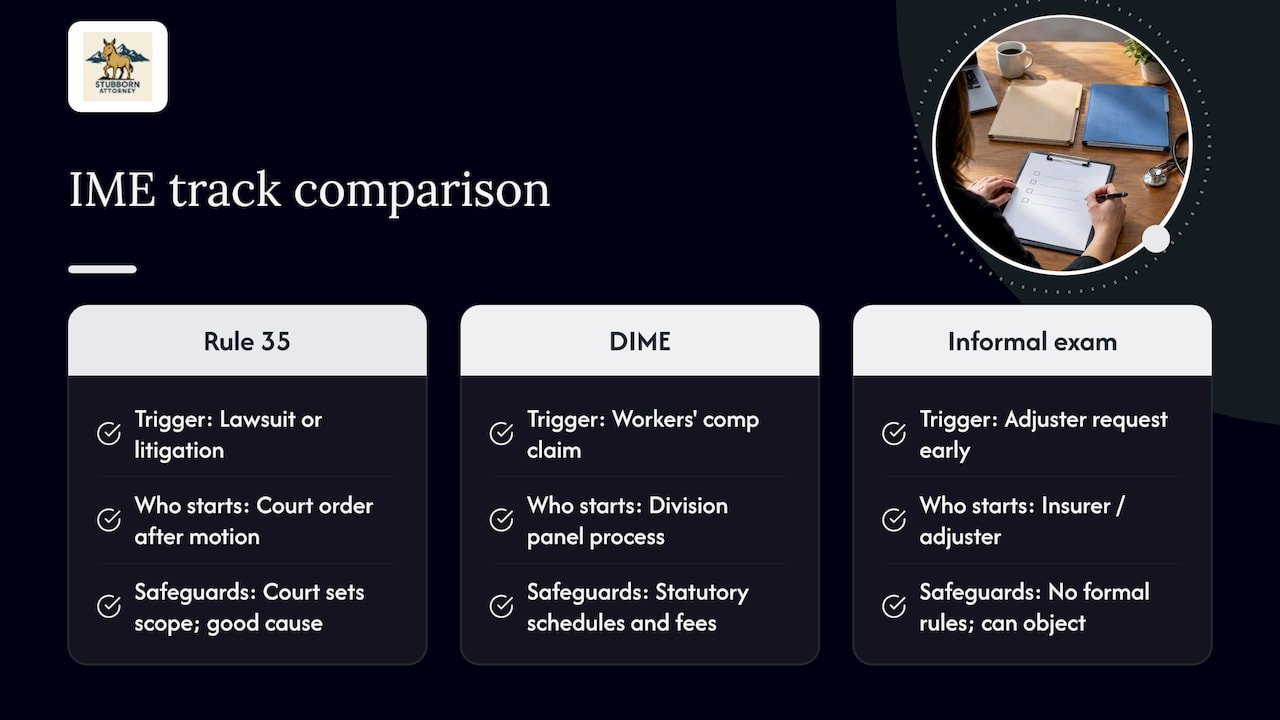
If you have filed a lawsuit, or the insurance carrier has taken a formal litigation stance, you are likely dealing with a Rule 35 civil exam. Under Colorado civil procedure, the party requesting the exam must file a motion and obtain a court order that specifies the time, place, scope and conditions of the exam. The requesting party carries the burden of showing good cause, meaning your physical or mental condition must genuinely be in dispute before a judge will order you examined.
Workers’ compensation claims run through an entirely different process. A Division Independent Medical Examination, known as a DIME, resolves disputes over maximum medical improvement or permanent impairment ratings. It involves a statutory panel selection process, specific scheduling windows, and fee rules set by the Colorado Division of Workers’ Compensation rather than a court.
A third scenario is common early on: an adjuster calls and asks you to see “their doctor” before any lawsuit or formal DIME request exists. This is typically an informal insurer exam, not a court or Division process, but you should still treat it carefully and preserve your right to object or request conditions before attending.
Your rights and the IME process in Colorado: notice, records, selection, fees, and recordings
Colorado’s rules give claimants real procedural leverage, but only if you know the deadlines.
In workers’ compensation cases, the insurer must deliver your medical records to the DIME physician at least 14 days before the scheduled exam. If the carrier misses that deadline, you can submit the records yourself rather than let the physician work from an incomplete file. Selection of a DIME physician follows a structured process under Rule 11: the parties can agree on a doctor, or the Division issues a three-physician list and the parties strike names until one remains. Scheduling generally falls within a moderate scheduling window typically spanning several weeks, and the requesting party typically advances the base DIME fee, with session law governing how those costs and timeframes are allocated.
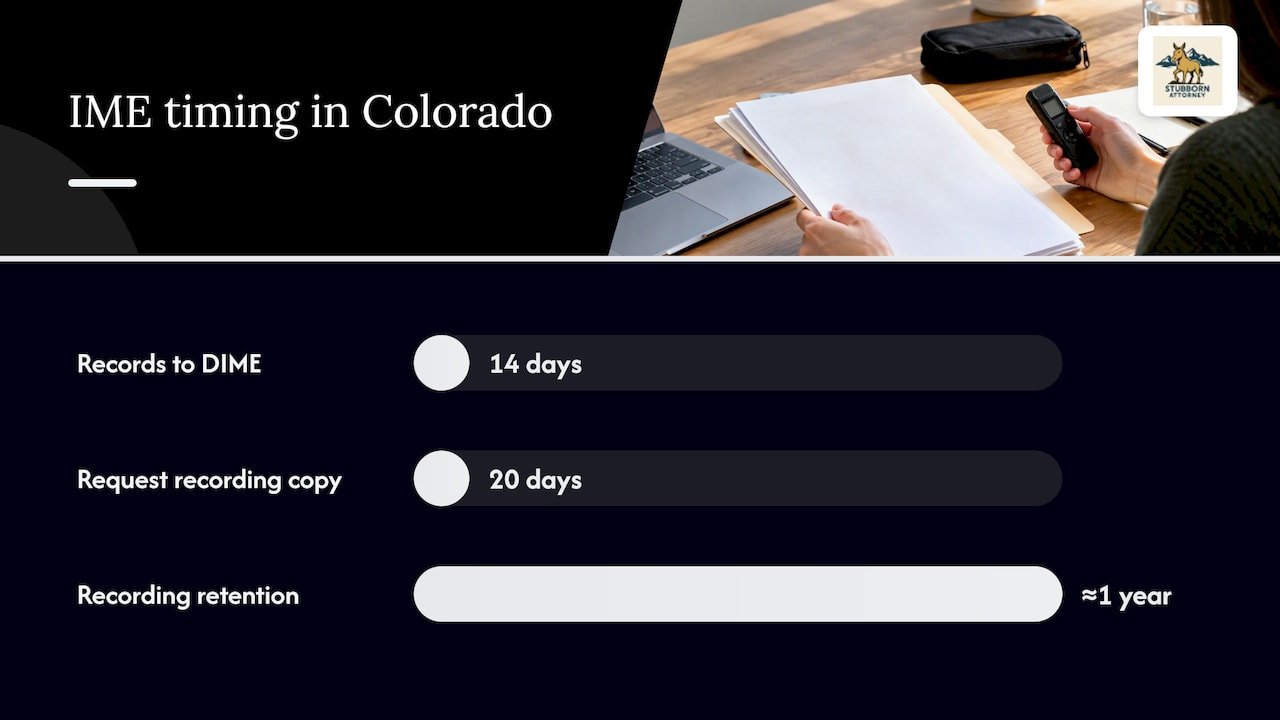
Audio recording is one of the most useful protections available to claimants. Division rules require that respondent-requested IMEs be digitally recorded, with the physician notifying you in advance. The recording must be retained for approximately one year, and you have 20 days from receiving the written report to request a copy.
A few practical points worth remembering:
- The examining physician must notify you before recording begins and keep the recording in digital format.
- You have 20 days after the written report arrives to request your copy of the recording.
- If a recording turns out missing or inaudible, the Division can order remedies, including a repeat exam.
- Claimants who cannot afford fees associated with the DIME process may apply for an indigent determination through Division forms.
How to prepare for the IME: evidence preservation and what to say and avoid at the exam
Preparation decides whether an IME report helps or hurts your claim, and most of the work happens before you ever walk in the door.
- Collect every medical record related to your injury, including imaging, physical therapy notes, and visits with specialists.
- Ask your treating physician to add any missing notes or clarify gaps in your chart before the exam date.
- Bring a current medication list, a written symptom timeline, and a copy of your job description if work limitations are part of your claim.
- During the exam, answer every question honestly and keep your responses brief and consistent with what your medical records already show.
- If the examiner states something inaccurate, correct it calmly in the moment rather than letting it stand uncorrected in the file.
- Avoid volunteering speculative activities or future plans the examiner did not ask about; stick to what has actually happened.
- If the exam is recorded, note the fact, mark your calendar for the copy request window, and flag any technical issues immediately.
Pro Tip: If you receive a copy of the recording, listen to it against the written report line by line and send any discrepancies straight to your attorney, since mismatches between what was said and what was written are often the strongest grounds to challenge a report.
Organizing your evidence and documentation before the exam date is one of the simplest ways to protect your claim from an unfavorable IME outcome.
How to oppose or limit an IME: motions, protective orders, and likely remedies
You are not required to accept every IME request as written, and Colorado law gives you several ways to push back.
Common grounds for challenging an exam include a lack of good cause, an exam that duplicates testing your treating physicians already performed, a scope that goes beyond the injuries actually in dispute, an insurer’s failure to supply required records on time, or an examiner with an undisclosed conflict of interest. In Hayes v. District Court, the Colorado Supreme Court confirmed that trial courts have broad discretion to set conditions on an exam, including who may attend and whether recording is permitted, and that those decisions are reviewed only for abuse of discretion.
Remedies vary by track. In civil cases, a judge can issue a protective order limiting the scope of the exam, reschedule it, or deny the motion outright if the insurer cannot show good cause. In workers’ comp cases, an administrative law judge can strike a DIME report entirely when the recording is missing, inaudible, or when procedural rules were violated during selection or scheduling.
Challenging an IME takes time, and that delay has to be weighed against what you stand to gain. An attorney can raise these objections cleanly, preserve the record for appeal, and avoid the kind of procedural missteps that waive your strongest arguments later. Insurers often frame IMEs as routine discovery, but the burden to justify one still sits with them.
When to hire a Colorado personal injury attorney about an IME
Hire an attorney before the exam if the outcome could determine your maximum medical improvement status or impairment rating, if your treating doctors and the IME examiner are likely to disagree, or if the insurer is already slow walking record production or scheduling. Once retained, counsel can demand the missing records, file objections or motions before the exam locks in unfavorable conditions, coordinate with your treating physicians so your medical story is consistent, and obtain the recording copy within the statutory window.
We have extensive experience representing injured people in Colorado and understand how insurers evaluate IME reports.
— Ryan
Get a free case evaluation before your IME
We built our practice around not backing down once a case is in our hands, and an insurer-ordered IME is exactly the moment that steady, stubborn approach matters most. We represent injured clients in a variety of personal injury claims and routinely assist clients facing IME or DIME disputes, applying knowledge of the Division’s rules on record deadlines and audio recordings.
- Bring your IME or DIME notice, any letter scheduling the exam, and all correspondence from the insurer.
- Bring your medical records and any imaging, therapy notes, or specialist reports you already have.
- We will assess which track applies to your exam, flag any missed deadlines on the insurer’s side, and map out your next steps.
Start with a free case evaluation so we can look at your IME notice and your claim timeline together, and see our full range of personal injury services if you want to understand how we handle a case from the first call through settlement or trial.
This article is general information, not a substitute for advice from a qualified lawyer. Consult a qualified legal professional about your own circumstances before acting on anything here.
FAQ
Do I have to attend a Colorado independent medical exam?
If the exam is court-ordered under civil rules or is a properly scheduled Division DIME in a workers’ comp case, you generally must attend or risk real consequences to your claim. An informal insurer request made outside those formal processes carries less legal weight, but you should still get legal advice before refusing or rescheduling.
Who pays for a Division IME in a Colorado workers’ comp case?
The requesting party typically advances the base DIME fee under Colorado Division rules, and claimants who cannot afford associated costs may apply for an indigent determination through the Division’s forms. Fee allocation and rescheduling costs are further addressed in session law governing the DIME process.
Can I get a copy of my IME audio recording?
Yes. Division rules require digital recording of respondent-requested IMEs, and you have 20 days from receiving the written report to request your copy, with recordings retained for 12 months.
What happens if the insurer’s doctor gives an unfair IME report?
Colorado case law, including Martinez v. Lewis, treats IME physicians differently from your treating doctors and generally limits direct claims against the examiner absent bad faith or malice. The more effective path is usually to challenge the insurer’s reliance on a flawed report through your claim or litigation rather than pursuing the physician directly.
Can a court limit what happens during my IME?
Yes. Colorado courts have discretion to set conditions on an exam, including who may attend and whether recording is allowed, as confirmed in Hayes v. District Court, and the party requesting the exam must first show good cause.
Sources
- Independent Medical Opinions in Workers’ Compensation | Department of Labor & Employment
- Hayes v. District Court