

When the 50% Rule Costs You: Lane Change Fault in Colorado
In most lane-change crashes in Colorado, the driver who moved out of their lane carries the fault, because state law puts the burden on that driver to change lanes only when it can be done safely. That finding typically comes with a class A traffic infraction and an insurance fault determination that follows the at-fault driver’s policy. Colorado’s modified comparative negligence rule still lets a partly-at-fault driver recover damages, as long as they are not more than 50% responsible.
Table of Contents
- How Fault Gets Determined in a Colorado Lane-Change Crash
- Colorado’s Lane-Change Laws and How Fault Affects Your Insurance
- What Evidence Proves Fault in a Lane-Change Collision
- Comparative Negligence and Common Defenses in Lane-Change Cases
- Your Step-by-Step Checklist After a Lane-Change Crash
- An Attorney’s View on When Lane-Change Fault Gets Complicated
- What the Research Actually Shows About Lane-Change Fault
- How We Help Colorado Drivers After a Lane-Change Crash
- FAQ
- Sources
How Fault Gets Determined in a Colorado Lane-Change Crash
Colorado law places a clear duty on the driver who is moving between lanes. Under Colorado Revised Statutes Title 42, a driver must stay within a single lane as nearly as practical and may only move from that lane after first making sure the move can happen with reasonable safety. That statute, found at 42-4-1007, is the starting point for almost every fault conversation after a lane-change wreck.
Insurance adjusters and courts do not stop at the statute, though. They look at the “totality of the circumstances,” meaning every observable fact that shows whether the lane change was actually safe when it happened. That review typically includes:
- Whether the driver signaled with enough time and distance before moving
- Whether mirror checks and a blind-spot glance happened before the move
- Whether there was an adequate gap in traffic to merge without forcing another driver to brake or swerve
- Whether lane markings allowed a lane change at that location, since a solid white line, an HOV lane, or a turn-only lane changes the analysis
- Whether signage or a traffic control device prohibited the movement entirely
A broken white line generally permits a lane change when safe, while a solid line signals that drivers should stay put. Adjusters also look at where the crash happened relative to intersections, on-ramps, and designated lanes, because those details often decide whether a driver had any legal right to be moving at all.
Colorado’s Lane-Change Laws and How Fault Affects Your Insurance
The statute that governs this whole area is C.R.S. 42-4-1007, which classifies an unsafe lane change as a class A traffic infraction. That classification carries its own fine and can add points to a driver’s record, separate from anything that happens in the civil claim over property damage or injuries.
Once fault is assigned, the consequences move into the insurance side of the equation. The at-fault driver’s liability coverage is the policy that pays for the other driver’s bodily injury and property damage, up to the policy limits. The Colorado Division of Insurance explains that drivers carry minimum liability coverage for exactly this reason, and that an at-fault accident can trigger a premium increase or, in some cases, a nonrenewal. When the at-fault driver is uninsured or underinsured, the injured driver’s own uninsured/underinsured motorist coverage, or collision coverage for vehicle repairs, steps in instead.
Lane violations are a growing share of Colorado’s injury and fatal crashes: Colorado State Patrol reported 684 fatal and injury lane-violation crashes in 2025, a 6.7% increase from 2024. That trend is part of why insurers scrutinize lane-change claims closely and why a fault finding on a citation can carry real financial weight beyond the ticket itself.
- Unsafe lane changes are charged as a class A traffic infraction under state law
- Liability coverage pays the other driver’s damages when you are found at fault
- UM/UIM or collision coverage may apply when the at-fault driver lacks adequate insurance
- A fault finding can lead to higher premiums or policy nonrenewal
Our guide to bodily injury liability in Colorado walks through what that coverage pays for and why the at-fault label matters so much to the outcome.
What Evidence Proves Fault in a Lane-Change Collision
Fault disputes in lane-change crashes often come down to evidence that captures the seconds before impact, since both drivers’ accounts tend to conflict. Some forms of evidence carry far more weight than others, and the value of nearly all of it drops fast with time.
- Video footage from a dashcam, nearby traffic camera, or a business’s security system is usually the strongest evidence available, because it shows the actual lane position and timing.
- Photographs of the vehicles, the roadway, lane markings, and the final resting positions help reconstruct who was where.
- Witness statements from drivers or pedestrians who saw the lane change add independent accounts that adjusters weigh heavily.
- Damage patterns, including the location and angle of scrapes, dents, and crush zones, often show which vehicle was struck while holding its lane and which was the one moving.
- Skid marks on the roadway can indicate braking or evasive action and help pin down the point of impact.
- Vehicle event data recorder (EDR) information, often called the black box, can capture speed, braking, and steering input in the moments before the crash.
- Cell phone and GPS data occasionally corroborate speed or location when other evidence is thin.
Damage-pattern analysis matters more in lane-change cases than in rear-end or intersection crashes, because the lateral offset and point of first contact usually tell a reconstructionist which car drifted into the other’s lane. Preserving the vehicle before repairs begin, even just with thorough photos, keeps that evidence available.
Pro Tip: Photograph the damage, the lane markings, and the full scene before either vehicle is moved or towed, since that record often matters more than anything said at the scene.
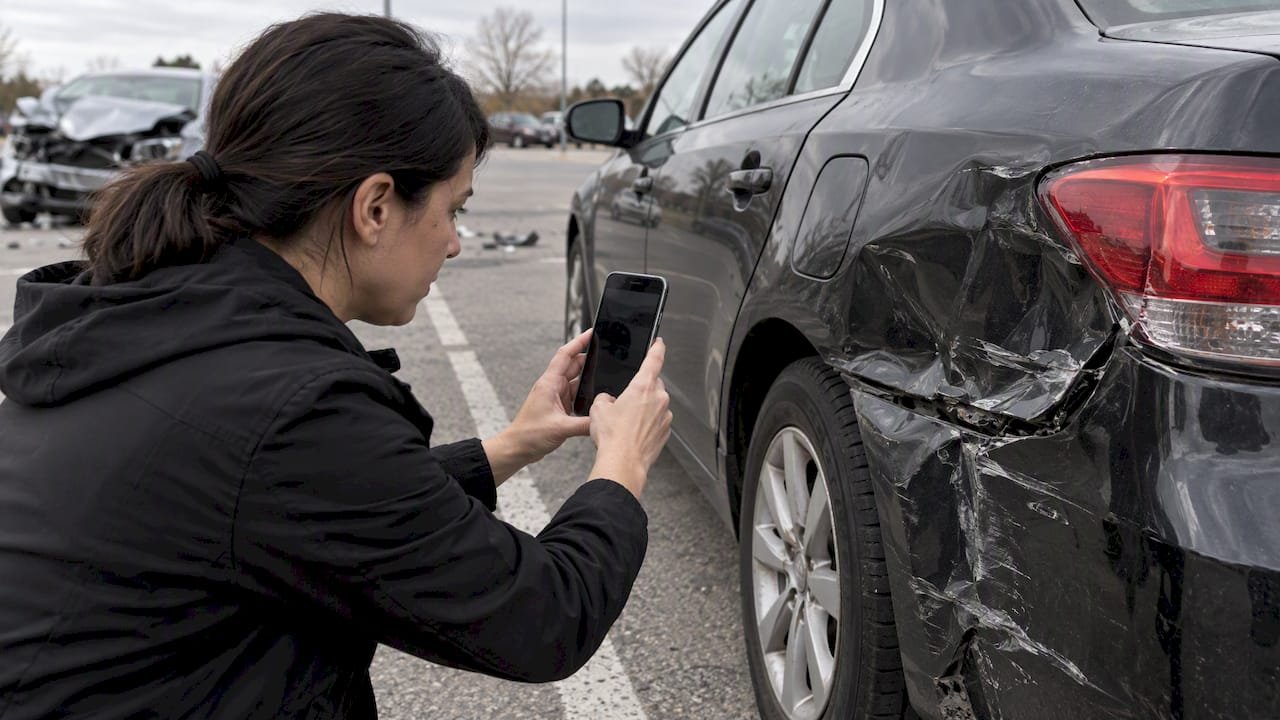
Request camera footage from nearby businesses or traffic systems within days, not weeks, since most systems overwrite recordings quickly. Get the names and phone numbers of any witnesses before they leave, and ask the responding officer for the police report number so you can follow up. Our 10 steps to strengthen injury claims after a car accident covers additional preservation steps worth taking in the first 72 hours.
Comparative Negligence and Common Defenses in Lane-Change Cases
Cross the 50% threshold, though, and the rule bars recovery entirely.
Insurers and opposing drivers raise a predictable set of defenses to shift percentage points of fault back onto the other side. Common arguments include:
- A sudden emergency, such as a tire blowout or an object in the road, forced the lane change
- The lane change was necessary to avoid a hazard the other driver created
- The other driver was speeding, which reduced the time available to react
- An obstructed view, such as a large vehicle blocking a mirror’s sightline, made the lane change reasonable under the circumstances
Certain behaviors tend to increase a driver’s share of fault rather than reduce it. Failing to signal, speeding through the merge, or driving while impaired are the kinds of facts that push a percentage higher once an adjuster or jury weighs them. CODOT’s crash reporting has consistently identified speeding as a top cause of fatal crashes, which is part of why speed shows up so often in these fault arguments.
Your Step-by-Step Checklist After a Lane-Change Crash
What you do in the hours and days after a lane-change crash shapes both your safety and your claim. A clear sequence helps you avoid missing something that matters later.
- Check for injuries and move to safety if the vehicles are drivable and it is safe to do so.
- Call the police to the scene so an official report gets created, even for a crash that looks minor.
- Photograph the scene immediately, including lane markings, vehicle positions, and visible damage.
- Collect witness names and phone numbers before anyone leaves.
- Seek medical care, even if injuries seem mild, since some symptoms appear hours or days later.
- Request and preserve video footage from any nearby cameras within the first few days.
- Notify your insurer promptly, but stick to the facts and avoid admitting fault or speculating about percentages.
- Keep medical and repair records organized from the start, since these documents support the value of the claim.
Pro Tip: Avoid discussing fault with the other driver at the scene. What you say can end up in the claims file and shape the fault determination before you have seen any evidence.
Fines, DMV points, and the statute of limitations all run on their own clocks once the crash happens, so reporting the claim and getting medical treatment promptly matters for more than just your health. Our Colorado car accident legal checklist lays out a printable version of these steps for reference after the fact.
An Attorney’s View on When Lane-Change Fault Gets Complicated
Ryan Malnar has worked as an attorney for over a decade and previously served as a claims adjudicator for the federal government, giving him a direct view of how insurers build their fault arguments from the inside. That background shapes how our firm approaches lane-change disputes, where the fault percentage often swings on details that a driver without legal help might not think to preserve.
Some cases call for legal representation more urgently than others. Serious injuries, a disputed fault finding, an uninsured or underinsured driver on the other side, or evidence that needs fast preservation, such as EDR data or surveillance footage, are the signals that typically mean a case benefits from an attorney’s involvement. Our guide on when you should hire an automobile accident attorney walks through these signals in more detail.
When an insurance adjuster reviews a lane-change claim, they are building a fault argument from the first phone call. Knowing that going in changes what you say and what you preserve.
— Ryan
What the Research Actually Shows About Lane-Change Fault
The most overlooked part of lane-change fault disputes is not the law itself. The statute is short and fairly clear. What actually decides these cases is how fast evidence disappears and how little most drivers do about that in the first 48 hours. Camera footage gets overwritten, memories of witnesses fade, and vehicles get repaired or totaled before anyone thinks to document the crush pattern.
Conventional advice tends to focus heavily on who signaled and who did not, as if that single fact settles the case. In practice, adjusters weigh the full picture, including speed, gap size, and lane markings, and a missing signal is rarely the only variable that decides a percentage. Colorado State Patrol’s own guidance leans toward creating space rather than reacting to an unsafe lane change, which tells you something: the agency closest to this data treats prevention as more valuable than after-the-fact blame. Drivers who want the strongest position after a crash should prioritize preserving video and witness information immediately, ahead of worrying about fault percentages they cannot control in the moment.
How We Help Colorado Drivers After a Lane-Change Crash
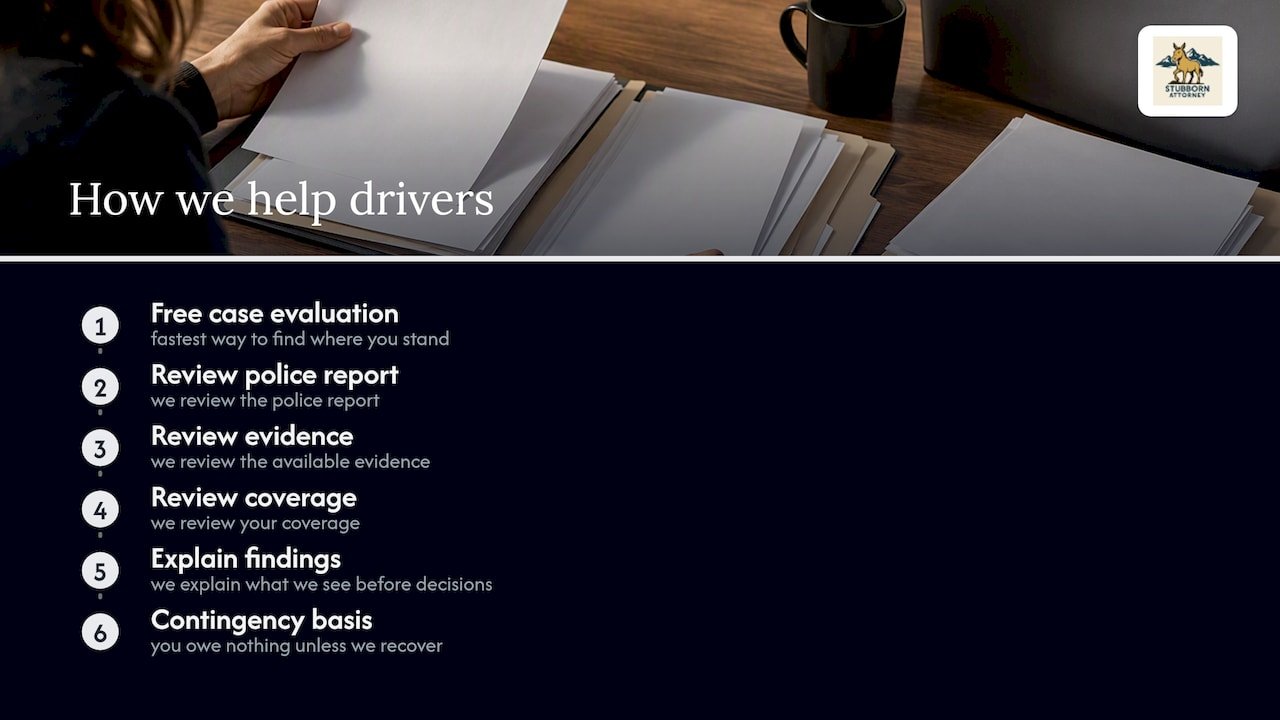
A lane-change crash often turns into a fight over small percentages of fault, and those percentages determine how much of your medical bills and lost wages you actually recover. We represent injured drivers on a contingency basis, meaning you owe nothing unless we recover compensation for you, and our attorneys handle cases directly rather than passing them through a call center.
We built our approach around the same qualities that get a mule through difficult mountain terrain: steady under pressure, careful about unnecessary risk, and unwilling to back down once we take a case. If you were in a lane-change crash and the fault determination feels unfair, or the insurer is pushing a percentage that does not match the evidence, a free case evaluation is the fastest way to find out where you stand. We review the police report, the available evidence, and your coverage, then explain what we see before you decide anything.
This article is general information, not a substitute for advice from a qualified lawyer. Consult a qualified legal professional about your own circumstances before acting on anything here.
FAQ
Is Colorado a no-fault state for car accidents?
No. Colorado is an at-fault, or tort, state, which means the driver responsible for causing a crash is financially responsible for the resulting damages. The Colorado Division of Insurance confirms that liability coverage, not a personal injury protection system, pays for injuries and property damage after a crash.
Is changing lanes in the middle of an intersection illegal in Colorado?
Colorado law requires a driver to change lanes only when it can be done with reasonable safety, and lane changes inside an intersection are riskier because of crossing traffic and limited reaction time. Whether it is a traffic infraction depends on the specific lane markings and signage at that intersection, which an officer or adjuster reviews case by case.
What time of day do most lane-change crashes happen in Colorado?
Colorado State Patrol data shows lane-violation crashes peak between 1 p.m. and 6 p.m., which lines up with the afternoon commute when traffic density and merging are both high. Crashes occur every day of the week, not just on weekdays.
What should I do if the other driver admits fault at the scene?
Write down what they said and get it from any witnesses who heard it, since statements made at the scene can change later. An admission helps your position, but photos, video, and a police report number still matter because fault disputes often shift once insurance companies get involved.
Sources
- Give Space to Aggressive Drivers | Colorado State Patrol
- Colorado Revised Statutes, Title 42 (Driving statutes)
- Auto insurance | Colorado Division of Insurance