


Colorado Drivers: 10 Day Filing Traps in Police vs Accident Reports
When police respond to a crash, the “police report” and the “accident report” are almost always the same document, an officer-completed crash report filed with the department. They diverge only when a separate driver self-report is legally required, or when someone confuses this record with an unrelated “incident report.” If police responded, get the report number and agency name before you leave the scene, then request the report and notify your insurer within days, not weeks.
Table of Contents
- Police Report vs. Accident Report: Clearing Up the Vocabulary
- What’s Actually Inside a Police Crash Report
- Do Different States Require Different Accident Reports?
- How Much Weight Does a Police Report Carry With Insurers and Courts?
- How Do You Get a Copy and Fix a Mistake?
- What Should You Document at the Scene and Send to Your Insurer?
- What Attorneys Actually Look for in a Crash Report
- Why the “Just Get the Police Report” Advice Falls Short
- Get Help Reading, Correcting, or Using Your Accident Report
- Where to Verify These Rules Yourself
- Sources
- FAQ
Police Report vs. Accident Report: Clearing Up the Vocabulary
Confusion starts with the labels. An officer-completed crash report is what most agencies mean when they say “police report,” “crash report,” “collision report,” or “accident report.” They’re the same document wearing different names, and asking a records clerk for any of these terms should pull the same file.
Three other documents get mixed into that conversation, and they shouldn’t be:
- Incident reports cover non-crash matters like theft or vandalism and run through a different filing pipeline entirely.
- Driver self-reports are forms you file yourself, sometimes required even when an officer never shows up.
- Insurance claim forms are your carrier’s internal paperwork and carry no legal weight as a state record.
Police aren’t required to respond to every crash, and departments vary widely on when an officer actually gets dispatched to a collision scene. That gap is exactly where driver self-reports become mandatory in many states, a point that trips up more people than you’d expect.
What’s Actually Inside a Police Crash Report
A crash report follows a predictable structure, whether it comes from Colorado Springs PD or a rural sheriff’s office in another state. Learning the layout helps you spot what matters before an adjuster does.
- Header data: report number, date, time, and exact location. This is what you’ll need to request a copy later.
- Party and vehicle information: names, insurance carriers, license and plate numbers for everyone involved.
- Witness section: contact details for anyone the officer interviewed at the scene.
- Narrative: the officer’s written account of what happened, blending direct observation with inference.
- Diagram: a sketch showing vehicle positions, points of impact, and road features.
- Coded fields: standardized categories, including a primary collision factor, drawn from uniform criteria set by NHTSA.
- Citations and injury notations: whether anyone was ticketed and the severity of reported injuries.
Reading a report well means separating what the officer saw from what the officer concluded. A statement like “vehicle one’s front bumper struck vehicle two’s rear panel” is an observation. A statement like “driver one failed to yield” is a conclusion drawn from those observations, and it deserves a second look, not automatic acceptance.
Pro Tip: Read the narrative twice. First pass for the story, second pass with a pen, marking every sentence as either “observed” or “concluded.” The conclusions are where disputes usually live.
Do Different States Require Different Accident Reports?
Yes, and this is where people lose claims without realizing it. State rules on who files what, and by when, vary enough that a driver who assumes “the officer’s report covers everything” can miss a legally required filing.
- New York splits the two documents cleanly: the officer’s MV-104 is the public, admissible record, while the driver-filed MV-104A is privileged and generally required within 10 days when property damage or injury crosses a set threshold.
- California uses the SR-1 form, which drivers must file with the DMV within 10 days of a crash involving injury, death, or damage over a set dollar amount, regardless of whether police wrote a report.
- Texas has shifted its approach to driver self-reporting over the years. The old CR-2 driver form has largely given way to reliance on the officer’s CR-3, which matters most when police decline to respond and no self-report fills the gap.
The pattern across all three: the officer’s report is the anchor document, but several states layer a driver obligation on top of it. Miss that second filing, and your insurer or the DMV may treat the crash as unreported on your end, even with a valid police report on file.
How Much Weight Does a Police Report Carry With Insurers and Courts?
A lot, but not final say. Insurance adjusters and courts treat the officer’s crash report as strong evidence, not a verdict. Adjusters routinely ask for the police report by name because it hands them a diagram, a narrative, and coded fault signals in one document, saving them investigation time.
That said, admissibility has real limits. Under the business records exception in Federal Rule of Evidence 803, the factual portions of a report, who was where, what the diagram shows, typically get admitted without much fight. The officer’s opinion about fault is a different story; many courts restrict how far that opinion can go, since the officer usually wasn’t a witness to the collision itself.
An officer’s crash report carries real weight in a claim, but it’s the observations, not the conclusions, that hold up best when tested in court.
Adjusters and attorneys often build their own picture alongside the report by:
- Pulling traffic camera or dashcam footage if it exists.
- Interviewing witnesses the officer never reached.
- Bringing in accident reconstruction when the physical evidence and the narrative don’t line up.
How Do You Get a Copy and Fix a Mistake?
Most agencies now handle requests through an online portal, though some smaller departments still require an in-person or mailed request at the precinct. You’ll typically need the report number, date, location, and a form of identification associated with the crash.
- Processing generally takes anywhere from a few days to two weeks, though some departments can take longer depending on staffing and backlog.
- Fees usually run between a few dollars and about twenty-five dollars, depending on the jurisdiction.
- Corrections go through a supplemental report request, not a rewrite. You submit the disputed detail with supporting evidence, and the officer or a supervisor decides whether to amend the record.
Pro Tip: Request your copy the moment the waiting period ends. If you plan to make a claim or hire an attorney, having the report early gives you time to flag errors before an insurer builds a position around them. For a fuller walk-through, see this guide to getting a report fast.
What Should You Document at the Scene and Send to Your Insurer?
The report you eventually pull is only as good as what actually happened at the scene, and reports don’t capture everything. Build your own file in parallel.
- Photograph vehicle positions before anything gets moved, plus close-ups of damage, license plates, and any relevant road signs or signals.
- Capture video if you can, including a slow pan of the full scene and any dashcam footage you have access to.
- Write down the responding officer’s name, badge number, and the report number before you leave.
- Collect names and phone numbers for every witness, even ones the officer doesn’t formally interview.
- If no officer responds, create your own written account immediately, note the time and location precisely, and call your insurer that same day.
Digital evidence degrades fast, phones get replaced, dashcam loops overwrite. Back up everything the night of the crash. For a more detailed walkthrough of what to preserve, this evidence-gathering guide covers the specifics.
What Attorneys Actually Look for in a Crash Report
Attorneys don’t read a crash report the way an insurer does. They’re hunting for gaps, a timestamp that doesn’t match a witness statement, a diagram that contradicts the narrative, a coded collision factor with no supporting observation behind it. Those inconsistencies are frequently where a client’s position gets stronger, not weaker.
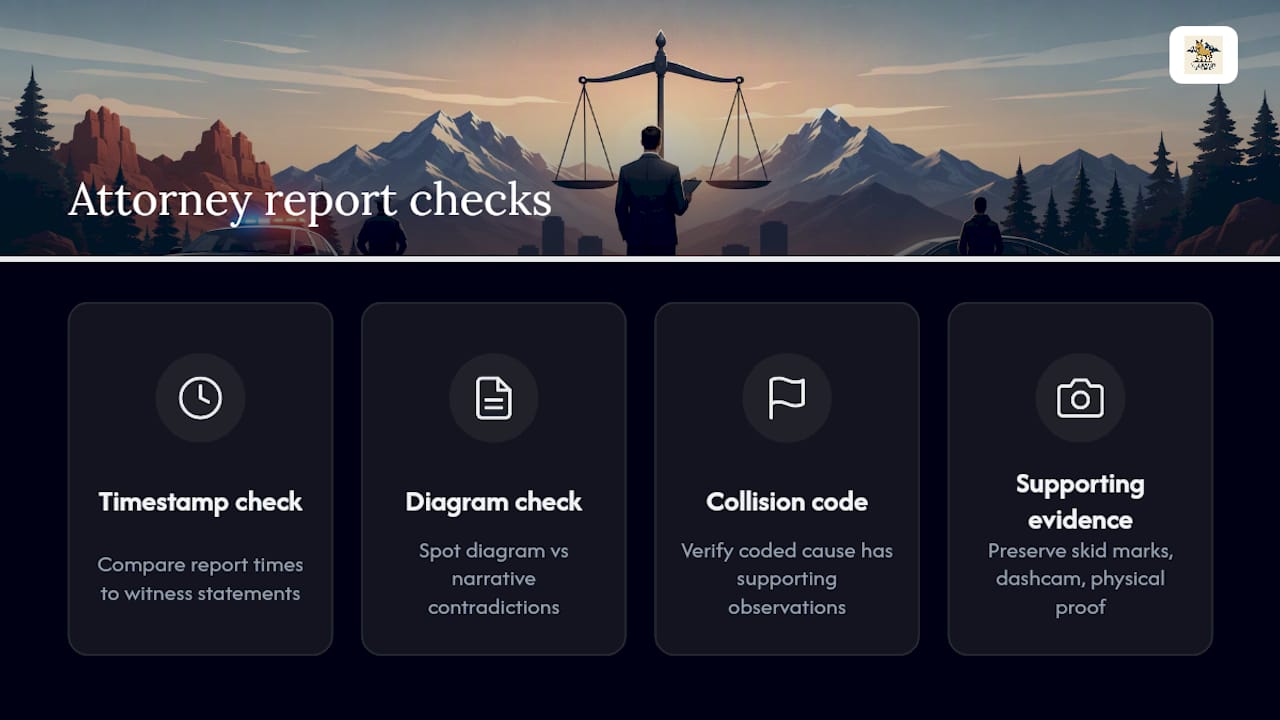
The most common client mistake is treating the officer’s stated cause as the end of the discussion. It isn’t. An officer wasn’t necessarily watching the moment of impact, and attorneys routinely dig past the coded conclusion into the underlying observations, physical evidence, and timing before accepting it. Getting legal help early matters here specifically because corrections, supplemental filings, and evidence preservation all get harder the longer you wait. A witness’s memory fades. Skid marks get repaved over. Dashcam footage gets overwritten.
Why the “Just Get the Police Report” Advice Falls Short
Most advice on this topic stops at “get a copy of the police report and hand it to your insurer.” That’s incomplete, and it’s the part of the conventional wisdom I’d push back on hardest.
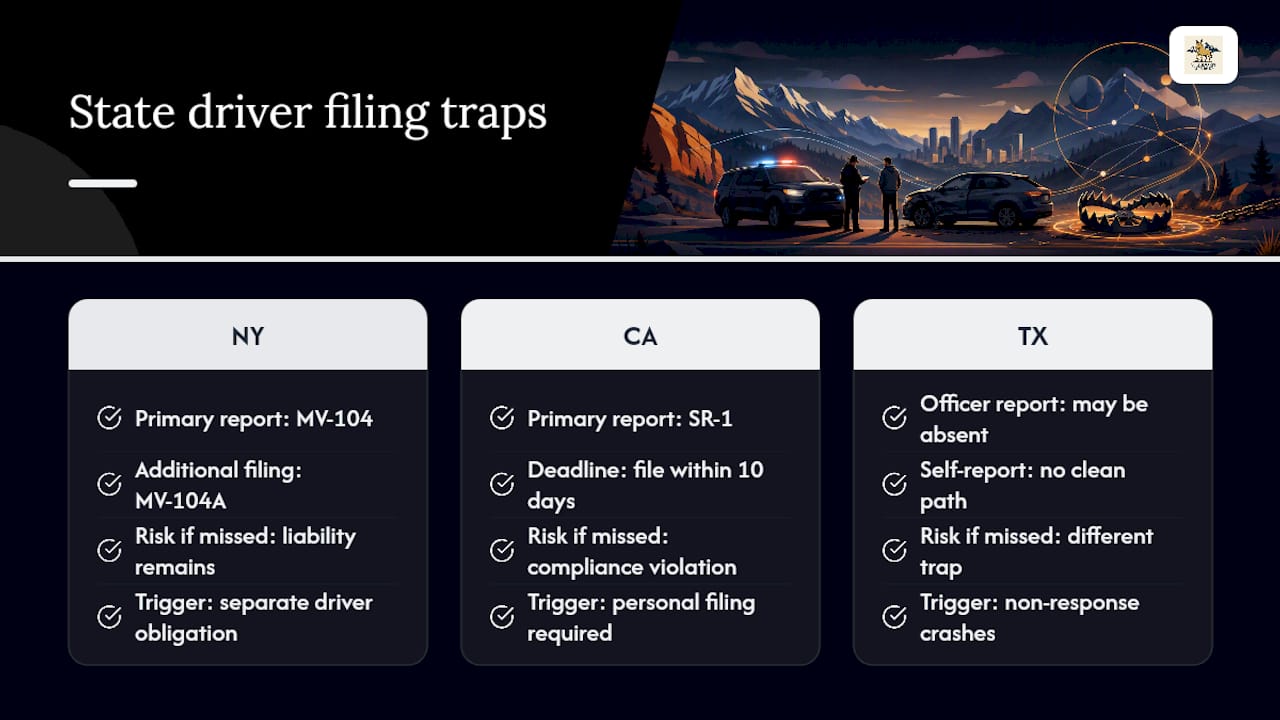
The report matters, but the state-specific driver filing requirements matter just as much, and they’re the piece almost nobody mentions until it’s too late. A New York driver who assumes the MV-104 covers everything can still be on the hook for a missed MV-104A. A California driver who never files an SR-1 within 10 days has a compliance problem that has nothing to do with fault. Texas drivers dealing with a non-response crash face a different trap entirely: no officer report and no clean self-report path.
What I’d prioritize first isn’t the report itself. It’s figuring out, within days of the crash, whether your state imposes a separate filing obligation on you personally. That single question determines whether you’re looking at a clean claim or a paperwork problem stacked on top of an injury claim. Once that’s settled, everything else, reading the narrative, requesting corrections, matching evidence to the diagram, follows in order.
— Ryan
Get Help Reading, Correcting, or Using Your Accident Report
Reading a crash report correctly and catching an error before an insurer locks in their position takes more than a quick skim, and that’s where a contingency attorney can help. Attorneys personally handle cases instead of routing them through a call center. Clients may get assistance in obtaining the correct records, requesting corrections when a narrative doesn’t match the evidence, and pushing back when an adjuster leans too hard on a coded conclusion instead of the underlying facts.
If you’re dealing with a Colorado crash and need help sorting out what your report means for your claim, our personal injury services page covers car, motorcycle, semi-truck, bicycle, and pedestrian accidents. Reach out for a free case evaluation and find out where you actually stand.
Where to Verify These Rules Yourself
For admissibility questions, read Federal Rule of Evidence 803 directly. For New York’s driver-report privilege and deadlines, see this MV-104 breakdown. For a plain-language look at the observation-versus-conclusion problem in report narratives, this reading guide is worth the ten minutes.
This article is general information, not a substitute for advice from a qualified lawyer. Consult a qualified legal professional about your own circumstances before acting on anything here.
Sources
- Federal Rules of Evidence Rule 803 — Exceptions to the rule against hearsay
- Findaccidentreport
- How to Read a Police Report: Telling Observation From Conclusion | ImNotAnAttorney
- How to Get a Car Accident Police Report in New York (Complete Guide)
FAQ
What Is the Difference Between a Police Report and an Accident Report?
In most crashes where an officer responds, there’s no difference. They’re the same officer-completed record, just called different names by different agencies. The terms only split when a state requires a separate driver self-report, like New York’s MV-104A, alongside the officer’s version.
Is a Police Report Different From an Incident Report?
Yes. An incident report covers non-crash events like theft or property damage, filed through a different process at the department. A crash report is specific to vehicle collisions and follows the standardized structure built around uniform crash criteria, including narrative, diagram, and coded factors.
What Does a Police Report for an Accident Look Like?
It typically includes a header with the report number and location, party and vehicle details, a witness section, a written narrative, a diagram of the collision, and coded fields like the primary collision factor. Citation and injury notations usually appear near the end.
Do I Still Need to File My Own Report if Police Responded?
Sometimes, yes. States like California require a driver-filed SR-1 within 10 days for qualifying crashes regardless of whether an officer wrote a report, and New York has a similar driver obligation tied to the MV-104A form. Check your state’s DMV rules before assuming the officer’s report covers your legal obligation.
Can Stubbornattorney Help Me Get or Correct My Accident Report?
Yes. Our team helps Colorado clients request the correct crash report, identify errors worth correcting, and build a claim around the full evidence picture rather than just the officer’s conclusion. Case evaluations are free, and you pay nothing unless we recover compensation for you, details are on our services page.