


Protect Your Claim: Treat PTSD Early After a Car Accident
Yes. Car accidents are one of the most common causes of PTSD in the United States, and the disorder can take hold even when your physical injuries are minor. If you’re replaying the crash, avoiding the road, or waking up in a panic weeks later, get evaluated by a doctor and a mental-health professional right away, then start documenting everything, because early, consistent treatment both speeds recovery and protects any future injury claim.
Table of Contents
- PTSD Car Accident Diagnosis: What Actually Separates Trauma From a Diagnosable Disorder
- PTSD Symptoms After a Car Crash: What Survivors Actually Experience
- How Common Is PTSD After a Car Accident, and Who’s Most at Risk
- How Doctors Screen for and Diagnose PTSD After a Crash
- PTSD Treatment Options That Actually Work After a Car Accident
- Recovery Timeline: What Helps Early and What to Watch For
- Proving PTSD After a Car Accident: What Insurers and Courts Actually Look For
- A Straight Answer on What Actually Moves These Cases Forward
- How We Help After a Crash Leaves More Than Physical Damage
- Sources
- FAQ
PTSD Car Accident Diagnosis: What Actually Separates Trauma From a Diagnosable Disorder
Almost everyone feels shaken after a collision. Your hands might tremble on the wheel for a week, you might replay the sound of impact a few times, and then it fades. That’s a normal stress reaction, not PTSD.
Post-traumatic stress disorder is a specific clinical diagnosis defined by the DSM-5, and it requires symptoms from four distinct clusters, all connected to the crash, lasting more than a month. The first cluster is intrusion: unwanted memories, nightmares, or flashbacks that force you to relive the accident. The second is avoidance, meaning you steer clear of driving, certain roads, or even conversations about the crash. The third is negative changes in mood or thinking, such as persistent guilt, detachment from people you love, or a conviction that the world is now unsafe. The fourth is hyperarousal, which shows up as being jumpy, irritable, unable to sleep, or constantly scanning for danger.
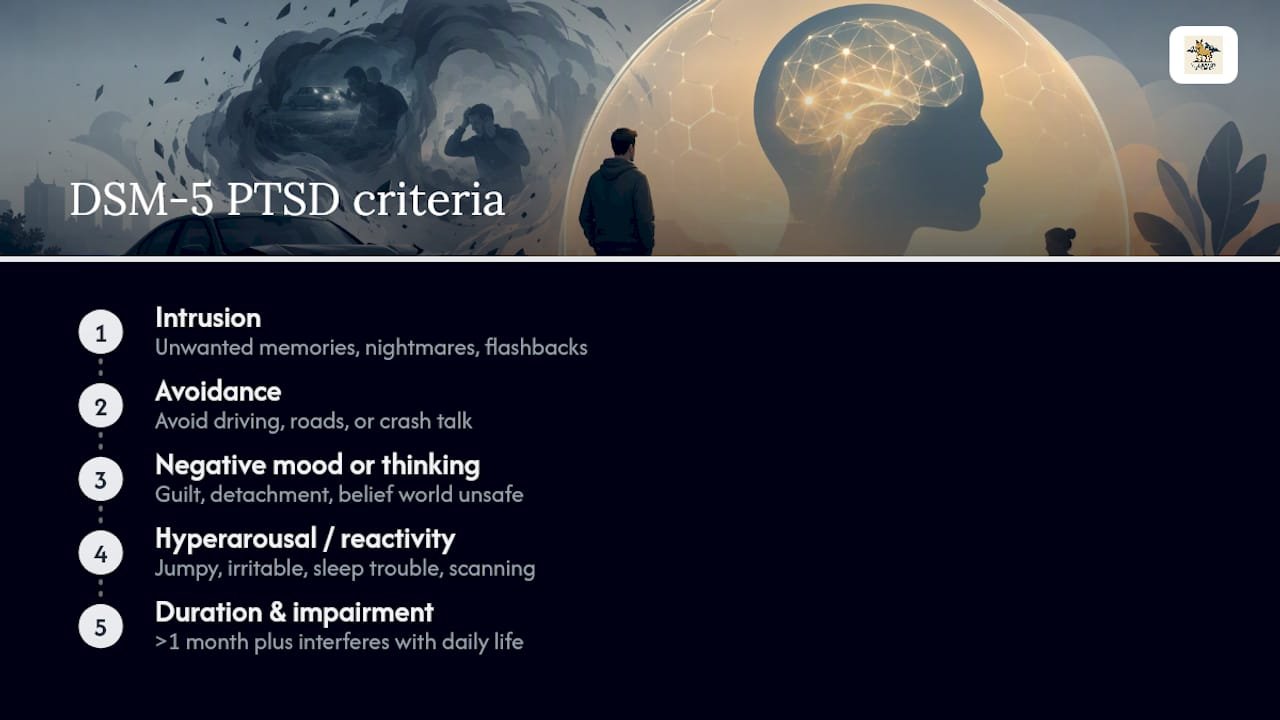
A car wreck qualifies as a “criterion A” traumatic event under DSM-5 as long as you experienced actual or threatened death or serious injury, whether that happened to you directly or you witnessed it happen to a passenger. That threshold is lower than most people assume. You don’t need to have been hospitalized. A T-bone collision at a stoplight where nobody was seriously hurt can still meet the exposure criterion if it felt life-threatening in the moment.
The line between an acute stress reaction and full PTSD comes down to two things: duration and impairment. Acute stress disorder covers the first month after the crash and is common; PTSD is the diagnosis clinicians consider when symptoms persist beyond four weeks and start interfering with work, relationships, or basic daily functioning. If you’re still avoiding your commute two months out, or you snap at your kids over noises that never used to bother you, that’s no longer “just shaken up.” That’s a signal to get assessed.
PTSD Symptoms After a Car Crash: What Survivors Actually Experience
PTSD after a vehicle collision rarely looks like the dramatic flashbacks you see in movies. It’s usually quieter and more disruptive than that, showing up in the small decisions you make every day without realizing why.
Intrusive symptoms are often the first thing people notice. You might find yourself back in the driver’s seat at 2 a.m., feeling the jolt of impact even though you’re lying in bed. Nightmares about the crash, or about car accidents in general, are common, and so are sudden flashes of memory triggered by something as ordinary as a car door slamming or brake lights flaring ahead of you.
Avoidance is where the disorder starts costing you real quality of life. Some survivors can’t get back behind the wheel at all. Others can drive but take absurd detours to avoid the intersection where it happened, or white-knuckle it through every left turn because that’s the direction the other car came from. A fear of highways, backseats, or even riding as a passenger is extremely common and often mistaken for simple caution rather than a trauma response.
Hyperarousal symptoms tend to bleed into every part of life, not just driving:
- Exaggerated startle response to horns, sirens, or sudden braking
- Irritability or anger outbursts that feel disproportionate to the trigger
- Chronic difficulty falling or staying asleep
- Trouble concentrating at work or school
- Hypervigilance while riding in any vehicle, constantly watching other drivers
Physical symptoms tend to travel alongside the psychological ones. Chronic neck and back pain from whiplash frequently overlaps with PTSD, and the two conditions can feed each other. Pain limits sleep and activity, which worsens mood and anxiety, which then heightens the perception of pain. Headaches, gastrointestinal issues, and unexplained muscle tension are also common in accident survivors carrying unresolved trauma.
The clearest sign you’ve crossed from distress into disorder is functional impairment. Are you turning down job opportunities that require a longer commute? Have you stopped driving your kids to school? Are you calling in sick because you can’t face getting in the car? When PTSD starts rewriting your daily choices, it’s no longer something to wait out on your own.
How Common Is PTSD After a Car Accident, and Who’s Most at Risk
PTSD after a motor vehicle collision is far more common than most drivers assume, and it develops faster than the popular image of trauma “creeping up” over years.
A systematic review covering more than 50,000 participants found that nearly half of road traffic accident survivors report PTSD symptoms within just six weeks of the crash. One year out, the same review put prevalence between roughly 17.9% and 29.8%, depending on the population studied and how PTSD was measured. That’s a wide band, but even the low end means close to one in five crash survivors is still meeting diagnostic criteria a full year later.
Nearly half of road traffic accident survivors show PTSD symptoms within six weeks of the crash, and one-year prevalence still runs from 17.9% to 29.8% across studies.
Recovery isn’t linear, and it isn’t guaranteed just because time passes. Some survivors improve steadily over the first three to six months. Others plateau, and a meaningful subset develops what clinicians call delayed-onset PTSD, where symptoms don’t fully surface until months after the crash, often after the adrenaline of dealing with insurance calls and vehicle repairs wears off.
Certain factors reliably predict higher risk:
- Severity of the collision and whether you believed you might die or be seriously hurt
- Physical injury, especially injuries requiring surgery, hospitalization, or ongoing pain management
- Witnessing serious injury or a fatality, even if you walked away unharmed
- Prior trauma history, including previous accidents, abuse, or combat exposure
- Inconsistent or delayed early care, both medical and psychological
On the flip side, strong social support, quick access to pain management, and early psychological support all correlate with a lower likelihood of the disorder becoming chronic. A 2025 cohort study of road trauma survivors found that effective pain control and consistent early psychological support were among the clearest modifiable factors reducing the risk of chronic PTSD. Those two levers, pain and psychological care, are largely within your control in the weeks right after a crash, even when the accident itself wasn’t.
How Doctors Screen for and Diagnose PTSD After a Crash
Getting an accurate diagnosis starts with a conversation, not a scan. There’s no blood test or imaging study for PTSD, which is exactly why the assessment process matters so much, both for your recovery and for any legal claim tied to it.
Most primary care doctors and therapists start with a brief self-report screen, something you can fill out in the waiting room in under five minutes. Common tools include the PTSD Checklist for DSM-5 (PCL-5) and the Primary Care PTSD Screen. These aren’t diagnostic on their own, but scoring above the cutoff typically triggers a referral to a mental-health specialist for a full evaluation.
The formal diagnosis comes from a structured clinical interview, where a psychologist or psychiatrist walks through each DSM-5 criterion in detail: what you’re re-experiencing, what you’re avoiding, how your mood has shifted, and how your arousal and reactivity have changed. This interview is also where a clinician distinguishes new PTSD from a pre-existing anxiety or mood disorder that the crash may have aggravated, a distinction that matters clinically and legally.
Here’s the practical path most survivors go through:
- Initial medical evaluation within days of the crash, covering physical injuries and a basic mental-health check.
- Brief screening tool (like the PCL-5) administered by a primary care doctor if symptoms are reported or suspected.
- Referral to a licensed therapist or psychiatrist for a full clinical interview if the screen comes back positive.
- Formal DSM-5 diagnosis and a documented treatment plan, usually within four to eight weeks of the crash.
- Ongoing symptom tracking through follow-up visits, adjusting treatment as needed.
Good documentation at each step should include a clear symptom timeline (when things started, how they’ve changed), specific examples of functional impairment (missed workdays, stopped driving, relationship strain), and a written treatment plan with follow-up dates. Clinicians also need your prior mental-health history on record, not to disqualify your current diagnosis, but to clearly show what changed after the crash versus what existed before it.
Pro Tip: Keep a simple daily symptom journal starting the first week after the accident, noting sleep quality, anxiety triggers, and anything you avoided that day. It takes two minutes and becomes one of the most persuasive pieces of evidence a therapist, or later, an attorney, can point to when establishing exactly when your PTSD began.
PTSD Treatment Options That Actually Work After a Car Accident
The good news buried in all this is that PTSD from motor vehicle accidents responds well to treatment, better than many other trauma types, according to the clinical literature. This isn’t a condition you have to manage forever by default.
Trauma-focused cognitive behavioral therapy (TF-CBT), especially exposure-based protocols, is the most extensively studied psychotherapy for accident-related PTSD. It works by gradually and safely helping you confront the memories and situations you’ve been avoiding, whether that’s driving past the crash site or simply sitting in a car again, so your brain relearns that those cues aren’t inherently dangerous. A clinical review of PTSD treatment after motor vehicle collisions identifies TF-CBT and EMDR as the two treatments with the strongest evidence base. In one controlled trial, 76% of participants who met full PTSD criteria no longer met those criteria after completing a CBT program, a remission rate that holds up well against most mental-health interventions.
EMDR (Eye Movement Desensitization and Reprocessing) is the other front-line option. It uses guided eye movements while you recall the traumatic memory, a process thought to help the brain reprocess the memory so it stops triggering the same intensity of fear response. It’s often faster than traditional exposure therapy for single-incident trauma like a car crash, and many survivors complete a course in fewer sessions than CBT requires.
Medication plays a supporting role rather than a starting point. SSRIs (selective serotonin reuptake inhibitors) are the medication class most commonly prescribed for PTSD, particularly when anxiety or depression symptoms are severe enough to interfere with engaging in therapy itself. A psychiatrist typically considers medication when:
- Symptoms are too severe to tolerate exposure-based work right away
- Comorbid depression or panic attacks are also present
- Sleep disruption is significant enough to block recovery on its own
Emerging adjuncts are worth knowing about, even though the evidence base is thinner than for CBT and EMDR. Virtual reality exposure therapy lets a therapist recreate driving scenarios in a controlled setting, useful for survivors who aren’t ready to face real traffic yet. Mem-Flex, a memory-flexibility training approach, has shown promise in early trials. A systematic review of PTSD following road traffic accidents found both VR exposure and Mem-Flex training produced statistically significant symptom reductions in randomized controlled trials, though the review notes larger trials are still needed before either becomes standard care.
Most survivors who respond well to treatment complete somewhere between 8 and 16 sessions of trauma-focused therapy, though timelines vary based on severity and whether other injuries are being treated at the same time. Expect gradual improvement rather than a sudden turning point: fewer nightmares first, then easier driving, then a slow return of tolerance for noise and unpredictability.
Pro Tip: Ask your therapist for a brief written summary after every few sessions, noting symptom changes and treatment response. If your case later involves an insurance claim, consistent, contemporaneous treatment notes are far more persuasive than a single diagnosis letter written months after the fact.
Recovery Timeline: What Helps Early and What to Watch For
The first six to eight weeks after a crash matter more than most survivors realize, not because you need to be perfectly calm by then, but because the actions you take in that window measurably affect whether symptoms fade or calcify into chronic PTSD.
Effective pain management is one of the most underrated interventions here. Unmanaged physical pain keeps the nervous system on high alert, which directly worsens hyperarousal symptoms and disrupts the sleep you need to process trauma. The 2025 cohort study on road trauma recovery found that survivors who received effective pain control and consistent psychological support early on had a lower risk of their symptoms becoming chronic. Getting your physical injuries properly treated isn’t separate from your mental-health recovery; it’s part of it.
Psychological first aid, meaning basic emotional support, reassurance, and connection with family or friends right after the crash, also appears to lower risk, even before formal therapy begins. You don’t need a therapist in the first 72 hours. You need someone checking in on you, making sure you’re eating and sleeping, and not judging you for being rattled.
Most survivors see meaningful improvement within three to six months if they engage with treatment early. Predictors of a longer, harder recovery include untreated physical pain, social isolation, a prior trauma history, and simply avoiding the topic altogether in hopes it resolves on its own. If you’re at the one-month mark and symptoms are stable or worsening rather than easing, that’s the signal to move from watchful waiting to specialty mental-health care.
While you’re waiting for or starting treatment, a few practical habits help: protect your sleep schedule as fiercely as you can, avoid using alcohol to numb anxiety since it reliably worsens PTSD symptoms over time, and try gradual, self-paced exposure to driving, like sitting in a parked car before attempting a short trip, rather than either avoiding the wheel entirely or forcing a long highway drive too soon.
Proving PTSD After a Car Accident: What Insurers and Courts Actually Look For
A PTSD diagnosis without documentation is a hard sell to an insurance adjuster. A PTSD diagnosis with a clean paper trail is a different conversation entirely, and building that trail starts the same week as your first therapy appointment, not months later when a claim gets contested.
Three things generally need to line up for a PTSD claim connected to a car accident: liability (someone else caused the crash), causation (the crash caused your PTSD, not some unrelated life event), and severity (your symptoms are documented and functionally significant, not just a vague complaint of feeling anxious). Insurers scrutinize the causation link hardest, because PTSD has no lab test and is often labeled, unfairly, as an “invisible injury” that’s easy to fake or exaggerate.
The evidence that carries real weight includes:
- A formal PTSD diagnosis from a licensed psychologist or psychiatrist, tied to a documented date of onset
- Continuous therapy or medication records showing ongoing, active treatment rather than a single visit
- Evidence of work disruption: missed days, reduced hours, or a formal note from an employer
- Documentation of how symptoms affect driving, sleep, or relationships, in your own words and your provider’s
- The original police report and crash documentation establishing what happened and when
Physical injury tied to the same crash often strengthens a PTSD claim considerably. Many jurisdictions weigh recoverability more favorably when psychological injury accompanies documented physical harm, or when PTSD symptoms clearly impair a “serious body function,” like the physical ability to drive or work. According to legal resources on psychological injury claims, victims often struggle to establish a clear, documented link between the crash and their psychological symptoms if they delay treatment, which makes early diagnosis one of the single most protective steps you can take for a future claim.
Settlement value for PTSD-related distress varies enormously based on documentation quality and severity. Practice-oriented settlement guides describe rough ranges: more modest, well-documented cases often settling in the $5,000 to $50,000 range, while severe, thoroughly documented PTSD with significant functional impairment can exceed $100,000, and catastrophic combined physical and psychological injury claims can run well beyond that. These figures are illustrative, not a guarantee, and every case turns on its own facts, but the pattern is consistent: cases with sparse or inconsistent treatment records settle low regardless of how genuinely someone is suffering. Reviewing the factors that affect personal injury settlement amounts more broadly helps put PTSD-specific damages in context alongside physical injury claims.
A Straight Answer on What Actually Moves These Cases Forward
Most people treat the medical side and the legal side of a car accident like two separate problems handled by two separate teams that never talk to each other. That’s the single biggest mistake we see, and it’s almost always the reason a legitimate PTSD claim gets undervalued or denied outright.
Here’s what insurance adjusters count on: survivors waiting weeks or months to seek psychological help because they’re focused on the physical injuries, or because they assume feeling anxious about driving is just something you push through. Then, when a claim finally references PTSD, there’s a gap between the crash date and the first treatment note, and the adjuster uses that gap to argue the trauma came from somewhere else in your life. A diagnosis without a documented onset date close to the crash is a diagnosis an insurer can pick apart.
The fix isn’t complicated, but it does require treating your mental health with the same urgency as a broken bone. Get screened early, keep every appointment, and let your medical and legal records build the same story at the same time. We’ve represented enough injured Coloradans to know that the strongest claims come from clients who started documenting from week one, not from clients with the most severe symptoms.
— Ryan
How We Help After a Crash Leaves More Than Physical Damage
Legal professionals handle the coordination most survivors don’t have the bandwidth to manage on their own: connecting your medical treatment records to your legal claim so nothing gets lost between the two. Many personal injury attorneys work on a contingency-fee basis, which means there’s no cost to you unless compensation is recovered on your case, and can assist in arranging the psychological and medical evaluations that give a PTSD claim real weight with an insurer.
Bring whatever you already have to a consultation, police reports, medical bills, therapy notes, anything documenting how the crash has changed your daily life, and we’ll help identify the gaps before they become a problem. If you haven’t started treatment yet, we can point you toward the evidence-preservation steps that strengthen a claim from day one. Focus on getting well first. Request a free case evaluation and let us handle the rest of the coordination while you recover.
Sources
This article draws on a systematic review of PTSD after road traffic accidents, clinical treatment reviews from PMC, and NIMH’s PTSD overview for clinical accuracy on diagnosis and evidence-based care.
This article is general information, not a substitute for advice from a qualified doctor. Consult a qualified healthcare professional about your own circumstances before acting on anything here.
- Post-Traumatic Stress Disorder (PTSD) Resulting from Road Traffic Accidents (RTA): A Systematic Literature Review
- Cohort study of road trauma survivors (2025)
FAQ
What does PTSD from a car accident look like?
It typically includes intrusive memories or nightmares about the crash, avoidance of driving or certain roads, irritability, trouble sleeping, and an exaggerated startle response to sounds like horns or braking.
How long does PTSD last after a car accident?
Many survivors improve within three to six months with treatment, but one-year prevalence still ranges from about 17.9% to 29.8% across studies, meaning a significant share of cases become chronic without care.
How much can you get for PTSD from a car accident?
Value depends heavily on documentation and severity; practice guides describe ranges from roughly $5,000 to $50,000 for more modest, well-documented cases up to $100,000 or more for severe, thoroughly documented PTSD, though every case is fact-specific.
How do you prove PTSD after a car accident?
You need a formal diagnosis from a licensed mental-health provider, continuous treatment records starting close to the crash date, and clear evidence of how symptoms disrupt work, sleep, or driving. Stubbornattorney can help connect that medical documentation to a legal claim during a free case evaluation.