

Insurer Tested $5,000 MedPay vs PIP for U.S. Drivers
MedPay pays your medical bills after a car accident, full stop. PIP pays your medical bills, too, but also covers lost wages, household help, and sometimes funeral costs, and it’s mandatory in several states. If you’re in a no-fault state that requires PIP, you keep it. If you’re not, MedPay is worth adding when your health insurance carries a high deductible or you regularly drive with passengers.
Table of Contents
- MedPay vs. PIP: What Each One Actually Covers
- Is PIP Required in My State?
- Who Pays First: Health Insurance, PIP, or MedPay?
- How Much Do MedPay and PIP Cost, and What Are Typical Limits?
- How Do I Decide Between MedPay and PIP for My Situation?
- What To Do After a Crash, and When To Call a Lawyer
- Why Coverage Choices Matter More Than People Think
- Get Help With a Disputed PIP or MedPay Claim
- Sources
- FAQ
MedPay vs. PIP: What Each One Actually Covers
MedPay does one job: it pays medical bills from a car accident, regardless of who caused the crash. It kicks in fast, usually with no deductible, and covers you, your passengers, and even you as a pedestrian hit by a car. That’s the whole scope. No wage replacement, no help around the house, nothing beyond medical costs.

PIP does more. Beyond medical bills, it typically pays 60 to 80% of lost wages if the crash keeps you out of work, covers essential services like childcare or housekeeping you can’t perform while injured, and in many states includes a funeral benefit. That breadth is the entire point of PIP: it was built to keep an injured driver financially afloat, not just pay the hospital.
Picture two versions of the same fender bender. With MedPay, a $3,000 emergency room bill gets paid quickly and the claim closes. With PIP, that same ER bill gets paid, plus a portion of the paycheck you missed during three weeks of recovery, plus reimbursement for the housekeeper you hired because you couldn’t bend over a vacuum.
The trade-offs show up in the fine print:
- MedPay ignores fault, pays medical only, and often has no deductible.
- PIP pays medical plus wages and services, but usually comes with more paperwork and, in some states, a deductible or copay.
- Neither replaces liability coverage for pain and suffering claims against the at-fault driver.
Is PIP Required in My State?
Whether you’re even allowed to skip PIP depends entirely on where you live. Several states operate under no-fault systems that make PIP mandatory, including Colorado Springs , Hawaii, Kansas, Kentucky, Massachusetts, Michigan, Minnesota, New Jersey, New York, North Dakota, Pennsylvania, and Utah, among others. Drivers in these states can’t legally opt out of PIP entirely, though some states let you choose lower limits or sign a waiver for certain benefits.
Outside those no-fault states, the picture flips. MedPay is usually optional, and insurers in tort states are often required only to offer it, not include it automatically. That distinction matters when you’re comparing quotes:
- No-fault states: PIP is mandatory; MedPay may still be offered as a supplement.
- Tort states: MedPay is optional and cheap; PIP may not be sold at all.
- Choice/no-fault hybrid states: drivers pick a coverage type that changes lawsuit rights and payment order.
State rules also decide whether you can sue the at-fault driver for pain and suffering or whether you’re limited to a lawsuit threshold. If you want the deeper mechanics of how PIP interacts with liability claims, Stubbornattorney’s guide on PIP versus bodily injury coverage breaks down where one stops and the other starts. Your best move is confirming current requirements with your state insurance department, since rules shift and insurers vary in how they apply them.
Who Pays First: Health Insurance, PIP, or MedPay?
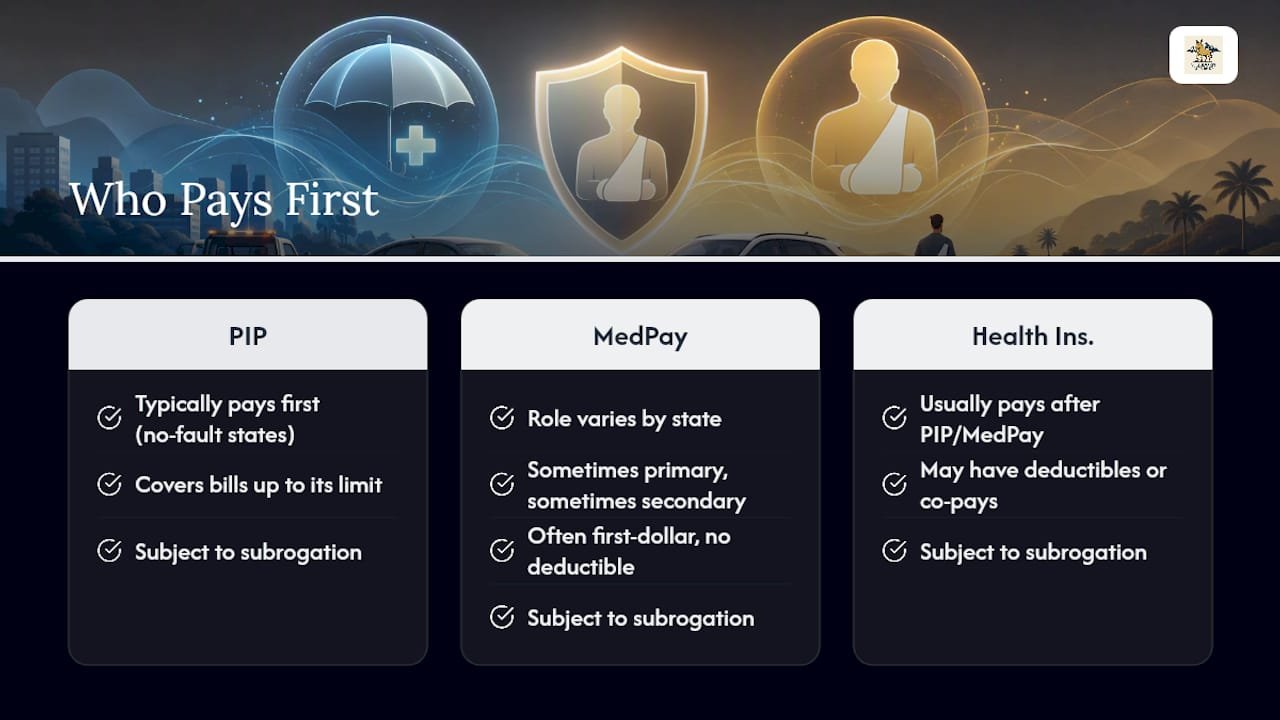
Payment order depends on your state and your policy, but a few patterns hold. In no-fault states, PIP typically pays first, ahead of your health insurance, covering bills up to its limit before anything else kicks in. MedPay’s role varies more: some states treat it as primary, paying immediately regardless of other coverage, while others treat it as secondary, filling gaps after health insurance pays its share. AAA notes that MedPay often pays first-dollar with no deductible, which is exactly why it’s useful even when you have solid health insurance.
Subrogation is where things get complicated. If your PIP or MedPay insurer pays your bills and you later win a settlement from the at-fault driver’s insurer, your own insurer can demand repayment for what it already covered. This is standard practice, not a gotcha, but it catches people off guard when a settlement check arrives smaller than expected.
Keep every medical bill, pay stub, and repair invoice tied to the accident. Clean documentation is what separates a smooth reimbursement from a repayment dispute that drags out for months. For more on managing the billing side while claims are pending, Stubbornattorney’s guide on paying for medical treatment after a crash walks through the coordination process.
How Much Do MedPay and PIP Cost, and What Are Typical Limits?
Pro Tip: If you’re on a high-deductible health plan, a small MedPay policy can quietly save you hundreds of dollars the moment you need an ambulance ride or an ER visit.
MedPay limits usually run from $1,000 to $10,000, with $5,000 being a common middle-ground choice for drivers who want meaningful protection without paying for a policy they’ll rarely max out. PIP minimums in no-fault states tend to run higher, since the coverage has to stretch across medical bills, wage replacement, and household services rather than medical costs alone.
Cost-wise, MedPay is cheap. Premiums often land between $20 and $80 a year depending on the limit you choose, which makes it one of the lowest-cost additions on a typical policy. PIP costs more because it insures more, and the exact premium depends on your state’s mandated minimum, your chosen limit, and how your insurer prices wage-replacement risk.
The deductible behavior is the real dividing line. MedPay commonly pays first-dollar, no deductible required. PIP, depending on the state, sometimes carries a deductible or a percentage copay on medical expenses, which changes how much cash you’ll front before benefits kick in.
How Do I Decide Between MedPay and PIP for My Situation?
Work through these questions in order, and the right answer usually becomes obvious by the third one:
- Am I in a state that requires PIP? If yes, you’re keeping it regardless of what else you decide. If no, you’re free to weigh MedPay on its own merits.
- How strong is my health insurance? A plan with a $6,000 deductible makes MedPay or robust PIP far more valuable than a plan with a $500 deductible and low copays.
- Do I need wage replacement? If missing two weeks of work would strain your finances, PIP’s income benefit matters more than MedPay’s medical-only scope.
- Do I regularly carry passengers? MedPay and PIP both typically extend to passengers in your car, which matters if you carpool, drive for a rideshare service, or shuttle family members often.
For most drivers outside mandatory-PIP states, a sensible stack looks like this: state-minimum liability, uninsured/underinsured motorist coverage sized to your assets, and a MedPay policy around $5,000 to catch immediate medical costs your health insurance won’t. If you’re in a PIP state, don’t downgrade your PIP limit just to save a few dollars a month. The wage-replacement piece alone often outweighs the premium difference. For a broader rundown of how these layers fit together, Stubbornattorney’s full guide to auto insurance types is worth reading before you finalize a policy.
What To Do After a Crash, and When To Call a Lawyer
Document everything immediately: medical visits, missed workdays, receipts for household help you had to pay for, and every letter your insurer sends you. Insurers often require strict, contemporaneous proof before releasing wage-replacement benefits under PIP, and thin documentation is the single biggest reason legitimate claims get delayed or denied.
- Report the crash to your insurer promptly, but don’t sign a liability release before understanding what it waives.
- Track every out-of-pocket cost tied to the accident, no matter how small it seems.
- If wage-replacement or subrogation demands are disputed, get documentation before responding.
Call an attorney when your insurer denies a claim, when a subrogation demand eats into a settlement you’re counting on, or when liability is contested alongside significant wage loss. Ryan Malnar’s background as a former federal claims adjudicator means he’s evaluated claims from the inside, which is exactly the perspective that helps when an insurer’s math doesn’t add up. For a structured way to protect your claim from day one, Stubbornattorney’s 10-step guide to strengthening injury claims is a solid starting point.
Why Coverage Choices Matter More Than People Think
Having sat on the insurance side of claims before practicing law, I’ve watched too many injured drivers assume their coverage would simply “handle it.” The gap between what a policy promises on paper and what actually gets paid out often comes down to a documentation detail nobody warned them about, or a subrogation clause buried in a policy they never read closely. Getting MedPay and PIP right before an accident happens is the cheapest insurance decision you’ll make all year.
— Ryan
Get Help With a Disputed PIP or MedPay Claim
If your insurer is fighting over subrogation, delaying a wage-replacement payment, or arguing about which policy should have paid first, that’s a fight worth having with backup. Stubbornattorney has spent years untangling exactly this kind of dispute across Colorado, drawing on Ryan Malnar’s experience evaluating claims from the insurer’s side before he ever represented injured drivers against them. That inside knowledge is the concrete edge you get here: someone who knows how adjusters build their denial before they send it.
If a PIP or MedPay claim has stalled, been denied, or triggered a subrogation demand that feels wrong, Stubbornattorney’s personal injury team offers a free case review to walk through what you’re owed and what your insurer is required to pay.
Sources
- Insurance
- Med Pay Insurance | What It Covers vs PIP | Insurance Geek
- Medical payments coverage vs personal injury protection | AAA/ACE
- PIP vs MedPay Insurance: The Complete 2026 Driver Guide
Always confirm current mandates with your own state’s insurance department, since minimum limits and opt-out rules change.
FAQ
Is PIP better than MedPay?
PIP offers broader protection because it covers lost wages and household services on top of medical bills, but MedPay is cheaper and often pays faster with no deductible. Which is “better” depends on whether your state requires PIP and how strong your health insurance already is.
Can you have both MedPay and PIP?
In many states, yes, and stacking them can help cover gaps, though some insurers or states restrict duplicate medical coverage between the two. Check your policy and state rules before assuming both will pay independently.
Does Texas have PIP or MedPay?
Texas requires insurers to offer PIP, though drivers can reject it in writing, and MedPay is also available as an optional add-on. Texas is not a no-fault state, so neither coverage is strictly mandatory once a driver signs a rejection form.
Is MedPay worth it?
MedPay is worth it for most drivers, especially those with high-deductible health insurance, because it pays medical bills quickly with little to no deductible. At $20 to $80 a year for meaningful coverage, it’s one of the cheapest ways to avoid an unexpected ER bill.