

How to Write a Property Damage Demand Letter That Gets Paid
A property damage demand letter is a formal written request that tells a responsible party or their insurer exactly what happened, what it cost you, and what you expect them to pay by a specific date. Send it once you have contemporaneous evidence, at least two independent repair estimates, and a clear dollar figure. Set the response deadline at a reasonable time frame typically between two and four weeks and keep the tone professional and firm, never angry.
Before you write a word, do this:
- Photograph the damage from multiple angles, with a timestamp, before any repairs begin.
- Get two independent repair estimates from licensed contractors or shops.
- Pull any incident, police, or inspection report tied to the event.
Quick fact: Letters that pair a firm deadline with two independent estimates are harder for an insurer to argue down, since there’s no ambiguity about the number or where it came from.
Table of Contents
- What Is a Property Damage Demand Letter and Why Send One?
- When Should You Send a Demand Letter for Property Damage?
- What Should a Property Damage Demand Letter Include?
- Property Damage Demand Letter Template You Can Copy
- How Do You Calculate Damages for a Demand Letter?
- How Should You Send a Property Damage Demand Letter?
- What Happens After You Send the Demand Letter?
- Why Structure and Evidence Change the Outcome
- Sources
- FAQ
What Is a Property Damage Demand Letter and Why Send One?
A property damage demand letter is a written, dated record that puts a responsible party or insurer on formal notice of a claim and a specific dollar amount owed. It’s not a lawsuit. It’s the step before one, and in some states, a required one. Courts and insurers treat it as documentation that you attempted a good-faith resolution, which matters if the case later moves to small claims or litigation.
You’ll reach for this letter in situations like:
- A neighbor’s tree falls on your fence or roof after prior warning signs.
- A contractor damages flooring, drywall, or landscaping during a job.
- A driver hits your parked car, fence, or mailbox.
- Water intrusion from a shared wall, pipe, or upstairs unit ruins your belongings.
- A tenant causes damage beyond normal wear and tear.
A well-built demand letter does three things at once: it documents your claim on paper, it prompts the other side (or their carrier) to actually respond instead of stalling, and it tends to improve your settlement odds because it shows you’re organized enough to go further if ignored.
When Should You Send a Demand Letter for Property Damage?
You’re ready to send once you can check off three things: you have dated photos and any relevant incident report, you’ve collected at least two repair estimates, and you know exactly who’s responsible (a person, a business, or an insurer). If you’re missing any of those, wait. A letter built on a guess at cost invites a lowball counteroffer.
- Confirm the responsible party and, if applicable, their insurance carrier and claim number.
- Check your state’s small claims rules. Some jurisdictions require a written demand before filing suit.
- Note your state’s statute of limitations for property damage claims. It varies widely, and evidence degrades fast. Broken items get discarded, memories fade, and witnesses move.
If an insurer already denied your claim, resolve any internal appeal steps first, then use the demand letter to formally reassert your position with new or organized evidence.
What Should a Property Damage Demand Letter Include?
The strongest demand letters read like a short legal memo, not an angry email. Every fact should be checkable, and every dollar should trace back to a document you’re enclosing.
Cover these elements, in this rough order:
- Header and identifying info: your name, address, phone, date; the recipient’s name and address; the property address; and the date of the incident.
- Incident description: a plain, factual account of what happened, when, and where. No hedging, no exaggeration.
- Legal rationale, when relevant: reference negligence or constructive notice, meaning the responsible party knew or should have known about a hazard (a rotting tree, a leaking pipe) before it caused damage.
- Itemized damages: a clear breakdown supported by independent repair estimates.
- Demand amount: one precise number, not a range.
- Deadline: 14 to 30 days is standard, depending on the complexity of the claim.
- Stated consequence: what happens if the deadline passes, such as filing in small claims court or escalating an insurer complaint.
- Enclosures list: dated photos, both estimates, receipts, any incident or police report, and professional inspection reports (arborist, contractor, engineer).
Pro Tip: Number your enclosures and reference them by number inside the letter (“see Enclosure 3, roofing estimate”). It makes the letter easy to verify and much harder to dismiss as vague.
Keep the language calm and specific. Skip words like “outrageous” or “unacceptable.” A letter that reads like it was written by someone in control of the facts gets taken more seriously than one that reads like a complaint.
Property Damage Demand Letter Template You Can Copy
Here’s a full template built around the standard sections practitioners use, adapted from formats like the sample layout published by the City of Jackson.
[Your Name]
[Your Address, City, State, ZIP]
[Date][Recipient Name / Insurance Company]
[Recipient Address]
RE: Demand for Payment — Property Damage at [Property Address], Incident of [Date]Dear [Name / Claims Adjuster],
On [date], [brief factual description of what happened and how it caused damage to your property]. [One or two sentences establishing responsibility, including prior notice if applicable.]
As documented in the enclosed estimates and photographs, the total cost to repair this damage is $[amount]. This figure reflects two independent estimates (Enclosures 2 and 3) along with receipts for incidental costs (Enclosure 4).
I am requesting payment of $[amount] within [14–30] days of the date of this letter. If I do not receive payment or a response by [specific date], I will pursue this matter through [small claims court / my insurance carrier / further legal action].
Please contact me at [phone/email] to discuss resolution.
Sincerely,
[Signature]
[Printed Name]Enclosures: (1) Incident report, (2) Repair estimate A, (3) Repair estimate B, (4) Receipts, (5) Photographs
A worked example: one widely cited case involved a tree from a neighbor’s yard falling onto a fence and a parked car, with the letter documenting a total of $6,200 (including fence repair and vehicle damage estimates), backed by two estimates and a prior notice the homeowner had sent about the tree’s condition months earlier.
Before sending:
- Attach estimates as separate documents, not summarized in the letter body.
- Photocopy or scan everything, and keep a full set for yourself.
- Note the date you send it and how (more on that next).
How Do You Calculate Damages for a Demand Letter?
Add up every cost the damage actually caused, not just the obvious repair bill. That means repairs or replacement, emergency mitigation (a tarp, board-up, or water extraction), temporary storage or rental costs, lost use of the property, and any incidental expense tied directly to the incident.
- Repair or replacement cost (from your estimates)
- Emergency mitigation (tarps, boarding, pumping, cleanup crews)
- Storage, rental equipment, or temporary housing
- Lost use of the property or item
- Miscellaneous incidental costs (towing, disposal fees, replacement locks)
Two independent estimates matter because a single number is an opinion. Two matching or close numbers are evidence a carrier has to reckon with. Present them side by side in your letter, then state your demand as the higher of the two, or an average, whichever you can defend.
A simple line-item format works best:
- Fence repair (Estimate A, Enclosure 2): $3,400
- Vehicle repair (Estimate B, Enclosure 3): $2,800
- Towing fee (receipt, Enclosure 4): $150
- Total demand: $6,350
Pro Tip: Contemporaneous evidence, meaning photos and reports made right after the incident, carries far more weight than anything assembled weeks later. If you haven’t documented the damage yet, do it today, not after you’ve started repairs.
Round out your evidence file with dated photos, both estimates, receipts, any official incident report, witness statements if available, and prior notices you sent about a known hazard, which help establish constructive notice.
How Should You Send a Property Damage Demand Letter?
Send it in a way that proves delivery, not just that you wrote it. Certified mail with return receipt requested is the standard for a reason: you get a signed confirmation the letter arrived, and that receipt becomes part of your file if the matter escalates.
- Certified mail, return receipt requested: slower, but creates a signed paper trail.
- Tracked courier: fast, trackable, but usually more expensive.
- Email with read receipt: convenient for insurers who accept digital correspondence, but weaker as standalone proof.
- Insurer web portals: useful for logging the claim, but always keep an emailed or mailed copy too.
Address the letter to the at-fault party directly, their insurer if one is involved (include the claim number if you have it), or a landlord or contractor when the damage falls under their responsibility. Keep a sending log: date mailed, method, tracking number, and a copy of the signed receipt once it comes back.
What Happens After You Send the Demand Letter?
Most insurers acknowledge receipt within a week or two, open an investigation, and respond with either an offer, a denial, or a request for more documentation within 30 to 45 days. Individual parties without insurance often take longer, or don’t respond at all.
- If you get an offer: compare it against your itemized damages. A low offer often means the adjuster is missing an estimate or incidental cost. Resubmit with the gap clearly explained.
- If you hear nothing by your deadline: send one firm follow-up referencing the original letter and date sent, then proceed to small claims court or consult an attorney if the amount or complexity exceeds what you’re equipped to handle.
- If it’s denied outright: request the denial in writing and the specific reason. That reason often reveals exactly what additional evidence would change the outcome.
Why Structure and Evidence Change the Outcome
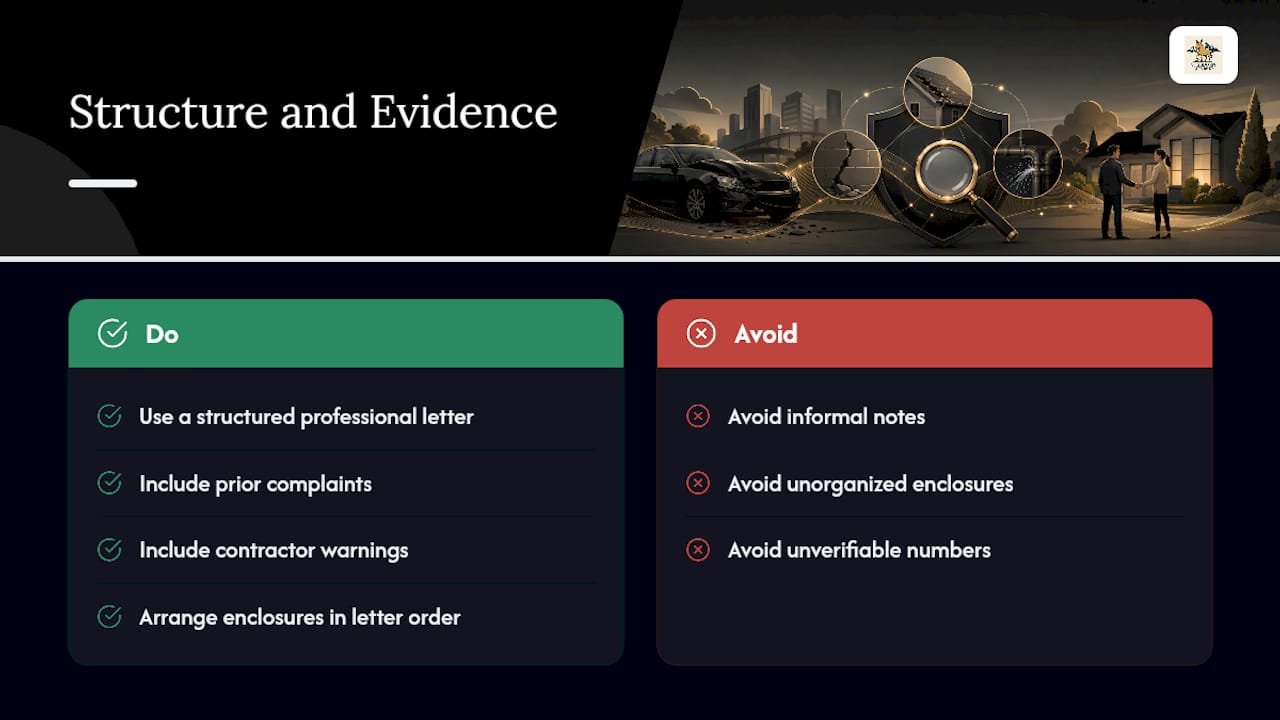
Constructive notice, the idea that a responsible party knew or should have known about a hazard before it caused damage, is often the single fact that decides liability. A prior complaint about an overhanging tree or a contractor’s ignored warning about a failing pipe does more work than any strongly worded sentence.
Pro Tip: Organize your enclosures in the same order you reference them in the letter. Adjusters and opposing parties are far less likely to dispute a number they can verify in ten seconds.
Practitioners who draft these letters for a living consistently note that a structured, professional letter backed by organized evidence moves faster toward settlement than an informal note, because it removes the guesswork the other side would otherwise use to stall.
Why contemporaneous evidence and two estimates matter
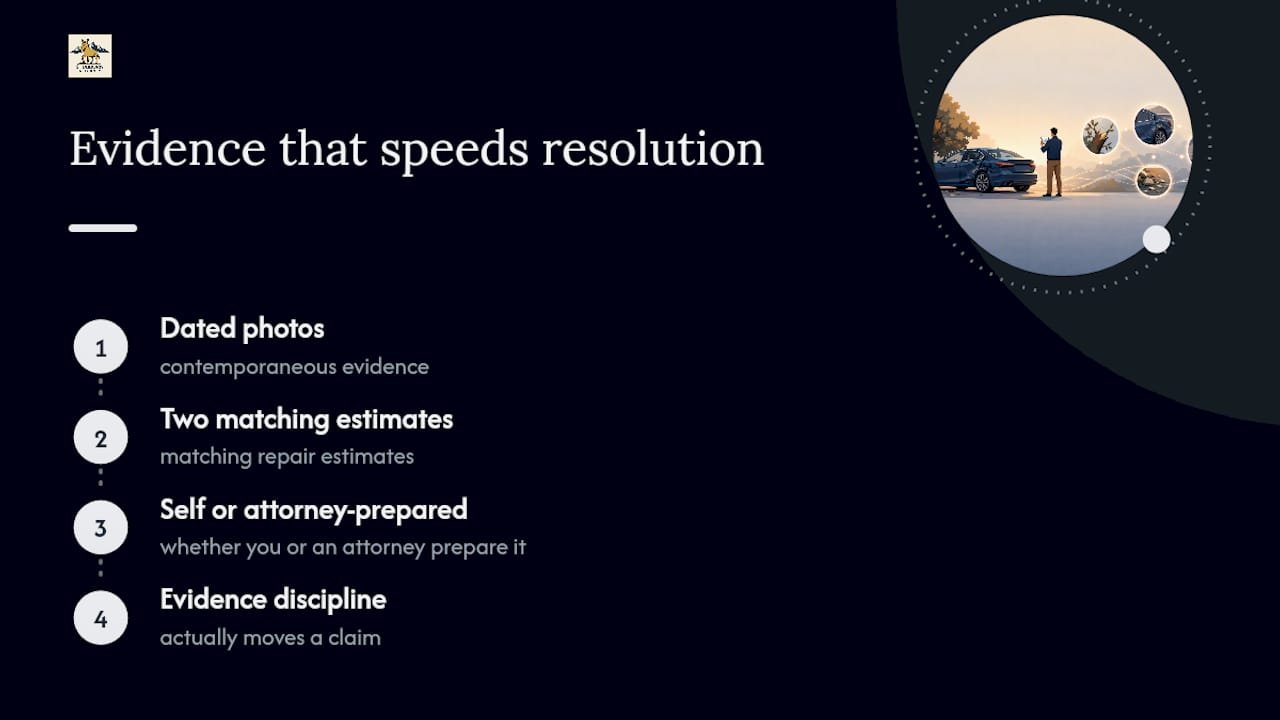
As a former claims adjudicator for the federal government, I’ve seen firsthand which letters get taken seriously and which get filed away. The pattern is consistent: letters with dated photos and two matching estimates get resolved faster. Whether you write the letter yourself or have it attorney-prepared, that evidence discipline is what actually moves a claim.
Get an Attorney-Prepared Demand Letter Instead of Guessing at the Numbers
A DIY letter works when the damage is straightforward and the other side is cooperative. When an insurer stalls, lowballs, or you’re not sure your evidence will hold up, Stubbornattorney’s personal injury and property claim team reviews your documentation, calculates a defensible demand figure, and drafts a letter carrying the weight of a law firm’s letterhead. Cases are handled on contingency, so there’s no upfront cost. If your claim involves a vehicle, contractor dispute, or an insurer that’s already denied you once, start with a free case review before your deadline to file runs out.
Sources
- Property Damage Demand Letter Example | FreeDemandLetter
- Docugov
- Demand Letter for Property Damage (Free Template) | JusticeDirect
- PropertyDamageDemandLetterSample.pdf
- Demand Letter for Property Damage | Trivent Legal
This article is general information, not a substitute for advice from a qualified lawyer. Consult a qualified legal professional about your own circumstances before acting on anything here.
FAQ
Is a Demand Letter Serious?
Yes. It’s a formal legal document that puts the recipient on notice of a specific claim and dollar amount, and it can be used as evidence of a good-faith settlement attempt if the case moves to small claims court or litigation.
What Should You Avoid Saying in a Demand Letter?
Skip threats, insults, exaggerated language, or admissions that weaken your position, like implying you contributed to the damage. Stick to verifiable facts, dates, and dollar amounts.
Can You Write Your Own Property Damage Demand Letter?
Yes, and many people do successfully for straightforward claims with clear evidence and cooperative insurers. If the insurer denies your claim or the damages are substantial, an attorney-prepared letter from a firm like Stubbornattorney often carries more weight and can be paired with a full case review.
How Long Does It Take to Settle After Sending a Demand Letter?
Insurers typically acknowledge a demand within one to two weeks and respond with an offer, denial, or request for more information within 30 to 45 days; individual parties without insurance can take longer or ignore it entirely.