

What to Do After an Accident: Protect Your Rights
After a crash, the most important post-accident actions are: move to safety, call 911, document everything, seek medical care within 24–72 hours, limit what you say, and notify your insurer promptly.
- Move to safety and turn on hazard lights
- Call 911 and request police and paramedics if anyone is hurt
- Photograph damage, license plates, road conditions, and injuries
- Exchange contact and insurance details only — no apologies, no fault discussions
- Get medical attention even if you feel fine
- Notify your insurer the same day; avoid recorded statements to the other driver’s insurer
The single biggest mistake injured people make is waiting. Waiting to see a doctor, waiting to call a lawyer, waiting to notify their insurer. Every delay gives the other side more room to dispute your injuries, your version of events, and your claim’s value.
The sections below walk through each step in order, from the first 15 minutes through the first week.
Table of Contents
- What are the most important post-accident actions at the scene?
- How to document the accident scene thoroughly
- What information should you exchange — and what should you keep to yourself?
- Should you call police, and how do you get the police report?
- Why you need medical attention fast — and how to document it
- How to notify your insurer and handle towing and rental logistics
- How to protect your claim after you leave the scene
- Common mistakes that can weaken your claim
- Your post-accident timeline: first 15 minutes through the first week
- When should you contact a personal injury attorney?
- Why early actions carry so much weight with insurers and attorneys
- The one rule we give every client after a crash
- Stubbornattorney can help you protect your claim from day one
- Sources
- FAQ
What are the most important post-accident actions at the scene?
Life and safety come first. Property and evidence come second, and only when it is safe to address them.
Before anything else, check yourself and your passengers for injuries. If your vehicle is drivable and staying put creates a hazard, move it to the shoulder or a nearby parking lot. Turn on your hazard lights immediately. If anyone is seriously hurt, do not move them unless there is an immediate danger like fire or oncoming traffic.
Call 911 even for what looks like a minor crash. Police presence creates an official record, and paramedics can assess injuries that adrenaline is masking. When you speak to the dispatcher, state your location clearly, describe any visible injuries, and let them determine whether to send an ambulance. NHTSA’s post-crash guidance also covers specific safety steps for occupants, including what to do with child car seats after a collision.
Pro Tip: Place road flares or warning triangles at least 100 feet behind your vehicle if you have them. This protects the scene and everyone in it without creating any legal exposure for you.
How to document the accident scene thoroughly
Scenes clear fast. Tow trucks arrive, rain washes away skid marks, and witnesses walk off. Start photographing within the first few minutes if it is safe to do so.

Accident photos are among the most persuasive pieces of evidence in any claim. According to Business Insider’s accident guide, photographs are crucial because scenes clear and memories fade — capture vehicle damage, license plates, road conditions, traffic controls, and visible injuries from multiple angles.
Minimum photo checklist:
- All four sides of every vehicle involved, including undercarriage damage if visible
- License plates of all vehicles
- Skid marks, debris, and fluid spills
- Traffic signs, signals, and road markings near the crash
- Your own visible injuries
- Wide-angle shots showing vehicle positions relative to each other and the road
- GPS screenshot or mile marker to establish exact location
Beyond photos, collect witness names, phone numbers, and a quick note about where each person was standing when the crash happened. A witness at the corner of an intersection saw something different than one who was parked across the street. That context matters later.
| What to capture | Details to include |
|---|---|
| Vehicle damage | All sides, close-up and wide-angle |
| License plates | All vehicles involved |
| Road conditions | Wet, icy, construction, potholes |
| Traffic controls | Signs, signals, lane markings |
| Injuries | Visible cuts, bruising, swelling |
| Witness info | Name, phone, location at time of crash |
What information should you exchange — and what should you keep to yourself?
Exchange the basics and nothing more. Progressive’s post-accident guidance is direct on this: share only names, addresses, phone numbers, and insurance information. Do not discuss how the crash happened, and do not apologize, even casually. Insurers treat apologies as admissions, and in states that use comparative fault rules, even a partial admission can reduce your compensation.
What to exchange:
- Full legal name and address
- Phone number
- Driver’s license number
- License plate number
- Insurance company name and policy number
What not to do: speculate about what caused the crash, say “I didn’t see you,” or offer any statement about speed or road conditions. These details belong in a formal statement with your attorney present, not in a parking lot conversation.
Pro Tip: If the other driver’s insurer calls you before you have spoken with an attorney, you are not required to give them a recorded statement. A polite “I’ll be in touch through my attorney” is sufficient. Your own insurer is different — your policy likely requires prompt cooperation — but even then, stick to facts and avoid speculation.
Should you call police, and how do you get the police report?
Request police response whenever there are injuries, significant vehicle damage, a hit-and-run, or any dispute about what happened. An officer’s presence produces an official crash report, which serves as an objective third-party record. Business Insider’s guide notes that police reports are frequently foundational when insurers dispute the facts later.
Before the officer leaves the scene, get:
- The officer’s full name and badge number
- The report number (even a preliminary one)
- The name of the law enforcement agency handling the report
- An estimate of when the report will be available
Most police reports become available within 3–10 days. You can typically request a copy online through the responding agency’s records portal or in person at the station. Some jurisdictions charge a small fee.
State DMV reporting rules add another layer. Many states require drivers to file a separate accident report with the DMV when injuries occur or when property damage exceeds a set dollar threshold, and deadlines can be as short as 10 days. The North Carolina Department of Insurance’s post-accident guide illustrates how state-specific these rules are. Check your own state’s DMV website or ask your attorney to confirm the deadline that applies to you.
A police report does not determine who wins a claim, but it shapes the entire conversation. An officer’s documented observations about road conditions, vehicle positions, and driver statements carry weight that no after-the-fact account can replicate.
Why you need medical attention fast — and how to document it
Adrenaline is a powerful pain blocker. You can walk away from a serious crash feeling fine and wake up two days later unable to turn your neck. Prompt medical evaluation within 24–72 hours is advised because symptoms like whiplash can appear later, and early medical records make it significantly harder for insurers to argue that your injuries came from something unrelated to the crash.
Go to the ER if you have head pain, loss of consciousness, numbness, chest pain, or any symptom that feels serious. Urgent care works for moderate symptoms. Your primary care physician is appropriate for a follow-up or for documenting injuries that are present but not emergencies. If imaging or specialist referral is recommended, follow through — gaps in treatment give insurers a reason to question the severity of your injuries.
Document everything: keep every bill, every provider note, every prescription receipt. Start a daily log noting your pain level, what activities you cannot do, and how your symptoms change. That log becomes evidence of how the crash affected your daily life.
Pro Tip: Tell every medical provider that your symptoms are the result of a motor vehicle accident. Keep it factual and consistent. This creates a clear causal record from day one — something insurers look for when evaluating claims.
How to notify your insurer and handle towing and rental logistics
Call your insurer the same day as the crash. Stick to the facts: time, location, vehicles involved, and whether anyone was injured. Most policies include a prompt-notice requirement, and failing to report quickly can complicate your claim. Progressive’s guidance notes that insurers may require documentation and that keeping a file of all bills, repair estimates, and related expenses strengthens your position.
What to tell your insurer:
- Date, time, and location of the crash
- Names and insurance information of other parties
- A factual description of what happened (no speculation)
- Whether you were injured and sought medical care
For your vehicle, document towing and storage costs from the start. Get at least one written repair estimate, and keep every receipt. If your policy includes rental coverage, confirm the daily limit and how many days are covered before you book anything. If the other driver is at fault, their liability coverage may pay for your rental, but that process can take time — your own collision coverage or rental endorsement may be faster.
How to protect your claim after you leave the scene
Keep every document in one place: photos, medical bills, repair estimates, towing receipts, prescription costs, and any written communication with insurers. A single folder, physical or digital, prevents things from getting lost when you need them months later.
Social media is a real threat to claims. Insurers and opposing counsel routinely monitor public profiles. A photo of you hiking, a post about feeling better, or even a comment that seems unrelated can be used to challenge the severity of your injuries. Set your accounts to private and avoid posting anything about the accident or your physical condition until your claim is resolved.
Surveillance footage disappears fast. Businesses typically overwrite security camera footage within 24–72 hours. If the crash happened near a gas station, restaurant, or intersection with a traffic camera, note those locations immediately.
Pro Tip: Send a written request to nearby businesses asking them to preserve any footage from the time of the crash. Do this within 24 hours. An attorney can send a formal preservation letter, which carries more weight — but acting quickly on your own is better than waiting.
For a detailed evidence checklist, this guide on gathering accident evidence covers what to collect and how to organize it.
Common mistakes that can weaken your claim
- Admitting fault at the scene. Even “I’m sorry” can be treated as an admission. Stick to exchanging information.
- Delaying medical care. A gap between the crash and your first doctor visit gives insurers room to argue your injuries happened elsewhere.
- Giving a recorded statement to the at-fault driver’s insurer. Per the California Department of Insurance, you are not required to do this, and adjusters sometimes use early statements to minimize reported injury severity.
- Posting on social media. Anything public can be used against you.
- Losing track of receipts and witnesses. Witness contact information and expense records are time-sensitive — collect and store them immediately.
- Accepting a quick settlement. Early offers often come before the full extent of injuries is known. Once you sign a release, you cannot reopen the claim.
Your post-accident timeline: first 15 minutes through the first week
| Time window | Priority actions |
|---|---|
| First 15 minutes | Move to safety, hazard lights on, call 911, check for injuries, begin photographing |
| First hour | Exchange information, collect witness contacts, get officer name and report number |
| Within 24 hours | Notify your insurer, seek medical evaluation, preserve surveillance footage |
| First few days | Follow up with a doctor if symptoms develop, organize all documents and receipts |
| First week | Obtain police report, get repair estimates, follow up on medical care, consult an attorney |
| State DMV deadline | File any required state accident report (varies by state — often 10 days for injuries) |
State reporting deadlines vary significantly. Some states require a DMV report only when injuries occur or damage exceeds a threshold; others require it for any crash. Check your state’s DMV website or the legal timeline guide to confirm what applies to you.
When should you contact a personal injury attorney?
Contact an attorney when injuries are more than minor, when fault is disputed, when multiple vehicles or parties are involved, or when an insurer makes a quick settlement offer. Quick offers almost always undervalue a claim, especially before the full medical picture is clear.
An attorney can take immediate steps you cannot easily do alone:
- Send preservation letters to businesses and agencies holding surveillance footage
- Handle all communication with the at-fault driver’s insurer
- Advise you on recorded statements and what not to sign
- Gather witness statements while memories are fresh
- Estimate the full value of your claim, including future medical costs
Most personal injury attorneys, including Stubbornattorney, work on a contingency fee basis. You pay nothing unless there is a monetary recovery. That structure means early legal consultation costs you nothing and can protect you from mistakes that are hard to undo. For guidance on when to hire an automobile accident attorney, the answer is usually: sooner than you think.
Why early actions carry so much weight with insurers and attorneys
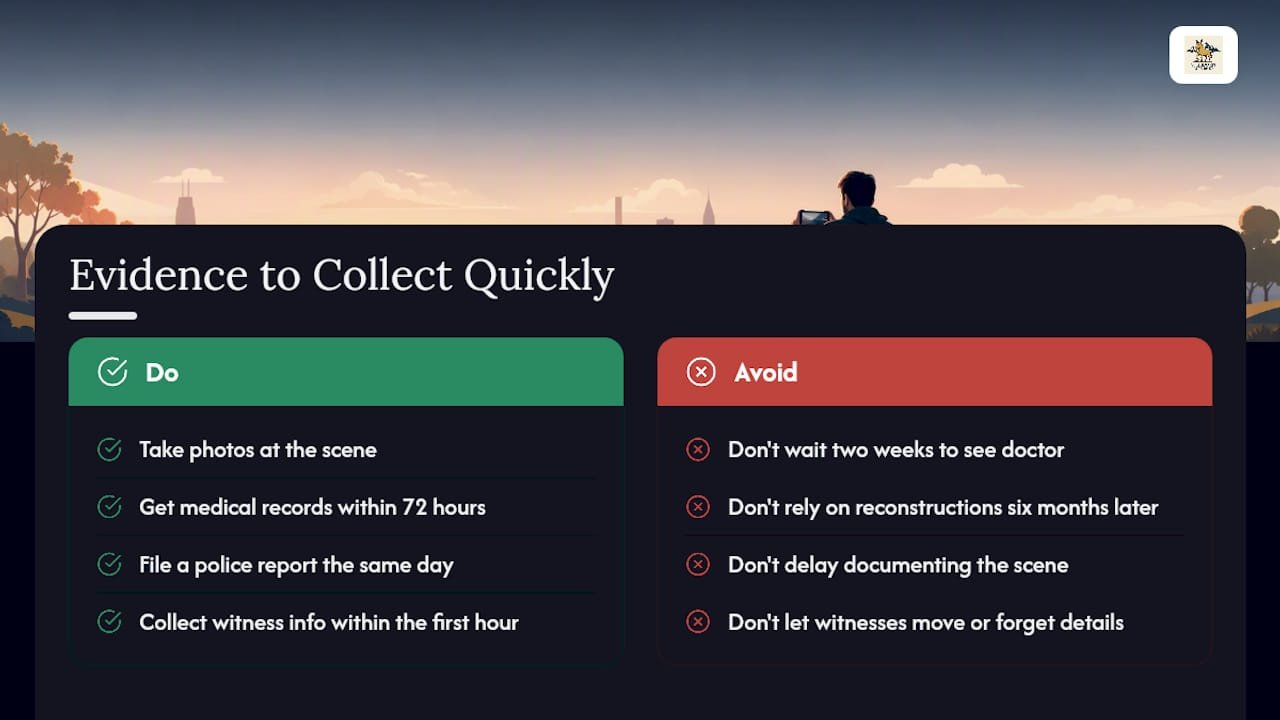
Insurers evaluate claims by looking at the quality and timing of evidence. Contemporaneous documentation — photos taken at the scene, medical records from within 72 hours, a police report filed the same day — carries far more weight than reconstructed accounts assembled weeks later. Business Insider’s step-by-step guide reinforces that police reports, photos, and witness statements reduce disputes and strengthen claim valuation.
The causal link between a crash and an injury is the central battleground in most personal injury claims. Early medical records establish that link. A two-week gap between the crash and your first doctor visit gives an adjuster a credible argument that something else caused your symptoms.
The value of a claim is not just about what happened — it is about what you can prove, and when you can prove it. Contemporaneous evidence collected in the first hours after a crash is worth more than the best reconstruction money can buy six months later.
Pro Tip: Lock down witness contact information within the first hour. People move, change numbers, and forget details quickly. A text message to a witness confirming their contact info creates a record that their information was accurate at that moment.
Acting quickly after a crash is not just about following a checklist. It is about why speed matters to the outcome of your case.
The one rule we give every client after a crash
After more than a decade representing injured people in Colorado, the rule is simple: protect your health first, your evidence second, and your words carefully throughout.
Ryan Malnar, founder of Stubbornattorney (Malnar Injury Law), has spent years on both sides of these claims — as a personal injury attorney and as a former federal claims adjudicator. That background makes one thing clear: the clients who fare best are the ones who got medical care quickly, documented thoroughly, and did not try to negotiate with the other driver’s insurer on their own. Colorado’s comparative fault rules mean that anything you say at the scene or in an early recorded statement can be used to reduce what you recover. The steps in this guide exist to prevent that.
Stubbornattorney can help you protect your claim from day one
When you are hurt in a crash, the gap between what you deserve and what an insurer offers often comes down to how well your claim was built in the first 72 hours. Stubbornattorney (Malnar Injury Law) steps in immediately: preserving evidence, handling insurer contact, and advising you on every statement before you make it.
Ryan Malnar’s background as a former federal claims adjudicator means he knows exactly how large insurers evaluate injury claims — and where they look for reasons to pay less. The firm works exclusively for injured victims on a contingency fee basis, meaning no fees unless there is a recovery.
Start with a free case evaluation to understand what your claim is worth and what steps to take next. You can also review 10 steps to strengthen your injury claim to see exactly how an attorney-guided approach changes outcomes.
Sources
- What to Do After a Car Accident: a Step-by-Step Guide | Business Insider
- Car seat use after a crash | NHTSA
- What to Do After a Car Accident | Progressive
- So you’ve had an accident, what’s next? | California Department of Insurance
FAQ
What are the most important steps to take right after an accident?
Move to safety, turn on hazard lights, call 911, photograph the scene, exchange contact and insurance information only, seek medical care within 24–72 hours, and notify your insurer the same day. Avoid admitting fault or giving recorded statements to the other driver’s insurer.
What should you never do after a car accident?
Never admit fault, apologize, or speculate about what caused the crash. Do not give a recorded statement to the at-fault driver’s insurer, post about the accident on social media, or accept a quick settlement before your injuries are fully evaluated.
What should you not tell your insurance company?
Stick to the basic facts: time, location, vehicles involved, and whether you were injured. Avoid speculating about fault, estimating speeds, or making statements about what you did or did not see. Recorded statements can be used to limit your claim, so consult an attorney before giving one even to your own insurer if injuries are significant.
When should you contact a personal injury attorney after a crash?
Contact an attorney as soon as injuries are more than minor, fault is disputed, multiple parties are involved, or an insurer makes a quick settlement offer. Early legal help preserves evidence, prevents damaging statements, and typically costs nothing upfront under a contingency fee arrangement.
How do you get a copy of the police report after an accident?
Get the officer’s name, badge number, and report number before they leave the scene. Most reports are available within 3–10 days through the responding agency’s online records portal or in person at the station. Your attorney can also request it on your behalf.
This article provides general information about post-accident steps and is not a substitute for legal advice. Laws and reporting requirements vary by state. Consult a qualified personal injury attorney to understand your rights and obligations in your specific situation.