

When to Contact a Lawyer: Situations and Timing Guide
Contact a lawyer immediately if you’ve been arrested, served with legal papers, seriously injured, or are facing a deadline on a lawsuit or government notice. For major contracts, contested divorce or custody, estate matters, eviction, or employment disputes, you should reach out within days, not weeks. The American Bar Association identifies these as the situations where early legal advice most often prevents irreversible harm.
First steps to take right now:
- Preserve all evidence: photos, texts, emails, contracts, and medical records
- Gather every document related to the matter (court papers, notices, correspondence)
- Write down a timeline of events while details are fresh
- Do not give detailed statements to the other party, their insurer, or investigators
- If arrested, say nothing beyond your name and invoke your right to counsel immediately
- Call a lawyer before your first court date, response deadline, or insurance statement
Pro Tip: Attorney-client confidentiality begins the moment you speak with a lawyer, even during a free initial consultation. You can share everything honestly without fear that it will be used against you. Many attorneys offer free 20–45 minute consultations, so there’s rarely a reason to delay that first call.
Table of Contents
- When to contact a lawyer: the most common situations
- How to prepare for your first lawyer consultation
- When handling it yourself is reasonable (and when it isn’t)
- What lawyer consultations and legal fees actually cost
- How to choose the right lawyer for your situation
- A personal injury lawyer’s view: when waiting costs you the case
- Why early contact with a lawyer protects you
- Useful resources for finding legal help
- Injured in Colorado? Stubbornattorney fights for what you’re owed
- Sources
- FAQ
When to contact a lawyer: the most common situations
Not every legal problem demands the same urgency. Some require a call within hours. Others give you a few weeks to plan. Knowing which category your situation falls into can be the difference between a strong position and a missed deadline.
The framework below, supported by practical decision guidance, organizes scenarios by urgency: call now, call soon, or plan ahead.
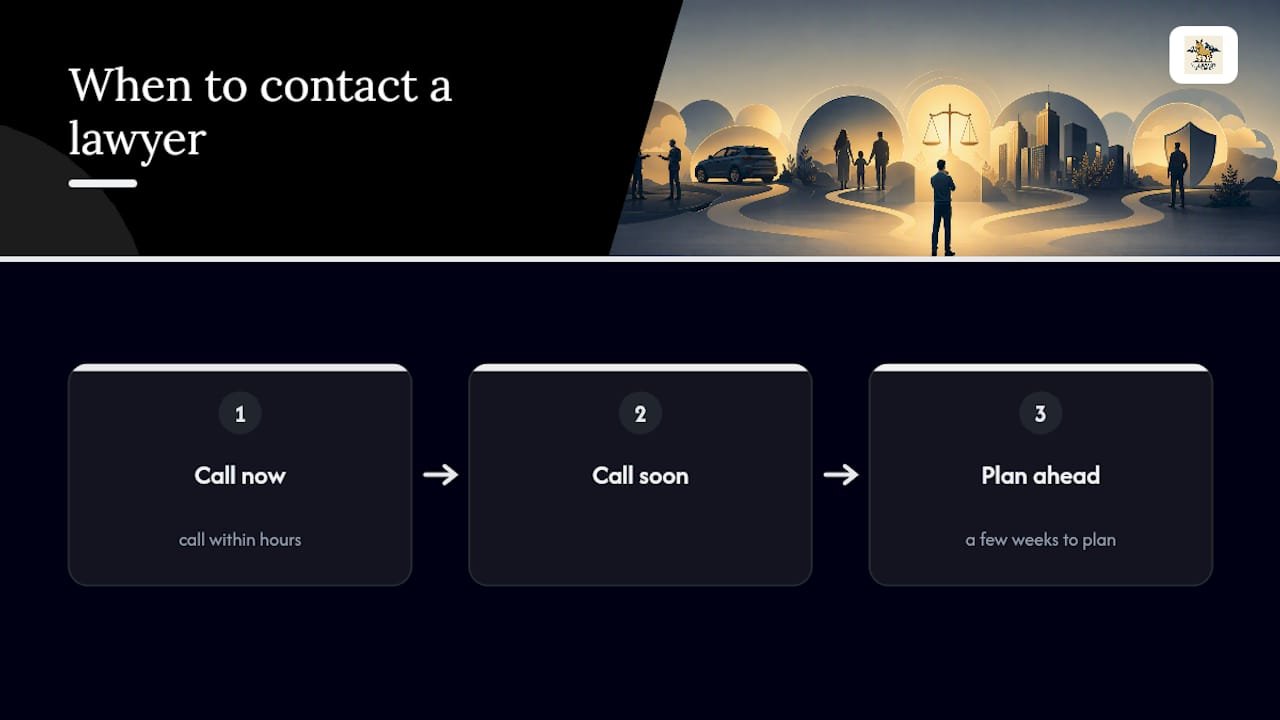
Call now (hours to days)
Criminal arrest or investigation. If police have arrested you, named you as a suspect, or asked you to “come in and talk,” stop. Contact a criminal defense lawyer before answering any questions. Anything you say can and will be used against you. The right to counsel is not a formality.
Being sued or served with legal papers. A summons or complaint typically gives you a few weeks to respond. Miss that window and the court may enter a default judgment against you, meaning the other side wins automatically. Call the day you receive papers.
Serious personal injury. If you’ve been hurt in a car crash, truck accident, slip and fall, or workplace incident and you needed medical treatment, contact an attorney before speaking with any insurance adjuster. Insurers move fast. Evidence disappears. Signs you need a personal injury attorney include disputed liability, significant medical bills, or lost wages.

Imminent statutory deadlines. Every state sets a statute of limitations on lawsuits. In Colorado, most personal injury claims must be filed within three years of the injury. Miss it and your claim is gone, regardless of how strong it was.
Government notices or administrative hearings. An IRS audit letter, a notice from a licensing board, or a deportation hearing notice all carry hard deadlines. The government has counsel. You should too.
Call soon (days to weeks)
Contested divorce or custody. If both parties agree on everything, you may have options. The moment one side disputes assets, support, or parenting time, you need representation. Courts make permanent orders that are difficult to modify later.
Eviction or foreclosure. A landlord’s notice to quit or a lender’s notice of default starts a legal clock. Tenants and homeowners often have more rights than they realize, but only if those rights are asserted on time.
Employment disputes. Wrongful termination, wage theft, harassment, or discrimination claims have filing deadlines with the EEOC and state agencies, often within several months from the incident. Waiting costs you options.
Landlord-tenant disputes beyond a security deposit. Habitability issues, illegal lockouts, or retaliation claims involve specific statutory procedures. A misstep in how you document or respond can undermine an otherwise valid claim.
Plan ahead (weeks to months)
Major contracts or business transactions. Signing a commercial lease, partnership agreement, or acquisition document without legal review is a risk that tends to surface later, at the worst possible moment.
Estate planning and probate. A will, trust, or power of attorney drafted without counsel often contains gaps that create family conflict and court costs. Probate disputes are expensive; a well-drafted estate plan usually isn’t.
Family law matters without immediate conflict. Prenuptial agreements, uncontested adoptions, and name changes are lower urgency but still benefit from a one-time legal review to confirm the paperwork is airtight.
When the other side already has a lawyer, or when a government agency is involved, treat your situation as one tier more urgent than it might otherwise seem. Forbes Advisor notes that the long-term cost of not hiring a lawyer, in lost assets, damaged rights, or missed deadlines, often exceeds the cost of early advice.
How to prepare for your first lawyer consultation
A well-prepared consultation produces a clear answer in 30 minutes. An unprepared one produces a follow-up appointment. Here’s how to make the first meeting count.
Documents to bring
- Court papers, summonses, or government notices (bring originals and copies)
- Contracts, leases, or agreements related to the dispute
- Photos and videos of injuries, property damage, or the scene
- Medical records and bills, if injury is involved
- All correspondence: texts, emails, letters from the other party or their insurer
- A written timeline of events in chronological order
- Your insurance policy declarations page, if relevant
- Pay stubs or tax returns if lost income is at issue
The timeline is often the most useful thing you can prepare. Lawyers need to understand what happened, in what order, and when, before they can assess your position.
Questions to ask during the consultation
A good consultation is a two-way interview. These questions drive decisions rather than just producing information:
- What is the statute of limitations for my situation, and how much time do I have?
- What should I do in the next seven days to protect my position?
- Is there anything I should stop doing immediately?
- What are the realistic outcomes, best case and worst case?
- Do you handle cases like mine regularly, and what has the outcome typically been?
- Who in your office will actually work on my case day to day?
- What is your fee structure, and when do fees begin?
- Is a contingency arrangement available for my type of matter?
- What information do you still need from me to give a complete assessment?
- If I choose not to hire you, what should I do next?
Pro Tip: End the consultation with a decision question: “Based on what you’ve heard, what would you do if this were your situation?” A good lawyer will give you a direct answer. Vague non-answers at this stage are a signal worth noting.
Many attorneys offer free initial consultations that cover whether full representation is needed, what the near-term deadlines are, and whether a limited-scope or DIY approach is reasonable for your matter. Walk in knowing what you want to walk out with: a clear next step, not just general information.
When handling it yourself is reasonable (and when it isn’t)
Some legal matters genuinely don’t require a lawyer. Knowing which ones can save you money. Misjudging the line can cost you far more.
When DIY tends to be safe
- Small claims court for disputes under your state’s dollar threshold (typically $5,000–$10,000), where procedures are simplified and judges expect self-represented parties
- Straightforward security deposit disputes where the facts are clear, the amount is modest, and no lease clause is contested
- Simple uncontested divorce where both parties agree on all terms, there are no minor children, and assets are minimal
- Basic will or advance directive using a state-approved form, for uncomplicated estates with no blended family or business interests
- Routine traffic violations where the fine is the only consequence and no license suspension is at risk
The conditions that make DIY safe are consistent: low dollar stakes, clear procedures, no opposing counsel, and no statutory deadline that triggers irreversible consequences if missed.
Alternatives to full representation
Legal aid organizations serve income-eligible clients at no cost. The Legal Services Corporation funds programs in every state. If you qualify, this is full representation, not a watered-down version.
Limited-scope (unbundled) legal services let you hire a lawyer for one piece of the matter: drafting a document, reviewing a contract, or coaching you before a hearing. You handle the rest. This is a practical middle ground when full representation is cost-prohibitive.
Mediation works well for neighbor disputes, co-parenting conflicts, and some employment matters where both sides want to avoid court. A mediator doesn’t represent either party but can help reach a binding agreement.
Document preparation services can complete forms accurately but cannot give legal advice. They’re appropriate for routine filings where the legal question is already resolved.

FindLaw cautions that court rules and evidence procedures are unforgiving to self-represented parties in complex cases. The moment the other side has counsel, the stakes are material, or a statutory deadline is in play, DIY becomes a gamble with asymmetric downside.
Red flags that mean DIY is the wrong call
- The other party has hired an attorney
- Criminal charges or a government agency is involved
- The dollar amount or asset at stake is significant to your financial life
- Evidence must be preserved, collected, or presented under procedural rules
- You’ve already missed one deadline or received a default notice
- The matter involves children’s welfare or parental rights
What lawyer consultations and legal fees actually cost
Legal fees vary more than most people expect, and the structure matters as much as the rate.
Common fee models
For personal injury cases, contingency fees mean you pay nothing unless you recover money. The firm absorbs the cost of investigation, filing, and litigation. That model exists precisely because injured people shouldn’t have to pay upfront to access justice.
Consultation fees vary widely by state and practice area, with some attorneys charging nothing for an initial meeting and others billing at their standard hourly rate from the first minute. Many personal injury and criminal defense attorneys offer free consultations as standard practice.
How timing affects your options. A lawyer retained early can send preservation letters to secure surveillance footage, medical records, and witness statements before they disappear. The same lawyer retained six months later may find that footage overwritten, witnesses unavailable, and the insurer’s initial offer already declined. Early contact doesn’t just protect rights; it often produces better outcomes at lower total cost because the lawyer has more to work with.
If cost is a barrier, these options exist:
- Legal aid: free representation for qualifying low-income individuals (find your local program through the Legal Services Corporation)
- Public defender: available for criminal matters if you cannot afford private counsel
- Law school clinics: supervised student attorneys handle certain civil matters at no cost
- Limited-scope services: pay for only what you need
The role of legal consultation in personal injury cases goes beyond advice: it’s an early assessment of what your claim is worth and what evidence needs to be secured now.
How to choose the right lawyer for your situation
Choosing a lawyer is a hiring decision. Treat it like one.
Trust signals worth looking for
- Focused practice area that matches your matter (a personal injury lawyer for injury claims, a family law attorney for divorce)
- Active standing with the state bar (verify at your state’s bar association website)
- Clear explanation of who handles your case day to day, not just who signs the retainer
- Written fee agreement before work begins
- Responsive communication during intake — if they’re slow before you’re a client, expect the same after
Texas Law Help’s selection guidance recommends confirming practice focus, asking about fees and staff, and verifying that a written fee agreement will be provided before any work begins. That advice applies in every state.
Questions to ask before signing anything
- How many cases like mine have you handled in the past two years?
- Who will be my primary contact, and what is the typical response time?
- What triggers additional fees beyond the retainer or contingency?
- What is a realistic timeline for resolution?
- What outcome range should I expect, and what factors most affect it?
Which type of firm fits your matter
Solo specialist: Often the best fit for a focused, well-defined matter (one car accident, one employment claim). Lower overhead can mean more personal attention and competitive fees.
Boutique firm: A small firm with a narrow practice focus, say, personal injury or immigration, tends to have deeper procedural experience in that area than a general practice shop. Worth seeking when the legal issue is complex within a defined category.
General practice firm: Useful for clients with multiple overlapping issues (a business dispute that also involves employment and contract questions). The tradeoff is that depth in any single area may be shallower.
For choosing legal representation that wins, the single most important factor is whether the lawyer has handled your specific type of matter repeatedly, not just whether they are licensed to do so.
Red flags to walk away from
- Guarantees of a specific outcome (no ethical lawyer makes them)
- Vague or verbal-only fee arrangements
- Pressure to sign immediately without time to review
- No written engagement letter
- Difficulty reaching anyone during the intake process itself
A personal injury lawyer’s view: when waiting costs you the case
Ryan Malnar, founder of Stubbornattorney (Malnar Injury Law), has spent over a decade representing injured Coloradans and recovering millions in settlements. Before practicing law, he worked as a claims adjudicator for the federal government, which means he understands exactly how insurers and agencies evaluate claims from the inside.
Personal injury signals that mean call now
- You received medical treatment after the accident, even if you were discharged the same day
- The other driver, property owner, or employer is disputing fault
- An insurance adjuster has already contacted you and asked for a recorded statement
- Your injuries are affecting your ability to work, even temporarily
- A semi-truck, commercial vehicle, or government entity is involved (these cases have shorter notice deadlines and more complex liability chains)
- You were a pedestrian, cyclist, or motorcycle rider (injuries tend to be severe; insurers tend to minimize)
Pro Tip: Report the accident immediately and preserve everything. Quick accident reporting creates an official record that is far harder for an insurer to dispute than your word alone weeks later. Photograph the scene, your injuries, and any property damage before anything is moved or repaired.
For automobile accident cases specifically, the first 72 hours are when the most useful evidence exists: skid marks, surveillance footage, witness contact information, and the other driver’s initial statements. A lawyer retained in that window can send preservation letters that legally obligate parties to retain that evidence.
Why early contact with a lawyer protects you
Calling a lawyer early doesn’t commit you to litigation. What it does is preserve your options. A lawyer can tell you in a 30-minute consultation whether your matter is urgent, what your realistic exposure is, and whether you need full representation or just a document review. That information is worth more than the cost of the call in almost every situation where the stakes are real.
Attorney-client confidentiality means that first conversation is protected. You can be completely honest about what happened, including the parts that feel complicated, without any risk that the information leaves the room. That’s the point of calling first.
If you’ve been injured in Colorado and you’re not sure whether your situation warrants counsel, a free case evaluation is the lowest-risk way to find out. Stubbornattorney offers free personal injury case evaluations with no obligation and no upfront cost. You pay nothing unless we recover for you.
Useful resources for finding legal help
These sources give you direct access to referrals, fee benchmarks, and state-specific guidance:
- American Bar Association — When Do I Need a Lawyer?: The ABA’s public education resource lists common situations that warrant legal advice and explains how to find a lawyer through state bar referral programs.
- FindLaw — How to Determine if You Need a Lawyer: Practical self-triage guidance covering when DIY is reasonable and when it becomes risky, with links to attorney search tools.
- Contracts Counsel — Lawyer Consultation Fee Guide: State-by-state consultation fee examples to help you set realistic expectations before calling a firm.
- Legal Services Corporation: The federally funded network of legal aid organizations. Use their program locator to find free civil legal help if you meet income eligibility requirements.
- Your state bar’s lawyer referral service: Every state bar operates a referral program that matches you with a vetted attorney in the right practice area, often for a reduced-fee initial consultation. Search “[your state] bar association lawyer referral” to find yours.
- Stubbornattorney — Free Consultation Guide: What to expect during a free consult, how to prepare, and what questions to ask to get the most useful answer in the shortest time.
Injured in Colorado? Stubbornattorney fights for what you’re owed
If you’ve been hurt in a car, truck, motorcycle, bicycle, or pedestrian accident in Colorado, or suffered a slip and fall or workplace injury, Stubbornattorney (Malnar Injury Law) takes your case on contingency. You pay nothing unless we recover money for you.
Ryan Malnar and his team have settled hundreds of injury cases and recovered millions of dollars for Colorado victims. As a former federal claims adjudicator, Ryan knows how insurers evaluate claims and how to counter their tactics. That inside knowledge is what you get when you call.
Review common personal injury case types and outcomes to see whether your situation fits, then request a free case evaluation. There’s no obligation, no upfront cost, and the conversation is fully confidential. Call or submit your information online to get started.
This article is general information, not a substitute for advice from a qualified lawyer. Consult a qualified legal professional about your own circumstances before acting on anything here.
Sources
- When Do I Need a Lawyer? – American Bar Association
- Do I Need a Lawyer? — Forbes Advisor
- How To Determine if You Need a Lawyer – FindLaw
- When Do You Need a Lawyer? Decision Guide
- When Should I Talk to a Lawyer? – Canan Law
- How To Select a Lawyer | Texas Law Help
FAQ
When should you contact a lawyer?
Contact a lawyer immediately after an arrest, when served with legal papers, after a serious injury, or when facing a government notice with a hard deadline. For contracts, estate matters, and family law disputes, reach out within days rather than waiting weeks.
What are three common situations when you should see a lawyer?
The three most common triggers are a criminal charge or police investigation, a personal injury with medical treatment or disputed liability, and being served with a lawsuit or divorce petition. Each carries deadlines that, if missed, can permanently damage your legal position.
How do you know if you need a lawyer?
You likely need a lawyer if the other side has counsel, the financial or personal stakes are significant, a statutory deadline is approaching, or the matter involves criminal exposure. ProctorLaw’s guidance notes that received legal papers, serious injury, and major contracts are reliable signals to call.
How much does it cost to talk to a lawyer?
Many personal injury and criminal defense attorneys offer free initial consultations. For other practice areas, consultation fees vary by state and attorney, with paid consultations varying widely. Always ask about the fee before scheduling.
What happens if you wait too long to contact a lawyer?
Waiting can result in missed filing deadlines, lost evidence, default judgments, and a weakened negotiating position. In personal injury cases, surveillance footage is typically overwritten within days and witness memories fade quickly. Early contact preserves options; delay closes them.