

Accident Injury Reporting Process: 2026 Guide
The accident injury reporting process is the structured sequence of steps you must follow immediately after a car accident to document injuries and report the incident accurately for insurance and legal purposes. In legal practice, this process is formally called personal injury claim documentation, and it covers everything from your first call to 911 through the final submission of medical records to your insurer. Every step you take in the first 24–72 hours directly shapes whether your claim gets paid in full or disputed. This guide walks you through each phase, including the jurisdiction-specific traps that catch most accident victims off guard.
What are the first steps in the accident injury reporting process?
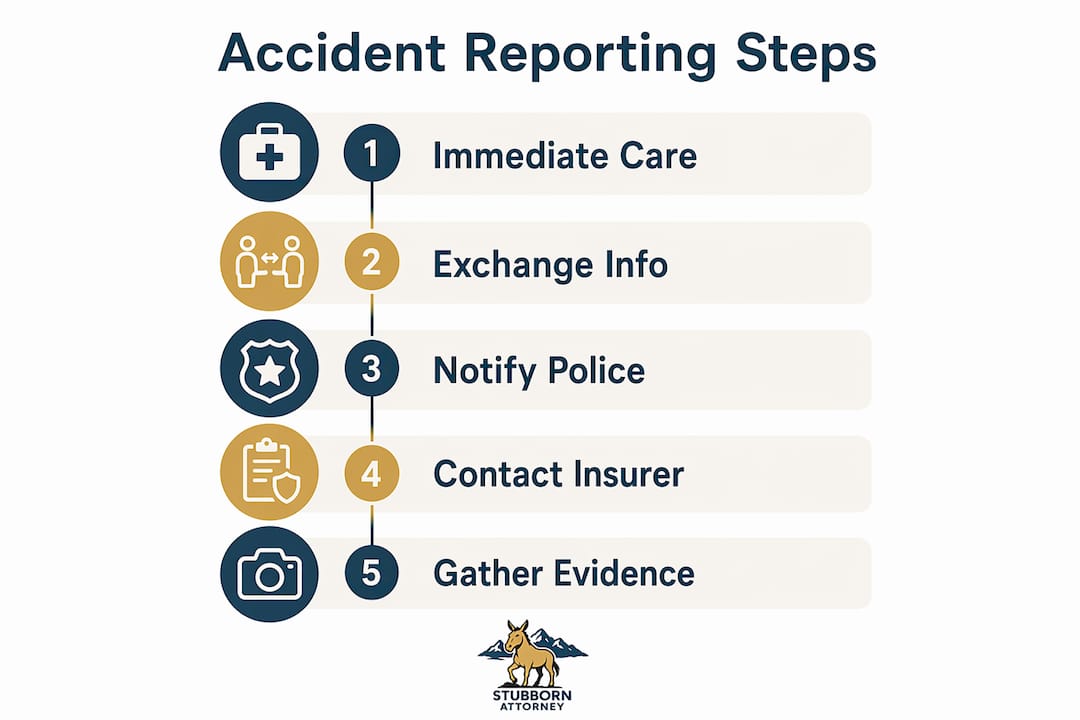
Immediate medical attention is the foundational first step after a car crash injury. Without a medical record created on the day of the accident, insurers can argue your injuries were pre-existing or unrelated to the crash. That single gap in timing has derailed thousands of otherwise valid claims.

Once you are safe and medical help is on the way, start building your evidence file at the scene. Your smartphone is your most powerful documentation tool in those first minutes.
Capture the scene thoroughly:
- Photograph all vehicle damage from multiple angles, including close-ups and wide shots showing road position
- Video the intersection, traffic signals, skid marks, and any road hazards
- Photograph your visible injuries immediately, and again in the days that follow as bruising develops
- Record the names, phone numbers, and addresses of all witnesses before they leave
- Note the exact time, weather conditions, and road surface condition
Exchange insurance cards, driver’s licenses, and vehicle registration information with every driver involved. Do not rely on memory. Photograph every document. When law enforcement arrives, ask the responding officer for the report number and the officer’s name and badge number. You will need both when you file your injury claim.
One rule applies to everything you say at the scene: stick to facts. Do not speculate about fault, apologize, or estimate your speed. Statements made at the scene can be used against you by the opposing insurer, and even a casual “I didn’t see you” can be framed as an admission.
Pro Tip: Take a short video narrating what you observe at the scene, including the time, location, and visible damage. A timestamped video is harder for an insurer to challenge than written notes made hours later.
How do you report a car accident to insurers and authorities?
Reporting your accident correctly means satisfying multiple, separate obligations. Most people assume a police report covers everything. It does not. You typically owe a report to your own insurer, the at-fault driver’s insurer, and in many states, a separate government agency.
Notifying your own insurance company
Notify your insurer as soon as possible after the accident, regardless of who caused it. Most policies require prompt notification as a condition of coverage. When you call, report factual details including the accident date, time, and location, the police report number, the names and insurance information of all drivers involved, and a brief, factual description of the collision. Provide photos and medical information as they become available. Do not speculate about fault or describe your injuries in terms of severity before you have a medical diagnosis.
State-specific reporting requirements
This is where many accident victims lose ground. The table below shows how reporting obligations differ by jurisdiction.
| Jurisdiction | Report Type | Deadline | Consequence of Missing |
|---|---|---|---|
| California | DMV SR-1 Form | 10 days | License suspension |
| Colorado | Driver’s accident report | 10 days (injury/death) | Potential claim complications |
| Montana | Insurer notification | Prompt (policy-specific) | Coverage denial |
| All states | Police report | At scene or within 24 hrs | Evidentiary gaps |
The California DMV SR-1 form is a separate mandatory filing from both the police report and your insurance notification. It is required within 10 days when an accident involves injury, death, or property damage over $1,000. Many California drivers never file it because they assume the police report is sufficient.
Missing the SR-1 deadline can result in license suspension, a consequence that has nothing to do with fault and everything to do with paperwork compliance. Colorado has its own driver report requirement for accidents involving injury or death. Check your state’s DMV website within 24 hours of the accident to confirm what forms apply to you.
Numbered steps for filing your insurance report:
- Call your insurer’s claims line within 24 hours of the accident
- Provide the police report number, accident location, and all driver information
- Submit photos and any available medical documentation
- Ask for your claim number and the name of your assigned adjuster
- Confirm in writing (by email) everything you reported verbally
- Check your state DMV website and file any required government forms before the deadline
Pro Tip: Send your insurer a follow-up email after every phone call summarizing what was discussed. This creates a written record that protects you if the adjuster later claims you reported something differently.
How do you obtain medical records for your injury claim?
Medical records are the backbone of your personal injury report. Without them, your claim is your word against the insurer’s. With them, you have objective, dated evidence of every diagnosis, treatment, and prescription tied to the accident.
Under the HIPAA Privacy Rule, you have a legal right to obtain your medical records from any covered provider within 30 calendar days of your request. That right is enforceable. Providers who delay beyond 30 days without a valid extension are in violation of federal law.
What to request from each provider:
- All visit notes from emergency room, urgent care, and follow-up appointments
- Diagnostic test results including X-rays, MRIs, and CT scans
- Prescription records and treatment plans
- Discharge instructions and referral letters
- Billing records showing dates of service and charges
Medical record retrieval averages about 15 days through structured services, but individual provider offices often run longer. That delay can slow your entire claim. Submit your records requests in writing on the same day you receive treatment, not weeks later when your attorney asks for them.
“Insurance disputes often hinge on incomplete documentation. Request complete medical records from all providers, including notes, test results, and discharge instructions, then cross-check for completeness before submission.”
Once you receive your records, read them carefully. Errors in medical records are more common than most patients realize. A wrong date, a missing diagnosis, or a mislabeled body part can give an insurer grounds to dispute the extent of your injuries. Flag any discrepancy and request a correction in writing before you submit the records to the insurance company.
Proactively requesting medical records and keeping proof of those requests reduces insurer disputes over causation and treatment extent. Keep copies of every request letter, every confirmation email, and every record you receive. That paper trail is your defense against a claims adjuster who argues your treatment was unnecessary or unrelated to the crash.
What mistakes derail the accident injury reporting process?
Most claim denials trace back to a small number of avoidable errors. Knowing them in advance puts you in a fundamentally stronger position than the average accident victim.
The most common mistakes that damage claims:
- Delaying medical treatment. Waiting more than 72 hours to see a doctor gives insurers a gap to exploit. They will argue the delay proves your injuries were not serious or were caused by something else after the accident.
- Giving a recorded statement to the opposing insurer. Insurance adjusters seek recorded statements early to lock you into descriptions that minimize your injuries. You are not legally required to give a recorded statement to the other driver’s insurer. Do not do it without an attorney present.
- Assuming one report covers all obligations. As shown above, a police report does not satisfy your insurer notification requirement, and neither satisfies a state DMV filing requirement. Each obligation is separate.
- Failing to document ongoing symptoms. Keep a daily injury journal from the day of the accident. Note pain levels, activities you cannot perform, and how the injury affects your sleep and work. This contemporaneous record is powerful evidence of ongoing harm.
- Discarding medical bills and receipts. Every out-of-pocket expense tied to the accident is potentially recoverable. Keep receipts for prescriptions, medical equipment, transportation to appointments, and any home care costs.
Pro Tip: Before you speak to any insurance adjuster, including your own, review your state’s accident report guidelines so you know exactly what you are required to say and what you are not.
The documentation you build in the first two weeks after an accident determines the ceiling on your settlement. Insurers evaluate claims based on what you can prove, not what you experienced. Every gap in your records is a negotiating chip for the other side.
Proper claims record-keeping includes showing you met all reporting deadlines, such as DMV reports, to prevent administrative penalties or claim denials unrelated to the injury facts themselves. Keep a dedicated folder, physical or digital, with every document organized by date.
What i’ve learned after a decade of injury claims
After more than ten years handling personal injury cases in Colorado, and years before that as a federal claims adjudicator, I can tell you the single biggest factor separating successful claims from failed ones: documentation speed.
Clients who call me within 48 hours of their accident almost always have stronger cases than those who wait two weeks. The evidence is fresher. The medical records are cleaner. The timeline is harder to attack. By contrast, clients who delay often face an uphill battle explaining why they waited to see a doctor or why they spoke to the opposing adjuster without counsel.
The misconception I hear most often is that being honest and cooperative with the other driver’s insurer will speed things up. It does the opposite. Insurance adjusters are trained to find inconsistencies in early statements. A phrase like “I’m a little sore” in a recorded call on day two becomes their argument that you were not seriously injured, even if an MRI three weeks later shows a herniated disc.
I also see clients who believe their attorney will handle all the documentation. Your attorney can guide the process and fight for your rights, but the raw evidence, the photos, the medical records, the daily journal, comes from you. The stronger the foundation you build in those first days, the more your attorney can do with it. How injury documentation is handled in the early stages of a Colorado accident claim directly affects what settlement is achievable months later.
My honest advice: treat the first 72 hours after an accident like a job. Document everything, see a doctor, file your reports, and call an attorney before you talk to any adjuster.
— Ryan
Get the right legal help for your injury claim
The accident injury reporting and claims process has more moving parts than most people expect. Missing one deadline or one form can cost you thousands of dollars or your right to recover at all. Stubbornattorney represents injured Coloradans who deserve a fair fight against well-funded insurance companies. Ryan Malnar’s background as both a personal injury attorney and a former federal claims adjudicator means he understands exactly how insurers evaluate and challenge your claim. If you have been in an accident and want to know where you stand, start with a free case evaluation before you say another word to any adjuster. You can also review common personal injury cases to understand how claims like yours are typically handled.
FAQ
What is the first step in the accident injury reporting process?
Seek medical attention immediately after the accident. Medical documentation created on the day of the crash is the core evidence for proving your injuries are directly related to the collision.
Do i need to file more than one report after a car accident?
Yes. Most accidents require separate reports to your insurer, local law enforcement, and in states like California, a DMV form such as the SR-1. Each has its own deadline and consequences for missing it.
How long do i have to report a car accident to my insurer?
Most insurance policies require prompt notification, typically within 24–72 hours. Some states also impose separate government reporting deadlines as short as 10 days for accidents involving injury or significant property damage.
Can i get my medical records before my attorney requests them?
Yes. Under HIPAA, you have the right to request your own medical records from any provider within 30 calendar days. Requesting them proactively speeds up your claim and reduces the risk of documentation gaps.
Should i give a recorded statement to the other driver’s insurer?
No. You are not legally required to give a recorded statement to the opposing insurer. Adjusters use early statements to minimize payouts. Consult an attorney before agreeing to any recorded interview.