

Why Accident Injury Claims Fail: Key Pitfalls for Colorado Victims
TL;DR:
- Proper documentation and prompt reporting are crucial for a successful injury claim in Colorado.
- Common claim failures result from procedural errors, missed deadlines, and insurance company tactics.
- Hiring an experienced injury attorney dramatically improves chances of fair compensation and case success.
Every year, Colorado accident victims with legitimate, serious injuries walk away from the compensation they deserve. Not because their injuries weren’t real. Not because the other driver wasn’t at fault. They lose because of avoidable procedural mistakes, documentation gaps, or insurance company tactics that most people simply never see coming. If you’ve been hurt in an accident and you’re wondering whether your claim will hold up, understanding these failure points isn’t just helpful. It’s the difference between a settlement that covers your losses and a denial letter that leaves you drowning in medical bills.
Table of Contents
- The foundation: What makes an accident injury claim succeed or fail?
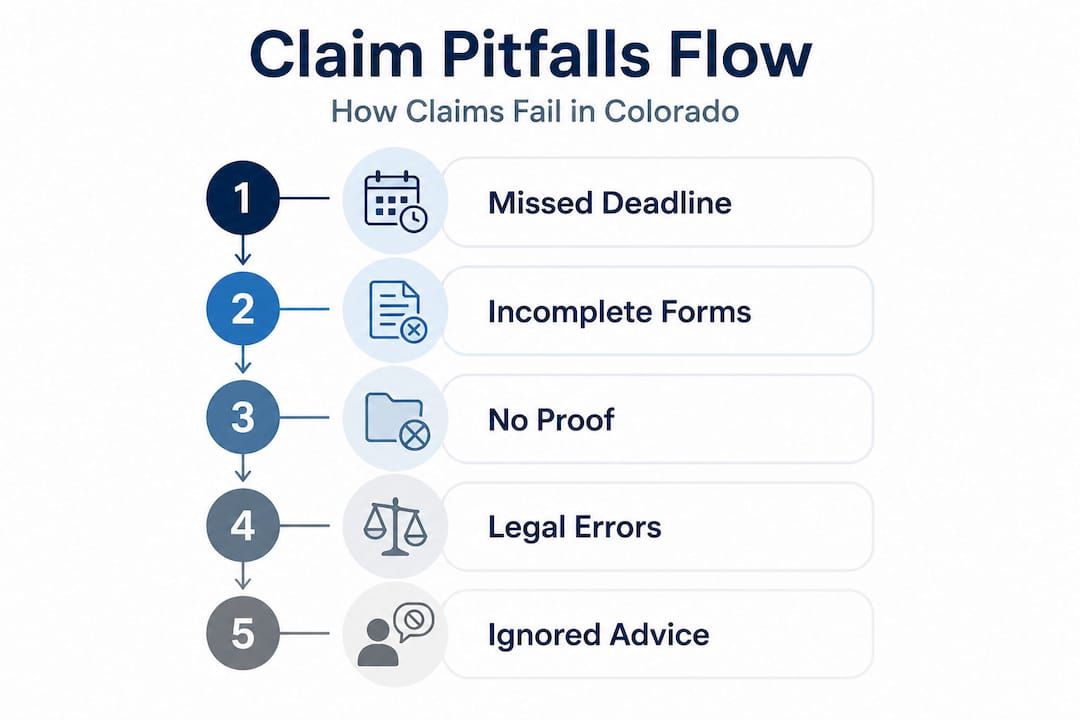
- Top 5 reasons accident injury claims fail in Colorado
- Documentation and proof: The deal-breakers in injury claims
- Insurance companies’ playbook: How insurers derail accident claims
- Critical mistakes: Legal errors and missed deadlines in Colorado accident claims
- The uncomfortable truth about winning accident claims in Colorado
- Take the right next steps for your Colorado claim
- Frequently asked questions
Key Takeaways
| Point | Details |
|---|---|
| Know common pitfalls | Failure to understand Colorado-specific claim rules leads to most denied accident claims. |
| Document everything | Strong documentation and timely records are essential for successful injury claims. |
| Watch for legal deadlines | Missing legal deadlines, especially statutes of limitations, can instantly end your case. |
| Outsmart insurance tactics | Insurers use strategies to minimize payouts, so being prepared counters their playbook. |
| Get legal guidance | An experienced attorney can dramatically improve your odds of a successful claim. |
The foundation: What makes an accident injury claim succeed or fail?
An accident injury claim is a formal legal demand for compensation after you’ve been hurt due to someone else’s negligence. In Colorado, winning that claim requires you to prove four core elements: liability (the other party was responsible), causation (their actions directly caused your injury), damages (you suffered real, measurable losses), and documentation (you have proof to back all of it up). Miss any one of these, and even the most sympathetic case can collapse.
The legal checklist for claims is a good starting point for understanding what needs to be in place before you approach an insurer or a court. Many victims assume their claim is solid simply because they were hurt. But the burden of proof rests squarely on you, the injured party. Colorado follows a modified comparative fault rule, which means your compensation can be reduced or eliminated entirely if you’re found to share blame for the accident.
Here’s a quick-reference table that shows what a strong claim looks like versus the most common reasons claims get rejected:
| Claim essential | What a strong claim includes | Common reasons for rejection |
|---|---|---|
| Liability | Clear evidence the other party was at fault | No police report, conflicting witness accounts |
| Causation | Medical records linking injury to the accident | Gap between accident and treatment |
| Damages | Bills, lost wage records, receipts | Vague or estimated losses with no documentation |
| Documentation | Photos, records, statements | Missing or incomplete records |
| Timeliness | Filed within Colorado’s statute of limitations | Filed too late or missed key deadlines |
| Consistency | Consistent account from day one | Changing story or social media contradictions |
Process mistakes also kill claims before they even reach the evaluation stage. Missed deadlines, incomplete forms, and failure to notify the right parties at the right time can all result in automatic denial. The injury case evaluation tips available through experienced Colorado attorneys can help you map out exactly what your claim needs before you submit it.
The qualities of a good lawyer matter enormously here because not all attorneys are familiar with the nuances of Colorado’s injury claim process. Whether you were in a multi-vehicle collision or a single-car crash with a defective road, the types of car accident claims vary widely, and each type has its own documentation and deadline requirements.
Pro Tip: Start a dedicated folder, either physical or digital, on the day of the accident. Store every receipt, photo, medical summary, and piece of correspondence related to your injury. Courts and insurers love paper trails, and gaps in yours will be exploited.
Top 5 reasons accident injury claims fail in Colorado
Most claims don’t fail because the victim was lying or the injury wasn’t serious. They fail because of specific, identifiable mistakes that happen early in the process. Here are the five most common:
-
Lack of medical documentation. This is the single biggest killer of valid claims. If you didn’t see a doctor immediately after your accident, or if you skipped follow-up appointments, the insurer will argue your injuries weren’t serious or weren’t caused by the accident. Even soft tissue injuries like whiplash need to be documented within days, not weeks. The longer you wait, the easier it is for the insurance company to claim the injury happened some other way.
-
Delayed accident reporting. Colorado law requires you to report accidents involving injury or property damage over a certain threshold to law enforcement immediately. Waiting days to file a police report gives the other side room to question your version of events. It also signals to the insurer that maybe the accident wasn’t as serious as you’re now claiming. Prompt reporting establishes a clear, official record that supports your account.
-
Shared fault complications. Colorado uses a modified comparative negligence standard. If you’re found to be 50% or more at fault for the accident, you receive zero compensation. Even being found 20% at fault reduces your payout by 20%. Insurance companies aggressively investigate ways to assign blame to you, and without an attorney managing that process, you may inadvertently say or do things that increase your perceived fault.
-
Missed statutes of limitations. Colorado generally gives personal injury victims three years from the date of the accident to file a lawsuit. But there are exceptions. Claims against government entities have much shorter deadlines, sometimes as little as 180 days. Missing any of these cutoffs means your case is dead, regardless of how solid it is. This is not a rule that courts bend for sympathetic circumstances.
-
Underestimating insurance company tactics. This might be the most dangerous mistake of all. Victims assume the insurance adjuster is a neutral fact-finder. They aren’t. Adjusters are trained to minimize payouts. They record early statements, offer lowball settlements before you know the full extent of your injuries, and monitor your social media for anything that contradicts your claim. Understanding why pursuing an injury case matters means recognizing that the process is adversarial from the first phone call.
“Studies suggest that claimants who handle injury cases without legal representation receive settlements that are, on average, significantly lower than those represented by an attorney. Insurance companies count on victims not knowing their rights.”
Pro Tip: Do not give a recorded statement to the other party’s insurance company without speaking to a lawyer first. That statement can and will be used against you. A single poorly worded answer can undermine months of otherwise solid claim-building.
Documentation and proof: The deal-breakers in injury claims
A closer look at claims shows that lacking robust documentation is the Achilles’ heel in most unsuccessful cases. You could have a fractured vertebra, two surgeries, and three months of physical therapy, and still lose your claim if the paper trail doesn’t support your story in a way that holds up to scrutiny.

The case examples showing proof from Colorado injury cases make this painfully clear. Cases with strong, consistent documentation tend to settle faster and for larger amounts. Cases with gaps, inconsistencies, or missing records drag on, settle low, or get dismissed entirely.
Here’s what strong documentation looks like compared to what weak documentation looks like in practice:
| Documentation type | Strong example | Weak example |
|---|---|---|
| Medical records | Immediate ER visit, consistent follow-ups, specialist referrals, treatment notes | First medical visit two weeks after accident, no follow-up |
| Police report | Filed same day, includes fault determination or witness info | No report filed, or report filed days later |
| Witness statements | Written statements with contact details collected at the scene | Vague recollection from a friend mentioned weeks later |
| Photo evidence | Time-stamped photos of scene, vehicles, injuries taken immediately | A few blurry photos taken days after the fact |
| Financial records | Itemized medical bills, pay stubs showing lost wages, receipts | Rough estimates of costs without supporting receipts |
| Personal injury journal | Daily log of pain, limitations, and emotional impact | No record of symptoms between appointments |
Actionable documentation steps you can take right now:
- Photograph the accident scene, your vehicle, the other vehicle, road conditions, and any visible injuries before anything is moved or cleaned up.
- Get the names, contact details, and statements of every witness at the scene, even brief ones.
- See a doctor within 24 to 48 hours of the accident, even if you feel “okay.” Adrenaline masks pain, and delayed symptoms are common with whiplash and head injuries.
- Request copies of every medical record, bill, and treatment note at each appointment and store them in your dedicated claim folder.
- Keep a daily pain and symptom journal. Write down how your injuries affect your sleep, your ability to work, and your daily activities. Courts and juries connect with this kind of firsthand detail.
- Save all communications with insurance companies in writing, and if you speak by phone, follow up with an email summarizing what was discussed.
Strong documentation doesn’t just support your claim. It prevents the other side from rewriting the narrative.
Insurance companies’ playbook: How insurers derail accident claims
Beyond your own actions, insurance companies often use behind-the-scenes tactics to derail legitimate claims. Understanding these tactics isn’t about being paranoid. It’s about being prepared. The more you know about how adjusters are trained to respond, the harder it is for them to take advantage of you.
Here are some of the most common tactics insurers use against Colorado accident victims:
- The early settlement offer. Days after your accident, before you know whether your injuries require surgery or long-term care, the insurer may offer a fast settlement. It sounds helpful. It’s designed to close your claim before your full damages are known. Once you accept, you sign away your right to any future compensation.
- The recorded statement trap. Adjusters ask for recorded statements framed as routine procedure. They then parse your words for inconsistencies or admissions that reduce your claim’s value.
- Surveillance and social media monitoring. If you claim a serious injury but post a photo hiking or lifting something at a family event, that image can appear in court to dispute your damages. Insurers hire investigators and routinely monitor public social media profiles.
- Disputing causation. The insurer may argue your injury was pre-existing and not caused by this accident. Without clear medical documentation establishing a direct link, this argument can be surprisingly effective.
- Delay tactics. Dragging out the claims process creates financial pressure on victims. People desperate for money to pay medical bills often accept lower settlements just to get relief.
“Insurance companies employ teams of adjusters, medical reviewers, and attorneys whose full-time job is to reduce what they pay out. The playing field is not level unless you have experienced legal representation in your corner.”
Warning signs of unfair claim handling include: unjustified delays in responding to your claim, requesting unnecessary or redundant documentation, denying your claim without a clear written explanation, or pressuring you to accept a settlement before your treatment is complete.
Understanding how insurers respond to claims and the strategies they deploy is critical knowledge for any accident victim in Colorado. Attorney involvement changes the dynamic immediately. Insurers know that represented claimants are harder to lowball, and they adjust their approach accordingly. An experienced injury attorney understands how to counter each of these tactics before they can do damage to your case.
Critical mistakes: Legal errors and missed deadlines in Colorado accident claims
Even well-documented claims can fail due to avoidable legal mistakes, especially missed deadlines. Colorado has specific procedural rules, and the legal system does not make exceptions because someone wasn’t aware of them. Let’s cover the most critical legal pitfalls in detail.
-
Missing the statute of limitations. Colorado gives most personal injury victims three years from the date of the accident to file a civil lawsuit. For wrongful death claims, the window is two years. For claims against a government entity, such as a city that failed to maintain a road, you may have as little as 180 days to file a formal notice of claim. Understanding the lawsuit timeline and deadlines for your specific situation is not optional. Miss it by one day and your case is gone.
-
Failing to properly notify all responsible parties. If multiple parties share liability, you must identify and notify all of them within the appropriate timeframe. Failing to name a responsible party early enough can prevent you from adding them later, reducing your total potential recovery.
-
Accepting a settlement without understanding its full scope. Signing a release of liability, even one that looks routine, often means surrendering all future claims related to the accident. If your injury worsens or new complications develop after you’ve signed, you have no legal recourse.
-
Failing to contest a claim denial properly. When an insurer denies your claim, there is a formal process for contesting that decision. Many victims simply give up or try to negotiate informally without following the required steps. Missing the window to file a formal appeal or complaint can permanently end your options.
-
Handling complex claims without legal support. Some cases appear straightforward but involve multiple liable parties, commercial vehicles, defective products, or government negligence. Each adds legal complexity that requires specific expertise. Choosing the right lawyer for your type of claim is just as important as hiring a lawyer at all.
To avoid these pitfalls, treat your claim like a calendar project from day one. Set reminders for every deadline. Keep notes of every phone call with insurers, including the date, time, and name of the person you spoke with. Better yet, put an experienced Colorado injury attorney in charge of deadline management from the start. That’s not outsourcing your responsibility. That’s recognizing that legal deadlines are not a matter of good faith. They’re hard cutoffs with real consequences.
The uncomfortable truth about winning accident claims in Colorado
After more than a decade of representing injured victims across Colorado, including years as a former claims adjudicator for the federal government, here’s what I know to be true: the claim process is not designed to be fair to victims. It is an adversarial system from the very first moment you dial your insurer’s number.
That’s not cynicism. That’s reality. And victims who treat it as a neutral, bureaucratic process are the ones who get hurt twice.
The most damaging myth I encounter is the belief that a valid claim will eventually win on its own merits. Facts matter, yes. But how those facts are presented, when they are presented, and by whom can be just as important as what those facts actually are. An insurer with a team of adjusters and attorneys will out-maneuver an unrepresented victim almost every time, not because the victim is wrong, but because the insurer knows the system and the victim doesn’t.
No detail is too small to document. I’ve seen cases hinge on a single text message, one timestamp on a photo, or a doctor’s note that mentioned the accident connection explicitly versus one that didn’t. Victims who assumed certain details were too minor to bother with often paid for that assumption later. Every piece of information is either working for your claim or against it.
Persistence and preparation matter more than most people realize. Insurance companies count on victims getting worn down by delays and lowball offers. The ones who protect themselves by using the protect your rights checklist and who build their cases methodically from day one are in a fundamentally stronger position than those who react as the process unfolds.
Don’t rely on common sense to guide you through a legal system you’ve never navigated before. Common sense says the truth will come out. Legal strategy says the truth needs to be presented in a specific format, at a specific time, with specific supporting evidence, or it may never be heard at all. That gap between common sense and legal reality is exactly where most claims fail.
Take the right next steps for your Colorado claim
Armed with this inside knowledge, here are resources and next steps to help you succeed with your accident injury claim. At Malnar Injury Law, known online as StubbornAttorney.com, we’ve spent over a decade doing one thing: fighting for injured Colorado victims with the same stubbornness and sure-footed persistence that defines how we approach every case.
We’ve settled hundreds of cases and recovered millions in compensation for people who came to us after being hurt, confused, and overwhelmed by a process stacked against them. If you want to find the best injury lawyer to handle your specific claim, start there. If you want to know your rights after injury in Colorado before your next step, we’ve got that covered too. And if you want to see Colorado case outcomes that show what’s possible with the right representation, those examples are waiting for you. The fight for fair compensation starts the moment you decide not to navigate it alone.
Frequently asked questions
How quickly should I report an accident in Colorado to avoid claim failure?
You should report your accident to law enforcement and your insurer as soon as possible, ideally the same day, because delays can lead to your claim being denied. Review the Colorado car accident legal checklist to make sure you’ve covered every required notification step.
Which documents are most important for proving my injury claim?
Medical records, police reports, witness statements, and clear photos of the scene are the most critical documents for proving your case. Top personal injury case examples from Colorado show that claimants with thorough documentation consistently achieve better outcomes.
What is the biggest legal mistake that causes claim denials in Colorado?
Missing Colorado’s statute of limitations is most often the fatal legal mistake because if you file too late, you permanently lose your right to compensation. Check the Colorado injury lawsuit timeline to understand exactly which deadlines apply to your specific type of claim.
Can dealing with insurance companies alone increase my chances of claim failure?
Yes, because insurers use tactics claimants rarely expect, and having an attorney can prevent undervalued or rejected claims. Understanding why attorneys fight insurance companies in Colorado explains how representation shifts the power balance in your favor.
Recommended
- Why pursue an injury case? Key reasons for Colorado victims
- Types of car accident claims: Your guide to Colorado options
- Top personal injury case examples and outcomes in Colorado
- Top qualities to seek in a personal injury lawyer in Colorado
- Personal Injury Claims: How to Maximize Your Compensation — Attorney Sean Quinlan