

Negligent Security in Colorado: When an Owner Is Liable
A negligent security claim in Colorado is a premises liability claim: you were hurt on someone else’s property, usually by another person’s crime, and the owner or operator knew or should have known about the danger and failed to use reasonable care. The claim is governed by a state statute, not a general rule that a business must stop every crime. The details of who you were on the property, what the owner knew and what caused your injury decide whether a case has legs. Our firm, Malnar Injury Law, now practicing under the Stubborn Attorney name, represents injured people in Colorado and Colorado Springs, and we work on contingency: you pay no attorney fee unless there is a monetary recovery in your case.
Most people who read this page arrived after a car accident search or a crash that left them thinking about parking lots, garages and roadside stops. That is not a detour. Many of the places where drivers get hurt by other people, such as a dark apartment garage, a gas station lot, a shopping center or a hotel, are covered by the same law. Below is what that law says, how it is applied, what evidence matters and what to do in the first days.
Table of Contents
- What negligent security means
- The Colorado law that controls these claims
- Foreseeability: the question every case turns on
- Where negligent security claims arise
- Worked example
- Fault is shared: how your own conduct matters
- The deadline: two years for negligence claims
- What to do after an incident
- Why a lawyer matters in this kind of claim
- Our perspective
- Talking to us about your case
- FAQ
- Sources
What negligent security means
Negligent security is not a separate statute. It is a label lawyers use for a premises liability case in which the injury came from a third party, often an assault, robbery, carjacking or shooting, and the argument is that the property’s security was inadequate. Typical failures include broken lighting, doors and gates that do not lock, no cameras or cameras nobody monitors, no guard where past incidents called for one, and ignored tenant complaints.
The person who hurt you is still responsible for what they did. A negligent security claim is aimed at the owner or operator whose property made the harm easier to commit. That matters in practice because the attacker is often unidentified, has no money or no insurance, while the property has liability coverage.
The Colorado law that controls these claims
Colorado’s Premises Liability Act, found at C.R.S. § 13-21-115, governs civil claims by people injured on another’s real property because of the property’s condition, activities or circumstances. The statute says a landowner’s liability is only what the Act specifies. In 2020 the Colorado Supreme Court, in Planned Parenthood v. PPRM, confirmed that the statute is the comprehensive and exclusive statement of landowner duties to people injured on the property. The same decision held that a jury could find insufficient security a substantial factor in a mass-violence case where the facility had long faced known threats.
In plain terms: you cannot sue a property owner in Colorado for a dangerous-premises injury on a broad theory you invent. You must fit the facts into the Act’s categories.
Who counts as a landowner
The Act defines a landowner broadly. It includes a person in possession of the property and a person legally responsible for its condition, activities or circumstances, according to the statute. That can reach the property’s owner, a tenant business that controls the space, or a management company. If more than one landowner is sued, the court decides how the Act applies to each. Identifying who controlled lighting, locks, cameras and guards on the day of the incident is therefore one of the first jobs in a case.
Your status on the property
The Act sorts visitors into three groups, and what you must prove depends on which one you were:
| Status | Typical example | What the Act allows you to recover for |
|---|---|---|
| Invitee | A customer in a store, a tenant using a parking lot, a hotel guest | Damages from the landowner’s unreasonable failure to use reasonable care to protect against dangers the owner actually knew about or should have known about |
| Licensee | A social guest, someone on the property with permission for their own purposes | Specified unreasonable failures about dangers the owner created and actually knew about, or failure to warn of certain dangers the owner actually knew about |
| Trespasser | Someone with no right to be there | A much narrower set of claims |
The invitee and licensee descriptions come from C.R.S. § 13-21-115. Most negligent security plaintiffs are invitees: a tenant attacked in the building’s lot, a shopper robbed leaving a store, a guest hurt at a hotel. The invitee standard is the one that lets a claim rest on what the owner should have known, not only what the owner admits knowing.
There is one wrinkle. On agricultural or vacant land, even an invitee may recover only for dangers the landowner actually knew about, per the same statute. Most commercial parking lots and apartment complexes are not in that category.
Foreseeability: the question every case turns on
A owner cannot be expected to prevent every crime. The question is whether the harm was foreseeable. Colorado’s pattern jury instructions, published by the Judicial Council, say an owner or occupant has a duty to use reasonable care to keep the premises reasonably safe and to carry on activities in a reasonably safe manner, in view of the foreseeability, if any, of injury to others (Instruction 12:7).
The companion instruction, 12:6, lists what a plaintiff must prove:
- The defendant owned, occupied or controlled the premises.
- A condition or activity on the premises created an unreasonable risk of harm.
- The defendant knew, or reasonably should have known, about the risk in time to correct it.
- The defendant’s failure to act caused the plaintiff’s injuries.
Every negligent security case is built around those four items. Foreseeability lives mostly in the third and fourth.
What makes a crime foreseeable
Foreseeability is a fact question, and it is proven with a record. The kinds of facts that carry weight include:
- Earlier crimes at or near the property, such as car break-ins, assaults, robberies or shootings, and how recent and similar they were.
- Calls to police from the address.
- Tenant or customer complaints about broken gates, burned-out lights or unlocked doors.
- Internal incident reports, maintenance requests and emails.
- Security measures the owner once had and then removed.
- Known threats against a person or business, which was central in the Planned Parenthood case above.
A property with a history of car thefts and a broken garage gate is in a different position from one where an attack came out of nowhere.
The 2022 legislative change
In 2021, the Colorado Bar Association’s magazine reported that the Colorado Supreme Court’s Wagner decision made foreseeability a major focus of proximate cause and raised the possibility of broader landowner exposure for third-party intentional acts (Colorado Lawyer, May 2021). The legislature responded. A legislative declaration added by SB 22-115, effective April 7, 2022, bars reliance on Wagner’s theory that a business selling certain controversial goods or services makes crime foreseeable, and it directs courts to consider whether the third party’s crime was the predominant cause of the injury, per the 2025 statute.
For you, this means a claim should be built on the specific property’s known risks and the owner’s specific failures, not on the type of business alone. Before relying on any case you read online that predates April 2022, check whether it still reflects the law. The Colorado General Assembly’s 2025 Red Book tabulates statutory changes from the 2025 regular session and is a place to check for amendments.
Where negligent security claims arise
If you came here after a vehicle collision, these settings may sound familiar, because the injury often happens next to the road:
- Apartment complexes and condos: attacks in unlit stairwells, garages with broken gates, or break-ins where locks were known to be defective.
- Parking lots and garages: carjackings, robberies at ATMs and assaults after dark where lighting or patrols were lacking.
- Hotels and motels: door locks that fail, unmonitored entrances, lax key control.
- Bars, clubs and event venues: fights and shootings where the venue ignored warning signs or failed to staff security reasonably.
- Gas stations, convenience stores and shopping centers: robberies and assaults at locations with a record of earlier incidents.
Not every violent event on property supports a claim. If the owner had no reason to anticipate it and took ordinary precautions, the claim will likely fail. If the facts instead show an owner who ignored a pattern, the claim has substance.
Worked example
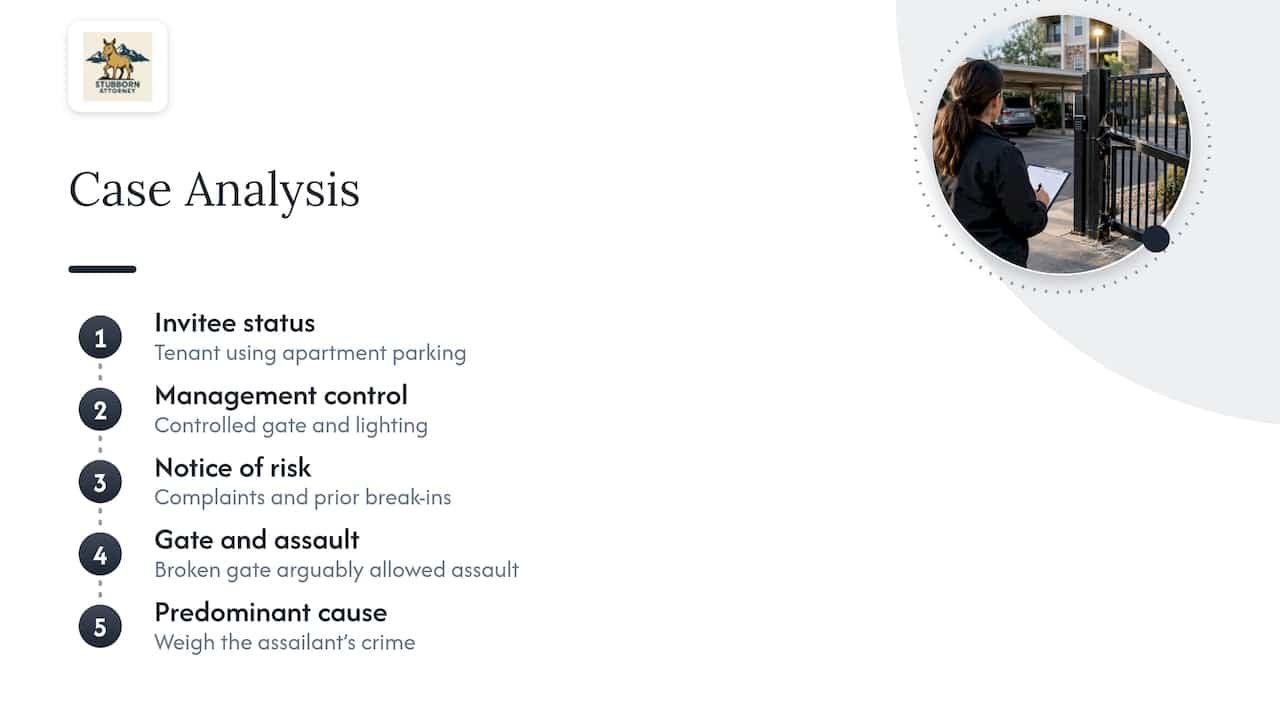
Suppose a tenant at an apartment complex in Colorado Springs is walking from the covered parking area to her unit at night. The gate to the garage has not latched for months, residents emailed management twice about it, and two cars were broken into the previous spring. A man who walked in through the gate assaults her and takes her car keys. She is hospitalized.
This is a hypothetical, not a result from any case. The analysis would run like this: she is an invitee; management controlled the gate and lighting; the complaints and break-ins support that management should have known; the broken gate arguably allowed the assault; and the assailant’s crime must be weighed on whether it was the predominant cause. Evidence of the emails, repair requests, police reports and the gate’s condition would be the core of the case.
Fault is shared: how your own conduct matters
Colorado applies comparative negligence. If a jury finds you partly at fault, your recovery is reduced by your percentage, and a plaintiff found 50% or more at fault cannot recover. Our page on the 50% rule and special verdicts in Colorado comparative negligence explains how that works. In negligent security cases the defense often argues the victim ignored a warning, walked somewhere unsafe or provoked a confrontation. A careful account of exactly what happened, given early and consistently, protects against that argument.
The deadline: two years for negligence claims
Colorado’s limitation period for tort actions, including negligence, is two years, according to a Colorado legislative memorandum on limitation periods. Special rules can shorten or lengthen time in particular situations, for example claims against government entities, so the safest approach is to treat the two-year mark as the outer limit and to start well before it. Evidence such as video, maintenance records and witness memories fades long before a deadline passes. For a wrongful death after a violent incident, see our overview of wrongful death claims in Colorado.
What to do after an incident
The following steps are general guidance. They do not replace advice from a lawyer who has reviewed your facts.
- Get medical care first. Your health comes before everything else. Medical records also document the injuries and their link to the incident.
- Report the crime to police and get the report number. A report creates an official record of the date, place and circumstances.
- Photograph the scene. Capture lighting, broken locks or gates, missing cameras, signs and the layout. Do it soon, because owners repair things quickly after an incident.
- Write down what happened. Note the time, what you saw and heard, who was nearby and what you were doing there.
- Identify witnesses. Names and phone numbers of neighbors, employees and bystanders matter.
- Ask that video be preserved. Surveillance footage is often overwritten within days or weeks. A lawyer can send a preservation request to the property.
- Keep earlier complaints. If you, or other tenants, reported problems before the incident, save the emails, texts and portal messages.
- Be careful with insurers and property managers. Do not give a recorded statement or sign a release before speaking to a lawyer. Early statements can be used to argue that you share fault.
- Keep a record of costs. Medical bills, missed work, repairs and pain and recovery notes all go into the value of a claim.
If you were also in a vehicle collision connected to the same incident, such as a crash during a carjacking or a hit-and-run in a lot, the insurance and premises claims may overlap. Our guide on car accident liability factors shows how fault is determined on the road side of the event.
Why a lawyer matters in this kind of claim
Negligent security cases are harder than a typical collision claim. Several parties may share control of the property. The owner’s insurer will argue the crime was unforeseeable, that someone else was in control, or that the criminal alone caused the harm. The statute narrows the theories you can use, and since 2022 the predominant-cause question must be addressed. The evidence on foreseeability sits in the other side’s files.
The right lawyer knows how insurers and agencies value claims. Our attorney Ryan Malnar worked as a claims adjudicator and adjuster for the federal government and has practiced law for over a decade, so he knows how large insurance companies and government agencies evaluate a claim. We represent only injured people. Cases are handled directly by attorneys, and our approach is built around persistence: when we take a case, we do not let go.
Our perspective
People often come to us after a car accident and only later learn that the place where they were hurt shares part of the blame. A parking garage with a gate that has not worked in months, a lot with no lighting, a complex that ignored resident complaints: these are failures somebody chose to tolerate.
I spent time as a claims adjudicator for the federal government before I became a trial lawyer, so I know how an insurer reads a file like this. It looks for the gap: the missing complaint, the late photograph, the inconsistent statement. We build the file the other way, with the records, the history and the timeline that answer foreseeability before the insurer raises it.
We settle injury cases and have recovered millions of dollars for people in Colorado. We represent only injured people, and we take cases on contingency, so you do not pay an attorney fee unless we recover money for you. The mule is our symbol because a mule keeps going up the trail when the path gets hard. That is how we treat your case.
Ryan
Talking to us about your case
If you were hurt in a parking lot, an apartment complex or another place that should have been safer, we can review what happened and tell you what the law means for your facts. Our personal injury practice in Colorado Springs covers premises cases, and our services page lists the accident types we handle, including car, motorcycle, pedestrian and slip and fall cases. Our overview of Colorado premises liability claims goes further into the steps that protect these cases, and understanding personal injury claims in Colorado walks through the claim process from start to finish. You can start from our home page.
FAQ
Is negligent security a different kind of lawsuit in Colorado?
No. It is a premises liability claim under C.R.S. § 13-21-115 where the injury came from a third party’s act and the argument is that the property’s security was inadequate. The same statute and the same elements apply as in other dangerous-property cases, as set out in the Judicial Council’s jury instructions.
Can I sue if the attacker was never caught?
Yes, a claim can be brought against the property owner or operator even when the attacker is unknown. The question is whether the owner knew or should have known of the danger and failed to use reasonable care. Police reports, witness accounts and property records can support that without identifying the attacker.
How long do I have to file?
Colorado’s limitation period for negligence claims is two years, according to a legislative memorandum on limitation periods. Some situations carry different rules, so speak to a lawyer soon after the incident rather than near the end of the period.
What if I was partly to blame?
Your recovery can be reduced by your percentage of fault, and a plaintiff found 50% or more at fault cannot recover under Colorado’s comparative negligence rules. Our page on comparative negligence in Colorado explains how juries weigh it.
How much does it cost to hire a lawyer for this?
We work on contingency, which means you pay no attorney fee unless there is a monetary recovery in your case. Contact us to discuss your situation.
Sources
- Colorado Revised Statutes § 13-21-115 (2025)
- Colorado Judicial Council, Civil Jury Instructions, Chapter 12 (2025)
- Planned Parenthood v. PPRM, Colorado Supreme Court (2020, 19SC251)
- Expanding Potential Exposure for Businesses, Colorado Lawyer (May 2021)
- Red Book 2025, Colorado General Assembly
- Colorado legislative memorandum on statutes of repose and limitations