
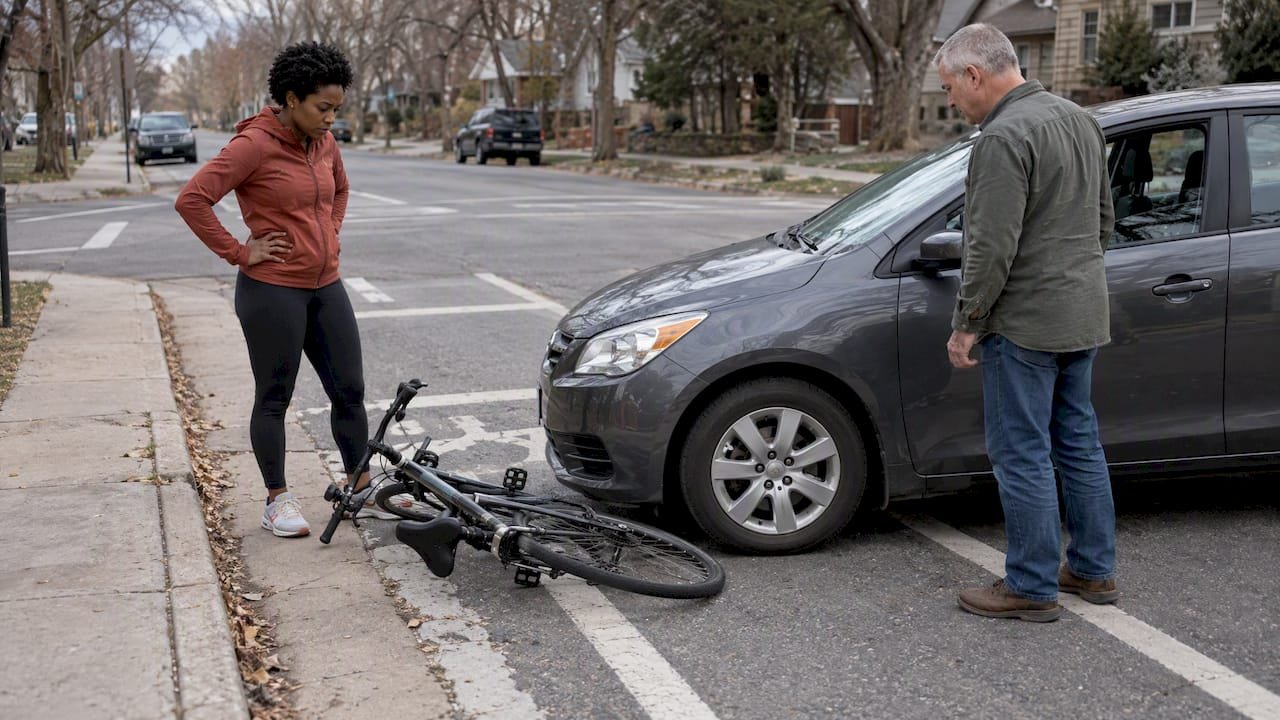
Who Is at Fault in a Colorado Bicycle Crash?
Fault in a Colorado bicycle crash is decided by comparing what the driver and the cyclist each did wrong. Colorado treats a cyclist as a driver of a vehicle, so the same duties of care apply to both. If you were hurt and were partly at fault, you can still recover money as long as your share of the blame is smaller than the other party’s. Your compensation is then reduced by your percentage. If your share is equal to or greater than theirs, you recover nothing.
This guide explains how that works in practice: who can be blamed, which traffic rules usually decide it, what evidence matters, and what to do in the first days. It is general information, not legal advice for your crash. The facts of your case and the date it happened change the answer, so talk to a Colorado injury attorney before you speak to an insurance adjuster about blame.
Table of Contents
- How Colorado decides fault after a bike crash
- The driver’s duties, and how breaking them creates fault
- The cyclist’s duties, and where blame can shift to you
- Comparative negligence: the 50% rule
- Is the cyclist impaired? Alcohol, drugs and bikes
- Who can be at fault besides the driver
- Evidence that proves fault
- What to do in the first days
- What you can recover, and how long you have
- Our perspective: why fault gets fought so hard
- Getting help with your bicycle claim
- FAQ
- Sources
How Colorado decides fault after a bike crash
There is no special “bicycle fault” statute. Fault is decided under ordinary negligence law: did someone fail to use reasonable care, and did that failure cause the injury? Insurance adjusters make a first call on this within days. If the claim goes to court, a jury or judge makes the final call.
Two official sources set the baseline. The Colorado Department of Transportation says bicyclists have the same rights and responsibilities as drivers of passenger vehicles, and its Colorado Bicycling Manual cites C.R.S. 42-4-1412 for that rule. The state’s model civil jury instructions add that a driver with the right of way and a bicycle operator with the right of way must each still use reasonable care for the conditions.
That second point matters more than most people expect. Having the right of way is not a free pass. A driver who has the green light but is speeding or looking at a phone can still be at fault. A cyclist who has the right of way but rides into traffic they could plainly see can be assigned part of the blame.
A note on the word “accident”
CDOT encourages people to say “crash” instead of “accident”, because the first word reflects that most of these events are preventable and avoids implying nobody was responsible. Insurance companies often use the opposite framing. Pay attention to the words in any statement you give.
The driver’s duties, and how breaking them creates fault
Most serious bike crashes with cars start with a driver mistake. These are the duties that come up most often.
Keep a proper lookout and drive at a reasonable speed
Colorado’s approved jury instructions say a driver must keep a proper lookout, drive at a speed reasonable for the conditions, and use reasonable care even when the driver has the right of way. That is the legal footing for the most common bike crash patterns: a driver turning right across a bike lane without checking, a driver turning left in front of an oncoming cyclist, or a driver pulling out of a driveway or side street.
Leave three feet when passing
Under Colorado’s three-foot law, a driver passing a bicycle must leave at least three feet of space. If that is not possible, the driver has to slow down and stay behind the cyclist until passing is safe. A close pass that clips a handlebar or forces a rider off the road is strong evidence of driver fault. We explain how to prove one in our guide to the Colorado three feet law.
Put the phone down
Colorado prohibits using a mobile electronic device while driving unless it is hands-free, a rule in effect since January 1, 2025. CDOT singles out distracted driving as a particular threat to vulnerable road users such as cyclists and pedestrians. If phone records show a driver was texting or scrolling at the time of the crash, that is hard to explain away.
Watch for cyclists at crosswalks and intersections
Many bike crashes happen where a path crosses a road or at a marked crossing. Who has to yield depends on the exact setup, whether the cyclist was riding or walking the bike, and the signal. Our article on Colorado crosswalk laws walks through the yield rules.
Dooring
Opening a car door into a cyclist’s path is a frequent cause of injuries in cities like Denver and Colorado Springs. The person who opens the door is generally the one who failed to check, which usually puts the blame on them. Document where the car was parked and whether the cyclist had room to ride farther from the parked cars.
The cyclist’s duties, and where blame can shift to you
Insurance companies look hard for anything a rider did wrong, because every percentage point they assign to you reduces what they pay. Knowing the rules helps you see where they will push.
- Obey traffic signals and signs. CDOT says cyclists must slow or stop as required under the Safety Stop Law, yield to traffic and pedestrians, and use lights and reflectors in low light. Riding at night without them is the classic argument for shared fault.
- Understand the Safety Stop rule. Under the 2022 amendment to C.R.S. 42-4-1412.5, a rider 15 or older (or younger with an adult) may roll through a stop sign after slowing to 10 mph or less and yielding. A county or city can set a different limit between 10 and 20 mph and post signs. A rider who did not slow or yield cannot rely on this rule.
- Expect the same penalties as drivers. Cyclists who violate traffic laws face the same penalties as motorists, though driver’s license points do not apply to bicyclists.
- E-bike riders carry more exposure. Careless driving by an electrical-assisted bicycle operator that causes bodily injury or death is a class 1 misdemeanor traffic offense under C.R.S. 42-4-1402.
Breaking one of these rules does not automatically make you the at-fault party. It becomes one piece of evidence the other side will use to argue you share the blame. The question is always whether the violation actually helped cause the crash.
Comparative negligence: the 50% rule
This is the rule that decides how much money is on the table.
Under C.R.S. 13-21-111, Colorado reduces damages in proportion to the injured person’s own negligence. Recovery is barred if that negligence is equal to or greater than the negligence of the person you are seeking recovery from. Colorado’s Supreme Court has explained that the system compares the negligence of the parties whose conduct caused the harm with the injured person’s own.
In plain terms:
| Your share of fault | What happens to your claim |
|---|---|
| 0% | You can seek full damages |
| 1% to 49% | You recover damages reduced by your percentage |
| 50% | You recover nothing |
| 51% to 99% | You recover nothing |
A worked example
Say a jury finds your total damages are $100,000. A driver turned left across your path without yielding, but you were riding at dusk with no rear or front light. The jury assigns you 20% of the fault and the driver 80%. Your recovery is reduced by 20%, to $80,000. If the jury had assigned 50% to each of you, you would recover nothing, even though the driver was equally to blame.
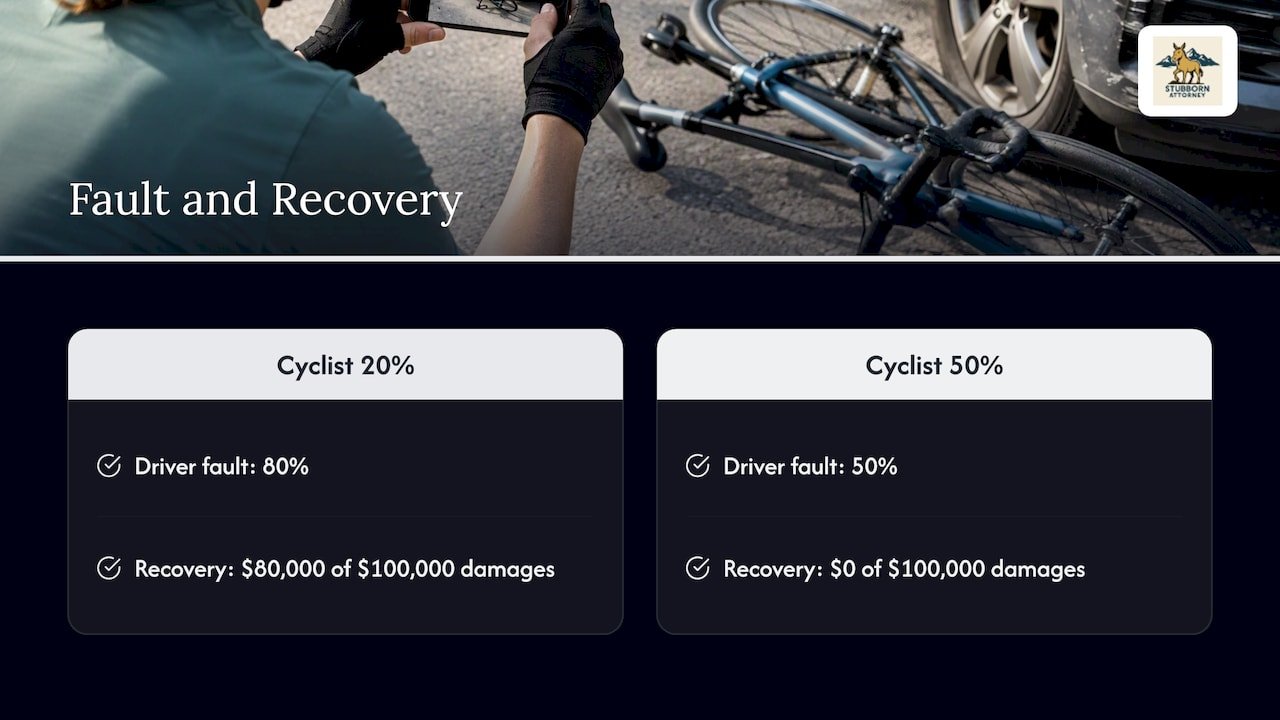
That cliff at 50% is why the early fight over blame is so important. A small shift in how fault is described can change the result of the whole case. Our article on the 50% rule and special verdicts shows how juries are asked to split fault.
Is the cyclist impaired? Alcohol, drugs and bikes
People often ask what happens with a DUI on a bike in Colorado. The Colorado Motor Vehicle Handbook explains that riding a bicycle while impaired by alcohol or drugs is illegal, and that impairment can be evidence of negligence that cuts into what a cyclist can recover under comparative negligence. The same handbook describes DUI and DWAI as the two main impaired-driving offenses, misdemeanors except for fourth or later offenses.
Impairment does not end your claim automatically. The question is still whether it caused the crash. A sober driver who runs a red light and hits a rider who had a drink earlier is still the main cause. But expect the insurer to raise it, and expect a larger fault percentage assigned to you if your riding was erratic. If alcohol or drugs were involved, tell your attorney at the very first meeting, before an adjuster raises it.
Who can be at fault besides the driver
Many riders assume it is one driver against one rider. Often more parties are involved.
- A second driver. A chain reaction, or a driver who forced another to swerve, can add a defendant.
- An employer. If the driver was working, such as a delivery or commercial driver, the company may share responsibility.
- A government body or property owner. Potholes, missing signage, bad detours and poorly designed crossings can contribute. Claims against public entities have their own strict notice rules, so ask a lawyer promptly.
- A product maker. A brake, fork, frame or e-bike battery failure can point to a product liability claim.
- The person who opened a car door. That may be a passenger, not the driver.
When several parties are at fault, the court compares each one’s negligence with yours. Identifying everyone early gives you more potential sources of compensation.
Evidence that proves fault
Fault is a story that has to be backed up. Here is what helps most, and what to do about it.
- The police report and crash report. In Colorado, a written report is required for crashes involving serious bodily injury, death, or more than $1,000 in property damage, according to CDOT’s bicycling manual. Ask the responding officer for the report number. The official legal record of crashes is kept in the DRIVES database at the Department of Revenue. Officers’ conclusions about fault are not final, but they carry weight with adjusters.
- Photos and video. Photograph the scene before cars move if you can: the position of the bike, skid marks, the lane markings, the signs and signals, and your injuries. Dash cams, helmet cameras, and doorbell or business cameras nearby can be decisive. Many businesses overwrite footage within days, so ask quickly.
- Witnesses. Get names and phone numbers from anyone who saw it. An independent witness is far more persuasive than either party.
- Your bike and gear. Do not repair or throw away the bike, helmet, lights or clothing. Damage patterns show impact angle and speed. Keep your ride data from a bike computer or phone app too, since it can show your speed and route.
- Phone records. If distraction is suspected, a lawyer can seek the driver’s phone records through formal requests once a claim is underway.
- Medical records. Prompt treatment links your injuries to the crash and closes the gap an insurer would otherwise use to argue something else caused them.
Our guides on what evidence matters after a crash and 10 steps to strengthen an injury claim cover collection in more detail, and the accident injury reporting process guide explains the reporting side.
What to do in the first days
- Get medical care. Go to the ER or urgent care even if you feel okay. Adrenaline hides injuries such as concussions, internal injuries and fractures.
- Call 911 and have police respond. A report creates an official record.
- Do not argue about fault at the scene. Exchange insurance and contact information. Do not say “I’m sorry” or “I didn’t see you.” Adjusters quote these words later.
- Be careful with the other driver’s insurer. Their adjuster is not working for you. You are not required to give a recorded statement, and you should not sign a medical release or accept a quick offer before you know the full extent of your injuries.
- Notify your own insurer. Look at your medical payments and uninsured or underinsured motorist coverage. These can apply to a cyclist hit by a car, and they matter if the driver has little or no insurance.
- Write down what happened while it is fresh: the time, the weather, the traffic, what you saw, and what the driver said.
- Call a Colorado injury attorney before you give detailed statements about fault.
What you can recover, and how long you have
An injured cyclist can seek compensation for medical bills, lost income, property damage such as the bike and gear, and non-economic harm such as pain and suffering, inconvenience and loss of quality of life. Colorado law defines noneconomic loss as nonpecuniary harm including pain and suffering, inconvenience, emotional stress and impairment of the quality of life. The same statute sets limits on the amount of noneconomic damages in many cases, and those limits are adjusted over time, so ask your attorney which figure applies to your claim. For a sense of what moves settlement values, see our article on factors that affect personal injury settlements.
Time limits are strict. CDOT’s bicycling manual states that personal injury claims generally must be filed within two years under C.R.S. 13-80-102. Certain claim types, such as those against government bodies or wrongful death claims, can have different deadlines or earlier notice requirements, and some motor vehicle claims may carry a different period. Do not guess: have an attorney confirm the exact deadline for your situation as early as possible, and treat the shortest possible deadline as your real one.
Our perspective: why fault gets fought so hard
We see the same pattern again and again. The first thing an insurer does with a bicycle claim is look for a reason the rider shares the blame, because a rider at 50% costs them nothing and a rider at 20% costs them 20% less. The question is rarely whether the driver was careless. It is whether the insurer can paint the cyclist as careless too.
That is where experience matters. Before opening this firm’s practice, I worked as a claims adjudicator and adjuster for the federal government, so I know how large insurers and agencies evaluate a claim: what they look for, what they discount, and which early statements they use against injured people. Malnar Injury Law represents only injured victims, and we handle cases directly rather than passing them along a production line.
Our advice to riders is simple. Do not try to win the argument about blame in the first phone call. Preserve the evidence, get treated, and let someone who knows the rules build the record. Colorado’s comparative negligence system rewards the side with better documentation, and we have seen how much a good set of photos, a witness and a prompt report can change a number. Persistence matters too: insurers often make low opening offers and count on exhaustion. We do not get tired.
— Ryan
Getting help with your bicycle claim
We represent injured cyclists across Colorado, including Colorado Springs, on a contingency fee basis: you pay no attorney fee unless we recover money for you. If you want an experienced attorney to look at who is at fault and what your claim may be worth, start with our page on bicycle accidents in Colorado, read how we handle a bicycle accident claim in Colorado Springs, or see everything we handle on our services page. You can also ask about a free case review.
FAQ
Who is at fault if a driver hits a cyclist in Colorado?
It depends on who failed to use reasonable care. Drivers must keep a lookout, drive at a safe speed, yield properly and leave three feet when passing. If the driver broke one of those duties and it caused the crash, the driver is usually primarily at fault. The cyclist can still be assigned a share if they ignored a signal or rode without required lights.
Can I still recover money if I was partly at fault?
Yes, as long as your share of fault is less than the other party’s. Your damages are reduced by your percentage. At 50% or more, Colorado bars recovery. That is why disputes over even small percentages can decide a case.
Can you sue for pain and suffering in Colorado?
Yes. Pain and suffering falls under noneconomic damages, which Colorado law recognizes along with inconvenience, emotional stress and loss of quality of life. State law limits noneconomic damages in many cases, and the limits change over time. An attorney can tell you which limit applies to your claim.
What happens if a cyclist rides while impaired?
Riding a bicycle while impaired by alcohol or drugs is illegal in Colorado, and it can be used as evidence of negligence. It can lead to a higher share of fault being assigned to the rider and reduce or eliminate recovery. It does not automatically decide the case, since the question is whether the impairment helped cause the crash.
Do I have to report a bicycle crash in Colorado?
A written report is required when a crash involves serious bodily injury, death, or more than $1,000 in property damage. If you are hurt, call 911 and make sure police create a report. Even when it is not strictly required, a report gives you an official record to build on.
Sources
- Information for Bicyclists, Colorado Department of Transportation
- Colorado Bicycling Manual, CDOT
- Colorado model civil jury instructions, Colorado Judicial Branch
- Your words matter: how to best report on traffic crashes, CDOT
- New 2025 law bans holding phones while driving, CDOT
- 2022 session law on stop signs and bicycles, Colorado General Assembly
- Crime classification guide for misdemeanor traffic offenses, Colorado General Assembly
- C.R.S. 13-21-111, Colorado Revised Statutes (2025)
- National Farmers Union Property v. Frackelton (Colo. 1983)
- Colorado Motor Vehicle Handbook, 2024
- Crash Data, Colorado Department of Transportation
- C.R.S. 13-21-102.5, Colorado Revised Statutes (2025)