

Insurance Surveillance in an Injury Claim: What to Expect
Yes, an insurance company can have you watched after you file an injury claim. It may hire a private investigator to follow you, film you in public, and comb through your social media. The goal is footage that makes your injuries look smaller than you say they are. Surveillance is legal when done within limits, it is far less damning than it feels, and the best defense is simple: live honestly, follow your doctor’s orders, and never exaggerate.
This guide explains why insurers do it, when it happens, what investigators can and cannot do, how footage gets used, and what to do if you suspect someone is watching you. We write it from the Colorado perspective, but most of the principles apply wherever injury claims are fought.
Table of Contents
- What insurance surveillance actually is
- Why insurers do it
- When surveillance is most and least likely to hurt you
- What footage rarely shows
- What investigators can and cannot do
- Social media is surveillance too
- Will the insurer have to show you the footage?
- How to protect your claim
- What not to say to an insurance investigator
- Our perspective
- Getting help with your claim
- FAQ
- Sources
What insurance surveillance actually is
Injury surveillance is the covert monitoring and recording of a claimant’s behavior using photos, video or direct observation. A claims standard published by a Queensland, Australia, motor accident regulator describes it as something insurers use when they have reasonable grounds to suspect fraud, misleading statements, or a significant gap between reported injuries and the medical evidence. That standard is Australian, not American, but it shows how the industry itself frames the practice: it is meant to be proportionate and purposeful, not a routine step on every file.
In practice, American insurers do not always wait for a strong suspicion. A claim with a large medical bill, a long treatment history, or a claimed permanent limitation can attract attention simply because more money is at stake. Surveillance costs money, so insurers weigh the expense against the possible reduction in what they pay. The Lloyd’s List analysis of surveillance in injury claims notes it can be costly and that there is no guarantee the footage will help the insurer.
Surveillance usually takes three forms:
- Physical surveillance. An investigator parks near your home, workplace, doctor’s office or a place you often go, and films when you appear.
- Social media monitoring. Public posts, photos, check-ins and tagged pictures are reviewed for anything that appears to contradict your claim.
- Database and records research. Investigators look at public records, prior claims, and your employment and activity history.
Why insurers do it
Insurers say the purpose is to catch fraud, and some fraud is real. Defense-side commentary, such as this Hill Dickinson article on surveillance in injury claims, describes surveillance as a useful tool against dishonesty when it is used appropriately.
But it also works as leverage. Video is easy for a jury or an adjuster to understand, and a few seconds of you carrying a grocery bag can feel more persuasive than pages of medical records. Reporting by CBC News on an Ontario woman who was secretly filmed and wrongly accused of fraud shows how footage can be used to try to discredit someone who was genuinely hurt. The same reporting describes how being watched can intimidate injured people. That pressure can push a claimant toward a lower settlement, which is why we treat the possibility of surveillance as a strategy question, not just a legal one.
Before a claim ever reaches that stage, the adjuster handling your file is already forming a view of what it is worth. Our piece on the role of the insurance adjuster in personal injury claims explains how that evaluation works.
When surveillance is most and least likely to hurt you
Surveillance is not equally useful in every case. Insurers run a cost-benefit analysis first. According to the Hill Dickinson article above, it is least effective when the injury involves tasks done mostly inside the home, such as hand dexterity problems, and most effective when a claimant alleges limits in public, such as trouble walking long distances or restricted mobility.
That gives you a rough way to think about risk:
| Your claim | Likelihood footage matters | Why |
|---|---|---|
| Claimed inability to walk, stand or sit for long periods | Higher | Everyday outings are easy to film |
| Claimed inability to lift or carry | Higher | Errands, loading a car, yard work are visible |
| Claimed hand, fine-motor or cognitive limits | Lower | Most of the difficulty happens indoors |
| Large, ongoing wage-loss or future-care claim | Higher | More money justifies the investigator’s cost |
| Short, well-documented soft tissue injury with steady treatment | Lower | Little to contradict |
This is a tendency, not a rule. Do not assume you are safe because your injury is mostly private.
What footage rarely shows
The most useful thing to understand about surveillance video is how little of your life it captures. Investigators may follow someone for days, but the usable video is often only a few hours or minutes. In one documented case in the CBC reporting, investigators spent 60 hours over 15 days watching a claimant and produced only 180 minutes of video. A related Queensland court decision, Peterkovic v QBE Insurance, ordered the insurer to hand over 180 minutes of surveillance footage.
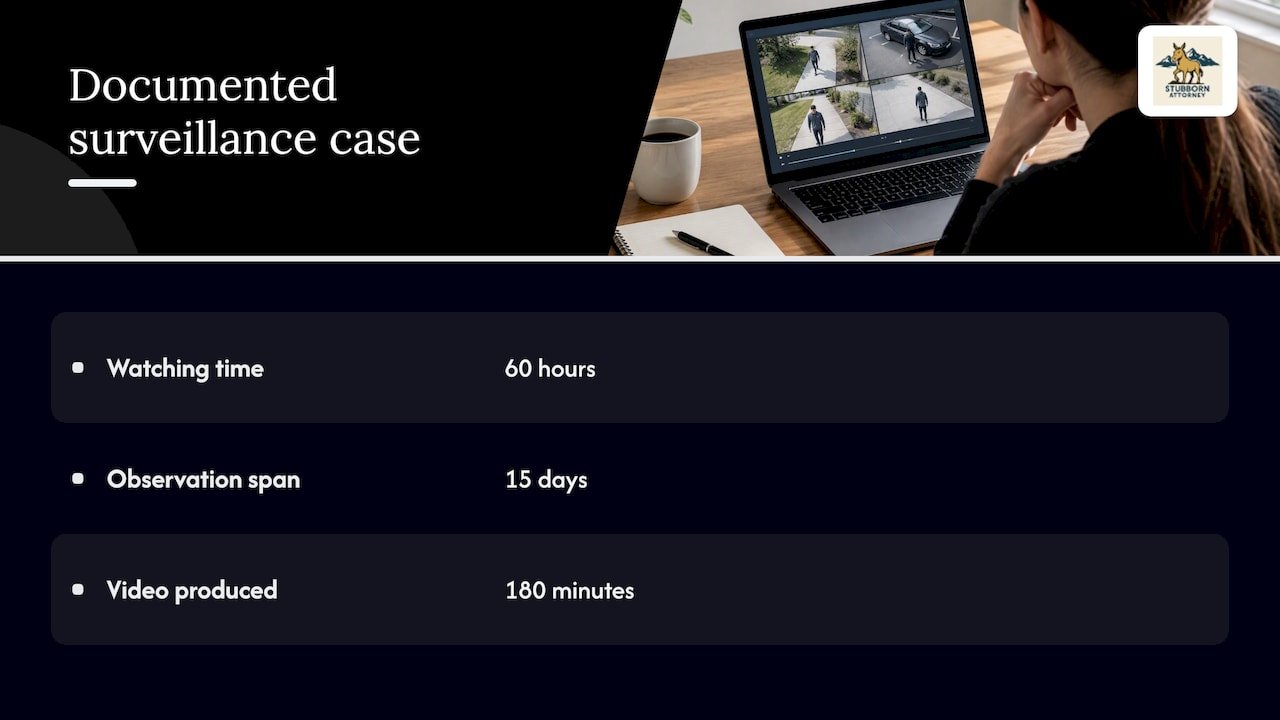
That gap matters. Chronic pain and injury are not constant. You may have a good hour and a terrible evening. You may push through a task and pay for it the next three days. A clip taken on a good morning does not show the night you could not sleep. A skilled attorney puts the footage next to your medical records, your pain journal and your treatment notes to show the full picture.
The Advocate magazine article on sub rosa video also warns that footage can be edited or framed to make a plaintiff look less hurt than they are. That is another reason to insist on receiving the complete, unedited recordings, not just the clips the insurer picks.
What investigators can and cannot do
Watching you in a public place is generally legal. If you are outside, visible from the street, at a store or at a park, you should assume you can be observed. Where limits apply varies by state and by the specific facts, so ask a Colorado attorney about your situation before you act on any of this.
What the industry’s own standards stress is that investigators should not entice you. The Queensland standard cited above treats tricking a claimant into doing something they said they could not do as unethical or unlawful. Again, that is an Australian standard, but the principle is the same in spirit across the profession: an investigator may observe, not manipulate.
Red flags worth documenting right away:
- A stranger who strikes up a conversation and steers it toward your injuries
- Someone asking you to lift, move or carry something
- An unfamiliar vehicle that seems to appear repeatedly near your home or appointments
- A person at a doctor’s office or gym who seems to be filming
- Friend requests from accounts you do not recognize
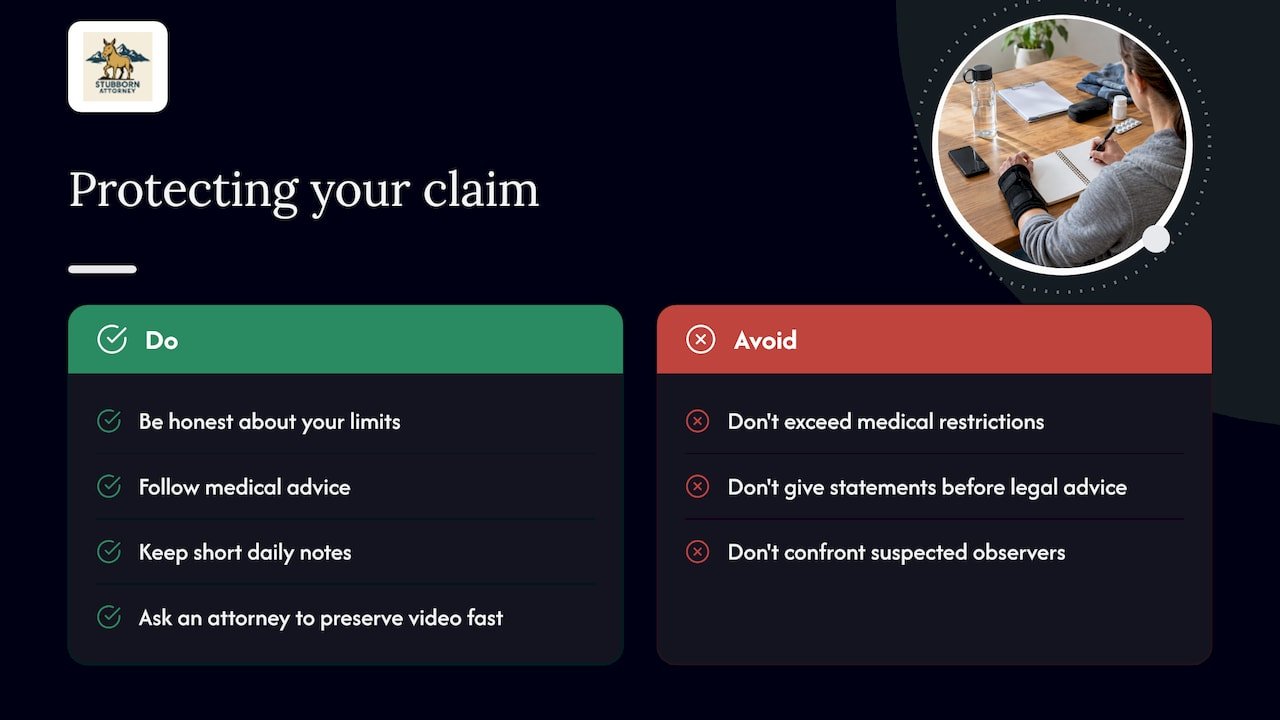
If any of this happens, write down the date, time, place, a description and any license plate number. Do not confront the person. Send what you have to your attorney.
Social media is surveillance too
For many claimants, the most damaging evidence is not a video from a parked van. It is their own feed. Investigators look for posts that seem to contradict your claim, and they can use photos you are tagged in by friends, even if you did not post them.
A few ground rules:
- Do not post about your injury, your pain, your treatment or your case.
- Do not post photos of physical activity, travel, parties or workouts while your claim is open.
- Ask friends and family not to tag you or post about you.
- Do not delete existing posts without talking to your attorney first. Deleting content after a claim starts can create its own problems, including accusations of destroying evidence.
- Do not accept requests from people you do not know.
A photo from a family barbecue might show you smiling and holding a plate. It will not show the pain medication you took beforehand or how you felt that night. Stripped of context, it can still be used against you.
Will the insurer have to show you the footage?
Often, yes, but not necessarily when you would like. The research we reviewed indicates that in many jurisdictions surveillance material is discoverable by the claimant’s legal team in a lawsuit, and generally is not shielded by privilege once the insurer intends to rely on it. The Colorado Supreme Court has favored broad discovery to avoid surprise at trial, as described in the Advocate article above. In a separate decision, Silva v. Basin Western, the court looked at whether insurance reserves and settlement authority are discoverable, so not every internal insurer document is open to you.
Timing is the tactical issue. Defense lawyers sometimes try to hold footage until after your deposition so you commit to your account of your limits before you know what they have. The Hill Dickinson article notes that courts generally admit surveillance of probative value even when it is disclosed late. That is a strong reason to answer every question about your abilities accurately and carefully the first time. If you are asked what you can and cannot do, be precise: “on a good day I can do this for ten minutes, and then I pay for it” is more accurate and safer than “I can’t do anything.”
Your attorney can request surveillance in discovery and ask about it directly. If the insurer refuses, there are procedural tools to compel disclosure. Our guide to personal injury trial preparation explains how that prep works before trial.
How to protect your claim
Protection does not mean hiding. It means being consistent and well documented.
Be honest about your limits, and consistent. The footage that hurts is footage that contradicts what you said. If you are truthful, a video of you walking to your car does not conflict with a claim that you cannot walk a mile.
Follow medical advice. If your doctor says no lifting over ten pounds, do not lift more. If you do something outside your restrictions, tell your doctor.
Keep a pain and activity journal. Short daily notes about symptoms, what you attempted and how you felt afterward give context to any snapshot. Our evidence checklist for injury cases covers what else to collect.
Be careful with recorded statements. An adjuster may ask you to describe your activities. Talk to a lawyer before giving one. Our page on recorded statements to insurers explains what to expect.
Preserve your own proof. Take photos early. See how accident photos support your claim.
Preserve third-party video fast. Surveillance cuts both ways. A security camera at a store or business may have recorded your accident, but many systems overwrite footage daily or weekly. One plaintiff-side practitioner writing in Plaintiff Magazine advises sending a preservation letter as soon as possible. If your claim involves a fall at a store or a crash near a business, ask an attorney to send one immediately.
Treat every medical exam seriously. An insurer may also ask you to see its own doctor. That exam is a type of observation too. Read what one IME can do to a claim before you attend.
What not to say to an insurance investigator
People often ask this, and the safest answer is short: say as little as possible and send contact through your attorney. If you do speak to anyone from an insurer, do not guess about your recovery, do not minimize (“I’m fine”), do not speculate about fault, and do not agree to a recorded statement or sign a broad medical authorization without legal advice. A casual “I’m doing okay” on a good day can be repeated back to you months later.
Our perspective
I spent years as a claims adjudicator and adjuster for the federal government before representing injured people, so I know how large insurers and agencies evaluate a claim. Surveillance is one of the tools they reach for when a file looks expensive, and I do not think it should frighten honest clients.
Here is what I tell people. Surveillance succeeds when a claimant has overstated something, or when a short clip is left to speak for itself with no context. It fails when the person has told the truth from day one, has medical records that match, and has a lawyer who puts the footage in perspective. A few minutes of video does not erase months of documented treatment.
We handle cases directly as attorneys, and part of that is preparing you early: what to post, what to say, what to write down, and what to do if someone seems to be following you. We would rather talk through these things in the first meeting than react to a surprise video later. When we take a case, we do not let go, and that includes standing next to you when the insurer plays its footage.
— Ryan
Getting help with your claim
If you were hurt in a crash or other accident in Colorado and you are worried about being watched, or you have already noticed someone, talk to us before you talk to the insurer. We represent injured people only, and our personal injury work covers car, truck, motorcycle, bicycle, pedestrian and slip and fall cases. You can see everything we handle on our services page, or request a free case review in Colorado Springs. We work on contingency, so you pay no fee unless we recover money for you.
If you want to understand where surveillance fits in the larger process, our roadmap of the injury claim stages and our timeline for personal injury claims are good places to start. When an offer arrives, read our checklist for the first settlement offer, and see the factors that affect settlement amounts.
FAQ
How long do insurance investigators watch you?
There is no fixed period. Surveillance may run over several days, sometimes repeated at key points in a claim. The recordings are often limited to a few hours a day, and in one documented case reported by CBC, 15 days of observation yielded only 180 minutes of usable video. Assume that any time you are in public during an open claim, you could be seen.
What does injury surveillance mean?
It means an insurer or its investigator covertly watches and records a person who has made an injury claim, using video, photos or direct observation, and often social media review as well. The aim is to compare what you do with what you have said about your limitations. It can be used to negotiate a lower settlement or to challenge your credibility in court.
What is the hardest injury to prove?
Injuries without clear imaging, such as soft tissue injuries, chronic pain and some concussion symptoms, are usually hardest because they rely on your account and your doctor’s records. That is also why they are most exposed to surveillance arguments. Consistent treatment, honest descriptions of good and bad days, and a symptom journal help close that gap.
Can I be filmed at my home?
Investigators commonly film what can be seen from public places, such as a driveway visible from the street. The rules can differ based on where the camera is and what it sees, so do not assume a particular act is off limits. If you think someone crossed a line, document it and tell your attorney, who can advise on Colorado law.
Should I stop living normally while my claim is open?
No. You do not have to hide, and you should keep going to appointments, buying groceries and caring for family. Just stay within your doctor’s restrictions, be truthful about what you can do, and do not exaggerate or understate your condition to anyone.
Sources
- Claims management standard 510: Surveillance, Queensland Motor Accident Insurance Commission
- Surveillance in personal injury claims: an update, Hill Dickinson
- Injured woman secretly videotaped by insurer, then wrongly accused of fraud, CBC News
- Surveillance in personal injury claims, Lloyd’s List
- Peterkovic v QBE Insurance (Australia) Limited [2023] QDC 220
- Fighting sub rosa corruption, Advocate Magazine
- Silva v. Basin Western, Inc., Colorado Supreme Court, 2002
- Obtaining surveillance videos of premises-liability accidents, Plaintiff Magazine