

Colorado three feet law: Prove a close pass and protect your claim
Colorado law requires drivers to leave at least three feet when passing a bicyclist, measured from the vehicle’s right-most projection, including mirrors, to the bicyclist’s left side. The rule applies to drivers and motorcyclists passing bicycles and e-bikes, and it allows crossing the centerline only when the move is safe for oncoming traffic. The requirement comes from C.R.S. § 42-4-1002, Colorado’s three-foot passing statute.
Table of Contents
- What C.R.S. § 42-4-1002 actually requires
- How drivers should execute a safe, legal pass
- Cyclist rights, riding position, and safety habits
- Signage, enforcement, and what a violation costs
- What to do after a close pass or a crash
- Why clear passing laws change outcomes on Colorado roads
- How Malnar Injury Law helps after a bicycle crash
- FAQ
- Sources
What C.R.S. § 42-4-1002 actually requires
The statute sets a clear, measurable standard rather than a vague suggestion to “give cyclists room.” A driver overtaking a bicyclist traveling in the same direction must leave at least three feet between the right side of the vehicle and the bicyclist, and that gap has to hold for the entire pass, not just at the moment of overtaking. According to CDOT’s guidance for bicyclists, the measurement counts mirrors and other projections, so a side mirror that clips a cyclist’s handlebar counts as a violation even if the car’s body never gets that close.
The law covers more than traditional bicycles. CDOT’s guidance confirms the three-foot rule applies when drivers and motorcyclists pass both bicyclists and e-bike riders, reflecting how common electric-assisted bikes have become on Colorado roads. A rider on a pedal-assist commuter bike gets the same three feet as someone on a road bike.
A few points of nuance matter for how the law actually functions:
- The three-foot distance is a legal minimum, not a recommended target; CDOT notes that higher speeds, wind, and rough pavement often call for more clearance.
- The duty applies statewide under the Model Traffic Code, regardless of whether a particular road has a sign reminding drivers of it.
- Measurement runs from the vehicle’s right-most point to the bicyclist’s left side, which means trailers, cargo racks, and wide mirrors all factor into whether a pass was legal.
This statewide scope matters because some drivers assume the rule only applies where they have seen a sign. It does not. The statute creates the duty on its own, and signage exists only to remind drivers of a rule that already governs every road in the state.
How drivers should execute a safe, legal pass
Knowing the three-foot rule is one thing. Executing it correctly on a two-lane road with oncoming traffic is another. CDOT’s guidance walks through the sequence drivers are expected to follow when a clean pass is not immediately available.
- Check whether three feet of clearance is available in the current lane; if the road is wide enough, complete the pass without crossing the centerline.
- If three feet is not available, slow down and stay behind the bicyclist until a safe gap opens, rather than squeezing by at the current speed.
- Move into an adjacent or oncoming lane only when that maneuver will not endanger oncoming traffic, which rules out passing on blind curves or near hill crests.
- Return to the original lane once the pass is complete and three feet of separation has been maintained throughout.
CDOT’s guidance is explicit that crossing a double yellow line to pass a cyclist is permitted, but only when the maneuver does not put oncoming drivers at risk. That is a fact-specific judgment call, not a blanket right to cross. A narrow mountain road with no shoulder and limited sight distance is exactly the kind of place where waiting behind a cyclist for a few seconds is the only lawful option.
Drivers towing trailers or driving wider trucks need to think about their own vehicle’s dimensions, since a mirror or trailer edge can turn what looks like a safe pass into a statutory violation. Weather adds another layer: wet pavement, glare, and gravel shoulders all reduce a cyclist’s ability to hold a straight line, which changes what counts as a safe gap.
Pro Tip: At speeds above 35 mph, add extra clearance beyond the three-foot minimum since wind drafted from a passing vehicle can push a cyclist off their line.
Cyclist rights, riding position, and safety habits
Bicyclists in Colorado have the same basic rights and duties as drivers under the Model Traffic Code, which is the legal basis for the fact that a cyclist is allowed to take the full lane when conditions call for it, such as avoiding debris, potholes, or a door zone next to parked cars. A cyclist riding near the center of a narrow lane is not automatically violating the law by failing to hug the shoulder.
A few rules shape how cyclists are expected to ride and what protections follow from them:
- Colorado’s Safety Stop law allows cyclists to treat a stop sign like a yield in many jurisdictions, though local ordinances vary, so riders should confirm the rule in their specific city.
- Cyclists may ride two abreast when it does not impede traffic, but must move to single file to allow a safe pass when needed.
- A cyclist’s compliance (or noncompliance) with other bicycle rules does not reduce a driver’s three-foot duty; the two obligations are separate.
Visibility remains the cyclist’s most practical tool for avoiding a close call in the first place. Bicycle Colorado’s Rules of the Road page recommends front and rear lights, reflective clothing, and clear hand signals before lane changes or turns, all of which give drivers more time to judge a safe pass. Riders who experience a close call should note the time, location, and vehicle description immediately, since those details fade fast and matter later if the incident needs to be reported.
Signage, enforcement, and what a violation costs
Colorado has started rolling out physical reminders of the three-foot law, but the signs themselves do not create the legal duty. The R4-19 Bicycle Passing Clearance sign guide from CDOT sets criteria for where these signs belong, based on bicycle traffic volume, crash history, and roadway geometry rather than a uniform statewide rollout. CDOT specifically advises against placing R4-19 signs on roads that already have usable bicycle lanes or wide shoulders, since the sign is meant to flag locations where drivers and cyclists share a lane directly.
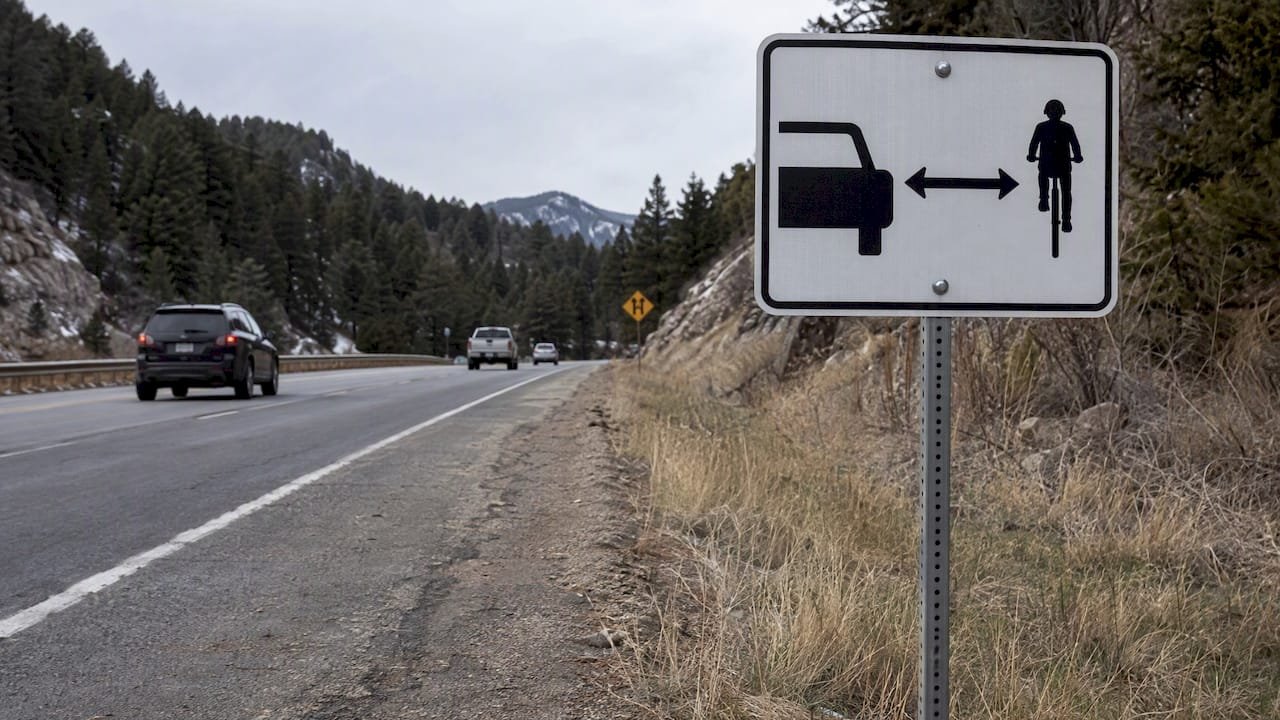
One factor driving the sign program: CDOT’s 2022 announcement notes that 35 states have adopted similar three-foot passing statutes, putting Colorado’s law in line with a broad national trend rather than an unusual local rule.
Enforcement works through standard traffic stops, and a violation of the three-foot law is a class A traffic infraction. Key points on how penalties and enforcement actually play out:
- A ticket for violating C.R.S. § 42-4-1002 is a traffic infraction, separate from any civil claim that might follow a crash.
- Serious injury or death resulting from unsafe passing can trigger additional scrutiny under Colorado’s vulnerable road user provisions, which carry heavier consequences than a standard infraction.
- Enforcement depends on an officer witnessing the violation or responding after a crash, so many close passes never result in a citation even when they were clearly unlawful.
That gap between what the law requires and what gets enforced is exactly why documentation matters so much when a close pass leads to a fall or a collision.
What to do after a close pass or a crash
A citation and a civil claim run on separate tracks. A driver can be ticketed under the three-foot law, cleared of a ticket entirely, or never stopped at all, and a cyclist can still pursue compensation for injuries if the evidence supports a civil claim for negligence. That distinction surprises a lot of riders who assume no ticket means no case.
Immediate steps at the scene make the biggest difference in how a later claim holds up:
- Call 911 if there is any injury, and request a police report even for a minor-seeming collision, since the report becomes a key piece of evidence later.
- Photograph the vehicle, any visible damage, road markings, skid marks, and the bicycle itself before anything gets moved.
- Get contact information from witnesses immediately, since bystanders rarely stay reachable for long.
- Seek medical evaluation the same day, even for injuries that feel minor, because documented treatment timelines matter for both insurance claims and any later litigation.
- Notify your own insurer promptly and avoid giving a recorded statement to the other driver’s insurer before speaking with an attorney.
Causation and damages, not just the existence of a ticket, determine whether a civil claim succeeds. An officer’s decision not to cite a driver does not mean the driver was not negligent, and a cyclist’s own conduct, such as riding position or lane choice, can become a comparative fault argument that reduces or bars recovery depending on the facts. Preserving dashcam or helmet-camera footage before it gets overwritten, and keeping every medical bill and treatment note, puts a claim in a far stronger position than relying on memory months later. Readers weighing next steps can review key deadlines for Colorado injury claims to understand how much time they have to act.
Pro Tip: Request the responding officer’s report number before leaving the scene; insurers and attorneys both need it to pull the full report later.
Why clear passing laws change outcomes on Colorado roads
A statute that measures distance in feet, rather than asking drivers to exercise vague “due care,” changes how these cases get argued. Vague standards invite disagreement about what was reasonable. A three-foot measurement invites a simpler question: was the gap there or not.
The biggest misconception I see is the assumption that a crash without a ticket means there is no case, or that a ticket automatically means there is a strong one. Neither is true. The citation measures compliance with a traffic rule at one moment. A civil claim measures what actually caused an injury and what it is worth, which depends far more on physical evidence than on whether an officer happened to see the pass.
The single piece of evidence that moves these cases more than any other is video, whether from a helmet camera, a dashcam on a following vehicle, or a doorbell camera on a nearby house. Cases built on video of the actual pass tend to resolve faster and with clearer liability than cases built on competing verbal accounts of how close a car really got.
— Ryan
How Malnar Injury Law helps after a bicycle crash
If a close pass turned into a fall or a collision, the practical question is not whether a driver technically broke the three-foot law, it is whether you can prove what happened and get your medical bills and lost time covered. The law firm represents injured bicyclists on a contingency-fee basis, which means clients pay nothing unless compensation is recovered for them.
Our work on bicycle accident claims covers gathering photo and video evidence, pulling police reports, dealing directly with insurance adjusters, and taking a case to litigation when an insurer will not offer a fair settlement. You can review our bicycle accident services or read more about how we handle bicycle accident claims in Colorado. If you were hurt in a close pass or a crash, request a free case evaluation and we will tell you directly whether you have a claim worth pursuing.
This article is general information, not a substitute for advice from a qualified lawyer. Consult a qualified legal professional about your own circumstances before acting on anything here.
FAQ
Can a police officer pull you over on a bicycle?
Yes, a bicyclist operating on a public road in Colorado is subject to traffic laws and can be stopped by police for violations such as running a stop sign or riding against traffic. Officers can issue citations to cyclists just as they can to drivers, since bicycles share the same basic rights and duties as motor vehicles under the Model Traffic Code.
Can you ride a 49cc mini bike without a license?
This depends on how the vehicle is classified and whether it is street-legal under Colorado’s motor vehicle code, which varies by engine size, speed capability, and intended use. Riders should check the specific classification rules with the Colorado Department of Revenue before assuming a small-engine bike is exempt from licensing.
Which is the most bike-friendly city in the United States?
Rankings of bike-friendly cities vary by source and methodology, and this article does not cover national city rankings. Colorado communities with strong bike infrastructure and active advocacy, supported by groups like Bicycle Colorado, are a better reference point for Colorado residents than any single national list.
What is the 3 foot law?
Colorado’s three-foot law, codified at C.R.S. § 42-4-1002, requires drivers and motorcyclists to leave at least three feet of space when passing a bicyclist or e-bike rider traveling in the same direction. If three feet cannot be safely provided, the driver must slow down and wait behind the cyclist until a safe pass becomes possible.
What happens if a driver cannot leave three feet?
The driver must slow down and remain behind the bicyclist rather than attempting a close pass, moving into an adjacent lane only when it is safe to do so. Squeezing by with less than three feet of clearance violates the statute regardless of how slowly the driver is going.
Sources
- Information for Bicyclists — Colorado Department of Transportation
- Rules Of The Road — Bicycle Colorado