

Adjuster vs Attorney in U.S. Claims: Why the First Call Often Decides
Adjusters evaluate, document, and negotiate claims: public adjusters represent you, the policyholder, while staff and independent adjusters represent the insurer. Attorneys give legal advice, send formal demands, and take insurers to court when needed. As a rule, hire a public adjuster for complex property valuation, and hire an attorney when liability, injuries, or a denied claim are on the table.
Table of Contents
- What does an insurance adjuster actually do?
- What does an attorney do when a claim gets disputed?
- When should you hire an adjuster instead of an attorney?
- How do fees and timelines compare between the two?
- How should you handle calls with the insurance adjuster?
- What insurers look for, and what actually wins a claim
- What the adjuster vs attorney debate gets wrong
- How Malnar Injury Law can help when you need an attorney
- Where to verify these rules yourself
- Sources
- FAQ
What does an insurance adjuster actually do?
Not every adjuster works for you. Staff and independent adjusters are hired by the insurance company to investigate claims, inspect property or injuries, gather documentation, and negotiate a settlement on the insurer’s behalf, according to the Bureau of Labor Statistics. Public adjusters work the other side of the table: they’re hired and paid by the policyholder, often through a fee tied to the settlement amount.
The role of an insurance adjuster in a personal injury claim becomes clearer once you understand the split in duties:
- Staff and independent adjusters inspect damage, consult experts, and recommend a payout the insurer is willing to make.
- Public adjusters prepare estimates, inventory contents, interpret policy language, and negotiate for the policyholder, per NAIC guidance.
- Many states require adjuster licensing, and some cap public adjuster fees or limit their scope on certain claim types.
An adjuster’s job also includes fraud control and cost containment for the company that employs them. That’s a big part of why early settlement offers often come in low and property valuations lean conservative: the person making the offer isn’t working for you unless “public adjuster” is on their business card.
What does an attorney do when a claim gets disputed?
An attorney’s toolkit looks different from an adjuster’s. Where an adjuster estimates and negotiates, a lawyer analyzes liability and coverage, builds an evidence plan, and can escalate a stalled negotiation into a formal legal dispute. That includes pursuing bad-faith or extra-contractual remedies when state law allows it and the insurer’s conduct warrants it.
- Attorneys review the policy and the facts to determine who’s liable and what coverage applies.
- They send formal demand letters, preserve evidence, and file suit when an insurer won’t negotiate in good faith.
- Most personal injury attorneys work on contingency, meaning you owe nothing unless they recover money for you.
The practical effect of hiring a lawyer isn’t just legal firepower. Once an attorney is involved, an insurer often reevaluates a file that a lone adjuster might have handled with a template offer. Guidance on when to hire an automobile accident attorney covers this shift in detail, particularly when a case moves from a straightforward property claim into one involving injury or disputed fault.
When should you hire an adjuster instead of an attorney?
Most people don’t need to choose blindly. A short checklist can tell you which professional actually fits your situation.
- If the dispute is purely about property valuation, such as storm damage to a roof or contents lost in a fire, a public adjuster’s specialty in estimates and inventories is often the right fit.
- If anyone was injured, or if fault is contested, an attorney should review the claim before you sign anything.
- If the insurer has denied the claim outright, cited a policy exclusion, or is dragging out the timeline, that’s a signal to get legal advice, not just a second opinion on numbers.
- If you’re facing a large, complex loss (a major storm claim, a structural failure, a business interruption) alongside a liability question, you may need both: a public adjuster to maximize the valuation and an attorney to handle liability and any bad-faith exposure.
A homeowner after a hailstorm with no injury dispute is a public adjuster case. A driver hit by a distracted trucker with a fractured wrist is an attorney case from day one. A denied claim citing a policy exclusion you don’t understand belongs in front of a lawyer before you argue with the insurer again.
Pro Tip: Document everything first, then request a free legal consult the moment liability, injury, or a denial enters the picture.
How do fees and timelines compare between the two?
Cost is where the two paths diverge sharply, and it’s worth knowing before you sign anything.
- Public adjusters commonly charge a percentage of the recovered settlement, though the exact rate and any caps depend on your state and the type of claim.
- Personal injury attorneys typically work on contingency, meaning a percentage of the recovery with no upfront fee and no fee at all if there’s no recovery.
- Straightforward, uncontested valuation claims can resolve in weeks to a few months once an adjuster completes an inspection.
- Litigation, once it starts, extends the timeline considerably compared to a negotiated settlement.
Some states cap the percentage a public adjuster can charge, particularly after a declared catastrophe. State licensing rules vary widely, so checking your state’s Department of Insurance before signing a fee agreement is worth the ten minutes it takes.
For a small, uncontested claim, handling it yourself or working with the insurer’s adjuster may be enough. For a large valuation dispute, a denied claim, or any claim involving injury, professional help usually nets you more after fees than going it alone, especially once liability or bad faith enters the picture.
How should you handle calls with the insurance adjuster?
The insurer’s adjuster will likely call you within days of filing. What you say on that call can shape the rest of your claim.
- Get medical care first if you’re hurt, then photograph damage, save receipts, and write down names, dates, and claim numbers as you go.
- On any call, stick to plain facts: don’t guess at fault, don’t speculate about injuries, and don’t agree to a recorded or sworn statement without advice first.
- Ask for important communications in writing so there’s a record beyond someone’s notes.
- Build a simple file: photos, repair estimates, medical records, the police report, receipts, and a dated log of every contact with the insurer.
- Stop negotiating alone and call a lawyer if the insurer keeps repeating a lowball number, pushes you to sign a full release, or evidence goes missing or gets altered.
The first settlement offer is often the moment this decision gets made, since accepting too early can close off options you didn’t know you had. The documentation steps for injury claims follow the same logic: the earlier you build a paper trail, the less leverage the insurer has later.
What insurers look for, and what actually wins a claim
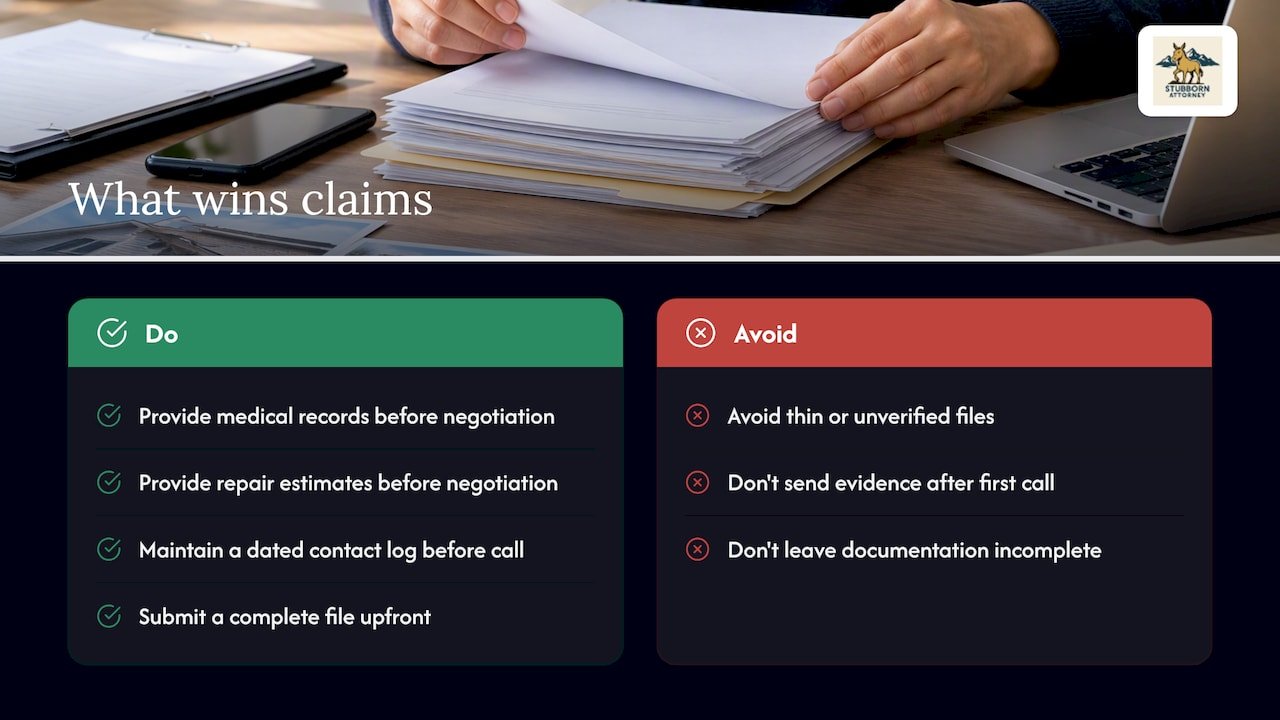
Insurers train adjusters to control cost and screen for fraud, and that shapes almost every early interaction you have with one. A file that looks thin or unverified gets a lower first offer almost by default, not necessarily out of bad faith, but because that’s the job description.
Evidence sequencing matters more than most people realize. Medical records, repair estimates, and a dated contact log should exist before the first real negotiation call, not after. Adjusters and attorneys who confer with legal counsel on contested claims, negotiate settlements, and represent clients at mediation or trial when needed are performing distinct, related roles within the same claims process, as described in the O*NET occupational summary for claims adjusters.
A file that arrives complete gets read differently than one that arrives thin.
That’s not a legal theory. It’s how claims get prioritized on the other side of the desk.
What the adjuster vs attorney debate gets wrong
Most advice on this topic treats the choice as binary: pick a side and stay there. That misses how claims actually unfold. A property claim can start as a simple valuation dispute and turn into a liability fight the moment the insurer cites an exclusion nobody flagged at the start.

The bigger failure in conventional guidance is timing. Readers are told to “call a lawyer if things go wrong,” but by then, a recorded statement may already be on file, or a release may already be signed. The decision point isn’t when the claim gets denied. It’s the first phone call.
Prioritize documentation before either professional gets involved. Photos, records, and a written log cost you nothing and protect every option that follows, whether that ends up being a public adjuster’s valuation skill or an attorney’s leverage in a dispute. Skipping that step is the most common and most avoidable mistake in this entire process.
— Ryan
How Malnar Injury Law can help when you need an attorney
If your claim involves a car, motorcycle, semi-truck, bicycle, or pedestrian accident, a slip and fall, a defective product, medical malpractice, or a wrongful death, that’s squarely legal territory, not a valuation dispute a public adjuster can resolve on their own. Malnar Injury Law, now operating as Stubbornattorney, takes these cases on contingency, so there’s no fee unless we recover money for you.
A free case review is the place to start. Bring what you’ve documented so far (photos, medical records, the police report) and we’ll tell you plainly whether your situation calls for an attorney or whether a public adjuster’s valuation work might be enough on its own. Full details on the services we handle and our pricing structure are available, or you can start with a free case evaluation today.
Where to verify these rules yourself
For the government and industry sources behind this guide: the BLS occupational handbook covers adjuster duties nationally, the NAIC public adjuster bulletin explains fee and licensing variation by state, and Investopedia’s claims adjuster primer offers a practical consumer-facing overview.
This article is general information, not a substitute for advice from a qualified lawyer. Consult a qualified legal professional about your own circumstances before acting on anything here.
Sources
- Claims Adjusters, Appraisers, Examiners, and Investigators : Occupational Outlook Handbook: : U.S. Bureau of Labor Statistics
- Public adjuster consumer outreach (NAIC legal bulletin)
- How to Become a Claims Adjuster: Duties, Requirements, & Advantages
- 13-1031.00 Claims Adjusters, Examiners, and Investigators (O*NET)
FAQ
Is an adjuster the same as an attorney?
No. An adjuster investigates and negotiates a claim’s value, while an attorney provides legal advice and can pursue litigation or bad-faith remedies. A public adjuster represents the policyholder, but neither type of adjuster can act as your legal counsel.
Should I hire a public adjuster or attorney?
It depends on what’s disputed: hire a public adjuster for a complex property valuation with no liability or injury question, and hire an attorney when fault is contested, someone was hurt, or the insurer has denied or delayed the claim. Some situations call for both, with the adjuster handling valuation and the attorney handling legal exposure.
What states don’t allow public adjusters?
Public adjuster licensing and fee rules vary significantly by state, and some states restrict scope or cap fees rather than banning the role outright. Check your state’s adjuster licensing rules through the NAIC before hiring one, since requirements differ by jurisdiction and claim type.
What scares insurance adjusters?
A well-documented file, a clear paper trail of communications, and the involvement of an attorney all tend to change how an adjuster handles a claim, since thin or unverified files are easier to lowball. Adjusters who know a claimant has legal representation often reevaluate the file rather than repeat a template offer.