

One IME Can Shift Your Personal Injury Claim: State Rules Matter
An independent medical examination, or IME, is a one-time forensic medical exam ordered by the opposing party in your claim, not a treatment visit. The exam and the report that follows can shape how your injury, causation, and damages are viewed, especially if you go in unprepared. Before you schedule or attend one, talk to a personal injury attorney so someone is protecting your rights and your record from the start.
Table of Contents
- What an IME is and how it differs from clinical care
- When an IME can be required or compelled
- Your rights, obligations, and how to check the rules where you live
- What actually happens during the exam
- How to prepare and what not to say
- How the report affects settlement and trial timing
- Challenging the exam or its findings
- Practical attorney tips for facing an IME
- Why persistence in IME preparation protects your claim
- How Stubbornattorney.com helps when an IME is part of your case
- Sources
- FAQ
What an IME is and how it differs from clinical care
An IME is a single, non-treatment evaluation performed by a doctor who has no ongoing relationship with you and answers specific questions posed by whoever hired them, typically an insurer, employer, or defense attorney. The AMA Guides Newsletter describes this one-time, non-treating structure as central to how IMEs work, and notes that report content and expectations shift depending on the setting, whether that’s a personal injury claim, a workers’ compensation matter, or a disability review.
That distinction matters because the examiner isn’t there to help you heal. According to a peer-reviewed overview of IME ethics and law, IME physicians are retained to provide a forensic opinion for the party paying them, and their professional responsibility differs from that of your treating doctor. Some courts and professional guidance recommend that examiners disclose medically significant findings they discover during the exam, but that expectation varies by jurisdiction and isn’t guaranteed.
A few practical points follow from this setup:
- The IME doctor works for the party who requested the exam, not for you.
- The exam is typically brief and focused on specific questions, not a full clinical workup.
- Standards like the AMA Guides shape best practices, but enforcement and adherence vary by examiner and case type.
- Whether the doctor tells you about an incidental finding depends on jurisdiction and the individual examiner’s practice.
Knowing this before you walk in changes how you answer questions and what you volunteer.
When an IME can be required or compelled
Whether you have to attend an IME depends on where you are in the claims process. If you’re still dealing directly with an insurance company before a lawsuit is filed, your obligation often comes from the policy itself. Many auto and no-fault policies include a cooperation clause that lets the insurer request an exam, and refusing can jeopardize coverage or benefits.
Once a lawsuit is filed, the picture changes. According to Nolo’s overview of how IMEs work in injury cases, a claimant generally cannot be compelled to undergo an IME before suit is filed, and courts typically address IME requests as part of formal discovery once litigation is underway. That gives you access to the procedural protections built into the court’s rules of civil procedure, including the ability to object to an unreasonable request.
Some patterns worth watching for:
- Pre-suit insurer pressure to attend an exam quickly, often before you’ve retained counsel.
- Court-ordered IMEs after filing, which follow discovery rules and can be challenged.
- Requests for excessive travel distances or exam types unrelated to your claimed injuries.
- Multiple or duplicative IME requests, which courts sometimes limit through protective orders when the request is unduly burdensome.
Many experienced plaintiff attorneys advise delaying cooperation with a pre-suit IME request until either a written agreement protects the claimant or a lawsuit is filed and discovery rules apply, according to Nolo.
Your rights, obligations, and how to check the rules where you live
IME rules vary enough by state and by insurance contract that general assumptions can backfire. Before you attend, confirm the specifics rather than relying on what you’ve read about someone else’s case.
- Check whether attendance is required. Review your insurance policy for cooperation clauses, or ask your attorney whether a court order compels attendance in your case.
- Ask about consequences for refusing. Declining an exam that your policy or a court requires can lead to denied benefits or, in litigation, sanctions, so confirm the stakes before you decide.
- Find out if you can get a copy of the report. Access to the IME report and limits on how it can be shared vary by jurisdiction and by whether the case is in litigation.
- Ask whether an attorney, witness, or recording device may accompany you. Some jurisdictions permit an observer or a recording, others restrict it, so this is a question for your attorney rather than an assumption.
- Request written confirmation of logistics. Exam location, scope, and any reimbursement for travel should be documented in writing before the appointment.
If you’re unsure where your state stands on any of these points, ask your attorney to pull the applicable rules of civil procedure and the language in your specific policy rather than guessing based on a friend’s experience in a different state.
What actually happens during the exam
An IME visit tends to follow a predictable structure, and knowing the shape of it helps you avoid surprises. The examiner typically starts with a review of your medical records, then moves into a brief interview about your history and current symptoms, followed by a focused physical exam targeting the body part or condition at issue.
- The exam is often short, sometimes limited to specific maneuvers rather than a full physical.
- Providers frequently use provocative tests, movements designed to reproduce or rule out reported pain, to assess whether your complaints match objective findings.
- Selective testing may be ordered if the examiner believes it’s necessary to answer the referring party’s questions.
- The written report usually summarizes the records reviewed, the exam findings, and an opinion on diagnosis, causation, or work capacity, and it goes to the party who hired the examiner.
A brief exam doesn’t mean a thorough one, and it doesn’t mean the report will be favorable. According to FindLaw’s overview of IME effects on claims, the report itself, not the length of the visit, is the product that matters most once it reaches the insurance company or the court. What you say and how the exam is documented both feed into that final write-up.
How to prepare and what not to say
Preparation starts before you ever walk into the exam room, and it starts with your own medical file. Reviewing your documented treatment history with your attorney beforehand helps you speak consistently about your symptoms and timeline.
- Review your medical records with your attorney so your account of symptoms and treatment stays consistent.
- Bring identification, your medication list, and any mobility aids you normally use.
- Dress comfortably for movement, since the exam may include physical maneuvers.
- Answer questions truthfully and concisely; don’t volunteer extra history, guesses, or comparisons to unrelated past injuries.
- Avoid statements like casually mentioning identical symptoms from years earlier without context, since that kind of offhand comment can be used to argue your current injury isn’t new or isn’t as severe.
- Confirm the exam’s scope, location, and any travel reimbursement in writing before the appointment.
Pro Tip: Treat every question as if it’s being recorded for the report, because in effect, it is.
How the report affects settlement and trial timing
Once the IME report lands, it typically becomes a tool for the party that ordered it. Insurers commonly use IME findings to dispute the existence of an injury, argue against causation, or claim that further treatment isn’t medically necessary, according to FindLaw.
- An unfavorable IME often prompts an insurer to lower a settlement offer or delay negotiations while it evaluates the new report.
- The report can shift the posture of settlement talks even before litigation, since insurers weigh it against your treating providers’ records.
- IME conclusions are rebuttable, meaning they aren’t the final word, and can be countered with your own treating physicians’ notes and independent rebuttal experts.
- After an unfavorable report, practical next steps often include lining up a rebuttal expert, filing motions to challenge the report’s scope or methodology, and re-evaluating your settlement position with updated evidence.
None of this happens on a fixed clock. Timing depends on where your case sits, whether litigation has started, and how quickly your attorney can respond with counter-evidence.
Challenging the exam or its findings
When an IME request or its resulting report goes too far, you have procedural and evidentiary tools to push back, though outright suing the examiner is rare and usually limited in scope.
- Attorneys often seek a protective order or ask the court to narrow the number or scope of IMEs when a defense request is duplicative or unduly burdensome, a remedy noted in the PMC overview of IME ethics and law.
- Rebuttal experts and your treating providers’ contemporaneous records are the most common way to counter an unfavorable IME conclusion.
- Suits against IME doctors are uncommon because courts generally treat the exam as a forensic evaluation rather than a treatment relationship, which limits the usual grounds for a malpractice claim; where such suits proceed, they typically hinge on conduct outside the scope of the forensic role.
- Documenting inconsistencies between the IME report and your medical history, and preserving a clear chain of custody for your records, strengthens your position at deposition and at trial.
Practical attorney tips for facing an IME
Attorneys who handle these exams regularly run a similar playbook: audit your medical records for anything that could be misread, flag and address red flags before the exam rather than after, and line up a witness or preparation session beforehand. When a request looks overly broad, they push for a narrower scope or file a protective motion. Keeping activity logs and contemporaneous symptom notes gives your side something concrete to counter a thin IME report.
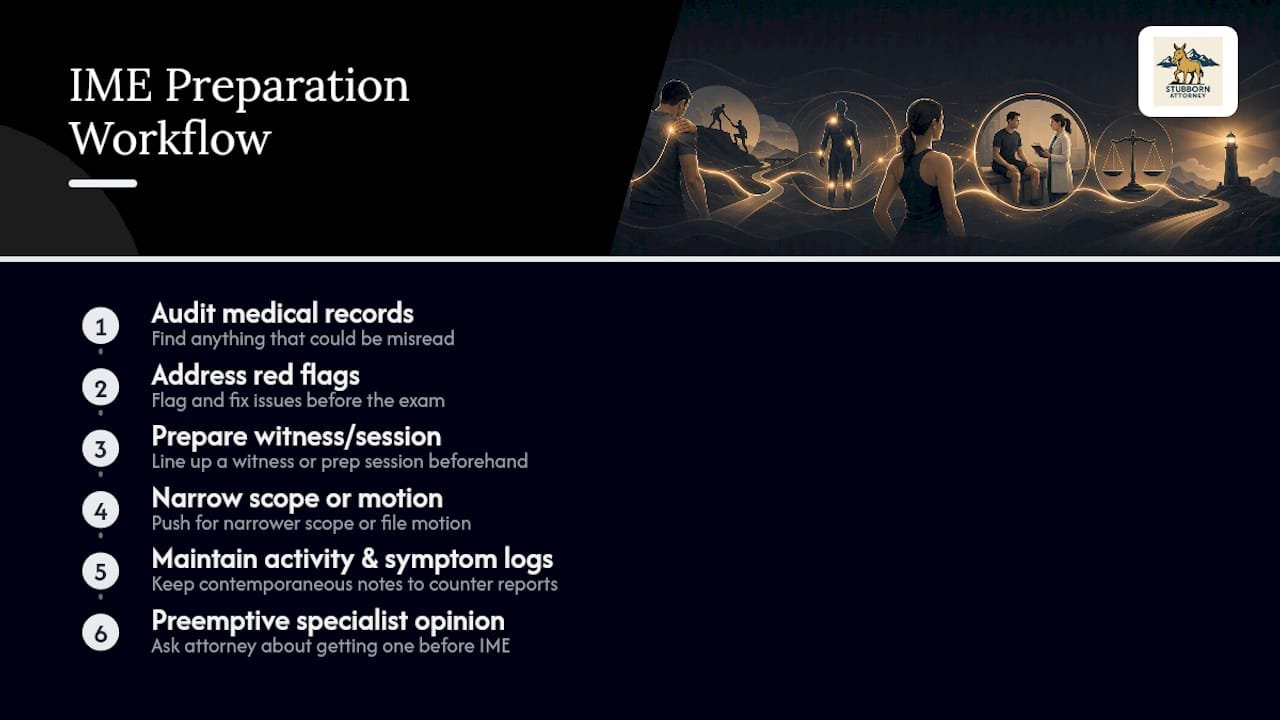
Pro Tip: Ask your attorney whether a preemptive specialist opinion, obtained before the IME, could blunt an unfavorable finding later.
Why persistence in IME preparation protects your claim
An unprepared claimant walks into an IME at a disadvantage, and insurers know it. Preparation and follow-through, not luck, are what keep an IME from quietly deciding your case.
— Ryan
How Stubbornattorney.com helps when an IME is part of your case
Facing an IME without a plan puts your settlement at risk before you’ve even walked into the exam room. Some personal injury attorneys offer free case evaluations and work on a contingency fee basis, meaning there is no cost unless a recovery is achieved.
- Experienced personal injury lawyers prepare clients for what to expect and what to avoid saying during an IME, seek protective orders or narrower exam terms when requests are unreasonable, arrange rebuttal experts and treating-provider records to counter unfavorable reports, and factor IME outcomes into negotiation strategy to protect settlement interests.
If an IME is part of your personal injury claim, reach out for a free case review before you attend.
Sources
For deeper reading, see the AMA Guides Newsletter on IME best practices and the PMC ethics overview on examiner duties. Check your own state’s rules of civil procedure and your insurance policy’s cooperation clause for the terms that actually govern your case.
This article is general information, not a substitute for advice from a qualified lawyer. Consult a qualified legal professional about your own circumstances before acting on anything here.
- Independent medical evaluation (IME) ethical and legal overview — PMC
- Independent Medical Evaluation Best Practices — AMA Guides Newsletter (2017)
- How Independent Medical Examinations (IME) Work in Personal Injury Cases — Nolo
- How Independent Medical Examinations Can Affect Your Claim — FindLaw
FAQ
How long after an IME can I expect a settlement?
There’s no fixed timeline; it depends on how quickly the report is issued and how your attorney responds to it. If the report is unfavorable, expect negotiations to slow while your side gathers rebuttal evidence before any settlement discussion resumes.
What should I avoid saying during an IME?
Avoid volunteering extra history, guessing at answers, or casually mentioning unrelated past symptoms without context, since offhand comments can be used to question the severity or timing of your current injury. Answer questions truthfully and briefly, and let your attorney help you prepare beforehand.
Can I sue the doctor who performed my IME?
Suits against IME doctors are uncommon because courts typically treat the exam as a forensic evaluation rather than a doctor-patient treatment relationship, which limits the usual grounds for a malpractice claim. Where such claims do proceed, they generally involve conduct that falls outside the scope of the forensic role itself.
Can I record my IME?
Whether you can record an IME depends on your jurisdiction and, sometimes, on the specific court order or policy governing your exam, so this varies from case to case. Ask your attorney to confirm the rule that applies where you live before the appointment.
Am I required to attend an IME before filing a lawsuit?
Generally, you cannot be compelled to attend an IME before a lawsuit is filed, though your insurance policy may include a cooperation clause that creates pressure to attend anyway. Once a suit is filed, courts typically handle IME requests through discovery rules, which give you more formal protections.