


Accrual Date Trap: Secure Colorado’s $1.5M Pain and Suffering Cap
Colorado’s pain and suffering cap for personal injury claims filed or accruing on or after January 1, 2025, is set at $1,500,000 by HB24-1472. Wrongful death noneconomic damages are capped at $2,125,000, unless the death resulted from a felonious killing, which removes the cap entirely. Medical malpractice caps phase up separately over five years to certain statutory amounts under C.R.S. §§ 13-21-102.5 and 13-21-203.
Table of Contents
- What Are Colorado’s Current Pain and Suffering Caps?
- What Counts as “Noneconomic Loss or Injury” Under Colorado Law?
- How Does the Wrongful Death Cap Work in Colorado?
- Medical Malpractice Caps: A Slower Climb to Higher Numbers
- Filing Dates, Accrual, and Arbitration Timing
- What the Higher Caps Mean for Your Claim’s Value
- An Attorney’s View on Negotiating Under the New Caps
- The Cap Increase Solves One Problem and Creates Another
- Get Help Understanding Your Claim’s Value
- Where to Verify These Numbers Yourself
- Sources
- FAQ
What Are Colorado’s Current Pain and Suffering Caps?
Colorado law splits noneconomic damages into different buckets depending on the type of claim, and each bucket now has its own number. Before 2025, the general noneconomic cap sat far lower, adjusted periodically for inflation under a 2020 update. HB24-1472 reset that baseline dramatically upward.
The table below breaks down where each figure applies and when it takes effect.
| Cap Type | Amount | What It Covers | Effective When |
|---|---|---|---|
| General noneconomic damages (personal injury) | $1,500,000 | Pain and suffering, emotional distress, loss of enjoyment of life | Causes of action accruing on or after January 1, 2025 |
| Wrongful death noneconomic damages | $2,125,000 | Grief, loss of companionship, emotional suffering of survivors | January 1, 2025 (no cap if death was felonious) |
| Medical malpractice noneconomic damages | Phasing to $875,000 | Pain and suffering tied to malpractice injury | Phased increase, January 1, 2025 through 2029 |
| Medical malpractice wrongful death | Phasing to $1,575,000 | Grief and loss from malpractice-caused death | Phased increase, January 1, 2025 through 2029 |
Every one of these figures gets adjusted for inflation starting January 1, 2028, and every two years after that, so the $1,500,000 general cap will not stay $1,500,000 forever. That inflation mechanism is baked into the statute itself, not left to future legislative action. If you’re trying to figure out how much for pain and suffering your specific case might be worth, these caps set the ceiling, not the floor. Most claims settle well below the maximum, since the cap only matters once your noneconomic damages actually approach it.
What Counts as “Noneconomic Loss or Injury” Under Colorado Law?
Colorado’s noneconomic damages cap only applies to a specific legal category, and understanding that category matters more than most claimants realize. Under C.R.S. § 13-21-102.5, “noneconomic loss or injury” includes pain and suffering, inconvenience, emotional stress, and impairment of quality of life.
That statutory language sounds abstract until you translate it into what a claim actually looks like. Recoverable noneconomic harms typically include:
- Physical pain from the injury itself, both immediate and ongoing.
- Emotional distress, including anxiety, depression, or trauma tied directly to the accident.
- Loss of enjoyment of life, such as being unable to hike, play with your kids, or return to a hobby you loved.
- Disfigurement or permanent impairment that changes how you experience daily life.
Here’s the part that trips people up: economic damages like medical bills, lost wages, and future earning capacity are a completely separate category. Colorado’s pain and suffering caps do not touch them. A claimant with $400,000 in medical bills and lost income faces no statutory ceiling on that portion of the claim, even while the noneconomic piece is capped at $1,500,000.
How Does the Wrongful Death Cap Work in Colorado?
Colorado’s wrongful death noneconomic cap of $2,125,000 applies when a family member sues over a death caused by someone else’s negligence, but it comes with a major carve-out. If the death resulted from a felonious killing, meaning it happened during the commission of a felony, the cap disappears entirely under the language in the HB24-1472 session law.
A few practical points matter for families evaluating Colorado wrongful death claims:
- The $2,125,000 figure covers noneconomic losses like grief, loss of companionship, and emotional suffering, not funeral costs or lost financial support, which fall under economic damages.
- HB24-1472 expanded who can bring a wrongful death suit to include surviving siblings in certain circumstances, a change from the traditional spouse-and-children-only structure.
- That sibling expansion matters most in cases where a single adult without a spouse or children is killed, since previously no one may have had standing to sue at all.
Families dealing with a felonious-killing scenario should move quickly. Evidence tied to criminal proceedings often overlaps with the civil case, and timing missteps can complicate both.
Medical Malpractice Caps: A Slower Climb to Higher Numbers
Medical malpractice claims don’t jump straight to the new ceiling. Instead, HB24-1472 phases the malpractice-specific caps upward incrementally over five years, starting January 1, 2025.
- Noneconomic damages in malpractice injury claims rise in steps toward a final cap of $875,000.
- Malpractice-related wrongful death claims climb toward a final cap of $1,575,000 over the same five-year window.
- Once the phase-in completes, both figures shift to the same biennial inflation adjustment schedule that applies to the general caps, beginning in 2028.
Compare that to where things stood before 2025: malpractice noneconomic caps had lagged behind general personal injury caps for years, a gap that frustrated patients and families dealing with serious harm from medical errors. The phased increase closes that gap gradually rather than all at once, which means a malpractice claim filed in 2025 faces a lower cap than one filed in 2028 or 2029, even for identical injuries.
Filing Dates, Accrual, and Arbitration Timing
The statute ties these caps to when a claim accrues, not necessarily when you file paperwork, and that distinction creates real disputes in practice.
- Accrual versus filing date matters. The higher caps apply to causes of action that accrue on or after January 1, 2025. An injury that occurred in late 2024 but wasn’t discovered or diagnosed until 2025 can raise genuine questions about which cap applies.
- Arbitration claims follow similar timing rules. Cases initiated through arbitration face comparable accrual-date scrutiny, and courts have already started litigating exactly when a claim “arose” for cap purposes.
- Statute-of-limitations deadlines still run independently. Missing a filing deadline can end a claim regardless of which cap would have applied, so don’t let cap confusion distract from the clock that’s actually running against you.
Preserve every record tied to when your symptoms began or your injury was diagnosed. That paper trail can end up deciding which cap governs your case.
What the Higher Caps Mean for Your Claim’s Value
A higher cap doesn’t automatically mean a higher settlement. It means the ceiling moved, but insurance adjusters still fight over where your case falls under that ceiling. Total case value combines your economic damages (uncapped) with your noneconomic damages (capped), and the negotiation dynamics shift depending on how close your noneconomic losses come to the new limits.
Strong noneconomic claims typically lean on:
- Detailed medical records documenting the injury’s severity and prognosis over time.
- Life-care plans or vocational assessments when the injury causes lasting impairment.
- Testimony, from you and people close to you, about specific activities you can no longer do.
Pro Tip: Keep a simple daily log after your accident, noting pain levels, missed activities, and sleep disruption. Generic claims of “pain and suffering” rarely move an adjuster, but a documented pattern over months does.
If you’re building a claim right now, get medical documentation locked down early, preserve everything related to accrual dates, and talk to a Colorado personal injury attorney before you say anything to an insurance company. Early legal input shapes how the rest of your case gets built.
An Attorney’s View on Negotiating Under the New Caps
Insurers didn’t wait for the ink to dry on HB24-1472 before adjusting their playbook. Expect adjusters to lean harder on disputing accrual dates, since a pre-2025 accrual date locks a claim into the old, lower cap, and that fight over a few weeks or months on a calendar can swing a settlement by hundreds of thousands of dollars.
Two tactics matter most in this environment. First, build the noneconomic case with the same rigor you’d bring to economic damages, meaning specific, documented, and consistent evidence rather than a vague narrative. Second, don’t let the cap become the anchor point in negotiation. Adjusters sometimes frame settlement talks around the cap number itself, when the real question should be what your specific losses are worth.
Experienced Colorado personal injury attorneys understand the negotiation dynamics in these cases, informed by insight into how insurance adjusters build their counteroffers.
The Cap Increase Solves One Problem and Creates Another
Raising the noneconomic cap to $1,500,000 was overdue. Colorado’s prior limits had fallen behind inflation for years, and serious injuries were routinely undervalued because the statutory ceiling sat below what a jury might reasonably have awarded. That part of the reform is straightforward good news for claimants.
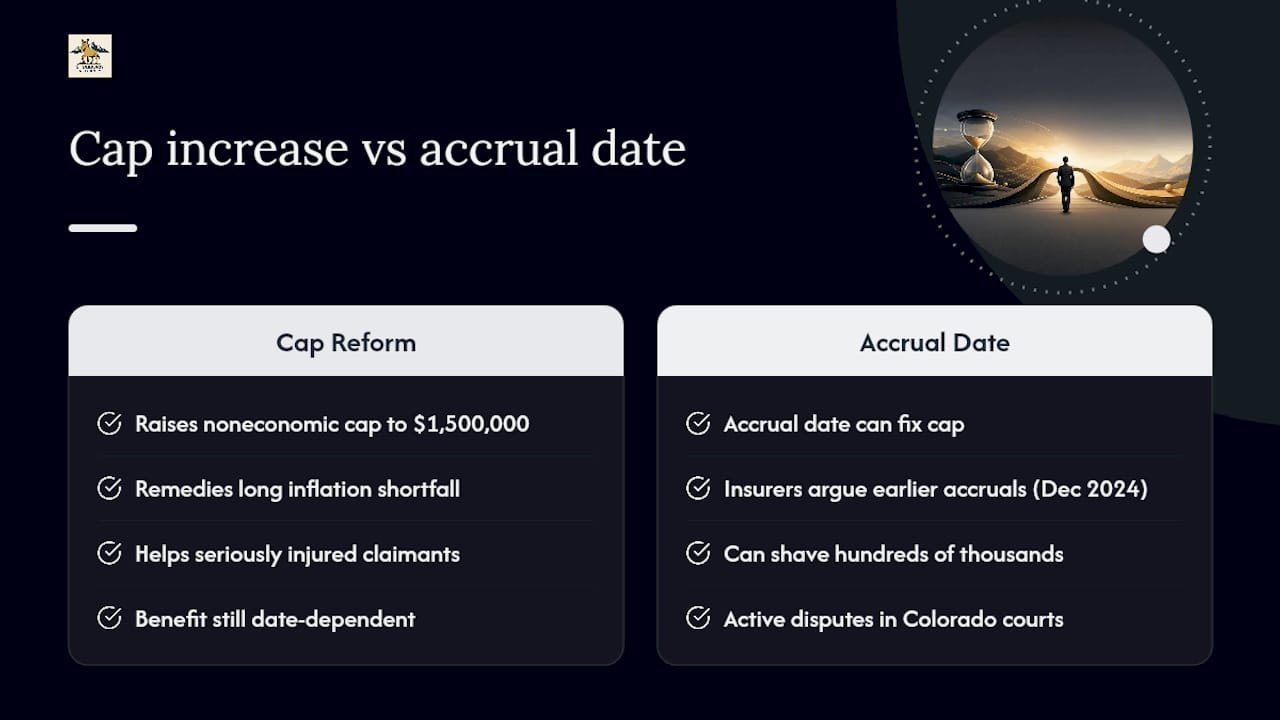
What gets lost in the coverage of the new numbers is the accrual-date fight that’s now happening quietly in courtrooms across the state. Claimants assume the headline figure applies to them, then discover an insurer arguing their injury technically accrued in December 2024, not January 2025, shaving hundreds of thousands off the ceiling. That dispute deserves far more attention than it’s getting in most explainers.
My advice: don’t treat the cap as an abstract legal detail to look up once and forget. Treat the accrual date as an active fact you need to nail down and document immediately, because it may end up mattering more to your case’s outcome than the injury itself. The reform is real progress. Whether you benefit from it depends on details most people never think to check.
— Ryan
Get Help Understanding Your Claim’s Value
The new caps changed the math, but they didn’t change the fight required to get a fair result. Choosing a personal injury law firm where your case is handled directly by attorneys, not passed through a call center, is especially important right now, when insurers are testing new arguments about accrual dates and phased malpractice caps that most claimants have never encountered. Attorneys with experience on both sides of claims negotiations understand how adjusters build their counteroffers, providing valuable perspective to clients.
Whether you’re dealing with a car accident, a wrongful death claim, or a medical malpractice injury, getting your documentation right from the start shapes everything that follows. Start with a free case evaluation to find out what your claim is actually worth under the current caps, or reach out through the wrongful death services page if you’ve lost a family member. Representation is on contingency, so there’s no fee unless your case results in a recovery.
Where to Verify These Numbers Yourself
Read the HB24-1472 bill page for the legislative summary, or download the full session law text for the exact statutory language. The Colorado Trial Lawyers Association also publishes a plain-language summary of the new caps worth reading alongside the statute itself.
This article is general information, not a substitute for advice from a qualified lawyer. Consult a qualified legal professional about your own circumstances before acting on anything here.
Sources
FAQ
What Is a Reasonable Payout for Pain and Suffering in Colorado?
There’s no single reasonable number. It depends on injury severity, documented impact on your daily life, and how close your damages come to the statutory ceiling, which is set at $1,500,000 for most personal injury claims accruing on or after January 1, 2025, under HB24-1472. Most cases settle well under the cap, since only the most severe injuries approach it.
How Much Money Can You Get From Pain and Suffering in Colorado?
The statutory maximum for noneconomic damages in a standard personal injury claim is set at $1,500,000, while wrongful death noneconomic damages cap at $2,125,000 unless the death was a felonious killing, which removes the limit entirely. Your actual recovery depends on the strength of your medical documentation and evidence of ongoing impairment.
Can You Sue for Pain and Suffering in Colorado?
Yes. Colorado allows claimants to pursue noneconomic damages, including pain and suffering, emotional distress, and loss of enjoyment of life, as part of a personal injury or wrongful death claim. These damages are capped by statute but remain fully recoverable within those limits under C.R.S. § 13-21-102.5.
Is There a Cap on Punitive Damages in Colorado?
Punitive damages follow a separate statutory framework from the noneconomic caps discussed here and are generally limited to an amount equal to the compensatory damages awarded, though a court can increase that limit in cases of continued misconduct. Punitive damages are distinct from pain and suffering and require proof of willful or wanton conduct, not just negligence.
Does Stubbornattorney Handle Cases Affected by the New Caps?
Stubbornattorney represents Colorado car accident, wrongful death, and medical malpractice clients navigating claims under the 2025 statutory caps. Case evaluations are free, and representation works on contingency, meaning there’s no fee unless you recover compensation.